History
The First United States Air Mail
May 15, 1918
Washington Polo GroundsDistrict of Columbia, United States
Belmont Park, New YorkNew York, United States
6
Aircraft
1
Stops
24cents
Stamp
The service
- Established
- 15 May 1918
- By
- US Post Office Department
- Route
- Washington to Philadelphia to New York
- Fields
- Polo Grounds, Bustleton, Belmont Park
- Aircraft
- Six Curtiss JN-4HM "Jenny"
- Flown by
- Army pilots
The first day
- Present
- President Woodrow Wilson
- Northbound pilot
- Lt George Boyle
- Aircraft
- No. 38262
- Outcome
- The first northbound flight went astray
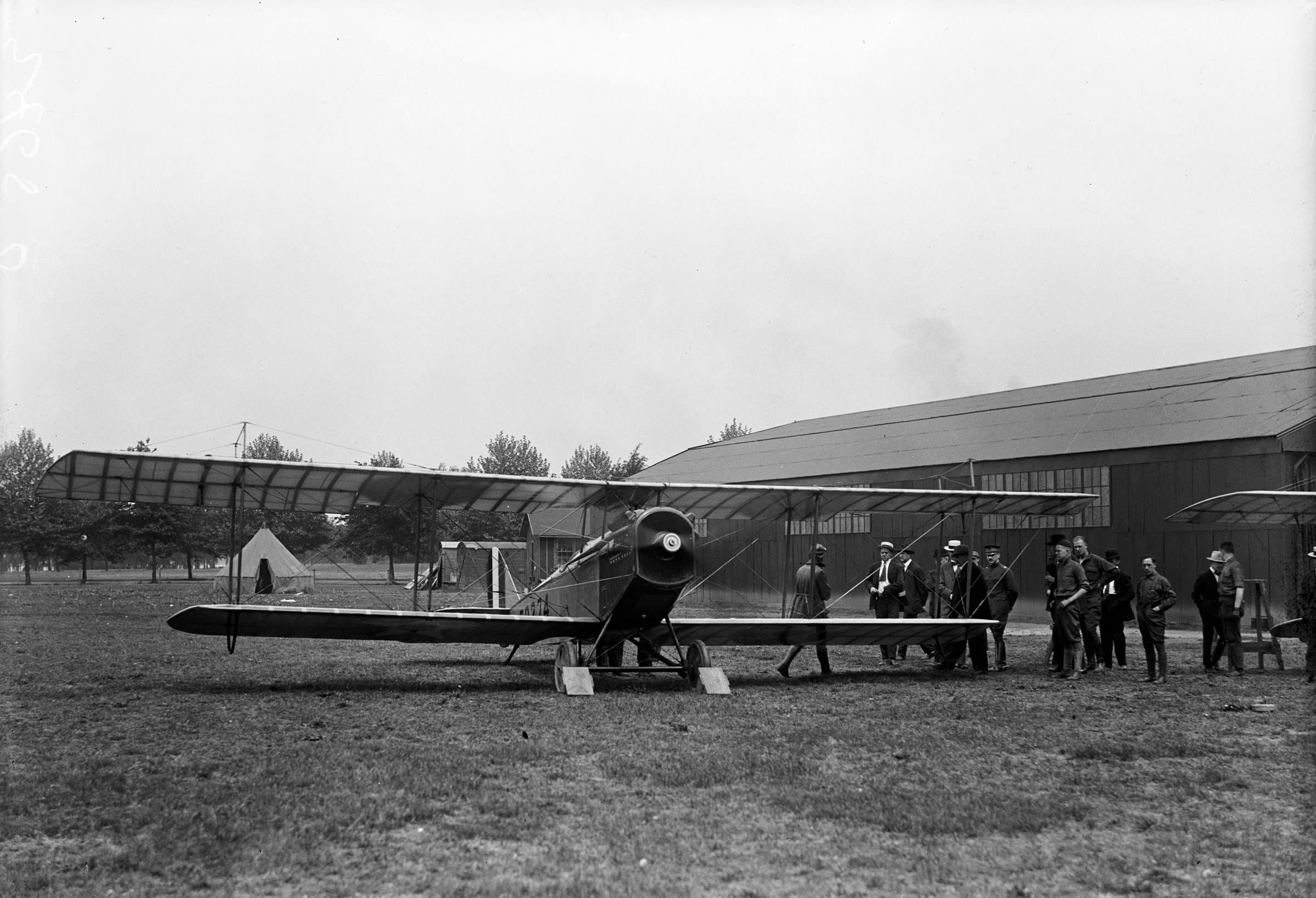
On 15 May 1918 the US Post Office Department established air mail as a class of service, inaugurating the Washington to Philadelphia to New York route with six Army Curtiss "Jenny" biplanes flown by Army pilots. President Woodrow Wilson watched the first departure from the Washington Polo Grounds.
On 15 May 1918 the United States Post Office Department began a scheduled air mail service between Washington, Philadelphia and New York. It was the first time the American government used aircraft to carry the mail as a regular class of service rather than as an experiment, and it is the point from which the country's commercial aviation industry can be traced without a break.
The day itself went badly. The Army supplied the aircraft, the pilots and the mechanics; six Curtiss "Jenny" biplanes were assigned to the route; and the young lieutenant chosen to fly the first northbound aeroplane out of Washington could not start it, because nobody had put any fuel in it. Once airborne he flew the wrong way, got lost, and put the aircraft down in a Maryland field about 22 nm from where he had started. President Woodrow Wilson had come to watch, with a bandaged hand.
What makes the date matter is not the first flight but the other five. The remaining legs ran to schedule, the service continued the next day and the day after, and within three months the Post Office had taken the operation over from the Army and was flying it with its own aircraft and its own civilian pilots. Within two years the route had been extended to San Francisco; within seven, Congress handed the work to private contractors, and the airlines that grew out of those contracts are the ancestors of United, American and TWA.
The service also produced, almost immediately, the most famous printing error in philately, and, fifteen years later, one of the ugliest political scandals in American aviation.
It is a story usually told for its comedy, and the comedy is real. But the reason the date is worth marking is that everything afterwards followed from it without a gap: the route west, the lighted airway, the contract system, the airlines, the regulation of all of it. The United States did not decide to have a commercial aviation industry. It decided to move the mail faster, and the industry was what that decision produced.
Background
Mail had gone by air before 1918, but only as a demonstration. The first occasion on which a pilot officially carried United States mail came in September 1911, when Earle Ovington, flying from an international air meet on Long Island, pushed a bag of mail out of his aircraft over Mineola, New York. The postmaster picked it up off the ground and delivered the contents. That was the model for the next several years: a licensed pilot, a special dispensation, a single sack of souvenir mail and a crowd.
Between 1911 and 1918 the Post Office authorised a long series of these experimental flights, usually tied to fairs and aviation meets. They proved that mail could be flown. They proved nothing at all about whether it could be flown to a timetable, in ordinary weather, by pilots who would still be available next week: which is the only question that matters to a postal administration.
What changed the calculation was the war. The rapid development of military aviation between 1914 and 1918 convinced postal officials that the aeroplane could become a genuine means of fast transport rather than a fairground attraction. Aircraft were being built in numbers, engines were becoming more reliable, and, critically, the Army was training pilots faster than it could send them to France.
Congress agreed. It appropriated $100,000 for the fiscal year ending 30 June 1918 to establish an experimental air mail route. The figure is worth noticing for how modest it was: this was a trial, funded as a trial, and it is a measure of how uncertain the whole idea still looked that the appropriation covered a single route between three cities on the eastern seaboard.
The Post Office had a further problem it had never faced before. When it had adopted railroads and steamboats, it contracted with the companies that owned them. In 1918 there were no commercial airlines to contract with. If the mail was going to fly, the government would have to fly it itself: and the only organisation in the country with aircraft, pilots and mechanics to spare was the Army.
The distinction between a demonstration and a service is the whole of the difficulty, and it is worth stating plainly. A demonstration needs one pilot, one good day and one bag. A service needs a second pilot when the first is ill, a second aircraft when the first is broken, a field at each end that can be used in March as well as June, and a published time that the public can rely on without knowing anything about aeroplanes. Everything that made the air mail hard between 1918 and 1925 was contained in that gap, and none of the pre-war flights had touched any of it.
Development
The arrangement that resulted was a division of labour between two departments that had never worked together. The War Department provided the aeroplanes, the pilots, the mechanics and the flying itself. The Post Office handled the mail, built the organisation around it and developed the airways. It was an improvisation, and it was understood on both sides as temporary.
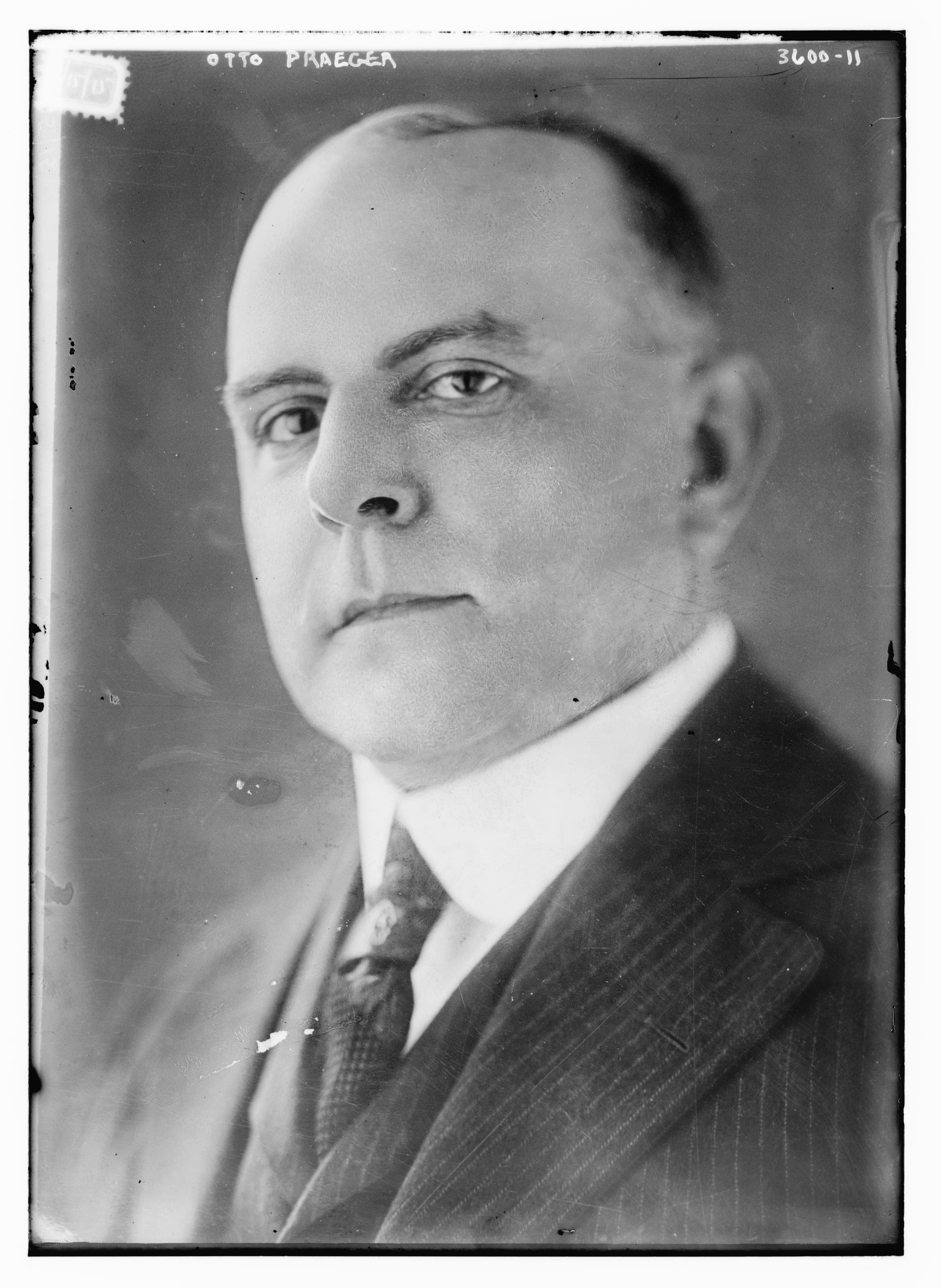
The driving force on the postal side was Otto Praeger, the Second Assistant Postmaster General, who was responsible for air mail from 1918 onwards and who pushed the service forward with a persistence that his pilots did not always appreciate. Praeger's conviction was that air mail would only ever be taken seriously if it flew on schedule in conditions that grounded everyone else, and he was willing to order flights in weather his pilots thought unreasonable. The argument that produced, whether the mail or the pilot came first, ran through the whole of the service's early history.
On the Army side the job fell to Major Reuben H. Fleet, who was given the task of setting up the route and had a matter of days to do it. Fleet had to find aircraft that could carry mail, modify them, choose pilots, identify landing fields in three cities and have the whole thing working on a date that had already been announced. He selected four of the six pilots himself. The other two were chosen by postal officials, which turned out to matter a great deal.
The route was Washington to New York by way of Philadelphia, with the mail changing aircraft at the midpoint. The design was a relay: two aeroplanes would leave simultaneously from the two ends, meet at Philadelphia, exchange mailbags, and a second pair would carry each load onward to the opposite terminus. On paper it halved the distance any one pilot had to navigate. In practice it meant that a single failure at one end still left three quarters of the day's service intact: which is precisely what saved the inauguration.
The two-department arrangement also explains a tension that never resolved. The Post Office was measuring success in delivered mail and published schedules; the Army was measuring it in aircraft and pilots it could account for at the end of the week. When Praeger ordered a flight into weather, the cost of refusing fell on the Army and the cost of cancelling fell on the Post Office, and neither department could overrule the other. It worked for three months because it was new, and it was replaced as soon as the Post Office had the means to replace it.
The machine
The aircraft was the Curtiss JN-4, the trainer universally known as the "Jenny" and the machine on which most American military pilots of the period learned to fly. The air mail version was the JN-4H, a higher-powered development, modified for the purpose by removing the front cockpit and replacing it with a compartment for mail. Six were assigned to the route. The aeroplane that appears on the 24-cent air mail stamp of 1918 is this aircraft, with the mail compartment where the front seat had been.
The Jenny was an entirely reasonable choice and an entirely inadequate one. It was available in quantity, it was simple to maintain, its pilots were already trained on the type, and it could be converted quickly. It was also a training aeroplane: slow, short-ranged, open to the weather, with no navigation equipment beyond a compass and whatever the pilot could see of the ground. Flying it from Washington to Philadelphia in poor visibility was a genuinely difficult piece of work, and flying it to a timetable was harder still.
This is the context for what happened on the first day, and for what the service did next. When the Post Office took the operation over in August it did not continue with converted trainers. Its first flight, from College Park, Maryland, on 12 August 1918, used a new purpose-built Curtiss R-4 with a Liberty engine of 400 horsepower: a substantially more capable aeroplane, bought because the work had shown what the work required.
The progression continued from there. The Post Office moved on to the de Havilland DH-4, another wartime design adapted for mail, and then to aircraft and navigation aids designed around the problem rather than borrowed from it: radio stations along the route from 1920, and from 1923 a lighted airway of beacons that made night flying across the continent possible. The Jenny got the service started; almost nothing about it survived the first year.
Navigation is the part hardest to imagine now. A 1918 air mail pilot flew by looking at the ground: at rivers, rail lines, towns and coastlines, compared against a map on his knee, with a compass to fall back on. There was no radio in the aircraft, no beacon on the ground and no way to ask anyone anything once the wheels left the grass. Cloud or haze did not merely make the job unpleasant; it removed the only instrument that actually worked. Boyle's failure and the whole subsequent programme of radio stations and lighted beacons are the same problem seen from two ends.
Preparation
Three fields were chosen, one for each city, and none of them was an aerodrome in any modern sense. In Washington the aircraft operated from the polo grounds in West Potomac Park, beside the river. Philadelphia's midpoint was Bustleton Field, in the north-east of the city. In New York the service used the infield of the racetrack at Belmont Park on Long Island. They were chosen because they were flat, open and close to a city, the same criteria that had governed aviation meets, and the choice tells you how little dedicated infrastructure existed to work with.

The pilots were six Army lieutenants. Major Fleet chose Howard Culver, Torrey Webb, Walter Miller and Stephen Bonsal. Postal officials chose the other two: James Edgerton and George Boyle. The distinction between the two groups was experience. Culver was a test pilot and a flying instructor, and was the only one of the six with more than four months of flying behind him. Edgerton and Boyle had graduated from the flight school at Ellington Field in Texas only recently, and neither had as much as sixty hours in the air.
Boyle's selection had a reason that had nothing to do with flying. He was engaged to the daughter of Charles McChord, a member of the Interstate Commerce Commission, and he was given the most conspicuous assignment of the day: the first aircraft out of Washington, in front of the President.
The Post Office had meanwhile prepared the commercial side. A new 24-cent stamp was issued for the service, printed in two colours, a blue Jenny inside a red frame, which required each sheet to pass through the press twice. The rate covered the first ounce and included special delivery. The stamps went on sale in Washington the day before the service began.
The choice of a polo field and a racetrack is not incidental detail. It meant there were no hangars worth the name, no fuel installation, no lighting, no boundary markings and no maintenance facility beyond what the mechanics carried with them: which is the practical reason Boyle's aircraft could sit on the grass unfuelled in front of the President without anyone noticing until the engine refused to start.
The event
The morning of 15 May 1918 at the polo grounds drew a crowd worth the occasion. President Woodrow Wilson attended with Mrs Wilson; so did Postmaster General Albert Burleson and the Assistant Secretary of the Navy, Franklin D. Roosevelt. The President's hand was bandaged. A few days earlier he had taken hold of the barrel of a cannon that had just been fired.

Lieutenant Boyle climbed into aircraft number 38262 and could not start it. The aeroplane had not been fuelled. Fuel was found, drained from other machines, and after a delay conducted in front of the President and the press, Boyle got into the air with the Washington mail aboard, something on the order of 124 pounds of it, though accounts of the day differ on the exact figure.
He then flew in the wrong direction. Whether from a compass problem or simple inexperience, Boyle went south-east instead of north-east, realised he was lost, and came down about eighteen minutes after take-off in a field near Waldorf, Maryland, roughly 22 nm from the polo grounds and rather further from Philadelphia. The aircraft was damaged on landing. The mail was recovered, carried back to Washington by road, and flown the following day.
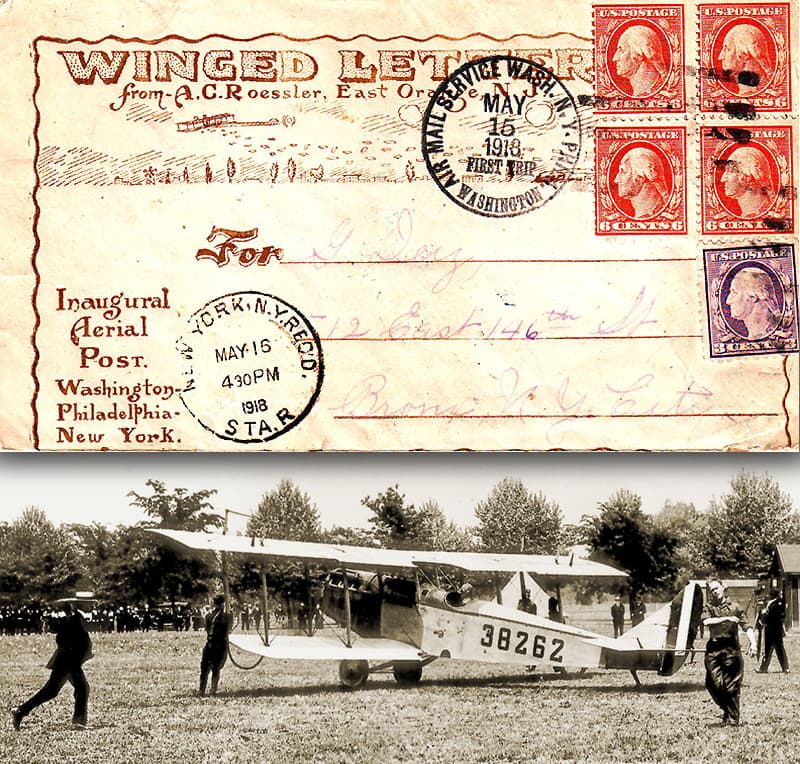
The rest of the day went to plan. At Belmont Park, Lieutenant Torrey Webb took off on time with the New York mail and flew it to Philadelphia, where he handed it to Lieutenant James Edgerton, who carried it on to Washington. Edgerton (the other novice, the other postal appointment) flew his leg without difficulty. By the end of the afternoon mail posted in New York that morning had been delivered in Washington, which was the entire point of the exercise, and the service ran again the next day.
It is worth being precise about what was and was not achieved. One of the day's flights failed, and it happened to be the one with the President watching, which is why it is the part everyone remembers. But the route worked in both directions, the relay at Philadelphia worked, and the Post Office had demonstrated the only thing it needed to demonstrate: that mail could be moved between cities by air on a published schedule. The rest was a matter of better aeroplanes and better pilots, and both were obtainable.
The contrast between the two novices is the most instructive thing about the day. Edgerton and Boyle were appointed the same way, trained at the same school, and had comparable and inadequate experience. One flew his leg competently and stayed in the service for years; the other became the anecdote. The difference was not a system working or failing but the ordinary variance between two people, which is exactly the variance a scheduled service cannot afford and spends the next decade engineering out.
Aftermath
Boyle was given a second chance, which says something about his connections. This time he was provided with an escort to fly him clear of the city and instructions to follow the Chesapeake Bay towards Philadelphia. He followed them exactly, around the curve of the bay, across to Maryland's eastern shore, where he landed once again out of fuel. That was the end of it. He was removed from the list of pilots for the service.
Edgerton went the other way. He stayed with the air mail, flew through conditions that would have justified turning back: on one occasion holding a machine in the air through a storm violent enough to hammer hail into the propeller: and after leaving the Army became the service's Chief of Flying Operations.

The larger change came in August. The Post Office Department had grown dissatisfied with the arrangement: with the discipline of Army pilots who answered to a different chain of command, and with equipment that had been designed to train aviators rather than to carry freight. On 12 August 1918 it took the service over. The first flight under postal operation left College Park, Maryland, for New York, flown by Max Miller, the first pilot the department hired, in the new Curtiss R-4.
To run the service the Post Office recruited Captain Benjamin Lipsner, Major Fleet's second-in-command, who resigned his Army commission to become the first Superintendent of the Air Mail Service. Lipsner hired his own pilots (Miller, Edward Gardner, Robert Shank and Maurice Newton among the first) and began almost immediately to look west. In September 1918 he sent two of his best pilots on a path-finding flight from New York to Chicago, four months after the service had begun and barely three after its first pilot had landed in the wrong field. The ambition had changed scale entirely.
The August handover is the moment the air mail stopped being an experiment conducted with borrowed equipment and became an organisation with its own aircraft, its own payroll and its own standards. The Post Office ran the flying itself from then until 1926. Those eight years are when the hard problems were actually solved: night flying, winter operations, navigation, maintenance, the training of pilots for a job that had not existed when they learned to fly: and they were solved by a postal administration because there was still nobody else to solve them.
The evidence
A great deal of the physical record of 15 May 1918 survives, partly because the people involved understood at the time that it mattered and partly because the objects concerned were, by their nature, collectable.
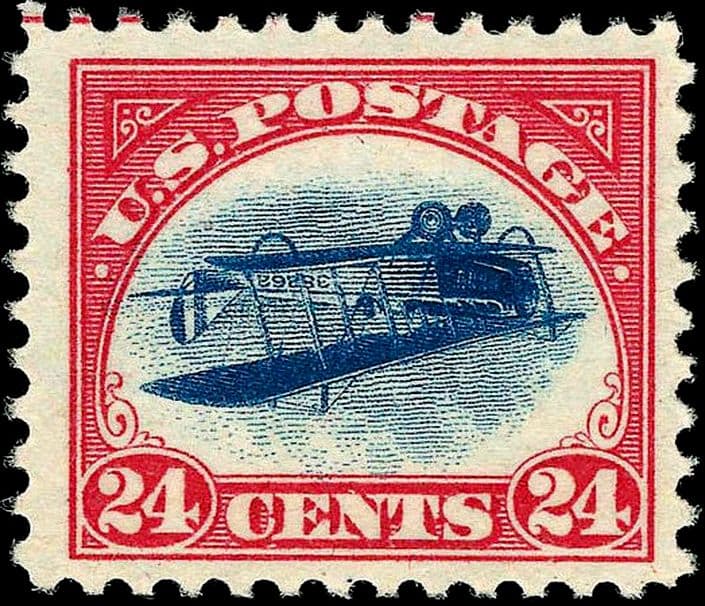
The most famous is an accident. The 24-cent stamp issued for the service had to be printed twice, once for the red frame and once for the blue aeroplane, and a sheet of one hundred went through the second pass upside down. The error was not caught. It was bought on 14 May 1918, the day before the service began, by a collector named William T. Robey of Washington, D.C. Only that one sheet was ever sold and no other example has ever been found. The Inverted Jenny is the most famous United States stamp and one of the best-known printing errors in the world; an ordinary copy of the same issue is worth a small fraction of one per cent as much.
The covers flown that day survive in numbers, including one that President Wilson signed. He did it at the request of Noah W. Taussig, who had written to him on 22 April 1918 proposing that the autographed cover be auctioned for the American Red Cross or another wartime charity. The object is both a piece of postal history and a small record of how the flight was understood at the time: as a public event worth attaching a fundraising appeal to.
Working documents survive too. James Edgerton's pilot logbook, with its entries for 14 and 15 May 1918, is held by the National Postal Museum, as is a 1918 airmail dispatch board still carrying the name flags of Eddie Gardner, Max Miller, Robert Shank and Maurice Newton: the four pilots the Post Office hired when it took the service over that August. Benjamin Lipsner donated much of the material from his years running the service to the museum, which is why the administrative side of the story is as well documented as the flying.
Taken together these objects make the 1918 service unusually well evidenced for its date. The reason is worth noting: air mail was, from the first morning, simultaneously a transport operation and a philatelic event, and the second guaranteed that the first would be documented. A great deal of what is known about early commercial aviation in the United States survives because collectors wanted the envelopes.
Controversy
The scandal came later, and it grew out of the thing the 1918 service made possible: the decision to pay private companies to fly the mail.
The Contract Air Mail Act of 1925, the Kelly Act, let the Post Office contract routes out to private airlines. It worked: by 1927 the department had handed over the flying entirely, and by 1929 more than forty-five airlines were carrying mail. It also created a problem. Mail contracts were paid by weight and the subsidies exceeded the cost of the work, so operators began flying bulk packages as mail and filling aircraft with junk mail to raise the weight. The system was inefficient in a second way as well: a great many of the carriers were small, underfunded and flying old aircraft over short routes, and coordinating them was expensive.
President Hoover's Postmaster General, Walter Folger Brown, asked Congress for the power to fix it. The Airmail Act of 1930 gave it to him. Payments were recalculated on the volume of mail rather than its weight, with a fee on larger aircraft whether or not they carried mail, to discourage padding and encourage operators to carry passengers instead. Airlines that had held a contract for two years could apply for a route certificate lasting up to ten more. And, controversially, Brown was given authority to extend or alter mail routes at his own discretion.
He used it at a meeting that became known as the Spoils Conference. Brown called together a small number of airlines, deliberately leaving out many smaller operators, and awarded the bulk of the mail contracts to three large carriers: Boeing Air Transport, which became United Airlines; Transcontinental Air Transport, which merged with Western Air and became TWA; and the Robertson Aircraft Corporation, which became American Airlines. Costs fell and the network became more coherent. Excluded operators pointed out that they had never been given the chance to bid, and that the winners were the companies closest to the administration.
In 1933 Senator Hugo Black led a Senate investigation into whether Brown's decisions had been lawful. William P. MacCracken Jr., the first Assistant Secretary of Commerce for Aeronautics, who had sat alongside Brown at the conference, refused to testify and was held in contempt of Congress. In February 1934 President Roosevelt and Postmaster General James Farley cancelled every domestic air mail contract and, by Executive Order 6591, handed the mail back to the Army Air Corps.
It was a catastrophe. Advisers had assured the President that the Air Corps could absorb the work within a week. In reality the Depression had cut flying hours and funding to the point where military pilots typically flew four hours a day, in daylight, in good weather, on obsolete aircraft: against a commercial industry that by then flew at night, in weather, on modern equipment. The Army flew the mail badly and at a cost in lives, the contracts went back to private carriers within months, and the Air Mail Act of 1934 rebuilt the system on different terms. The episode did more than any other single event to force the reform of both the airline industry and the Army Air Corps.
The underlying difficulty was never really corruption. It was that a subsidy paid by weight rewards weight, and a subsidy awarded by discretion rewards proximity to whoever holds the discretion. Both the 1925 system and Brown's 1930 correction were attempts to buy a national air network with postal money, and each produced the behaviour its formula paid for.
The people
The air mail service was assembled in weeks by a small number of people, and the record is unusually clear about who they were.
Otto Praeger, as Second Assistant Postmaster General, was the official who made it happen and kept it happening. His insistence that the mail fly on schedule regardless of weather built the service's reputation for reliability and also made him, from the pilots' point of view, the most dangerous man in the organisation. Major Reuben Fleet built the operational side in a matter of days (aircraft, modifications, fields, crews) and then handed it on; his second-in-command, Benjamin Lipsner, resigned his commission to run the civilian service as its first Superintendent and later gave his papers and objects to the National Postal Museum, which is why so much of this is documented at all.
Among the pilots, Torrey Webb flew the successful first leg out of New York and Howard Culver was the only genuinely experienced aviator of the six. James Edgerton, picked as a novice and expected to prove nothing, became one of the service's most capable pilots and eventually its Chief of Flying Operations. Max Miller, the first pilot the Post Office hired, flew the first postal-operated flight in August 1918 and the pathfinding route west; he was killed in 1920 when his aircraft caught fire.
George Boyle is remembered for failing, which is unfair in one sense and instructive in another. He was a barely trained pilot handed the most public assignment of the day for reasons of family connection, in an aeroplane nobody had fuelled, with no navigation aid beyond a compass and the ground. That he got lost is not surprising. That the choice was made at all is the more interesting fact, and it is the clearest illustration of how improvised the whole undertaking was.
The generation that followed included Charles Lindbergh, who flew the mail on a contract route out of St Louis before the flight that made him famous. The air mail was where a large proportion of America's first professional pilots learned long-distance, all-weather, on-schedule flying, because it was the only work of that kind that existed.
What the roster shows, read as a whole, is how thin the pool was. Six pilots were needed and two had to be taken straight from flight school; the organisation was run by a postal official and an Army major who had never done anything like it; the man who ended up in charge of the civilian service had been an Army captain a fortnight earlier. There was no profession to recruit from, because the profession was being invented by these people in the course of doing the job.
Legacy
The eastern route was a trial, and it passed. Its success led directly to the extension of the system westward, and by 1920 the Post Office was operating a transcontinental air mail route from New York to San Francisco, 2,270 nm with seventeen primary landing fields along it.
Making that route work required inventing the infrastructure of air navigation more or less from nothing. On 20 August 1920 the department ordered the establishment of air mail radio stations at each of the primary fields, the first network of its kind in the country. From 1923 it began lighting the airway with beacons so the route could be flown at night, which is what made a genuinely faster-than-rail transcontinental mail service possible: an aeroplane that stops at dusk cannot beat a train that does not.
With the route working, the Post Office did what it had always intended and got out of the flying business. The Contract Air Mail Act of 1925 let it award routes to private operators; by 1927 the transfer was complete. The airlines that grew on those contracts became the American industry: United, TWA and American all trace their corporate ancestry to air mail carriers, and for years mail contracts, not passengers, were the primary source of airline revenue. Commercial aviation in the United States was built on a postal subsidy, and the shape of the industry that emerged was substantially determined by how that subsidy was awarded.
The service that began at the polo grounds eventually made itself redundant, which is the most complete form of success available to an experiment. Air mail ceased to be a separate domestic class of service in 1975 and internationally in 1995, not because aircraft had stopped carrying letters but because all long-distance first-class mail had come to travel by air as a matter of course. The premium disappeared because the thing it paid for had become ordinary.
What began on 15 May 1918 was therefore not really a flight. It was a decision to treat aviation as infrastructure (to fund it, schedule it, regulate it and eventually contract it out) and every part of the American aviation system that followed grew from the arrangements made around that decision, including its scandals.
There is a further legacy that is easy to miss because it is administrative rather than technical. The air mail established, early and permanently, that the American government would shape aviation through contracts and payments rather than by owning it. Britain and France built flag carriers; the United States bought a service from private companies and regulated what it had bought. Almost every subsequent argument about American commercial aviation (route awards, subsidy, consolidation, who is allowed to fly where) is a continuation of the argument that began when the Post Office decided to stop flying the mail itself.
Related entries
- The 1918 Flights, Smithsonian National Postal Museum
- May 15, 1918, Smithsonian National Postal Museum
- US Airmail Stamps / Inverted Jenny, Smithsonian National Postal Museum
- 1918: The Inverted Jenny, Smithsonian National Postal Museum
- 100 Years of Air Mail, Smithsonian National Air and Space Museum
- Airmail Comes of Age, Federal Aviation Administration
- Air Mail Service, Wikipedia
Checked September 29, 2026