Manufacturer
Embraer
Brazil1969
Embraer S.A.
Company
- Country
- Brazil
- Headquarters
- São José dos Campos, São Paulo, Brazil
Founding
- Founded
- August 19, 1969São José dos Campos, São Paulo
- Founded as
- Empresa Brasileira de Aeronáutica
- Founders
- Ozires Silva

Embraer is the Brazilian aircraft maker founded in 1969 by Ozires Silva with government backing, now the third largest producer of civil aircraft after Boeing and Airbus. Privatised in 1994, it is best known for its ERJ and E-Jet regional airliners and its business jets, and builds military aircraft including the C-390 Millennium transport.
Embraer is the third-largest maker of commercial airliners in the world, behind Airbus and Boeing, and the only one of consequence outside North America, Europe and China. It is also the only one that began as a state enterprise in a country with no aircraft industry to speak of, was taken to the edge of collapse, privatised, and then grew into a genuine competitor on three continents.
The company was created by decree in 1969 to build one aeroplane, a small twin-turboprop called the Bandeirante, designed inside a government research institute by engineers trained at a Brazilian institute of technology a few streets away. Nothing about the circumstances suggested what followed. Brazil in 1969 had no supply chain, no established airframe industry and no obvious market, and the usual outcome for a state aircraft company in such a position is a long, subsidised production of indifferent aircraft nobody else wants.
What happened instead is that Embraer found a gap the large manufacturers did not want and filled it properly. Short-haul routes with thin traffic were served badly by anything Boeing or Airbus built, and Embraer spent fifty years working that seam, turboprops first, then regional jets, then the larger E-Jets that now compete directly at the bottom of the mainline market. In 2025 the company delivered 244 aircraft and ended the year with a firm order backlog of US$31.6 billion, a record.
It is not only an airliner manufacturer. Embraer runs four businesses: commercial aviation, executive jets, defence and security, and services. In 2025 the executive aviation unit delivered twice as many aircraft as the commercial one. The defence arm has put a Brazilian-designed military transport into European air forces, which is not something the industry expected of it.
The Brazilian state has never entirely let go. It holds a golden share with veto powers over, among other things, any change of control and any change to the company's military programmes: a reminder that Embraer was built as an instrument of national policy and, in the one respect that matters most to a government, still is.
Origins
The story begins with a school rather than a company. The Instituto Tecnológico de Aeronáutica, ITA, was established at São José dos Campos in 1950 as Brazil's first institution of higher education dedicated to aerospace, part of a deliberate post-war decision by the Brazilian Air Force to build an aeronautical capability from the education upward rather than by buying foreign licences. For nearly twenty years before Embraer existed, ITA was producing aeronautical engineers for an industry that did not.
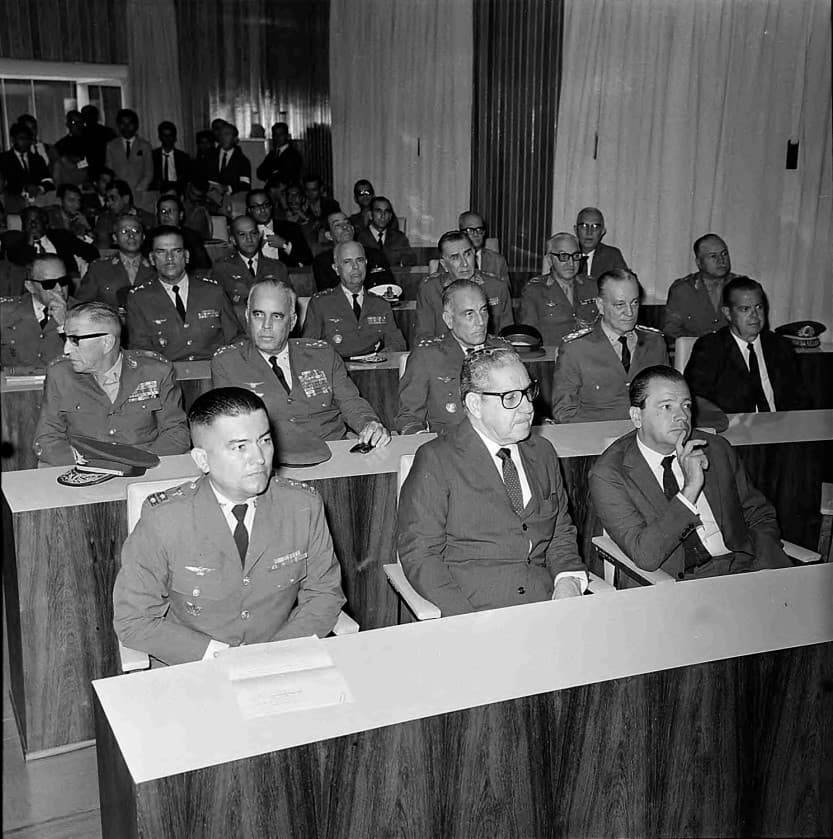
Ozires Silva was one of them, and he is the reason the rest happened. Born in Bauru in 1931, he joined the Air Force Preparatory School in 1948, flew solo in 1949 and received his military brevet in December 1951, then served from 1952 flying PBY Catalina amphibians out of Belém. In 1959 he went to ITA as a serving officer and graduated in 1962 at the age of thirty-one as the top student of his year, taking the gold medal; the dean called him the most aeronautical of the engineers ITA had ever produced.
He then went to work at the Instituto de Pesquisas e Desenvolvimento, the Air Force's research and development institute, where he led the aircraft department. The project he took up there was for a small, rugged twin-turboprop able to operate from the short and poor strips that served most of Brazil, a country whose geography made surface transport impractical over most of its area and whose regional aviation was effectively non-existent. Development began in 1965 and construction in 1966. The prototype, the EMB 110 Bandeirante, first flew on 22 October 1968.

The aeroplane worked, and that created a problem the research institute could not solve: there was nowhere to build it in quantity. The answer was a company, created for the purpose. Decree 770 was published on 19 August 1969 and formally established Empresa Brasileira de Aeronáutica S.A., Embraer. Silva was appointed its first managing director. Operations began in January 1970 in São José dos Campos, a few streets from the institute whose graduates would staff it.
The choice of site was not sentimental. São José dos Campos already had ITA, the research institute, an air force base and a trained population, which meant the new company started with the one input a developing aircraft industry cannot import: people who knew how to design aeroplanes. Everything else (tooling, suppliers, capital, customers) had to be built or bought, and was.
It is worth stating how unusual this was. Embraer was not a private venture that attracted state support, nor a foreign manufacturer's licensed assembly line, which were the two normal routes into aircraft manufacturing for a middle-income country in the 1960s. It was a state company designing its own aircraft from a domestic research base, staffed by domestically trained engineers, aimed at a market nobody else was serving. The model is frequently cited and almost never successfully copied.
Expansion
The Bandeirante made the company. It was unglamorous, strongly built and suited to exactly the conditions that defeated more sophisticated aeroplanes, and it sold well beyond Brazil: to regional operators in the United States, Europe, Africa and Australia, in a market that had been served by converted light twins and war-surplus transports. For a first product from a country with no aviation industry, selling into the United States was a far larger achievement than the aircraft's modest specification suggests.

What followed in the 1970s and 1980s was a deliberate widening. The EMB 200 Ipanema was a crop-duster, a product with no prestige whatever and a large domestic market, and it is still in production: later becoming the first series-produced aircraft certified to run on ethanol, which in a country built around sugarcane ethanol is a neat piece of industrial logic. The EMB 121 Xingu was a pressurised business turboprop. The EMB 312 Tucano was a turboprop military trainer that sold internationally and gave Embraer its first substantial defence export business.
The EMB 120 Brasília, which flew in 1983, was the company's bid for the next rung up: a thirty-seat pressurised turboprop for the regional airline market that had grown rapidly in the United States after deregulation. It sold in hundreds and established Embraer as a serious regional manufacturer rather than a maker of useful small aeroplanes.
Alongside the civil work ran a collaboration that mattered more for capability than for revenue. The AMX, a subsonic ground-attack jet developed jointly with Aeritalia and Aermacchi of Italy from the early 1980s, gave Embraer its first experience of a modern combat jet programme and of working as an equal partner with established European manufacturers. The aircraft itself had a modest career. The transfer of practice was the point.
By the end of the 1980s Embraer had done something few state aircraft companies manage: it had built a genuine export business across several product lines, in civil and military markets, without a protected captive customer large enough to carry it. That achievement is what made the collapse of the early 1990s so shocking, and it is why the company was worth saving.
The jet age
The turboprop market Embraer had mastered began to disappear underneath it. American regional airlines, feeding the hubs that deregulation had created, wanted jets: passengers disliked propellers, the routes were lengthening, and the economics of a thirty-to-fifty-seat jet had become defensible in a way they had not been a decade earlier. A company whose entire product line was turboprops faced the prospect of being technically competent and commercially irrelevant.
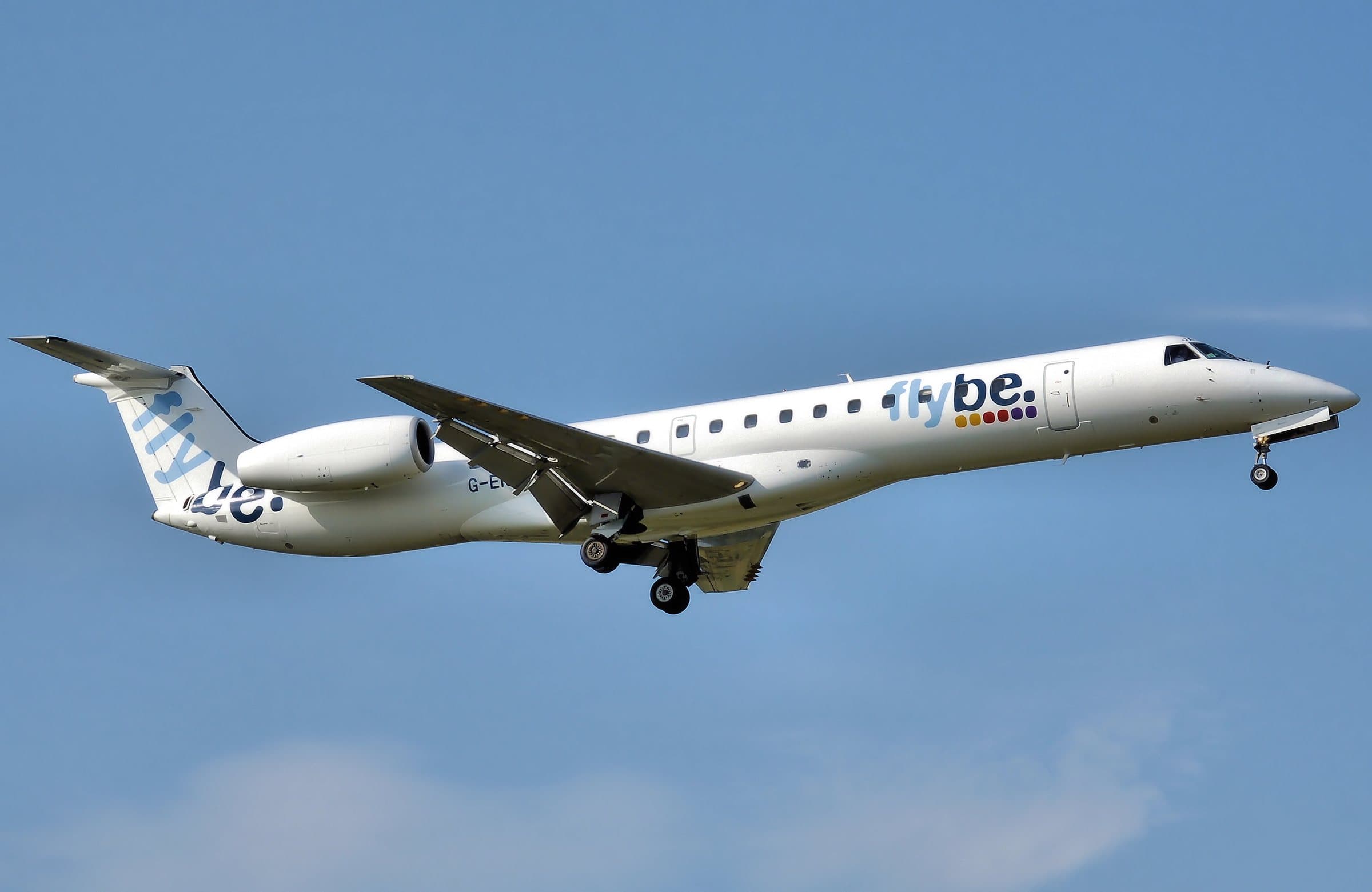
The response was the ERJ 145, and it was a close-run thing: developed during precisely the years when Embraer was running out of money, and completed only because the privatisation that followed brought in capital to finish it. The aircraft first flew on 11 August 1995, received its type certificate on 10 December 1996, and the first was delivered that same month to ExpressJet, which flew it as Continental Express; revenue service began on 6 April 1997.
It worked completely. The ERJ family, the 145 and the shortened 135 and 140, sold 1,231 aircraft before production ended in 2020, and ExpressJet alone eventually operated 250 of them. For most of a decade the regional jet market was a duopoly between Embraer's ERJ and Bombardier's CRJ, two companies from outside the traditional aerospace powers dividing a segment that Boeing and Airbus had declined to enter.
The strategic significance is larger than the sales figures. The ERJ 145 moved Embraer from a maker of niche utility aircraft into a manufacturer of jet airliners sold to major network carriers in the largest aviation market in the world. It also established the pattern that has governed the company ever since: identify a size of aeroplane the duopoly does not want to build, build it properly, and defend the position by being the only serious option in it.
The limitation of the ERJ was its fuselage. Derived from the Brasília turboprop's cross-section, it was narrow, with a single-seat and double-seat arrangement either side of the aisle and no meaningful stretch potential beyond fifty seats. To go further up the market Embraer would have to start again with a new and wider aeroplane, which is what it did.
Products
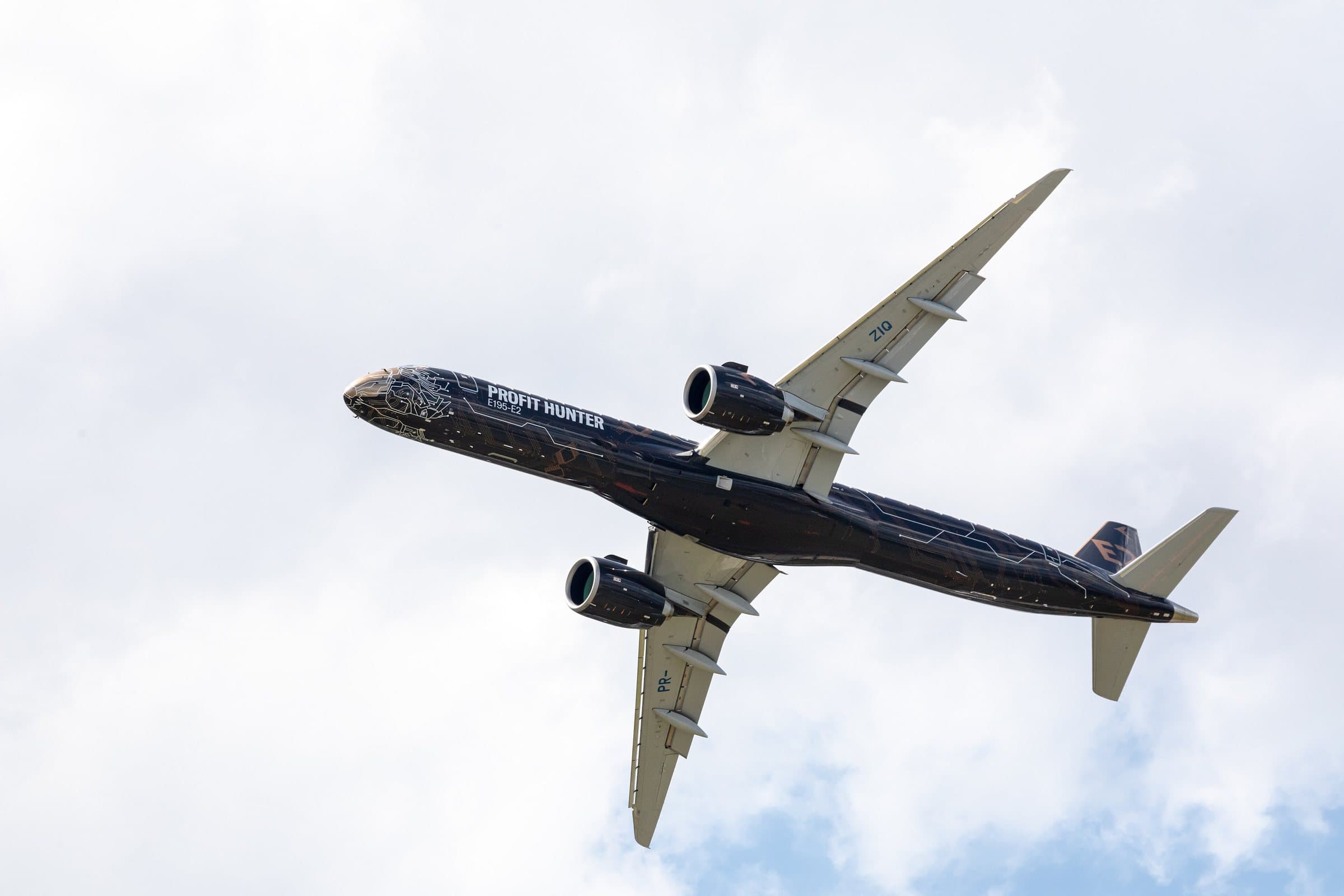
The E-Jet, launched at the end of the 1990s and in service from 2004, was the company's move into the mainline market. It was an entirely new design with a four-abreast cabin, underwing engines and no commonality with the ERJ, built in four sizes (the E170, E175, E190 and E195) covering roughly seventy to one hundred and twenty seats. The segment it occupied had been the preserve of the smallest Boeing and Airbus narrowbodies, aircraft that were really too large for the routes and were flown at a loss to protect networks. Embraer offered an aeroplane actually sized for the job.
It sold in quantity, and in the United States it benefited from an unusual structural advantage: the scope clauses in American pilots' union contracts, which cap the size and weight of aircraft a mainline carrier's regional affiliates may fly. The E175 fits those limits; most things larger do not. A contractual provision in American labour agreements has shaped Embraer's order book for two decades.
The second generation, the E2, re-engined the family with Pratt & Whitney geared turbofans and redesigned the wing. The E190-E2 was certified on 28 February 2018 and entered service with Widerøe of Norway on 24 April 2018, on flight WF622 from Bergen to Tromsø. The larger E195-E2 was certified in April 2019 and delivered to Azul of Brazil that September. The E175-E2, the variant that would matter most in the United States, has been repeatedly delayed, because the aircraft as designed exceeds the scope-clause weight limits that made its predecessor successful. The company's best-selling model is held in place by a labour agreement it cannot renegotiate.
Executive aviation has grown into the larger half of the business by unit volume. The range runs from the Phenom 100 and 300 light jets through the midsize Praetor family to the Lineage, an airliner-derived corporate aircraft. In 2025 Embraer delivered 155 executive jets against 78 commercial aircraft: a ratio that would surprise anyone who thinks of the company purely as a regional airliner manufacturer.
Services and support is the fourth business and the least visible. It ended 2025 with a US$4.9 billion backlog, more than the defence arm, which is the ordinary economics of modern aerospace: the aeroplane is sold once and maintained for thirty years, and the second transaction is frequently worth more than the first.
Defence
Embraer's defence business is small by the standards of the global primes and has achieved something they would not have predicted: it has sold Brazilian-designed military aircraft into NATO air forces.
The foundation is the Tucano and its successor. The EMB 312 Tucano was a turboprop trainer that sold widely from the 1980s, including to the Royal Air Force in a licence-built form. Its development, the A-29 Super Tucano, is a turboprop light attack and armed reconnaissance aircraft: a category the major manufacturers largely abandoned and which turned out to be exactly what was wanted for counter-insurgency, border patrol and the air forces of countries that cannot afford or do not need fast jets. Cumulative firm orders reached 302 aircraft by 30 June 2025, with a contract for four signed with Panama during the third quarter of that year.
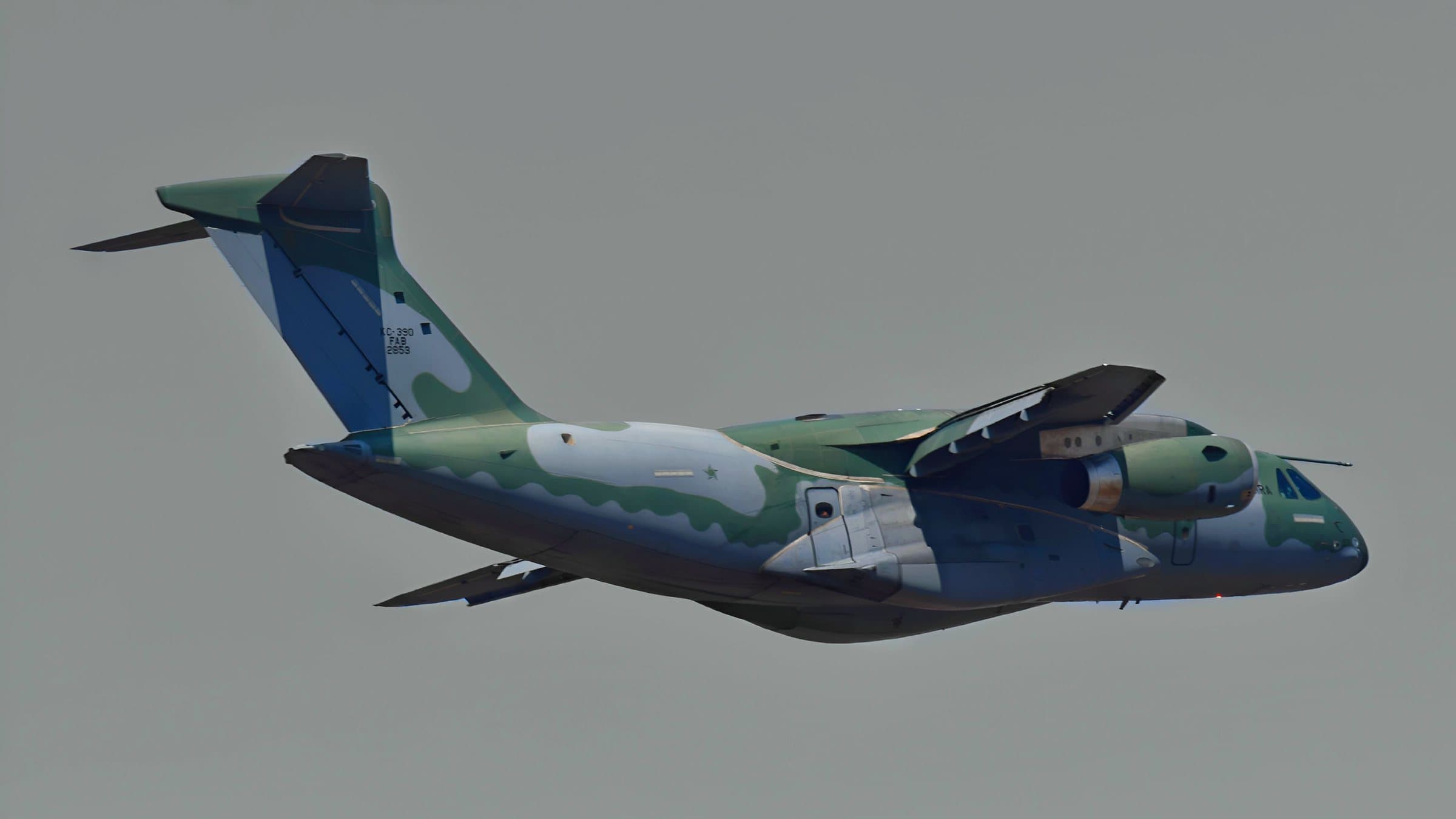
The more consequential programme is the KC-390 Millennium, a twin-turbofan military transport and tanker in the same broad class as the Lockheed C-130: the aircraft that has defined that role since the 1950s and against which nothing much has succeeded. Embraer's entry is jet-powered rather than turboprop, which gives it speed and ceiling at some cost in short-field performance, and it has been bought by air forces that would historically have bought American.
The order book makes the point. Portugal has taken delivery of its third aircraft during the third quarter of 2025. Firm and prospective orders include Sweden, Slovakia and Lithuania, three NATO members choosing a Brazilian transport, with those contracts not yet in the reported backlog because they are not fully in effect. Brazil itself agreed in August 2025 to reduce its own order from nineteen aircraft to eighteen, which is a reminder that the home customer's budget is not unlimited.
The defence segment closed 2025 with a US$4.6 billion backlog. That is a fraction of what a major defence contractor carries, and it is remarkable for a company that forty years ago was building crop-dusters and light trainers. The KC-390's European sales are the clearest evidence that Embraer has crossed from being a specialist regional manufacturer into a company that competes with the American primes on their own ground, in a market where procurement is political and incumbency is nearly everything.
Manufacturing
Embraer's manufacturing is concentrated in the state of São Paulo and arranged around a problem the company created for itself by succeeding: São José dos Campos, the original site, ran out of room.
The headquarters site remains the centre of engineering, development and commercial aircraft production, and it is where the company's history is physically located, the research institute, the technological institute and the works all within a short distance of each other. Botucatu builds the agricultural aircraft. The logistics centres sit at Taubaté and Campinas.
The expansion that solved the space problem was Gavião Peixoto, begun in 2001 some 315 kilometres west of the headquarters. It is now where the Super Tucano and the KC-390 are built, along with paint shops, a business-jet cabinet shop and a service centre, and its flight-test runway (15,400 feet long and 312 feet wide) is the largest paved runway in the Americas. A company that was created to build one small turboprop now operates the longest runway on two continents.
Outside Brazil, Embraer has industrial units in the United States, Portugal and China, and a network of service, maintenance and spare-parts centres at São José dos Campos, Fort Lauderdale, Mesa, Nashville, Windsor Locks and in China. Completion, final flight test and delivery of the midsize business jets are consolidated at Melbourne, Florida: placing the final stage of production inside the market that buys most of them, which is both a commercial convenience and a political one.
The international footprint reflects a reality of the industry that Embraer understood early. An aircraft manufacturer selling into the United States and Europe is subject to the procurement politics of those markets, and a factory inside the customer's borders answers an argument that technical merit does not. The company's defence sales into NATO countries and its executive-jet business in North America both sit on that logic.
Workforce
Embraer's distinguishing asset has always been engineers, and the supply of them was arranged before the company existed. ITA had been producing aeronautical graduates at São José dos Campos since 1950, which meant Embraer opened in 1970 with access to two decades of accumulated domestic training. Few state aircraft programmes in developing countries have had that, and it is the single clearest reason this one worked where others did not.
The relationship has persisted. The company, the technological institute and the air force research establishment occupy the same city and have moved people between them for half a century, producing something close to an aerospace cluster in a country that has only one. The depth of that pool is also a constraint: Brazil's aeronautical engineering capacity is concentrated in one place, and Embraer's fortunes and that city's are not separable.
The workforce has been through at least one severe contraction. The crisis of the early 1990s involved large-scale redundancies as the company ran out of money and orders simultaneously, and the privatised Embraer that emerged in 1994 was a smaller and harder organisation than the state one that went in. That episode is remembered within the company as the period that nearly ended it, and it shaped a management culture noticeably more cost-conscious than its state-owned predecessor.
There is a further structural feature worth noting. Embraer's governance caps any single shareholder's voting rights at 5 per cent of issued shares and foreign shareholders collectively at 40 per cent of votes at a general meeting. The company is therefore not controllable by any one investor, domestic or foreign: an arrangement designed to keep a privatised national champion national, and one that has had the side effect of making the firm unusually independent of the short-term demands that a controlling shareholder can impose.
Competition
Embraer's competitive position has been shaped less by what it builds than by what the duopoly declines to build. Boeing and Airbus have spent thirty years moving up in size, because a larger aeroplane earns more per unit and the development cost is similar. Everything below about a hundred and thirty seats has been progressively abandoned, and Embraer has lived in that space.
For most of its jet era the direct rival was Bombardier, whose CRJ family fought the ERJ for the regional market and whose larger CSeries then attacked the E-Jet from above. That contest ended in a way neither company intended: Bombardier, having spent more on the CSeries than it could sustain, sold the programme to Airbus, where it became the A220. Embraer now faces, at the top of its range, an aeroplane backed by one of the two manufacturers whose absence from the segment had been its opportunity.
The other challengers have fared worse. Mitsubishi spent more than a decade and a very large sum on the SpaceJet and cancelled it in 2023 without delivering an aircraft, defeated by the certification process rather than the engineering. Russia's Superjet has been confined by sanctions and supply chains to a largely domestic market. ATR continues to hold the turboprop segment that Embraer left. The pattern across all of them is that entering the airliner business is far harder than it appears, which works to the advantage of whoever is already in it.
Embraer's defensible position therefore rests on two things: being the only manufacturer offering a properly sized seventy-to-one-hundred-and-forty-seat aircraft family with a full support network, and holding the American market segment defined by pilot scope clauses. The first is durable. The second is not entirely within its control, as the E175-E2's weight problem demonstrates.
In defence the competitive logic inverts. There Embraer is the challenger, selling against Lockheed Martin in a transport category that company has owned since the 1950s, and winning orders in Europe largely by offering a modern aircraft at a price and with an industrial-offset package the incumbent has not matched.
Mergers and ownership
The most consequential corporate event in Embraer's recent history is a merger that did not happen.
In the late 2010s, with Airbus having absorbed Bombardier's CSeries, Boeing moved to acquire Embraer's commercial aircraft business. The structure agreed under a Master Transaction Agreement would have placed the commercial aviation unit into a joint venture 80 per cent owned by a Boeing subsidiary and 20 per cent by Embraer, with a second joint venture to develop markets for the C-390 Millennium transport held 51 per cent by Embraer and 49 per cent by Boeing. Boeing was to pay US$4.2 billion. The Brazilian government's golden share, which carries a veto over changes of control and over military programmes, was preserved.
On 25 April 2020 Embraer received notice that Boeing was terminating the agreement, on the basis that certain closing conditions had not been satisfied by the preceding day's deadline. Embraer's response was unusually blunt for a regulated filing. The company stated its belief that Boeing had wrongfully terminated, that it had manufactured false claims as a pretext to avoid its commitments and the US$4.2 billion purchase price, and that it had engaged in a systematic pattern of delay and repeated violations of the agreement, driven by its own financial and business difficulties. Both sides commenced arbitration.
The timing is impossible to separate from the circumstances. Boeing in April 2020 was simultaneously grounded by the 737 MAX crisis and facing the collapse of air travel in the first months of the pandemic. Whether the termination was a genuine response to unmet conditions or an expensive escape from a deal the buyer could no longer afford is the question the arbitration exists to answer.
What matters for Embraer is the counterfactual. Had the transaction closed, the company would have been a defence and executive-jet business with a minority stake in an aeroplane line run from Seattle. Instead it retained a commercial aviation unit that ended 2025 with a US$14.5 billion backlog, up 42 per cent on the previous year. The deal's collapse was experienced as a disaster and may yet be read as a reprieve.
Crisis
Embraer nearly died, and the episode is the hinge on which its whole history turns.
By the start of the 1990s the company was in serious trouble. Its product line was turboprops in a market turning to jets; the Brazilian state that owned it was in fiscal crisis and could not fund development; and the new aircraft that might have saved it, the ERJ 145, needed capital the shareholder did not have. A state enterprise that cannot invest in its own next product is not a going concern, and Embraer by then was effectively insolvent.
Ozires Silva, who had left to run Petrobras in 1986 and then served as Minister of Infrastructure in 1990, returned to Embraer in 1991 to carry out the privatisation. It took 1,152 days. The process was contested: selling a national aeronautical champion is not a neutral act in Brazilian politics, and the company's military programmes made it more sensitive still. The sale was completed on 7 December 1994.
The settlement that emerged was a compromise rather than a clean privatisation, and the compromise is why the company still exists in the form it does. The state gave up ownership and control but retained a golden share with veto rights over seven defined categories of decision: changes to the company's name or purposes, changes of controlling interest, changes to military programmes, transfers of defence technology, the discontinuation of spare-parts supply for military aircraft, and amendments to the governing provisions themselves. Voting rights were capped at 5 per cent for any shareholder and 40 per cent in aggregate for foreign holders, with any acquisition of 35 per cent or more requiring federal approval and a public tender offer.
The company that emerged had private capital, private management incentives and a state veto over anything that would change what it fundamentally was. Within a year the ERJ 145 flew; within three it was in airline service; within a decade Embraer was the world's third-largest airliner manufacturer. It is as close to a controlled experiment in the effect of ownership on industrial performance as the aerospace industry provides, and the honest reading is that neither pure state ownership nor pure privatisation produced the result, the hybrid did.
Setbacks
The years since 2020 have been the hardest since the privatisation, and for reasons that mostly arrived from outside.
The Boeing termination removed, at a stroke, both a US$4.2 billion payment and the strategic premise on which the company had reorganised itself: it had already separated its commercial aviation unit in preparation for the sale. It landed in the same quarter as the collapse of global air travel, at a company whose customers are regional airlines with thin balance sheets. Embraer entered the pandemic restructured for a transaction that no longer existed.
The E175-E2 is the other persistent difficulty, and it is more structural than commercial. The aircraft is a better aeroplane than the one it replaces and cannot be sold into its principal market, because it exceeds the weight limits written into American pilots' scope clauses. Those limits are set by collective agreements between airlines and their pilots' unions; Embraer is not a party to them and cannot negotiate them. The company has a developed, certified-in-progress product waiting on a labour settlement in another country.
Supply chain difficulties have affected deliveries across the industry since 2021, and a manufacturer of Embraer's size has less leverage over engine makers and structural suppliers than Airbus or Boeing. The 2025 figures show a company that has worked through most of it, 244 deliveries and a record backlog, but the backlog itself reflects demand that could not be met as much as demand newly won.
The deeper vulnerability is scale. Embraer competes against two manufacturers that each deliver more aircraft in a month than it does in a year, and against defence primes many times its size. It has survived by being irreplaceable in specific segments rather than large, which works until somebody decides to contest one of those segments properly. Airbus's acquisition of the A220 is exactly that, and it is the most serious competitive threat the company has faced.
Legacy
Embraer's significance is partly the aeroplanes and substantially the demonstration. It is the standing counter-example to the proposition that commercial aircraft manufacturing is closed to new entrants.
The scale of what was built is easy to understate. A country with no aeronautical industry in 1969 now has a manufacturer that delivered 244 aircraft in a single year, carries a US$31.6 billion order backlog, builds the airliners that operate a large share of American and European regional flying, and sells military transports to NATO air forces. No other middle-income country has achieved anything comparable in aerospace, and several have spent more trying.
The mechanism is worth stating precisely, because it is frequently misdescribed. Embraer did not succeed because it was state-owned, and it did not succeed because it was privatised. It succeeded because a state investment in education and research twenty years ahead of time produced engineers; because those engineers were given a product aimed at a real and unserved market rather than at national prestige; because the company was commercialised when state ownership had become the binding constraint; and because the state kept a veto narrow enough to protect sovereignty without impeding management. Remove any one of those and the thing does not work.
The limits are equally clear. Embraer remains a niche manufacturer by the standards of the duopoly, dependent on segments the larger firms have chosen not to contest and on a labour agreement in a foreign country. Its most important corporate decision of the last decade was taken by Boeing, in Boeing's interest, and is still in arbitration. A company of this size does not control its own circumstances.
What it does control is a reputation for building the right-sized aeroplane properly, which in an industry that has spent thirty years making everything larger has turned out to be a durable position. The next test is whether that holds against an Airbus-backed competitor in the same space: and whether the engineers keep coming out of a technological institute in São José dos Campos, which is where the whole thing started and, in the end, still rests.
Products
Programmes the company has built or is building. Entries that exist elsewhere in FLYPEDIA are linked.
Airliners
- Embraer EMB 110 BandeiranteOut of production
A turboprop passenger aircraft; the company's first product.
- Embraer ERJ familyOut of production
Regional jets, also built in China by Harbin Embraer.
- Embraer E-JetIn production
A family of narrow-body short- to medium-range airliners; 1,800 delivered by May 2024.
Military aircraft
- Embraer EMB 312 TucanoOut of production
A military trainer of the 1980s.
- Embraer C-390 MillenniumIn production
A military transport using technology from the Embraer 190.
General aviation
- Embraer Legacy 600Out of production
A business jet derived from the regional jet, in service from 2002.
Genealogy
Embraer's line: the state company of 1969, privatised in 1994 and listed as Embraer S.A. in 2000.
Scroll to see the full diagram
Timeline
August 19, 1969
Embraer is founded
1974
Licence to build Piper light aircraft in Brazil
December 7, 1994
Privatised
2000
Listed on the New York and São Paulo stock exchanges
2005
Embraer Executive Jets is created
April 2020
Boeing cancels its purchase of Embraer's commercial business
March 2026
The first Brazilian-built Gripen F-39 is rolled out
- Ozires Silva, Embraer
- Corporate Governance Model, Embraer Investor Relations
- Form 6-K: Fourth Quarter and Full Year 2025 Deliveries and Backlog, Embraer S.A., filed with the US Securities and Exchange Commission
- Form 6-K: Boeing's termination of the Master Transaction Agreement, Embraer S.A., filed with the US Securities and Exchange Commission
- Form 20-F: Annual Report for 2020, Embraer S.A., filed with the US Securities and Exchange Commission
- Widerøe introduces the Embraer E190-E2 into revenue service, World Airline News
- Embraer, Wikipedia
- Embraer ERJ family, Wikipedia
- Embraer E-Jet E2 family, Wikipedia
Checked October 5, 2026