Aircraft
DH.82 Tiger Moth
TIGR
The de Havilland Aircraft Company LimitedUnited Kingdom
- Role:
- Elementary trainer biplane
- First flight:
- 1931
78kt
Cruise speed
262nm
Range
General
- Role:
- Elementary trainer biplane
- Status:
- Retired
Programme
- First flight:
- October 26, 1931
- Introduction:
- 1932
- Produced:
- 1931 to 1944
- Number built:
- 8,868
Crew & capacity
- Crew:
- 1
- Capacity:
- 1 passengers
Dimensions
- Length:
- 24 ft
- Height:
- 9 ft
- Wingspan:
- 29 ft
- Wing area:
- 239 ft²
Weights
- Empty weight:
- 1,116 lb
- Maximum takeoff weight:
- 1,825 lb
- Fuel capacity:
- 22 US gal
Powerplant
- Engine:
- 1 × de Havilland Gipsy Major I inverted inline, 130 hp (97 kW)
- Power:
- 130 hp (97 kW)
Performance
- Maximum speed:
- 94 kt
- Stall speed:
- 35 kt
- Rate of climb:
- 768 ft/min
- Ceiling:
- 13,599 ft
Price
- Used market:
- ≈ $54,124 – $115,014
As of 2026-09. See references.
Converted at European Central Bank reference rates of 2026-09-01.
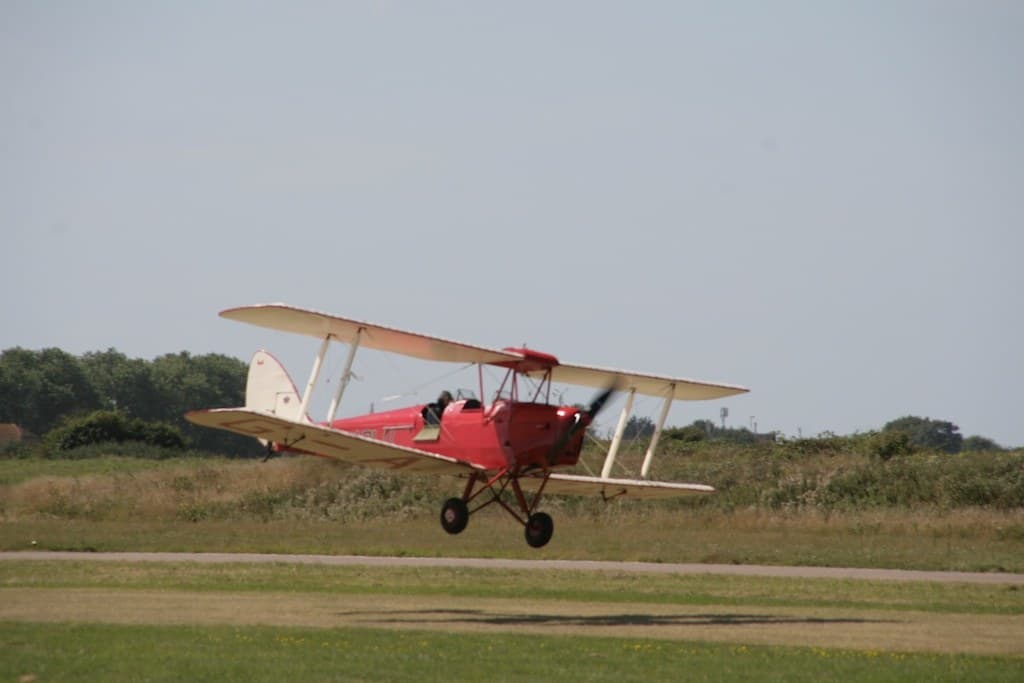
The de Havilland DH.82 Tiger Moth is a two-seat, single-bay biplane trainer, and the only biplane among the light trainers of its generation still widely remembered today. Fabric over a wooden and metal-tube airframe, an open tandem cockpit, a fixed undercarriage and a 130-horsepower inverted inline engine: nothing about the specification was unusual for 1931. What set it apart, and what has kept it in the air for nearly a century, was how deliberately it was built to be difficult.
Where most primary trainers of its era and since have aimed for forgiveness, the Tiger Moth was prized for the opposite. It punished a sloppy turn with a dropped wing and an incipient spin, and it demanded active, continuous footwork on the rudder that a careless student could not fake. The theory behind that choice was explicit: an air force training thousands of pilots at a time needed a machine that would expose a poor one before he reached an operational squadron, not after. A pilot who could fly a Tiger Moth cleanly could be trusted with almost anything that came next.
It became the principal elementary trainer of the Royal Air Force and, through the Empire Air Training Scheme, of Commonwealth air forces from Canada to Rhodesia, producing the great majority of Allied pilots who went on to fly Spitfires, Lancasters and everything between. Roughly 8,800 were built in Britain and under licence abroad, and thousands survive today, flown, restored and still taught on, in numbers that few aircraft of any era can match.
History
The Tiger Moth did not begin as a new design but as a modification of an existing one. Through the late 1920s, the DH.60 Moth had become de Havilland's most successful light aircraft and the RAF's standard elementary trainer, but its wing arrangement created a real problem for a training role: the upper wing's centre-section structure sat close over the front cockpit, obstructing a student's escape by parachute in an emergency. In an aircraft meant to teach beginners, that was not an acceptable risk to carry indefinitely.
De Havilland's answer, developed through 1931 under chief designer Arthur Hagg, was to sweep both wings backward and stagger them so that the front interplane struts, and the centre-section structure above the front seat, moved forward and clear of the occupant's exit path. The change looks cosmetic in a photograph: a rakish backward lean to the wings that gives the Tiger Moth its distinctive silhouette against the DH.60's straighter one: but it was a direct structural response to a safety problem, not a styling choice. The prototype, effectively a modified Moth designated DH.60T, first flew on 26 October 1931, and the type entered production as the DH.82 the following year.
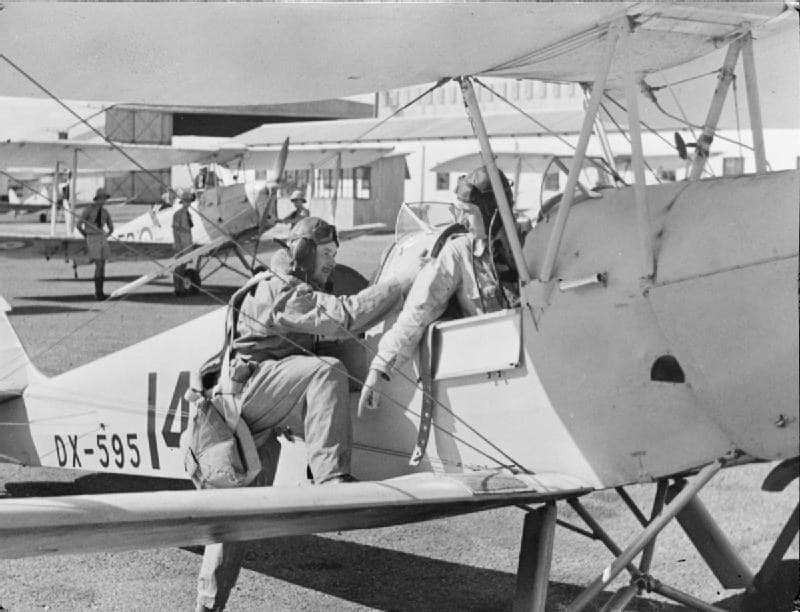
The RAF adopted it immediately as its standard basic trainer, and the improved DH.82A followed in 1934 with a more powerful Gipsy Major engine and a plywood-decked rear fuselage in place of fabric, easing the load a parachute-carrying instructor placed on the structure behind the cockpit. By the time war began in 1939, the Tiger Moth was already the aircraft on which most RAF pilots had made their first solo flight, and the outbreak of war multiplied that role many times over.
From 1940, the Empire Air Training Scheme dispersed elementary flying training across Canada, Australia, New Zealand, Rhodesia and South Africa, out of range of the Luftwaffe and close to open airspace and good weather. Tiger Moths, built locally under licence as well as shipped from Britain, became the first aircraft flown by tens of thousands of Commonwealth pilots training under the scheme: Canada alone built and operated large numbers through Winnipeg-based de Havilland Canada production, fitted with a cockpit canopy and other modifications to cope with prairie winters. Alongside training, small numbers flew coastal patrol duties around the British Isles in 1940, some briefly and improbably fitted with light bomb racks as an emergency anti-invasion measure, a role for which the aircraft was never remotely suited but which reflected how thin Britain's defences were at the time.

When the war ended, thousands of Tiger Moths became instantly surplus to a training establishment that no longer needed them at wartime scale. Sold off cheaply through the late 1940s and 1950s, they flooded into civilian hands (flying clubs, private owners and postwar conversion firms) at prices that put a genuine RAF-pedigree biplane within reach of ordinary pilots for the first time. That surplus is the direct reason so many Tiger Moths survive today: an aircraft built by the thousand for a training need that vanished overnight became, almost by accident, the foundation of postwar vintage aviation in Britain and the Commonwealth.
Design

The Tiger Moth's most distinctive feature, and the reason it exists at all, is the sweep and stagger of its wings. Unlike the straight, unstaggered wings of the DH.60 Moth it descended from, the Tiger Moth's wings rake noticeably backward, moving the forward interplane struts and centre-section structure clear of the front cockpit. That was not an aerodynamic refinement; it was a direct fix for the DH.60's flaw of trapping a front-seat occupant behind wing structure in an emergency, giving a student or instructor an unobstructed path to bail out by parachute. Almost every other visual signature of the type, the rakish look that separates it at a glance from its straight-winged forebear, follows from that one safety-driven decision.

Structurally the aircraft is conventional for its period: a fabric-covered wooden wing structure on a fuselage of welded steel tube, also fabric-covered, with plywood decking added around the rear cockpit on the DH.82A to bear the weight and loads of a parachute-equipped instructor. The undercarriage is fixed, with a tailskid on early aircraft and a tailwheel standard on later ones and Canadian-built variants. Power comes from a de Havilland Gipsy Major inverted inline four-cylinder engine of around 130 horsepower, mounted uncowled enough that a walk-around inspection can see most of its cylinders directly: a maintenance-friendly arrangement typical of trainers meant to be serviced by relatively junior ground crew at dozens of scattered airfields.
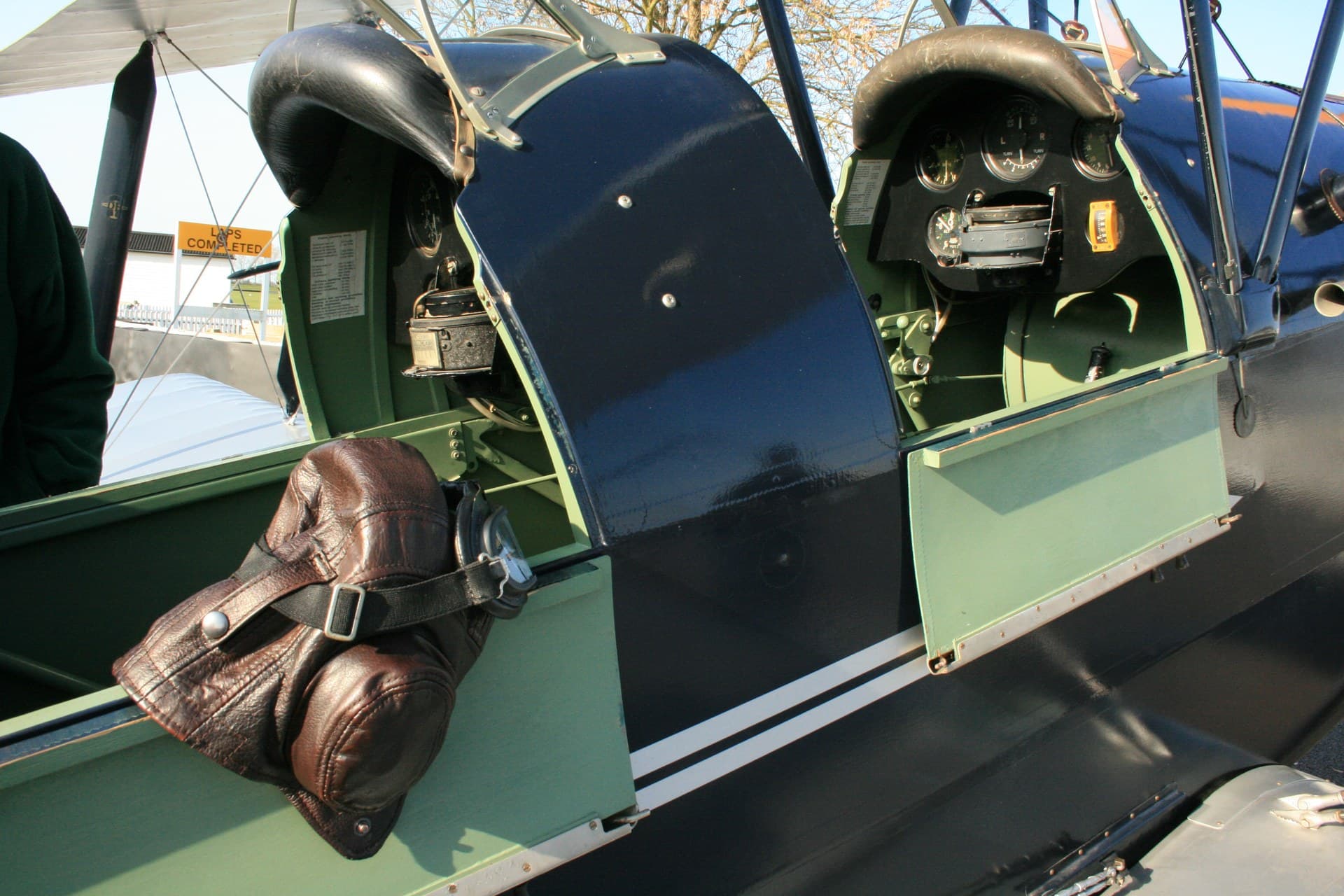
The cockpits are open, tandem and spartan: a compass, airspeed indicator, altimeter and engine gauges, with dual flight controls but no radio, electrical system or starter on the original specification. The engine is started by hand-swinging the propeller, a task that became a familiar rite of passage at every elementary flying school that operated the type. Nothing in the design was advanced even by 1931 standards, and that was largely deliberate: a training aircraft built in the thousands needed to be simple to build, simple to repair in the field, and forgiving of the airframe damage that inexperienced students inevitably inflict, even while it demanded real skill to fly well.
Flight characteristics
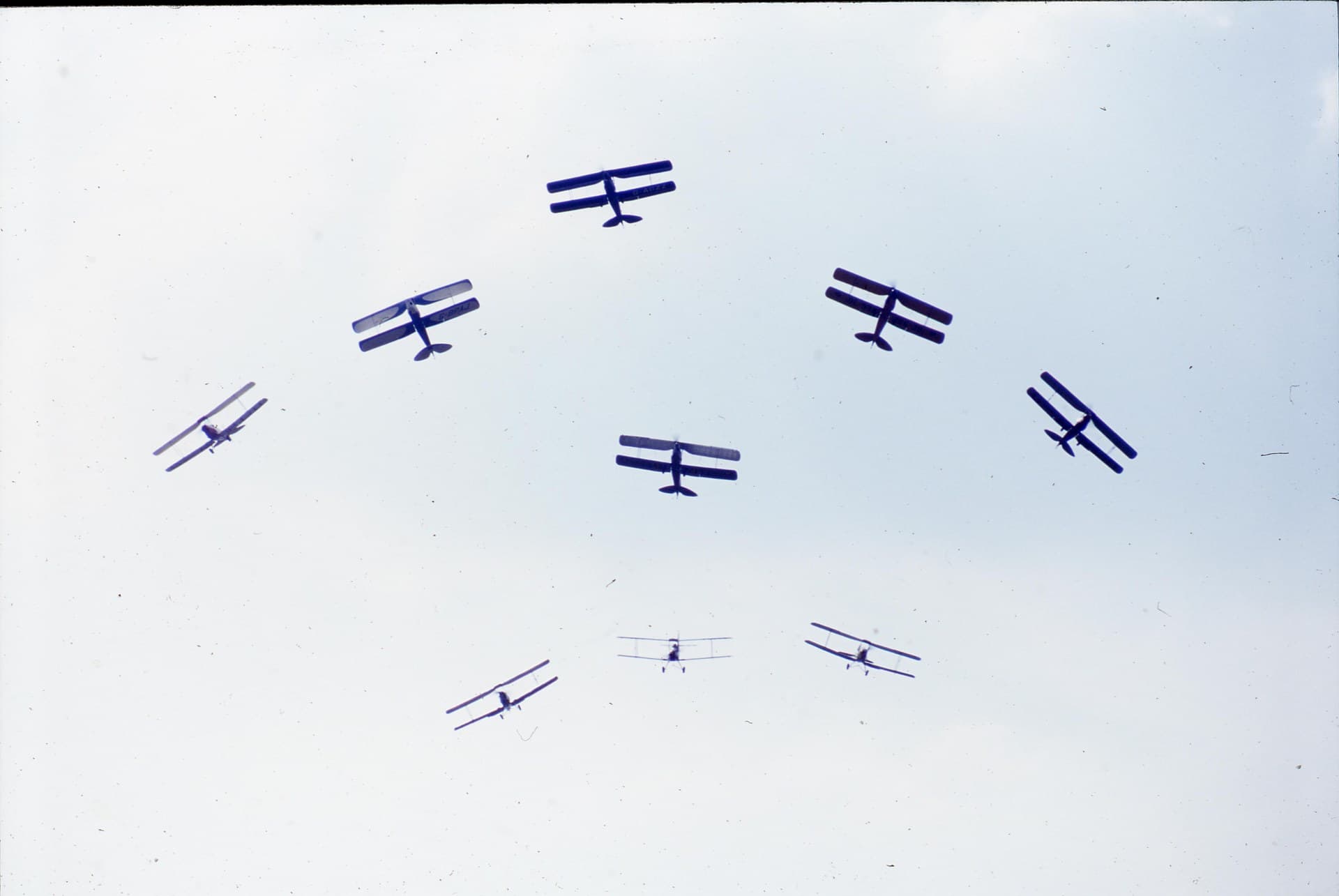
Pilots who trained on the Tiger Moth describe it in terms almost opposite to those used for a Cub or a Champ: not forgiving, but demanding, and valued precisely for that. At a stall speed of around 35 kt and a wing loading light enough to feel every gust, the aircraft would drop a wing sharply and with little warning if handled carelessly in a turn, a trait instructors used deliberately to teach students to respect the aeroplane rather than merely operate it.
Without flaps, brakes worth the name on early aircraft, or a starter, everything about flying it was manual and immediate: hand-swinging the propeller to start, judging the approach entirely by eye and feel, and working the rudder continuously on the ground to prevent the swing that a fixed-tailskid or early tailwheel biplane will develop the instant directional control lapses. An open cockpit added its own discipline: wind, noise and weather were not filtered out by a canopy, and a student learned to read the aircraft's behaviour partly through what could be felt and heard rather than what could be read off an instrument.

That difficulty was not incidental to the training syllabus; it was the point of choosing a biplane trainer of exactly this character. An air force training pilots by the tens of thousands during wartime needed an early filter: an aircraft that would expose a weak or careless student at the elementary stage, before the cost of failure moved to an operational squadron and a real aircraft. The Tiger Moth's unforgiving handling did that filtering as reliably as any written exam, and pilots who mastered it generally found later, faster and heavier aircraft comparatively straightforward by contrast.
Flight training

The Tiger Moth's central role was elementary flying training, first for the RAF alone and then, from 1940, across the Commonwealth. Under the Empire Air Training Scheme, elementary flying training schools in Canada, Australia, New Zealand, Rhodesia and South Africa put student pilots through their first hours in the air on Tiger Moths before they advanced to intermediate and operational types: a pipeline that fed the RAF and Commonwealth air forces with pilots throughout the Second World War, at a scale no single country could have sustained training entirely on its own soil under wartime conditions.

The Air Transport Auxiliary, the civilian organisation that ferried aircraft between factories, maintenance units and squadrons, also relied heavily on Tiger Moths, both to train and check its pilots and to fly the type itself among the dozens of aircraft classes its ferry pilots, men and women alike, were qualified to deliver. The ATA's first eight women pilots, among the earliest women to fly military aircraft professionally in Britain, trained and flew on Tiger Moths as a matter of course, a detail that sits alongside the type's broader role in normalising women's military flying duties in wartime Britain.
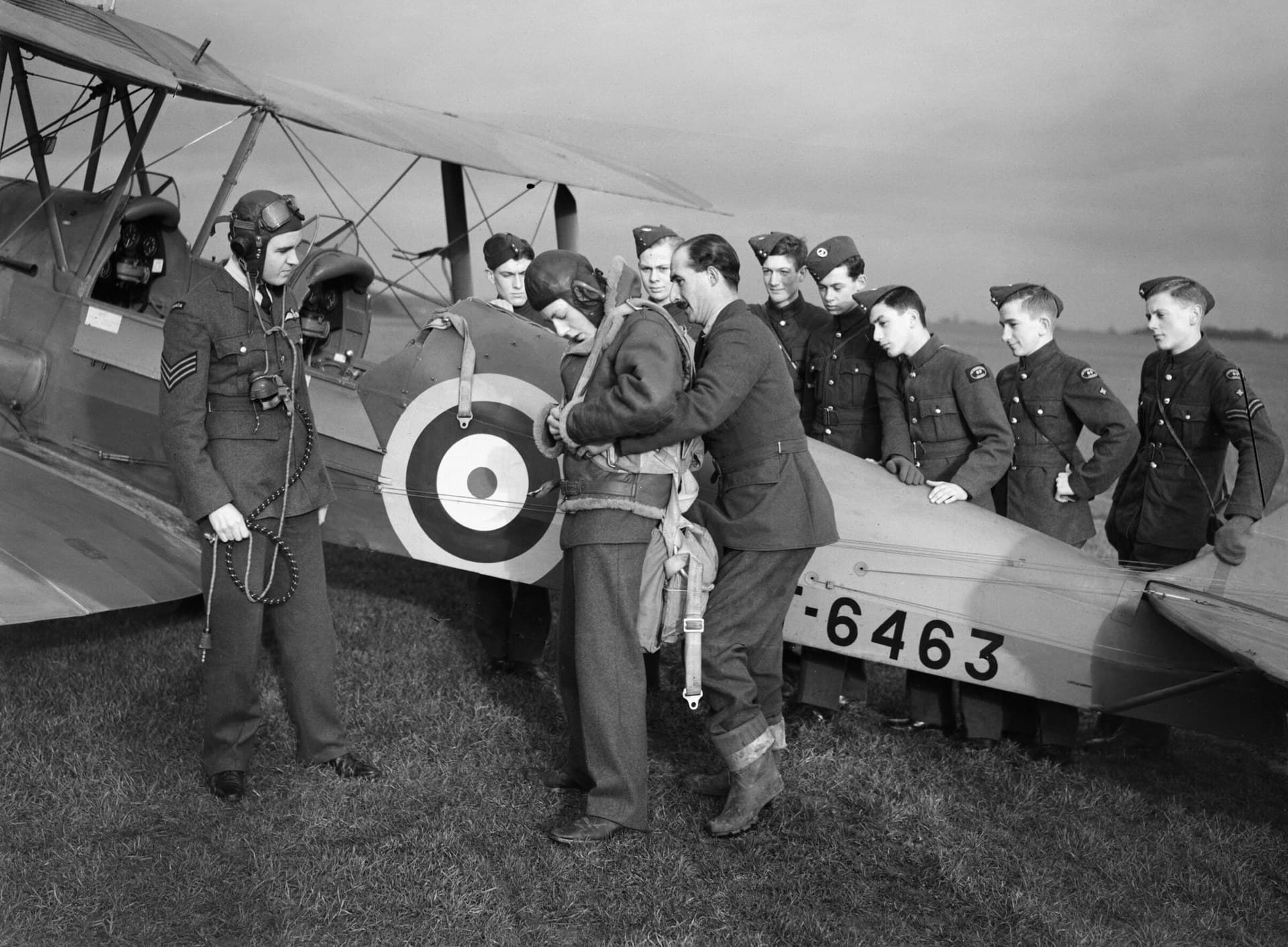
Allied nations occupied by Germany also used the Tiger Moth to rebuild their air forces from British soil: Belgian, Dutch, Norwegian, French and other exile training units operated the type at RAF airfields, giving pilots who had fled occupied Europe their first hours back in the air on the same elementary trainer flown by their British and Commonwealth counterparts. For a generation of Allied airmen from a dozen different countries, the Tiger Moth was the aircraft in which flying training, and often a flying career, began.
Military service
 de Havilland DH.82B Queen Bee
Beyond its central role as a trainer, the Tiger Moth saw a handful of genuinely unusual military applications. The most significant was the DH.82B Queen Bee, a radio-controlled target drone derived from the Tiger Moth airframe with a fuselage of wooden monocoque construction rather than steel tube, first flown in 1935. Flown either conventionally with a pilot aboard or unmanned by radio control from the ground or from a controlling aircraft, the Queen Bee was used by the Royal Navy and RAF to give anti-aircraft gunners live target practice against a full-size aeroplane: a genuine radio-controlled drone operating years before the term became common currency, and reportedly the origin of the word "drone" itself for a remotely piloted aircraft, taken from the Queen Bee's name. Winston Churchill was shown a Queen Bee launch in June 1941, evidence of the level of official interest the programme attracted even at the height of the war.
 de Havilland DH.82B Queen Bee
In 1940, with invasion feared imminent and Fighter Command's aircraft committed elsewhere, a small number of Tiger Moths based in Britain were fitted with improvised light bomb racks for anti-invasion patrol duties along the coast, an emergency measure that reflected how thin the country's defences briefly ran rather than any genuine combat suitability in the type. It saw no significant use of that kind and the fitting was removed once more capable aircraft became available.
The Tiger Moth's real military value, though, was never as a combat type but as the machine that made every other combat type possible: the shared first aircraft of the pilots who went on to fly them.
Production
De Havilland built roughly 8,868 Tiger Moths in total, a figure spanning production at the company's Hatfield and Morris Motors-operated shadow factories in Britain and under licence at de Havilland subsidiaries and other manufacturers in Canada, Australia, New Zealand, Norway, Sweden and Portugal, one of the widest geographic production spreads of any light aircraft of its era, driven directly by the demand of Commonwealth and Allied elementary flying training during the Second World War.
 de Havilland DH.82C Tiger Moth
Canadian production, run by de Havilland Canada from Downsview, near Toronto, was large enough and distinct enough in detail, a fitted cockpit canopy, wheel brakes, a tailwheel and cold-weather modifications suited to Canadian winters, to be tracked separately as the DH.82C. Australian-built aircraft, produced by de Havilland Australia, similarly supplied the Empire Air Training Scheme's schools in that country and, alongside New Zealand production, kept elementary training running across the Pacific dominions without dependence on wartime shipping from Britain.
Production wound down as the war ended and the RAF's wartime-scale training requirement collapsed almost overnight; British output ceased in the mid-1940s, though some overseas lines continued a little longer to work through existing orders and spares. The result was an immediate and enormous surplus, thousands of airframes released onto the civilian market within a few years of the type's peak production: a surplus that shaped the Tiger Moth's postwar identity as much as its wartime service did.
Legacy
 Thruxton Jackaroo
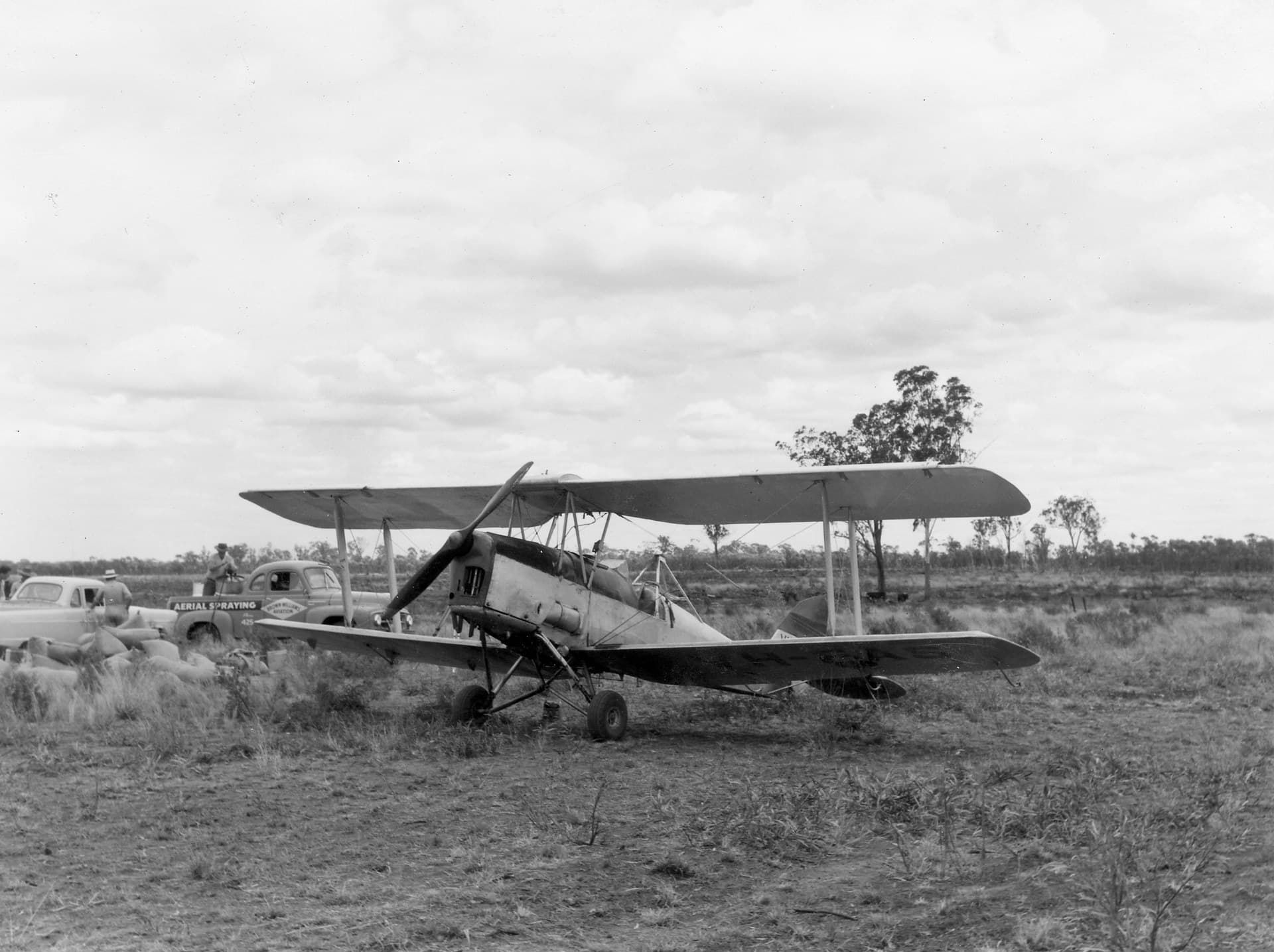
Peace turned the RAF's surplus Tiger Moths into the foundation of postwar civil aviation across Britain and the Commonwealth. Sold off cheaply through flying clubs, private owners and specialist dealers from the late 1940s, they became the default aircraft on which a new generation learned to fly outside any military structure at all, filling much the same social role for postwar British aviation that the Cub filled in the United States. Others were converted for agricultural work, fitted with spray gear or hoppers for aerial seed-sowing and crop protection in Australia, New Zealand and elsewhere, a working role several still perform.
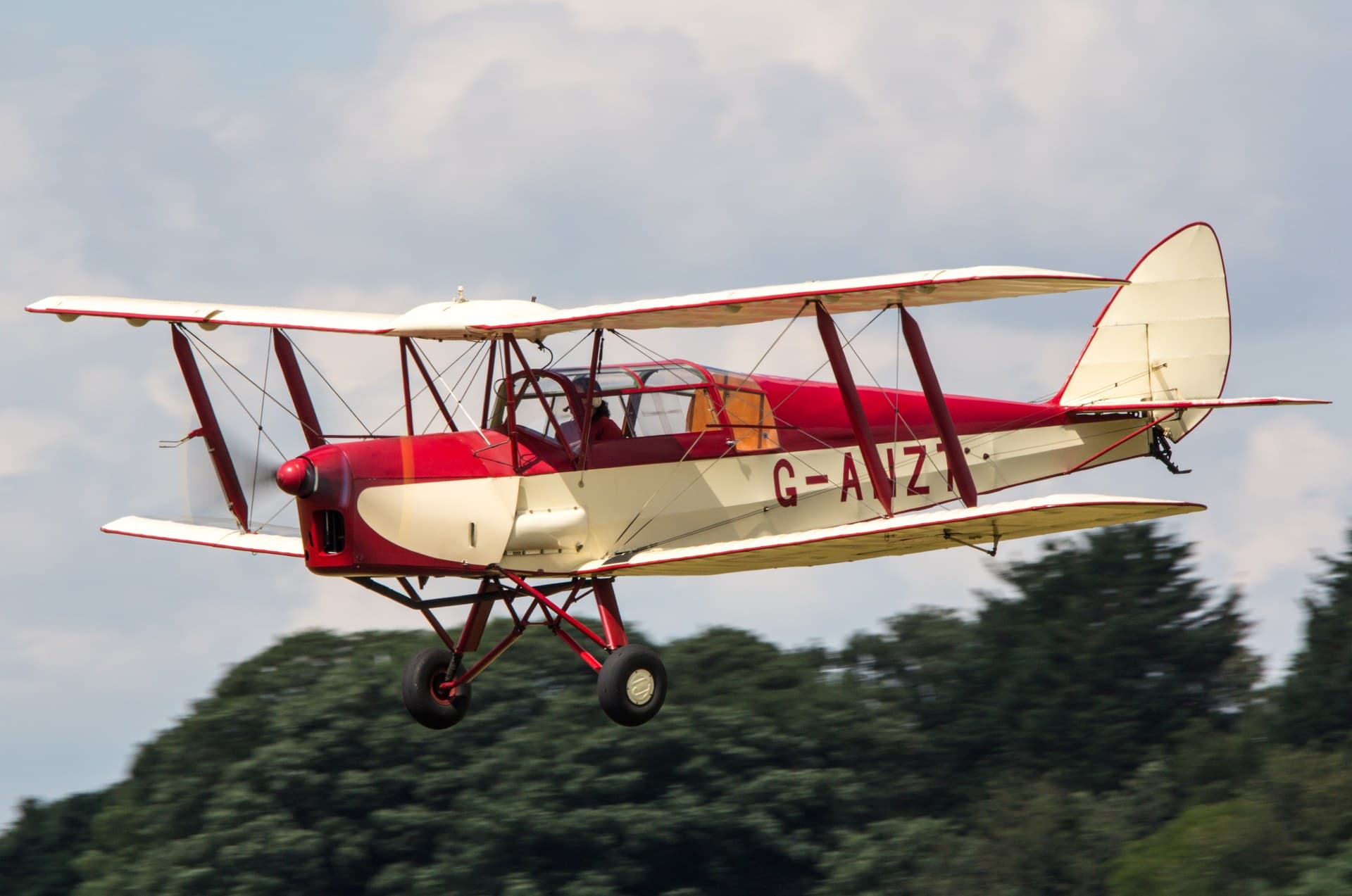
The most distinctive postwar conversion was the Thruxton Jackaroo, developed from the mid-1950s by widening the fuselage to fit an enclosed cabin with four seats side by side in place of the open tandem cockpits, a domesticated Tiger Moth for private owners who wanted the type's charm without its exposure to the weather. A number remain airworthy today, recognisable at a glance by their glazed cabin against the silhouette of an otherwise standard Tiger Moth.

Unlike the trainers it is most often compared with, the Tiger Moth was never meant to be gentle, and that is exactly why pilots still seek it out for tailwheel and vintage instruction: it teaches genuine stick-and-rudder discipline in a way later, more forgiving designs cannot. Airworthy examples now sell for tens of thousands of pounds, supported by an active warbird and vintage-aircraft community, aviation museums that keep restored and flying examples on public display, and enough surviving airframes that the type remains a familiar sight at British airshows nearly a century after its first flight: an aircraft that punished sloppiness by design has, by outlasting almost every trainer built to replace it, had the last word.
Model evolution
de Havilland DH.60T Tiger Moth (prototype)
1931The prototype and immediate origin of the type: an existing DH.60 Moth airframe reworked by chief designer Arthur Hagg with swept, staggered wings to clear the front cockpit for parachute escape, retaining the Moth's fuselage and undercarriage largely unchanged. First flown from Stag Lane Aerodrome on 26 October 1931, it was quickly ordered into production as the DH.82 rather than treated as a one-off modification.
Wings swept back and staggered relative to the DH.60, moving the interplane struts and centre-section structure clear of the front cockpit. The DH.60's wing structure sat close over the front cockpit, obstructing a student's escape by parachute in an emergency. Sweeping and staggering the wings was the direct fix, developed specifically because the aircraft's role as a trainer made that risk unacceptable.
de Havilland DH.82 Tiger Moth
1932The production version of the prototype, adopted by the Royal Air Force as its standard elementary trainer. Fabric-covered throughout, including the rear fuselage decking, with the swept, staggered wings that define the type.
Production-standard fittings and a de Havilland Gipsy III engine in place of the prototype's Gipsy II.
de Havilland DH.82A Tiger Moth
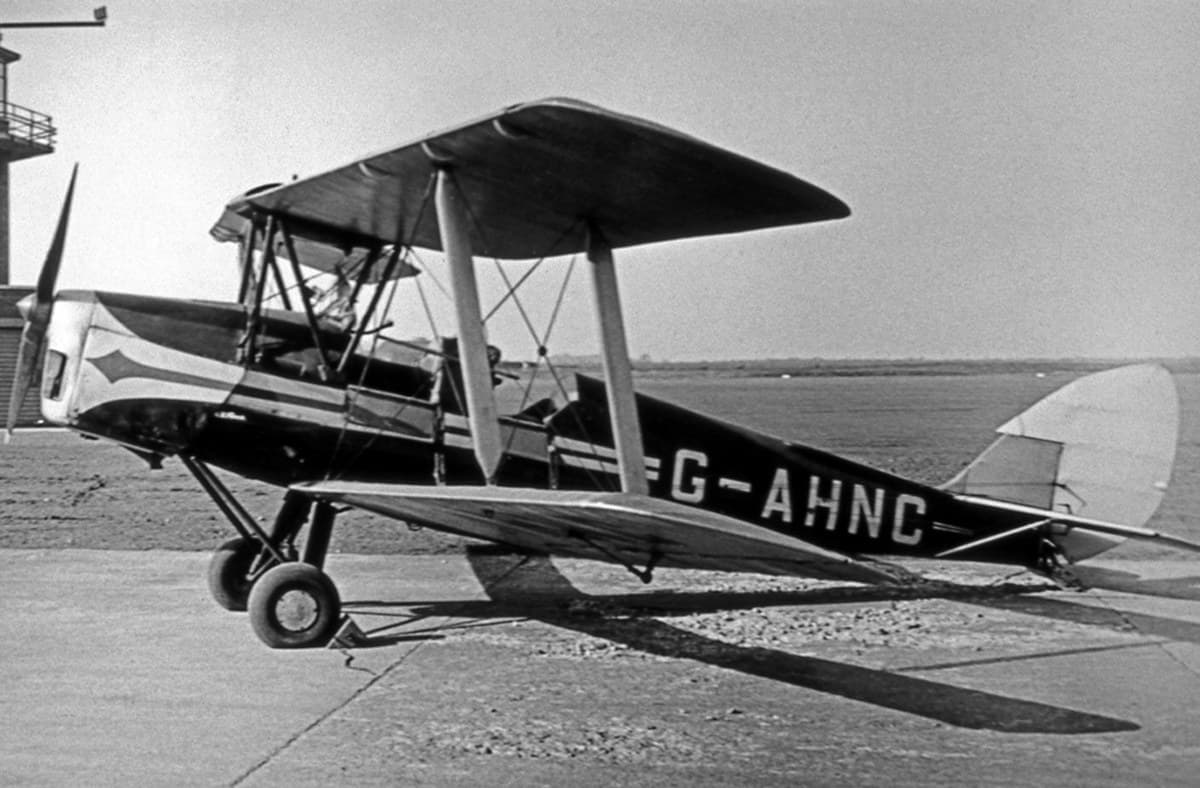
1934The definitive and by far most numerous version, with a more powerful Gipsy Major engine and a plywood-decked rear fuselage in place of fabric. The variant flown by the great majority of RAF and Commonwealth elementary students during the Second World War.
Gipsy Major engine in place of the Gipsy III, and plywood decking replacing fabric on the upper rear fuselage. The fabric decking behind the rear cockpit was proving too lightly built for the loads an instructor wearing a parachute placed on it when climbing in and out. Plywood decking solved that structural weakness while the more powerful engine improved climb performance with two aboard.
de Havilland DH.82B Queen Bee
1935A radio-controlled target drone derived from the Tiger Moth, with a wooden monocoque fuselage in place of the steel-tube structure. Flown either with a pilot aboard or unmanned by radio control, it gave anti-aircraft gunners live-fire practice against a full-size aircraft, and is credited as the origin of the word "drone" for a remotely piloted aircraft.
Wooden monocoque fuselage in place of the fabric-covered steel-tube structure, plus radio-control equipment for unmanned flight, retaining the Tiger Moth's wings and engine installation. Anti-aircraft gunnery training against towed targets or ground silhouettes could not replicate a real, manoeuvring aircraft. A genuinely expendable, radio-controllable aeroplane solved that training gap directly, and the Tiger Moth's cheap, well-understood airframe was the obvious basis to build it from.
Taken seriously enough at the highest level that Winston Churchill personally attended a Queen Bee launch in June 1941, an unusual mark of official interest for a target drone rather than a combat type.
de Havilland DH.82C Tiger Moth
1937The Canadian-built variant produced by de Havilland Canada for the Empire Air Training Scheme, distinguished by an enclosed cockpit canopy, wheel brakes, a steerable tailwheel and cold-weather modifications suited to prairie winters.
Sliding cockpit canopy, wheel brakes, steerable tailwheel in place of a tailskid, and a cabin heater and other cold-weather equipment; some aircraft also fitted with a more powerful Gipsy Major 1C engine. An open-cockpit trainer built for British weather was a poor fit for training conducted through a Canadian prairie winter, where exposed students and instructors faced genuine cold-injury risk and ice on an open cockpit rim was a real hazard. The Canadian modifications addressed the operating environment directly, rather than the aircraft's flying characteristics.
Thruxton Jackaroo
1957A postwar civilian conversion widening the Tiger Moth's fuselage to fit an enclosed cabin with four side-by-side seats in place of the open tandem cockpits, developed by Rollason Aircraft at Thruxton.
Widened fuselage with an enclosed four-seat cabin, revised undercarriage to handle the added weight, and a strengthened structure in place of the Tiger Moth's open tandem cockpits. Surplus Tiger Moths were cheap and plentiful by the 1950s but offered only two open, weather-exposed seats, of limited appeal for private touring or family use. Rebuilding the fuselage around an enclosed four-seat cabin turned a war-surplus trainer into a practical private touring aeroplane without discarding its proven airframe and engine.
Blueprints
- de Havilland History, de Havilland Aircraft Museum
- de Havilland Tiger Moth II, Royal Air Force Museum
- Winston Churchill and the Secretary of State for War waiting to see the launch of a de Havilland Queen Bee radio-controlled target drone, 6 June 1941 (H10307), Imperial War Museums
- GDH.82/A Tiger Moth Production Histories, Air-Britain
- Vintage Aircraft Overview: The Tiger Moth, AvBuyer
- Mothenomics, DH Moth Club
- de Havilland Tiger Moth, Wikipedia
Checked September 2, 2026