Aircraft
P-51 Mustang
North American AviationUnited States
- Role:
- Single-seat long-range fighter
- First flight:
- 1940
313kt
Cruise speed
1,434nm
Range
General
- Role:
- Single-seat long-range fighter
- Status:
- Retired
Programme
- First flight:
- October 26, 1940
- Introduction:
- 1942
- Produced:
- 1940 to 1945
- Number built:
- 15,875
Crew & capacity
- Crew:
- 1
Dimensions
- Length:
- 32 ft
- Height:
- 14 ft
- Wingspan:
- 37 ft
- Wing area:
- 235 ft²
Weights
- Empty weight:
- 7,639 lb
- Maximum takeoff weight:
- 12,103 lb
Powerplant
- Engine:
- 1 × Packard V-1650-7 (Rolls-Royce Merlin) liquid-cooled V12, 1,490 hp (1,720 hp war emergency power)
Performance
- Maximum speed:
- 380 kt
- Ceiling:
- 41,896 ft
Price
- New in 1944:
- $51,572
- Used market:
- $1,000,000 – $4.5M
As of 2025-08. See references.

The North American P-51 Mustang was a single-seat, long-range fighter designed and built by North American Aviation, first flying on 26 October 1940 and entering combat with the Royal Air Force in 1942. Conceived at British request and largely designed within weeks, it went on to become the definitive American fighter of the Second World War, with total production across all marks reaching roughly 15,000 airframes.
The airframe's defining feature was a laminar-flow wing, developed with NACA, that kept drag low at high speed. Paired at first with an Allison engine that ran out of breath above about 15,000 ft, the Mustang did not become the aircraft it is remembered as until 1942, when a Rolls-Royce test pilot flew one and suggested fitting a Merlin. The resulting P-51B transformed a capable low-altitude fighter into one that could out-perform the best German fighters at the altitudes where American bombers flew.
What made the Mustang decisive was not any single quality but the combination of two: Merlin performance and, with drop tanks, enough range to escort B-17s and B-24s from England to Berlin and back. No earlier Allied fighter could do both. From early 1944 that combination let the Eighth Air Force fight the Luftwaffe over its own territory on a sustained basis, at a cost the German fighter force could not absorb.
The Mustang is often credited, in shorthand, with winning the air war over Europe outright: a claim that flattens a more complicated story involving attrition, pilot training, fuel shortages and the P-47 and P-38, which flew escort missions of their own before the Mustang arrived in numbers. Its more defensible legacy is narrower and still substantial: it was the aircraft that finally let American bombers fly deep into Germany with a fighter beside them the whole way, and it went on to serve into the jet age, flying ground-attack missions in Korea a decade after its first flight.
History
 Mustang Mk I
The Mustang exists because of a British shopping trip. In April 1940 the British Purchasing Commission, buying aircraft in the United States to make up shortfalls in RAF production, asked North American Aviation to build Curtiss P-40s under licence. North American's president, Dutch Kindelberger, proposed instead to design a new, better fighter around the same Allison engine: and to do it fast enough that the offer was credible. The prototype, the NA-73X, rolled out in September 1940 and flew on 26 October, a pace still cited as evidence of what a determined manufacturer could do outside a peacetime procurement cycle, even if the airframe reaching that first flight had no armament, no combat equipment and, initially, no engine of its own fitted.
 P-51D
P-51DThe RAF took the aircraft into service as the Mustang Mk I in 1942, mainly in the low-level tactical reconnaissance and Army co-operation role its Allison engine suited: above roughly 15,000 ft, power fell away and it could not compete as a fighter. The turning point came in April 1942, when Rolls-Royce test pilot Ronnie Harker flew a Mustang Mk I and reported that, re-engined with a Merlin, it would be exceptional. Trial conversions confirmed it: a Merlin 61 with a two-stage, two-speed supercharger restored high-altitude power and transformed the aircraft's performance envelope.
 P-51D
P-51DFrom December 1943 the Merlin-engined P-51B entered combat with the US Eighth Air Force, and with drop tanks it could escort heavy bombers to Berlin and back, the first Allied fighter able to do so. Its arrival coincided with, and materially enabled, the sustained daylight campaign against the Luftwaffe in early 1944, including the air battles of "Big Week" in February. American bomber losses fell sharply once escorts could stay with the formations the whole way.
The Mustang did not fight only over Germany. The all-Black 332nd Fighter Group, the Tuskegee Airmen, flew red-tailed P-51s on escort missions from mid-1944, and Mustangs served across the Mediterranean and Pacific theatres. After 1945 it remained a first-line fighter with dozens of air forces, and when war returned to Korea in 1950, redesignated F-51D, it flew ground-attack sorties in a conflict its designers could not have anticipated a decade earlier.
Development
 XP-51
XP-51North American's engineering team, led by Edgar Schmued, built the NA-73X around two choices that mattered more than anything visible on the surface. The first was a laminar-flow wing section developed with the National Advisory Committee for Aeronautics (NACA), whose smoother pressure profile cut drag at speed more than the marginal handling costs at low speed. The second was the placement of the coolant radiator in a duct under the rear fuselage, shaped to exploit the Meredith effect: air heated by the radiator and expelled through the duct produced a small amount of thrust, offsetting much of the drag the radiator would otherwise have cost. Neither idea was unique to the Mustang, but few aircraft combined both as cleanly.

The airframe's ceiling, however, was set by its engine. The Allison V-1710, without a two-stage supercharger, lost power steeply above about 15,000 ft, and no amount of aerodynamic refinement could fix that. The 1942 Merlin conversions changed the equation entirely: the Merlin 61's two-stage, two-speed supercharger held power at altitude, and the resulting P-51B was, by mid-1943 trials, faster than the Spitfire IX at most heights on a fraction more fuel burn, with far greater range.
The last major airframe change came with the P-51D. Combat experience over Europe made the earlier framed, razorback canopy's poor rear visibility a liability worth fixing, and North American cut down the rear fuselage and fitted a bubble canopy, at the cost of some longitudinal fin area. The resulting loss of directional stability was serious enough that a small dorsal fin fillet ahead of the tailplane was added on the production line and retrofitted to earlier D-model aircraft to restore adequate handling: a fix arrived at only after the redesign had already gone into service.
Design
 P-51D
P-51DThe P-51D was a low-wing monoplane of all-metal, stressed-skin construction, armed with six .50 calibre Browning machine guns in the wings (earlier marks carried four) and capable of lifting bombs or rockets on underwing racks in the fighter-bomber role. Its wing, mounted with a slight dihedral, carried self-sealing fuel tanks and, from the P-51B onward, pylons for drop tanks that roughly doubled combat range.
The cockpit sat well forward, ahead of a fuselage fuel tank added to the D model that extended range further at the cost of aft centre-of-gravity handling until it burned down. The bubble canopy of the D and later marks gave the pilot close to unobstructed visibility, a deliberate trade against the earlier framed canopy's better streamlining. Fit and finish were plain rather than refined (this was an aircraft built to a wartime production schedule, not to showroom standards) but pilots consistently rated its handling as light, stable and forgiving for an aircraft of its performance, with none of the vicious stall characteristics some contemporaries carried into a hard turn.
Technical characteristics
 P-51B
P-51BThe P-51D was powered by a single Packard V-1650-7, the American-built version of the Rolls-Royce Merlin, a liquid-cooled V12 rated at 1,490 hp and up to 1,720 hp on war emergency power, driving a four-blade propeller. Maximum speed was about 380 kt at 25,000 ft, with a service ceiling near 41,900 ft and a range of roughly 1,434 nm with external drop tanks: figures that made it, on introduction, faster and longer-ranged at altitude than any Allied fighter that had preceded it in numbers.
Empty weight was around 7,639 lb and maximum take-off weight about 12,100 lb, giving a wing loading that, combined with the laminar-flow wing, favoured high-speed stability over the tightest possible turning circle, the opposite trade-off to the Spitfire's elliptical wing. Armament on the D model comprised six .50 calibre Browning machine guns with up to 1,880 rounds, supplemented by underwing racks for bombs or rockets in the fighter-bomber role.
Military service
 P-51B/C
The Mustang's central wartime role was long-range escort. From early 1944 the Eighth and Ninth Air Forces used P-51Bs, Cs and Ds to accompany B-17 and B-24 formations deep into Germany, fighting the Luftwaffe's interceptors over their own airfields rather than only at the coast. Fighter Command doctrine shifted accordingly, escorts were increasingly released to hunt rather than tied to close formation flying, and Luftwaffe pilot losses through 1944 climbed to a rate its training pipeline could not replace.
 P-51D
P-51DThe 332nd Fighter Group, the Tuskegee Airmen, flew Mustangs marked with red tails on escort duty over Europe from mid-1944, part of a unit that had already proven itself in P-40s and P-47s over the Mediterranean; their bomber crews' regard for the group's escort record became one of the more durable stories of the war, even as later scholarship has qualified some of the specific claims made for it at the time. Mustangs also flew from Corsica and Italy with the Fifteenth Air Force, and in the Pacific theatre from Iwo Jima, escorting B-29s to Japan at the edge of the type's range.
After 1945 the Mustang remained a first-line type with the US Air Force and dozens of allied air forces. When the Korean War began in 1950, redesignated F-51Ds were rushed back into service, some pulled from Air National Guard units, flying close air support and interdiction rather than the air-superiority role that had defined the type in 1944, since jets now handled fighter combat. No. 77 Squadron RAAF flew Mustangs from Japan on missions over Korea in the war's early months before converting to the Gloster Meteor.
Production

North American built Mustangs at Inglewood, California, and Dallas, Texas, with total production across all marks, from the Allison-engined Mustang I through the P-51H, commonly put at around 15,000 to 16,000 airframes, the exact figure depending on which sub-variants and licence-built aircraft are counted. Production ran from 1940 to 1945, making it, alongside the Spitfire and Bf 109, one of the most numerous fighters of the war, though well short of the numbers reached by the most heavily produced single designs.
Manufacture scaled rapidly once the Merlin conversion proved itself: P-51B and C models, built respectively at Inglewood and Dallas, differed only in factory of origin, and the D model that followed became the most numerous single Mustang variant by a wide margin. Production wound down through 1945 as the war ended, with a small further run of the lightweight P-51H continuing briefly into peacetime before North American turned its production lines to jet aircraft.
Operators
 P-51D
P-51DThe United States Army Air Forces, and from 1947 the US Air Force, operated the Mustang in greater numbers than any other user, through the Second World War and into the Korean War as the F-51D. The Royal Air Force was its first operator, flying Mustang Mk I through Mk IV variants from 1942, initially in the tactical reconnaissance role its Allison-engined marks suited and later, with Merlin power, in bomber escort and fighter-bomber duties over occupied Europe.
 F-51D
F-51DBeyond its two principal users, the Mustang equipped air forces across the Commonwealth, Latin America and Asia into the 1950s and, in a handful of cases, considerably later: Dominican Republic Mustangs remained in service into the 1980s, among the last piston fighters flying operationally anywhere. The Royal Australian Air Force flew Mustangs over Korea before converting to jets, and the type's postwar spread made it, for a period, one of the most widely operated fighters in the world, sustained by the large surplus stock left over from wartime production.
Records and notable flights
 F-51D
F-51DThe Mustang's most consequential record was not a speed or altitude mark but an attritional one: from early 1944, Eighth Air Force P-51 groups were credited with destroying more Luftwaffe aircraft than any other Allied fighter type, a toll historians treat as decisive to grinding down German fighter strength ahead of the Normandy landings, though it was achieved in concert with P-47s and P-38s rather than by the Mustang alone. Individual Mustang pilots, including several credited with more than twenty aerial victories, rank among the highest-scoring American fighter pilots of the war.
A lightened, purpose-built racing derivative of the Mustang, rather than a wartime production aircraft, later set closed-course piston-engine speed records at the Reno Air Races, a reminder that the airframe's basic aerodynamics had headroom its wartime engines never fully exploited. The F-82 Twin Mustang, a longer-range derivative built by joining two modified Mustang fuselages, holds a place in Korean War history as the aircraft credited with the first American aerial victory of that conflict, on 27 June 1950.
Legacy
 P-51H
P-51HThe P-51 Mustang is remembered, with more justification than most popular claims about individual weapons of the Second World War, as the aircraft that let the American daylight bombing campaign against Germany continue at a sustainable cost. That reputation rests specifically on the Merlin conversion and the drop-tank range it gained from late 1943: the Allison-engined Mustang that first entered RAF service was a solid tactical aircraft, not a war-winning one, and it is worth being honest that the type's fame belongs mostly to what it became after a Rolls-Royce test pilot's suggestion in 1942, not to what North American originally delivered.
Today it survives in greater numbers, in flying condition, than almost any other wartime fighter, sustained by a warbird restoration and airshow economy that keeps well over a hundred examples airworthy worldwide. That survival rate, unusual for a mass-produced combat aircraft, has made the Mustang one of the most visible embodiments of Second World War air power to modern audiences, seven decades after the type left frontline service.
Model evolution

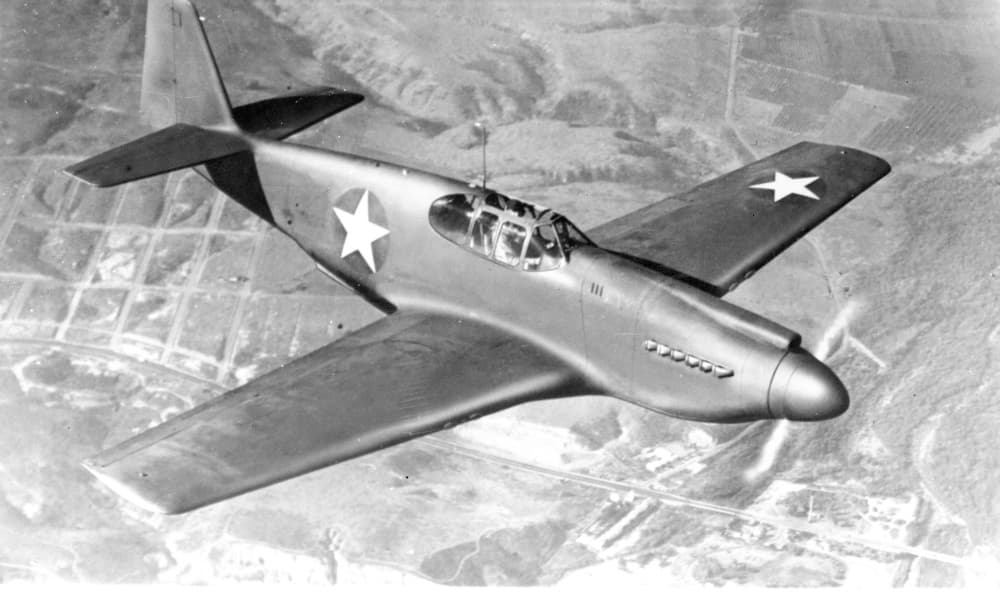
NA-73X / Mustang Mk I
1940The original design, built to a British Purchasing Commission specification and flown for the first time on 26 October 1940. Powered by an Allison V-1710, it entered RAF service in 1942 armed for tactical reconnaissance and Army co-operation rather than pure fighter work.
Introduced the laminar-flow wing and Meredith-effect radiator duct developed with NACA, both retained through every later mark. The Allison engine's lack of a two-stage supercharger left power falling away above roughly 15,000 ft, confining the type to low-altitude tactical work until it was re-engined.
RAF Army co-operation squadrons valued its speed and range at low level, but fighter pilots who flew it against the Fw 190 found it outclassed above medium altitude.
P-51A
1943A refined Allison-engined version built in smaller numbers than the marks either side of it, with a more powerful V-1710-81 and increased internal fuel. It remained best suited to low and medium altitude and saw most use in the China-Burma-India theatre and in photo-reconnaissance form as the F-6B.
Increased internal fuel capacity over the Mk I and lightened armament to four .50 calibre guns, trading firepower for range and speed. Built while the Merlin conversion was still being trialled, it represented the ceiling of what the Allison-engined airframe could achieve before re-engining changed everything.


P-51B / P-51C
1943The Merlin-engined Mustang that changed the aircraft's reputation, built at Inglewood as the B and at Dallas as the identical C. It entered combat with the Eighth Air Force in December 1943 and, with drop tanks, became the first Allied fighter able to escort heavy bombers all the way to Berlin.
Replaced the Allison with a licence-built Packard V-1650-3 Merlin carrying a two-stage, two-speed supercharger, and added underwing pylons for drop tanks. Rolls-Royce test pilot Ronnie Harker's April 1942 flight in a Mustang Mk I convinced Rolls-Royce that a Merlin conversion would fix the airframe's one real weakness: high-altitude power.
Trials against a Spitfire IX showed the converted airframe faster at most heights on similar power, with far greater range, a result that reshaped Eighth Air Force fighter procurement.

P-51D
1944The definitive and most numerous Mustang variant, built in far greater numbers than any other mark and the version most associated with the type today. It carried the war's daylight escort campaign through 1944 and 1945 and, redesignated F-51D, fought again in Korea.
Replaced the earlier framed canopy with a bubble hood over a cut-down rear fuselage for all-round visibility, added two more wing guns for six total, and fitted a dorsal fin fillet ahead of the tailplane. Cutting down the fuselage for the bubble canopy removed keel area and made the aircraft directionally unstable, particularly with drop tanks fitted; the dorsal fin fillet was added specifically to restore it after the problem showed up in service.
Pilots welcomed the visibility but some early D-model units reported the tail problem before the fillet was retrofitted; once corrected it was regarded as the best all-round Mustang of the war.
P-51H
1945A lightened, aerodynamically refined redesign intended for the invasion of Japan, reaching combat units too late for the Second World War. It was the fastest production Mustang but saw no wartime combat and served relatively briefly before jets took over the fighter role.
Cut structural weight substantially through a taller tail, a lighter-gauge airframe and a lightened Merlin V-1650-9, raising top speed to around 423 kt. Developed to give the planned invasion of Japan a Mustang variant with the performance margin to counter faster, later-generation opposition, a requirement the war's end removed.

F-82 Twin Mustang
1945A long-range escort and, later, night-fighter derivative built by joining two modified Mustang fuselages on a common wing and tailplane, with a pilot in each cockpit sharing the workload on long missions. It flew the first American aerial victories of the Korean War in June 1950.
Joined two lengthened Mustang fuselages with a central wing section and horizontal tailplane, retaining Merlin or, on later F-82 models, Allison power, and adding radar for the night-fighter role. The Pacific war's distances exceeded even the drop-tank-equipped Mustang's endurance for very long escort missions, and a second pilot reduced fatigue on flights that could last well over ten hours.
Blueprints
- North American P-51D Mustang, National Museum of the United States Air Force
- North American P-51D Mustang, Royal Air Force Museum
- North American P-51D Mustang, Smithsonian National Air and Space Museum
- North American Mustang Mark III, Imperial War Museums
- Tuskegee Airmen National Historic Site, National Park Service
- How Much Does A P-51 Mustang Cost In 2025?, Simple Flying
- North American P-51 Mustang, Wikipedia