Aircraft
Piper J-3 Cub
CUB
Piper Aircraft CorporationUnited States
- Role:
- Light trainer
- First flight:
- 1938
65kt
Cruise speed
191nm
Range
General
- Role:
- Light trainer
- Status:
- Retired
Programme
- First flight:
- January 1, 1938
- Introduction:
- 1938
- Produced:
- 1938 to 1947
- Number built:
- 19,888
Crew & capacity
- Crew:
- 1
- Capacity:
- 1 passengers
Dimensions
- Length:
- 22 ft
- Height:
- 7 ft
- Wingspan:
- 35 ft
- Wing area:
- 179 ft²
Weights
- Empty weight:
- 761 lb
- Maximum takeoff weight:
- 1,219 lb
- Fuel capacity:
- 12 US gal
Powerplant
- Engine:
- 1 × Continental A-65 (65 hp)
- Power:
- 65 hp (48 kW)
Performance
- Maximum speed:
- 76 kt
- Stall speed:
- 33 kt
- Rate of climb:
- 531 ft/min
- Ceiling:
- 11,483 ft
Price
- New in 1938:
- about $1,300
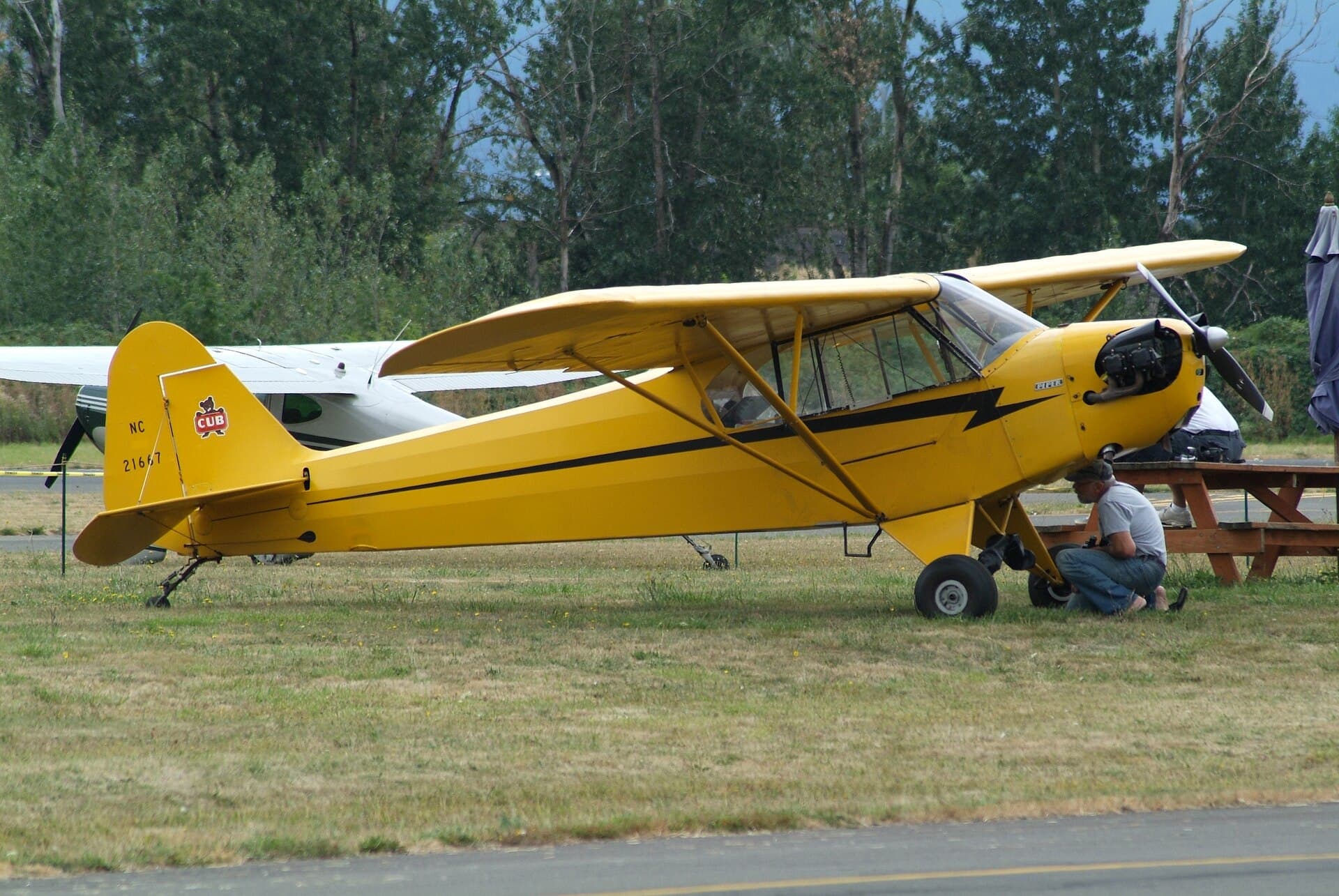
The Piper J-3 Cub is the aircraft that taught America to fly. A two-seat, high-wing monoplane of fabric stretched over a welded steel-tube fuselage and wooden wing spars, it is small, slow and almost defiantly simple, a 65-horsepower engine, a control stick, a handful of instruments, and a tailwheel. Nothing about it was advanced even in 1938. That was the point.
Between 1938 and 1947, Piper Aircraft built nearly 20,000 Cubs, and thousands more rolled off the line as its military sibling, the L-4 Grasshopper. Most of a generation of American pilots, civilian and military alike, made their first solo flight from the Cub's back seat, the only seat from which it can be flown alone, trimmed forward by the weight of an empty front cockpit.
Its silhouette is inseparable from its livery: Lock Haven Yellow with a single black go-fast stripe, a scheme so closely tied to the type that reproductions and modern derivatives still wear it as a kind of uniform. Few aircraft are as instantly recognizable from a mile away, or as often misidentified up close: the Cub's rounded tail and framed windows are frequently confused with the similarly yellow Aeronca Champ or the flat-sided Taylorcraft, its two closest rivals of the era.
The Cub's era as a mainstream trainer ended when buyers began abandoning taildraggers for tricycle undercarriages, easier to taxi, easier to keep straight on takeoff, and, above all, easier to land without the ground-looping swing that punishes a careless tailwheel pilot. That shift is exactly what carried the Cessna 172 to dominance a generation later. But the Cub never disappeared. It endures in bush strips, on floats and skis, in warbird formations and vintage clubs, and (improbably, for an aircraft with a 1938 price tag under $1,500) as one of the more expensive things you can buy secondhand in general aviation, because nobody is making any more of them.
History
The Cub did not begin as a Piper. In 1930, C. Gilbert Taylor's Taylor Brothers Aircraft Manufacturing Company, struggling through the Depression in Bradford, Pennsylvania, developed a light, cheap two-seat trainer named the Taylor E-2 Cub. It sold poorly and the company nearly failed. Its rescue came from an unlikely source: Bradford oilman William T. Piper, who had invested in Taylor Brothers and, when the firm went bankrupt in 1931, bought its assets at the liquidation sale for a few hundred dollars rather than let the tooling be scrapped.
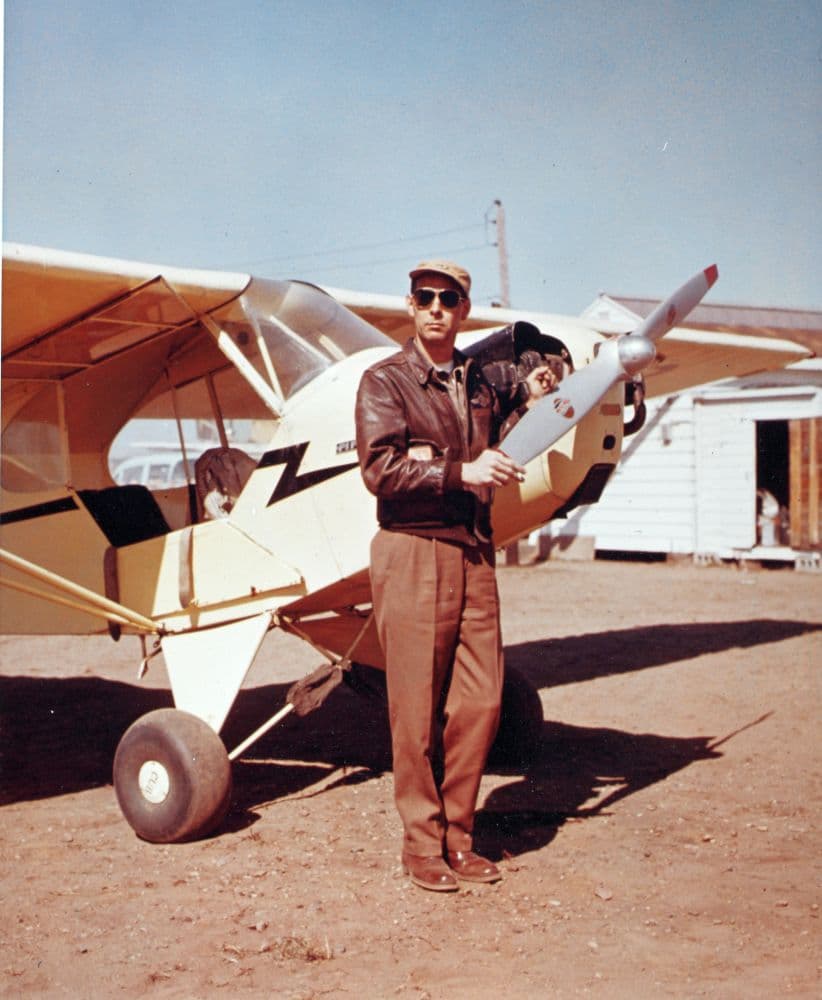
Piper kept Taylor on as chief engineer and kept the Cub in production, refining it steadily through the 1930s. The definitive J-3 arrived in 1937 to 38, the third major redesign of the basic airframe, with a fully cowled engine, a more rounded tail and cabin, and, crucially, a price that undercut nearly every other trainer on the American market. When a fire destroyed the Bradford factory in 1937, Piper relocated production to Lock Haven, Pennsylvania, the town whose name would become permanently attached to the aircraft's signature yellow.
Gilbert Taylor and William Piper parted ways acrimoniously in 1935, Taylor selling out his remaining stake and going on to found the Taylorcraft Aviation Corporation: a direct competitor that produced an aircraft strikingly similar in size and mission, and one still regularly confused with the Cub by casual observers. Piper renamed his company Piper Aircraft Corporation in 1937 and built the J-3 into the aircraft that would define him.
By the end of the 1930s the Cub was the best-selling light aircraft in the United States, a position secured almost entirely by its price and its forgiving, honest handling: an aircraft that a working-class American could plausibly afford to learn on, at a moment when aviation was still widely seen as the province of the wealthy.
That affordability turned into national policy. From 1938 the Civilian Pilot Training Program, created to build a reserve of airmen as war approached in Europe, put tens of thousands of American students through elementary flight training at civilian schools; by the time it wound down in 1944 it had trained some 435,000 pilots. The Cub was the aircraft most of them met first, and Piper's advertising was happy to round the proportion to four out of five: a claim that was never independently audited, but that reflected a genuine dominance of the training fleet.
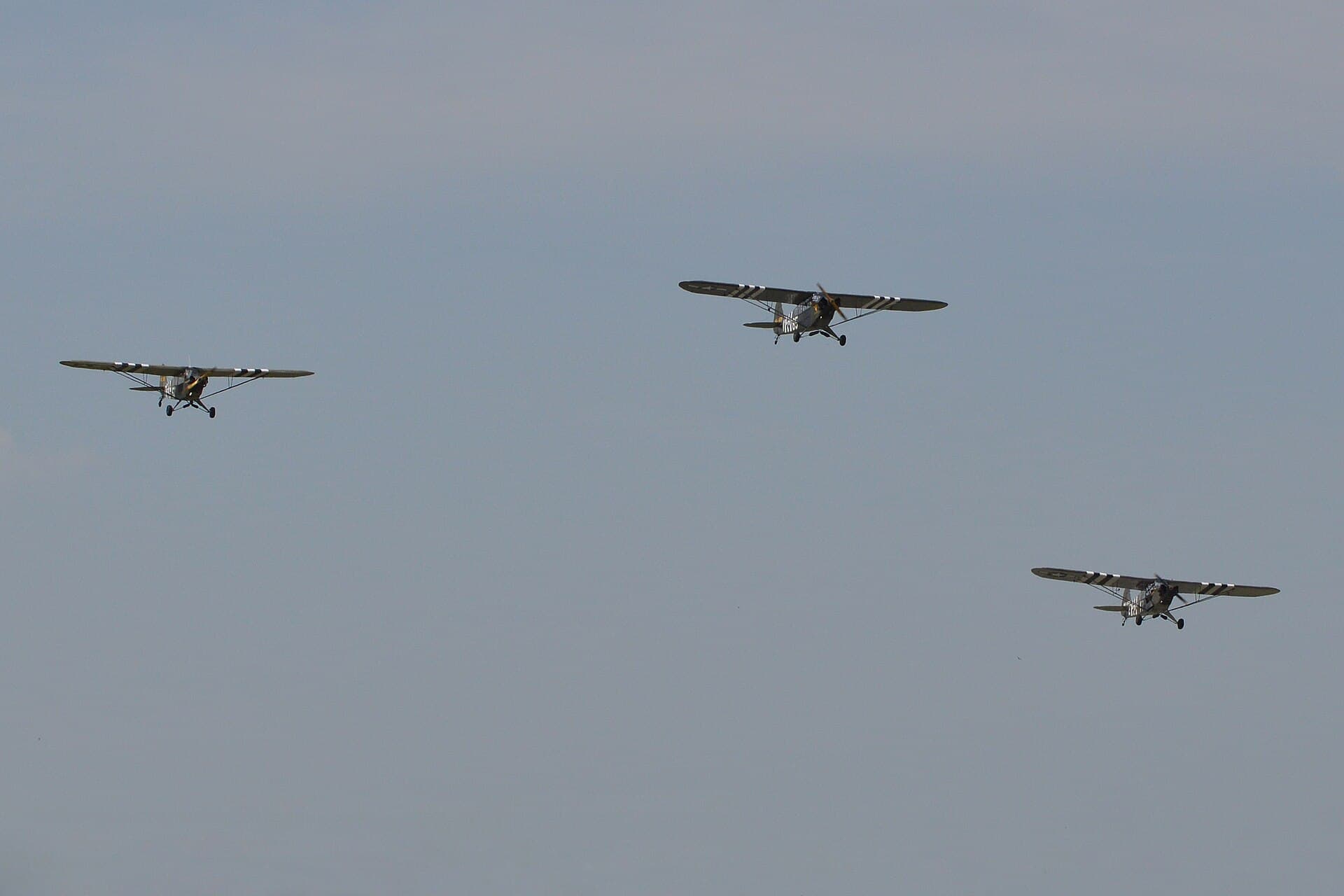
The war then took the Cub itself. Around 5,600 were built for the U.S. Army as the L-4 Grasshopper, unarmed and fabric-covered, flying artillery observation, liaison and casualty evacuation over North Africa, Italy, Normandy and the Pacific. It was dangerous work: an L-4 loitering over a battlefield to direct gunfire was slow, low and entirely without protection, and losses to ground fire and enemy fighters were routine. The type also produced one of the war's odder footnotes in Major Charles Carpenter, who bolted bazookas to the wing struts of his L-4 and used it to attack German armour, an improvisation the Army tolerated rather than authorised.
Production ended in 1947 after roughly 19,888 J-3s. The immediate cause was not obsolescence but a market collapse: the general-aviation boom that manufacturers had confidently forecast for returning veterans never materialised at the predicted scale, and the industry built far more aeroplanes in 1946 than it could sell. Piper survived it, and replaced the J-3 with its own descendants: the PA-11 Cub Special and, in 1949, the more powerful PA-18 Super Cub, which stayed in production for another half-century.
The Cub's afterlife has been longer and more valuable than its production run. Fitted with floats or skis it became a standard bush aircraft in Alaska and northern Canada, where its low stall speed and short-field manners mattered more than its lack of speed or payload. It remains one of the few aircraft of its era still flown routinely rather than merely preserved, and the economics have inverted completely: a well-restored J-3 now commands many times what a new one cost, an aeroplane originally sold on being the cheapest way into the air having become a sought-after collectible.
Development
The J-3 designation covers a family of engine fits rather than one fixed aircraft. The baseline J-3C used a 65-horsepower Continental A-65; the near-identical J-3F carried a Franklin engine of the same output, and the J-3L a Lycoming O-145. All three shared the same airframe, weight and performance almost exactly: the letter suffix identified the powerplant supplier, a detail that mattered to Piper's engine-supply contracts more than it did to the aircraft's handling.
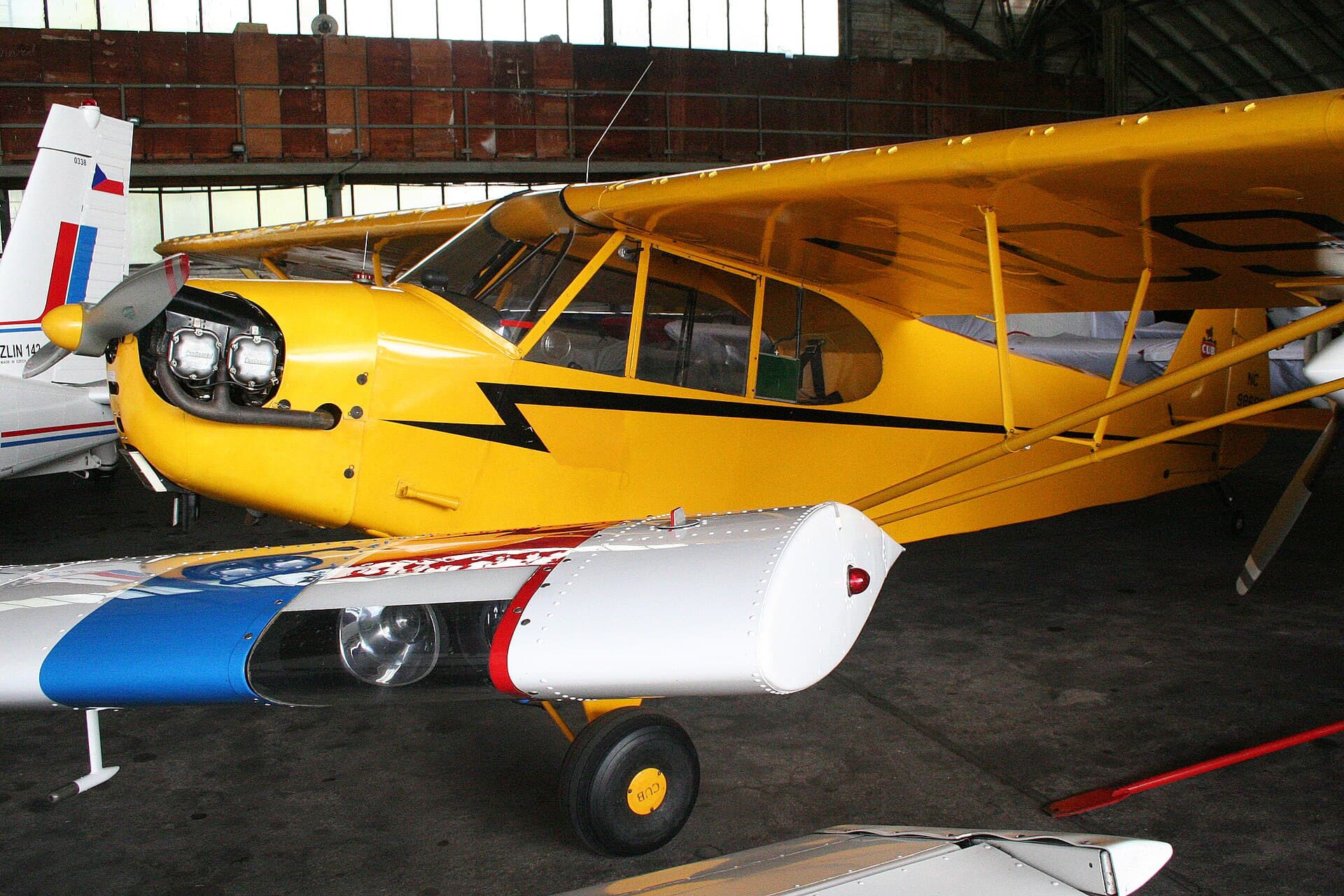
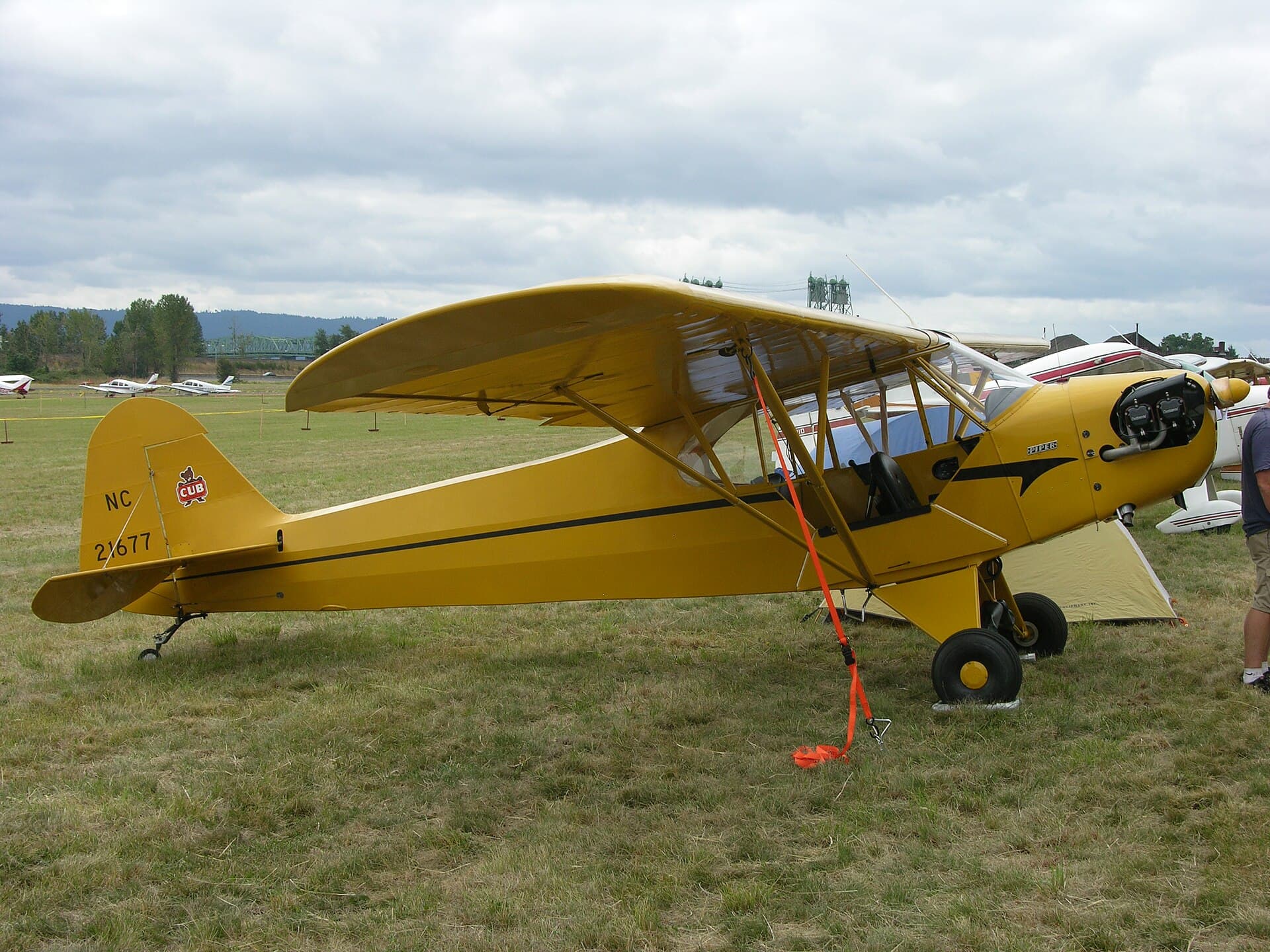 Piper J-3C-65 Cub
Earlier engines of 40 to 50 horsepower had powered the pre-war Cub line before the 65-horsepower standard became dominant by 1939, a jump that improved climb and useful load enough to make the aircraft comfortably safe for primary instruction rather than merely adequate for it. Standardizing on 65 horsepower also happened to align the Cub with the minimum power the Civil Aeronautics Authority required for its new pilot training initiative: a coincidence that would shortly matter enormously.
Throughout the run, Piper resisted the temptation to complicate the airframe. Flaps, an electrical system, brakes worth the name and a starter were all omitted or optional; the aircraft that rolled out of Lock Haven in 1946 was recognizably the same design as the one built in 1938, refined at the margins rather than redesigned. That conservatism was deliberate: Piper's business case depended on keeping the unit cost as low as competitors' far less capable trainers.
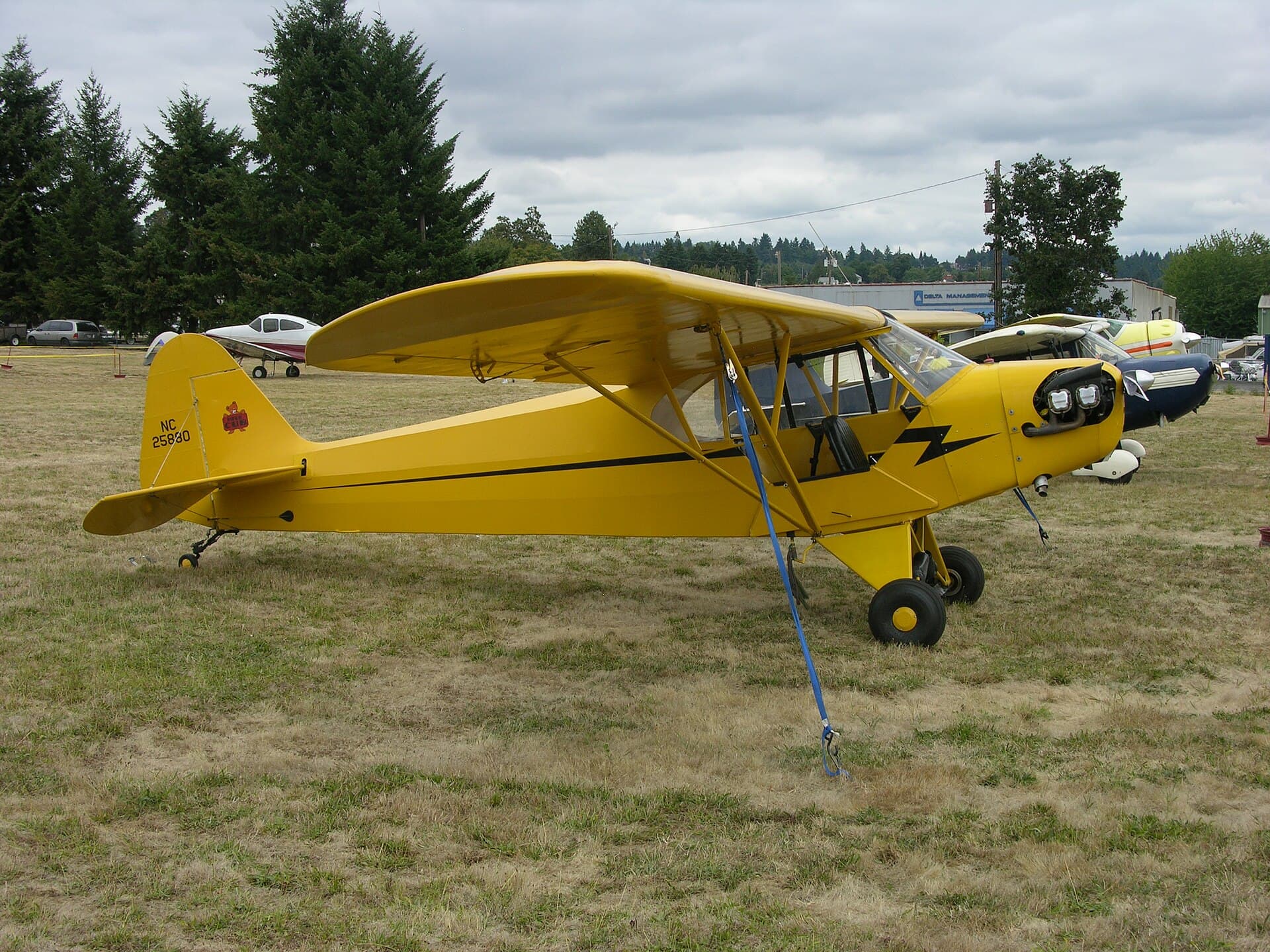 Piper J-3L-65 Cub
Production paused for the war years' military-only output and resumed for civilian buyers in 1945 to 46, meeting an enormous postwar surge in demand from returning servicemen who had learned to fly, or wanted to. The J-3 was finally succeeded in 1949 by the PA-18 Super Cub, a heavier, more powerful redesign that kept the Cub's silhouette and its fabric-over-tube construction but abandoned its studied simplicity for genuine cross-country and bush-flying capability.
Design
Structurally the Cub is almost the definition of a light aircraft of its generation: a welded 4130 steel-tube fuselage frame, wooden wing spars and ribs, and the whole airframe covered in doped cotton or, in modern restorations, synthetic fabric. It is light enough, around 761 lb empty, that two people can lift the tail and turn it by hand, a party trick every Cub owner eventually performs.
The two seats sit in tandem rather than side by side, a layout with real consequences: the pilot flying solo sits and flies from the rear seat, not the front, because the aircraft's centre of gravity only balances correctly that way with the front seat empty. It is a detail that surprises almost everyone learning to fly one for the first time, and one that carried directly into military use, where the L-4's observer sat forward with a clear view down and to the sides.
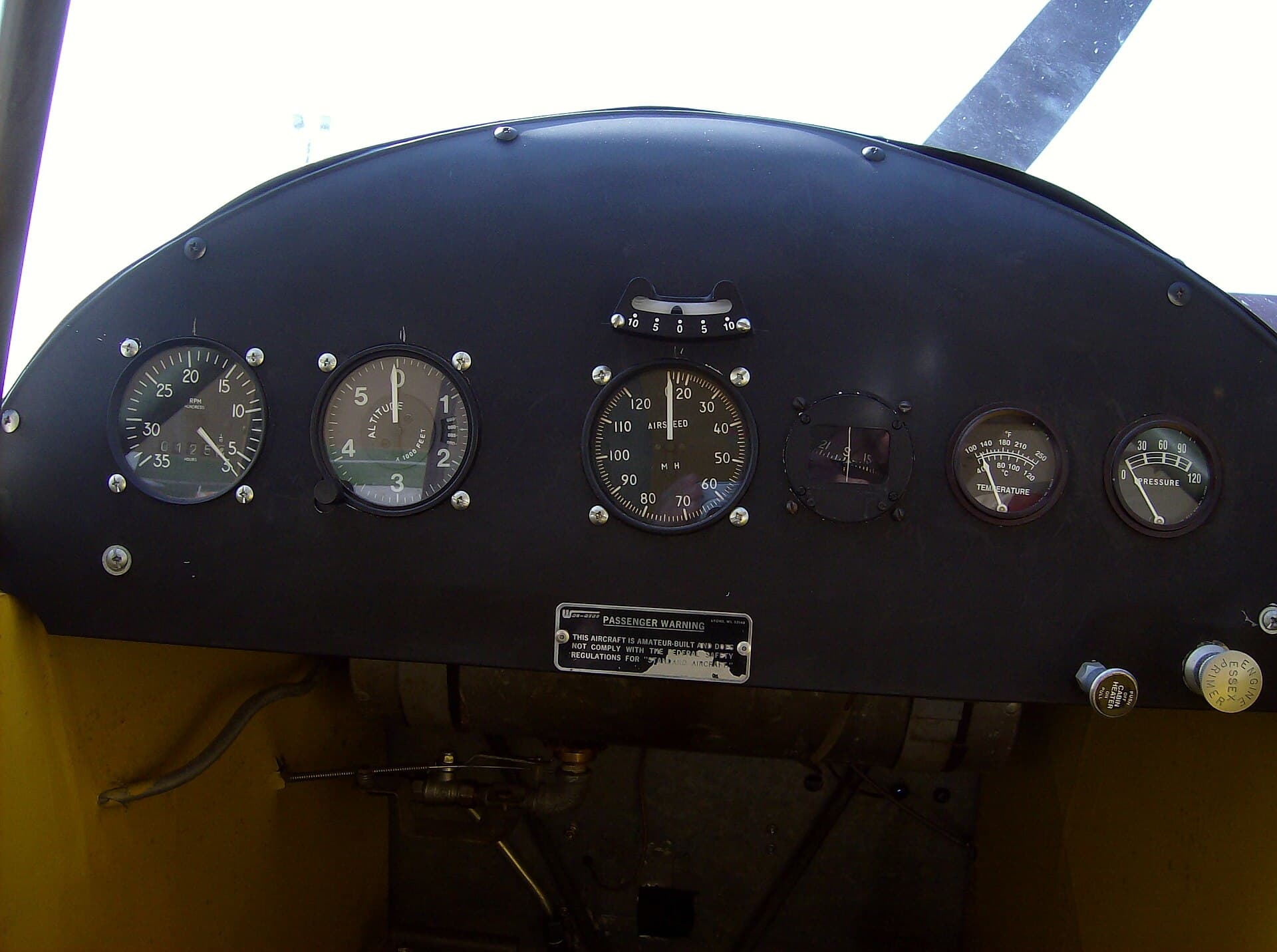
The cockpit is correspondingly austere: an airspeed indicator, altimeter, oil temperature and pressure gauges, a compass, and not much else. There is no electrical system on the original J-3 (no radio, no lights, no starter) and the engine is swung by hand. Flight controls are a single centre stick and rudder pedals with cables running externally along the fuselage, visible and serviceable rather than concealed.
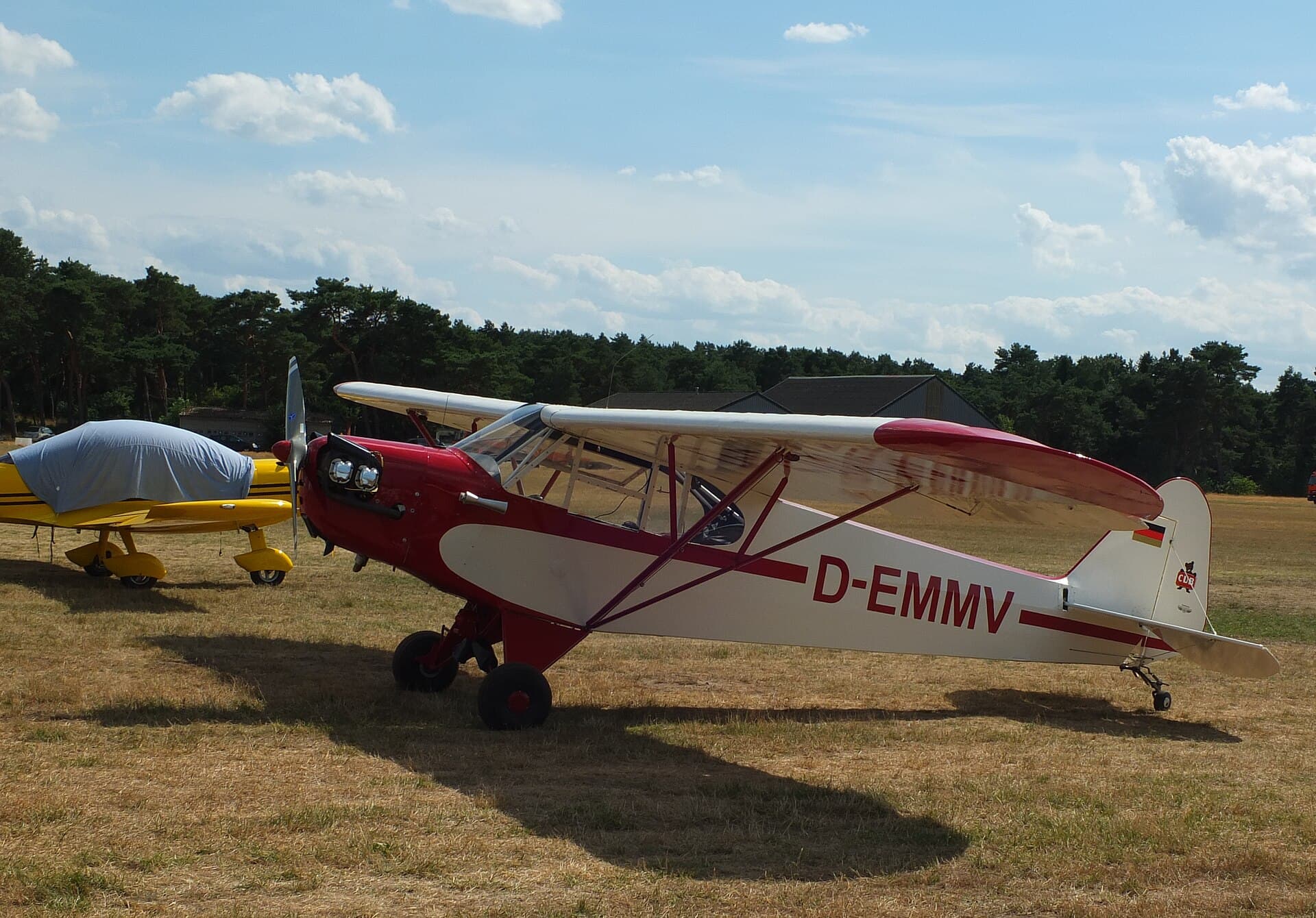
The yellow-with-black-stripe scheme, so closely identified with the type that it is sometimes called "Cub Yellow" or "Lock Haven Yellow," was in fact chosen for visibility rather than branding: a bright, saturated colour made a slow, low-flying trainer easier to see against sky and ground alike, a genuine safety consideration for an aircraft that would spend its working life in touch-and-go patterns above crowded training fields. The scheme became so associated with the aircraft that later Piper models, and modern light-sport derivatives built by other manufacturers entirely, still wear it as a deliberate homage.
Flight characteristics
Pilots who learned on a Cub tend to describe it the same way regardless of decade: slow, forgiving, and entirely honest about what it is doing. At a cruise speed barely above 54 kt and a stall speed near 32 kt, there is time to think through a mistake before it becomes consequential: a quality that made it a natural primary trainer even as later aircraft offered more speed and less patience.
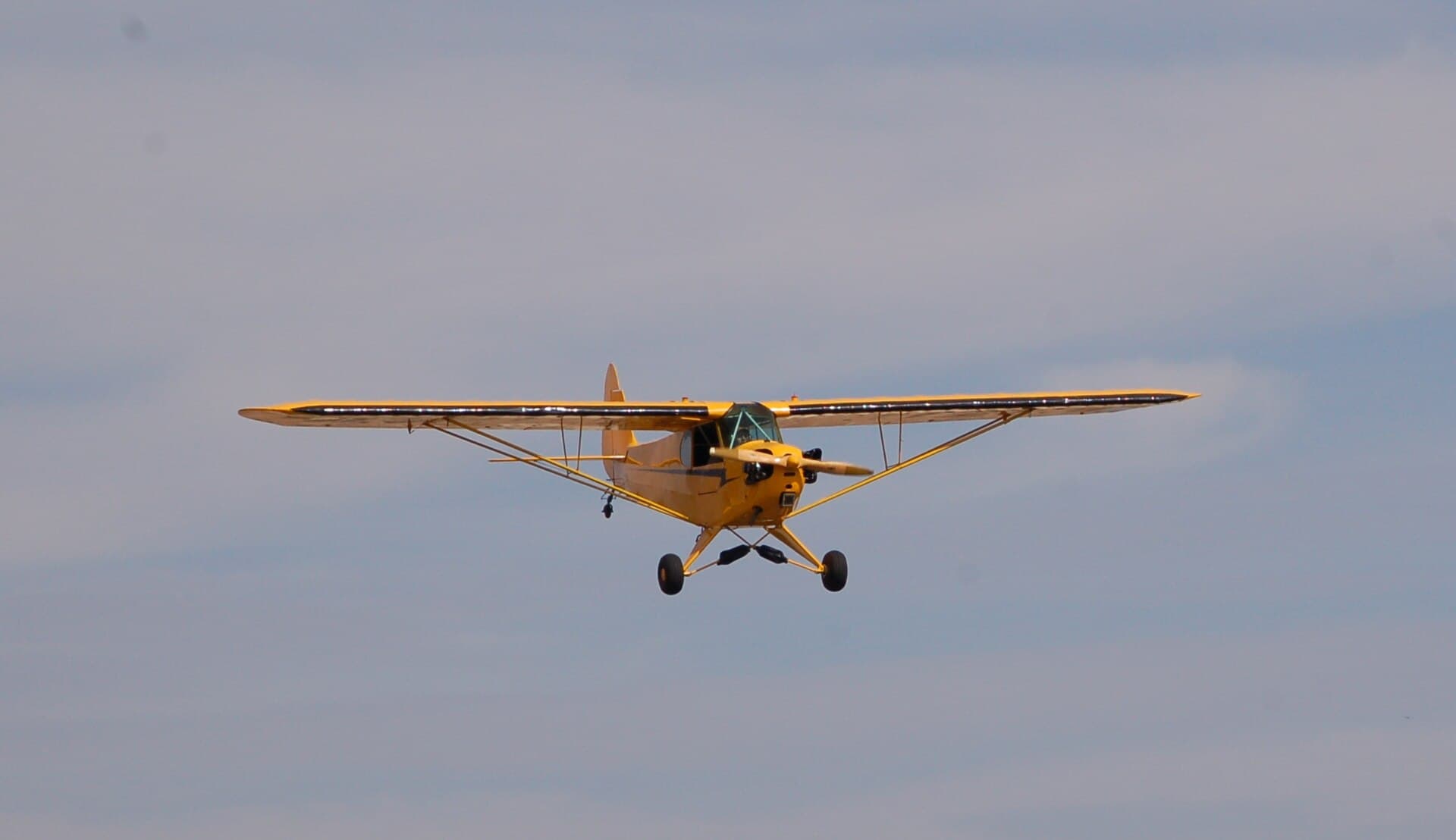
Being a taildragger, the Cub demands active rudder work on the ground that a nosewheel aircraft simply does not: on takeoff roll and landing rollout, a pilot who lets the tail wander invites a ground loop, the swinging spin that a tailwheel aircraft can enter if directional control is lost at low speed. It is this exact demand: full attention on the rudder pedals from the moment power is applied to the moment the aircraft stops rolling: that the nosewheel undercarriage of aircraft like the Cessna 172 was designed to remove, and its removal is a large part of why the taildragger trainer nearly vanished from flight schools.
In the air, control response is light and immediate, with no flaps to manage and few systems to monitor; a Cub pilot's workload is almost entirely about airspeed, attitude and wind. Its low wing loading makes it exceptionally responsive to gusts and thermals, springy in a way that modern trainees, accustomed to heavier and more damped aircraft, often find startling on a first flight.
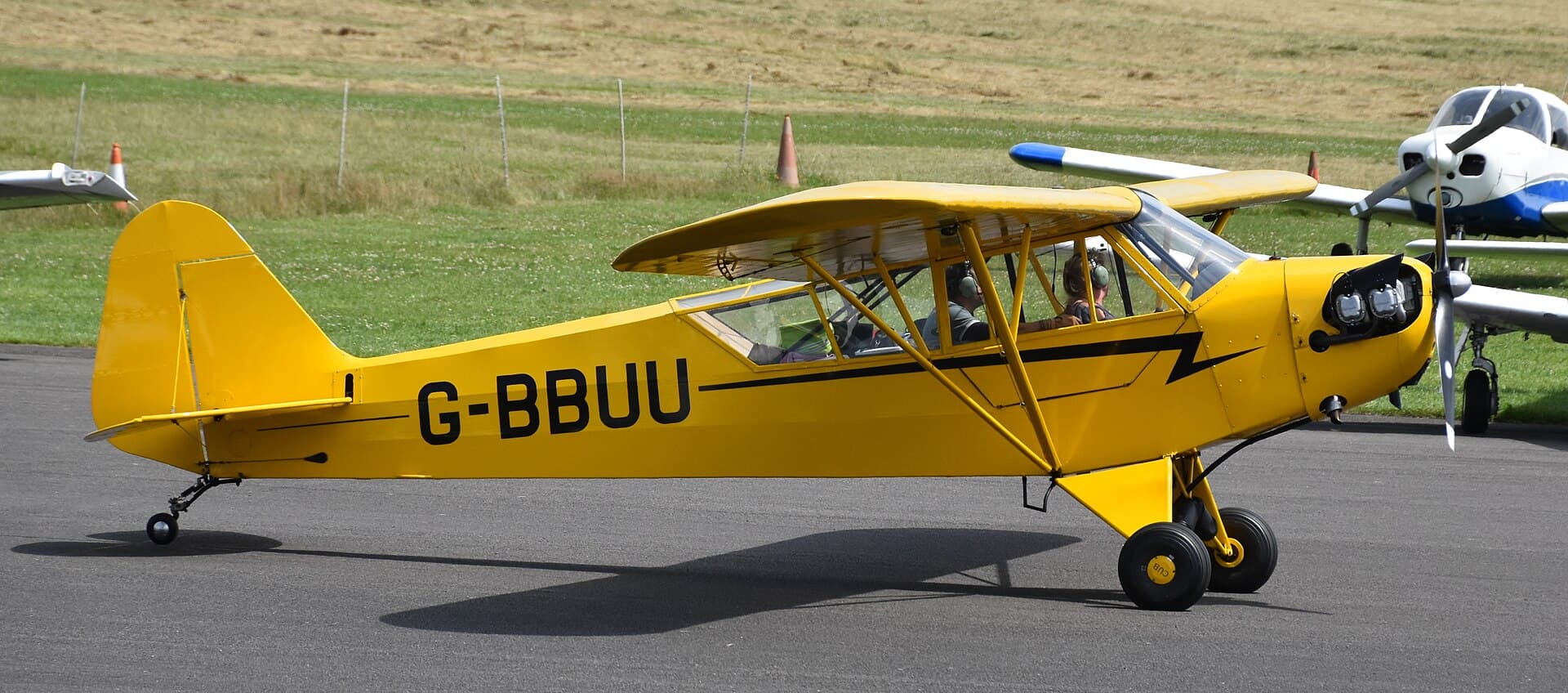
That same lightness is what makes the Cub prized rather than merely tolerated by pilots who fly it for pleasure rather than certification: an aircraft that can be landed on a sandbar, a mountain strip, or a stretch of frozen lake with equal unconcern, so long as the pilot respects its low cruise speed and its total dependence on favourable wind for anything but the shortest of fields.
Flight training
The Cub's most consequential moment arrived not from Piper's sales department but from an Act of Congress. The Civilian Pilot Training Program, launched in 1938 and expanded rapidly as war loomed in Europe, subsidized flight instruction at colleges and flying clubs across the United States, explicitly to build a pool of pilots the country could draw on in an emergency. The Cub, cheap to buy, cheap to operate and forgiving to fly, became the program's default trainer almost by default of everything else being more expensive.
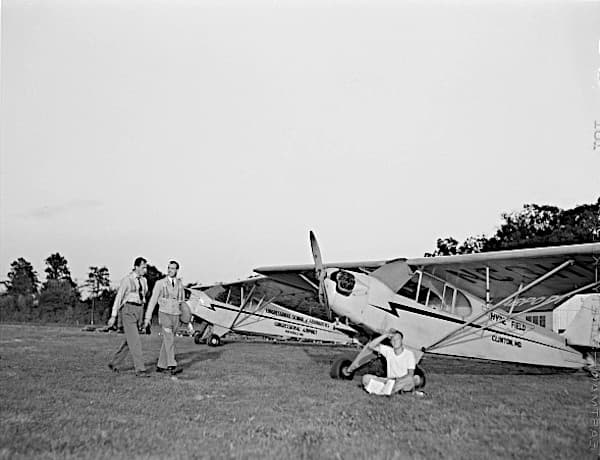
By some estimates the great majority of CPTP students soloed in a Cub, and Piper leaned into the association: wartime advertising credited the J-3 as the aircraft that "taught America to fly," a slogan close enough to literal truth that it outlived the war by decades. When the United States entered the conflict in December 1941, the CPTP's pilot pipeline fed directly into military flight training, and the flying skills a generation of future combat and transport pilots first learned had almost always begun in a Cub's back seat.
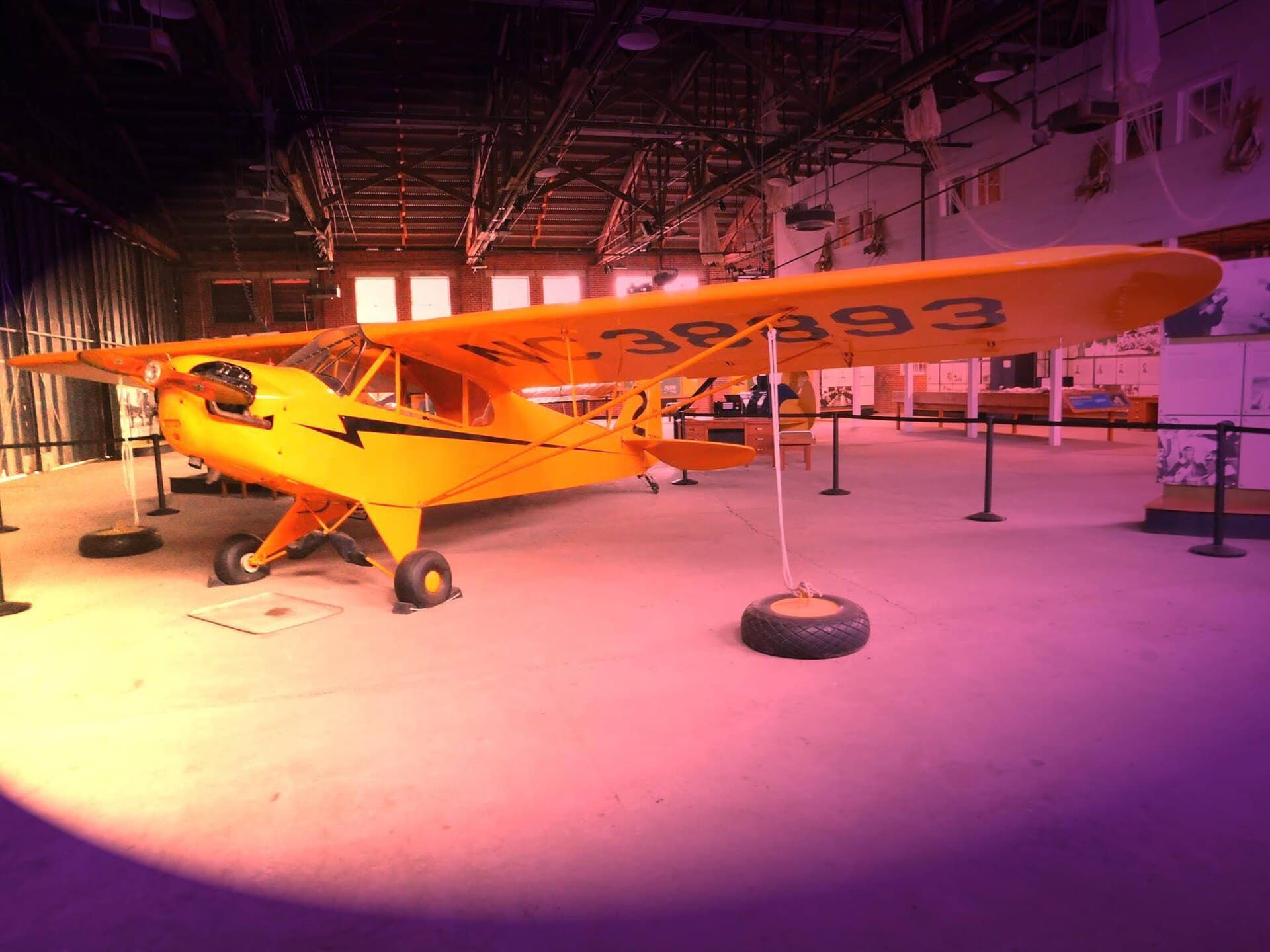
The program was also, within the limits of a segregated era, unusually open: it funded instruction at historically Black colleges, most famously at Tuskegee Institute in Alabama, where Cubs and Piper's own instructors trained the first Black civilian and, subsequently, military pilots in the United States, the origin of the Tuskegee Airmen. Moton Field, where that training took place, is preserved today as a National Historic Site, and the Cub's role in it is inseparable from the story told there.
After the war, the same qualities that made the Cub a mass trainer for the CPTP kept it in flight schools for another generation, even as newer, nosewheel-equipped designs began drawing students away through the 1950s and 1960s. Its training legacy, though, was already secure: an aircraft designed as a Depression-era economy product had, almost by accident, become the standard first airplane of an entire era of American aviation.
Military service
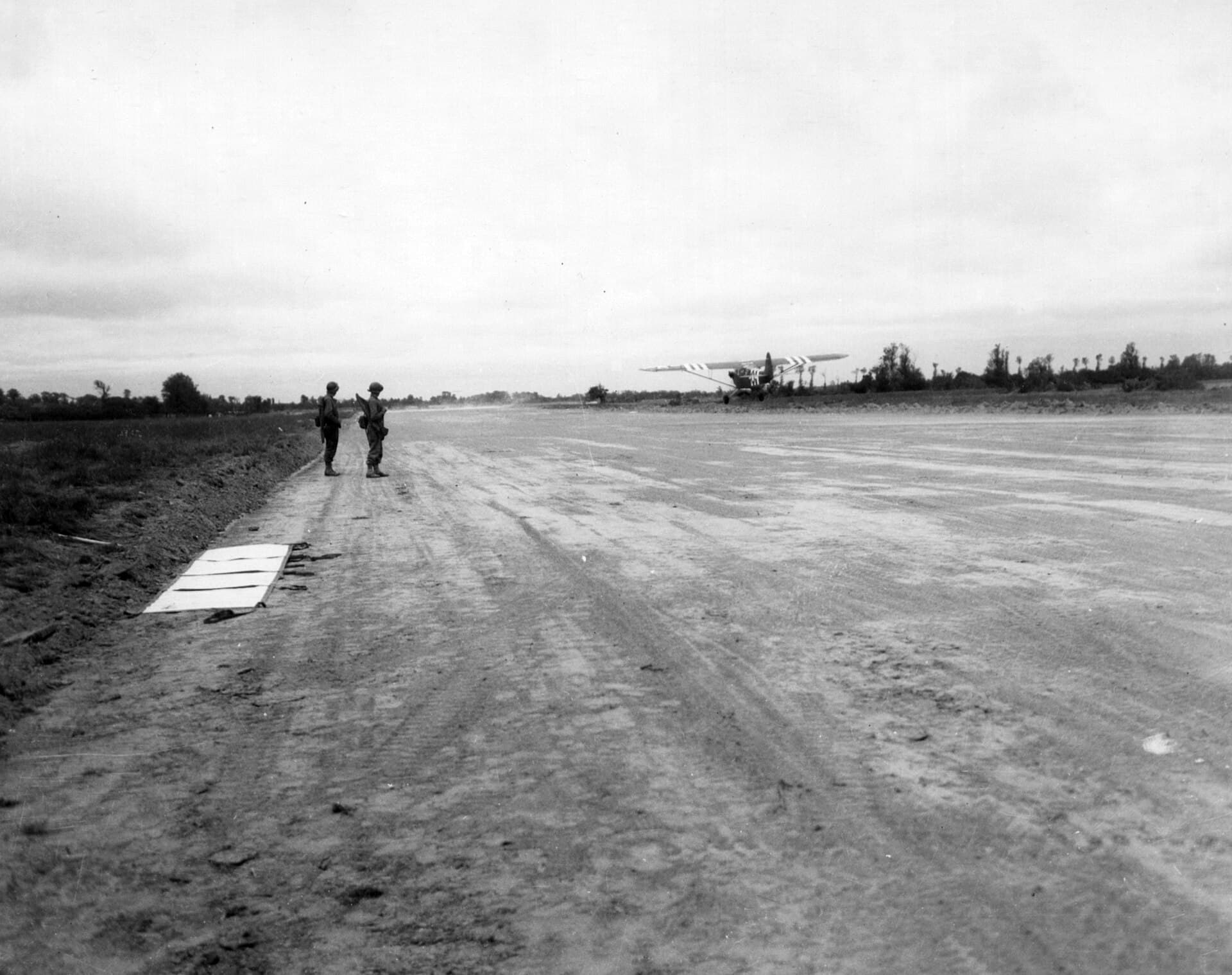
The Cub's military career began quietly, in prewar liaison trials, and grew into one of the largest single procurements of light aircraft the U.S. Army ever made. Redesignated the L-4 Grasshopper, the militarized Cub added a raised rear turtledeck with extra glazing for observation, but was otherwise close to the civilian J-3, the same engine, the same tandem seating, the same fabric-over-tube construction.
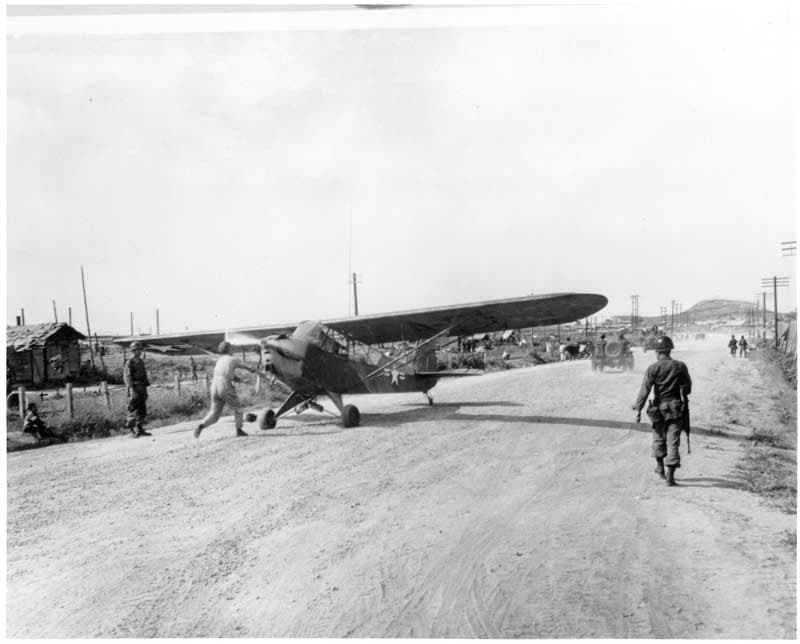 Piper L-4 Grasshopper
Its job was liaison and artillery spotting rather than combat: L-4s carried forward observers who radioed fall-of-shot corrections back to artillery batteries, flew wounded and dispatches between front-line units, and gave field commanders an eye in the air that did not need a paved runway or a squadron of ground crew to operate. They flew from farm fields, roads and hastily cleared strips within a few kilometres of the front line, at altitudes and speeds low and slow enough that faster aircraft found them almost impossible to intercept usefully.
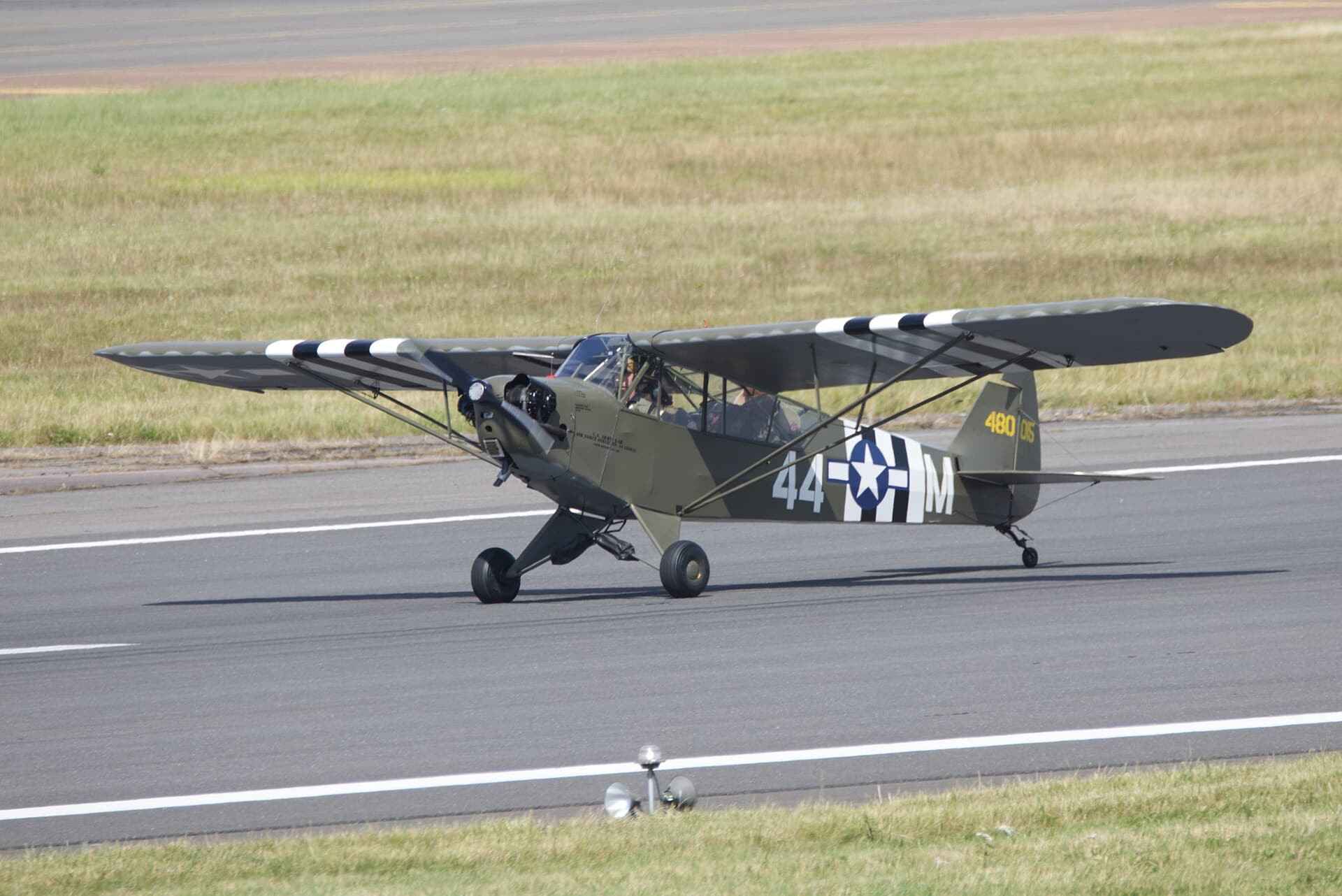 Piper L-4J Grasshopper
L-4s flew in every major American theatre of the war, from North Africa through Sicily and Italy to Normandy, where they operated from strips scraped out of hedgerow country within earshot of the front, and across the Pacific. Sub-variants like the L-4H and L-4J added minor equipment differences, including some electrical starting and radio fits absent from the civilian Cub, but the airframe underneath never stopped being recognizably a J-3.
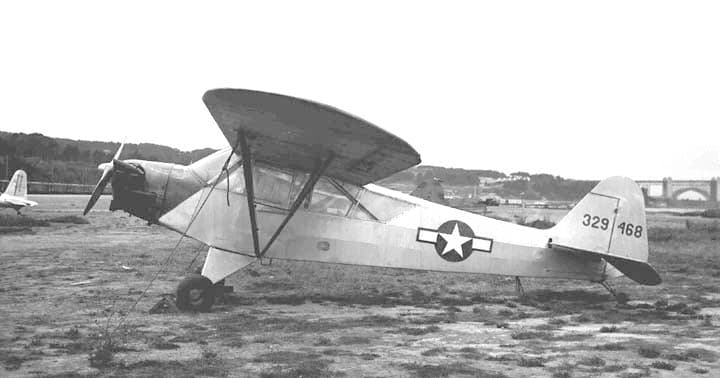 Piper L-4H Grasshopper
After 1945, thousands of surplus L-4s were sold off to civilian buyers at prices even lower than a new Cub had commanded before the war, converting them back to civilian registration and, in many cases, back to the yellow paint their military drab had briefly replaced: one of the more direct pipelines by which a wartime liaison aircraft became a peacetime flying-club fixture.
Production
Piper built roughly 14,000 J-3 Cubs for the civilian market between 1938 and 1947, alongside some 5,700 L-4 Grasshoppers for the military: a combined total approaching 20,000 airframes, an extraordinary run for a light aircraft of any era and one of the highest production totals any single American light-aircraft type has ever reached.
Production was concentrated almost entirely at Piper's Lock Haven, Pennsylvania plant, on the banks of the Susquehanna River: a site the company would occupy for decades afterward and one still commemorated locally as the birthplace of the type. At the program's wartime peak, Lock Haven turned out finished Grasshoppers at a rate that startled even Piper's own management, built by a workforce drawn substantially from the surrounding rural Pennsylvania counties.
The low unit cost that made the Cub commercially viable also made it vulnerable to postwar market conditions: a 1946 to 47 general-aviation sales boom, driven by returning veterans with pilot training and government loans, briefly overproduced light aircraft across the entire American industry, the Cub included, and by 1947 Piper ended J-3 production in favour of the redesigned PA-11 Cub Special and, in 1949, the heavier PA-18 Super Cub.
Despite that comparatively short twenty-year span from first flight to the end of the line, survival rates are unusually high for an aircraft this old: simple fabric-and-tube construction is straightforward and comparatively affordable to restore, parts commonality across the type's long run keeps salvage viable, and a large, active owner and restorer community, organized in significant part around dedicated Cub clubs, has kept a meaningful fraction of the original production still flying today.
Legacy
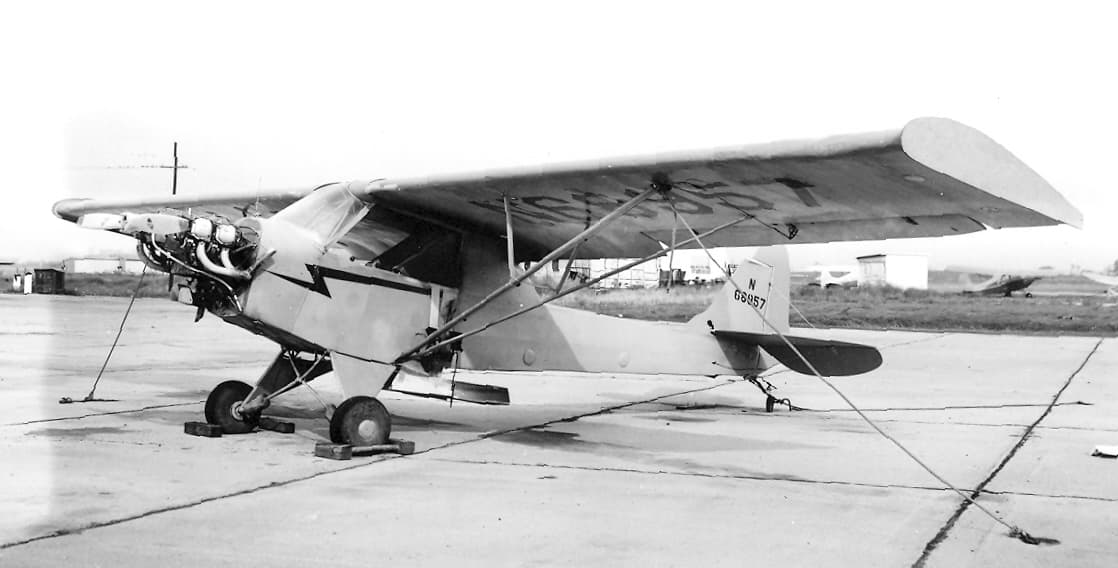
The Cub's second life has run longer than its first. Fitted with floats or skis, it became a staple of Alaskan and Canadian bush flying, where its short-field manners and low stall speed suited gravel bars and frozen lakes better than almost anything built since; float and ski conversions remain common today on Cubs that have not flown a training pattern in seventy years. Others were converted for agricultural spraying and dusting, their back seats replaced with chemical tanks, a working role a genuine handful still perform on small farms.
The direct comparison the encyclopedia keeps returning to is the Cessna 172. Where the 172's development story turns on the industry-wide abandonment of taildraggers for the ease of a nosewheel, the Cub is the aircraft, and the type of aircraft, that abandonment was a reaction against: harder to master, more demanding of a pilot's attention on the ground, and for exactly that reason still sought out by pilots who want to learn or maintain genuine stick-and-rudder skill rather than merely operate a machine. Flight schools that offer tailwheel endorsement training still reach for a Cub, or one of its close derivatives, more often than any other type.
That demand has had a striking effect on price. An aircraft that sold for around $1,300 new in 1938, inexpensive even by Depression-era standards, now regularly changes hands for tens of thousands of dollars, a well-kept example commanding more, in real terms, than it would have cost a working American to buy outright alongside a modest house. Scarcity, an active restoration culture and enduring demand from tailwheel and warbird-adjacent flying communities all feed that market; unlike a specification, it is not a fact that holds still.
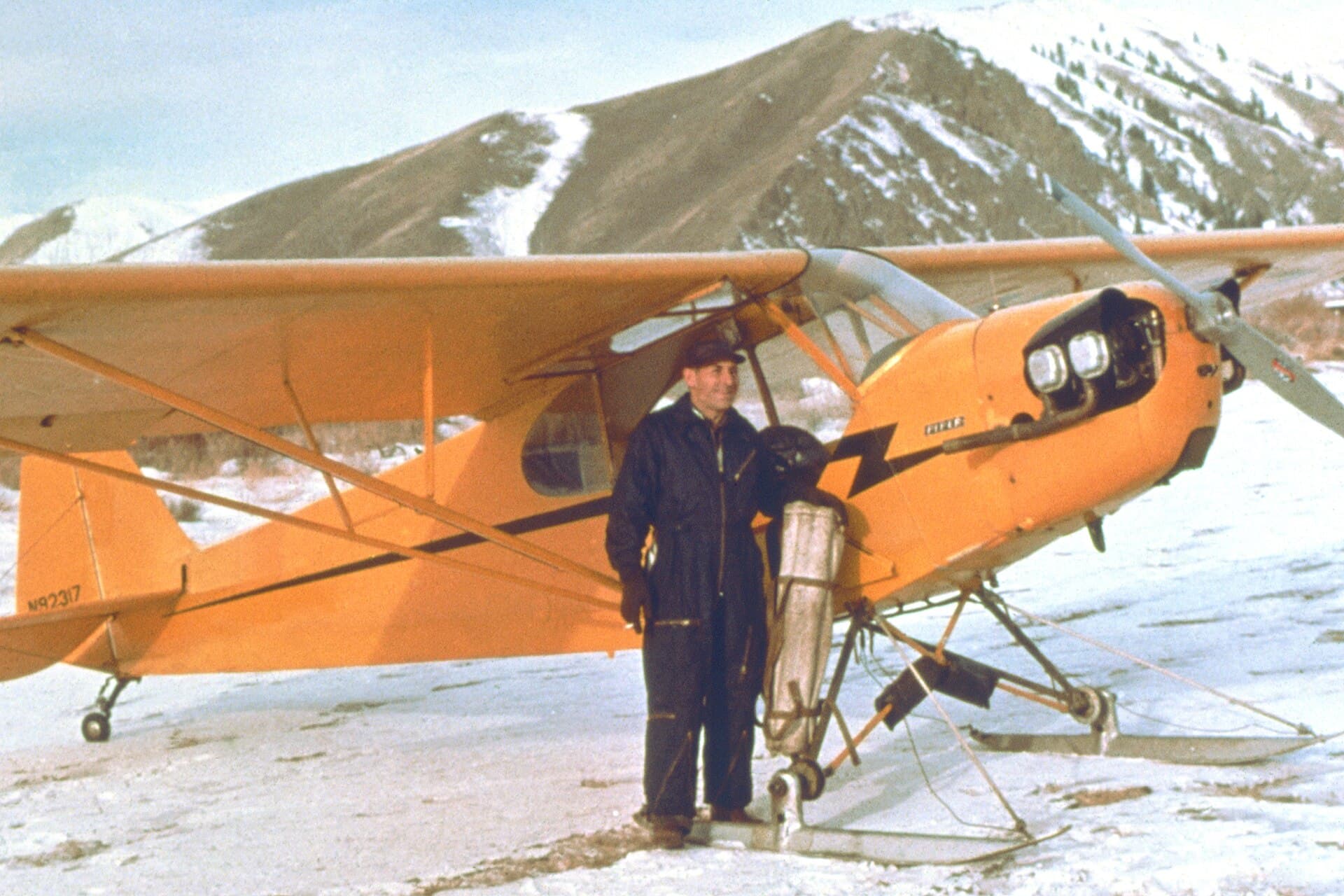 Ski-equipped Piper Cub
Seen against its own foil, the Cessna 172, the Cub's legacy is less about which aircraft "won" than about what each generation of pilot wanted from a first airplane. The 172 offered ease and reach it needed most people to feel safe and confident learning to fly at all. The Cub offered something narrower and, to the pilots who still seek it out, more valuable: the unfiltered experience of flying itself, stripped down to a stick, a rudder, and 65 honest horsepower.
Model evolution
Taylor/Piper J-2 Cub
1936The immediate predecessor of the J-3, built under both the Taylor and early Piper names as control of the company passed between them. A 40 to 50 horsepower two-seater with a squarer tail and a boxier cabin than the J-3, it was the first Cub built in genuine volume, roughly 1,200 in three years, against a few hundred for all the E-2s before it.
Reworked from Gilbert Taylor's E-2 with an enclosed cabin, a redesigned tail and a more reliable engine installation. The E-2 had proved too spartan and too underpowered to sell, and the company had already gone through bankruptcy once. The J-2 was the attempt to make the same basic aeroplane comfortable and dependable enough that a flying school would actually buy it, the change of emphasis that turned a failing design into a commercial one.
Piper J-3C-65 Cub
1938The definitive, best-known Cub: a fully cowled 65-horsepower Continental A-65, a rounded tail and cabin, and the aircraft most associated with the type today. Flown solo from the rear seat for balance, finished in the Lock Haven yellow with a black lightning stripe that became the type's signature.
Adopted the fully cowled 65 hp engine as standard, and the rounder fuselage and tail lines that distinguish the J-3 from the J-2 before it. The J-2's 40 horsepower left no margin on a hot day with two aboard, and the exposed cylinders were both draggy and awkward to cool evenly. Sixty-five horsepower gave the aeroplane a usable climb rate with an instructor and a student in it, which is what a training aircraft is actually sold on.
Piper J-3L-65 Cub
1939Mechanically identical to the J-3C apart from its Lycoming O-145 engine in place of the Continental A-65, one of several parallel engine fits Piper offered, alongside a Franklin-powered J-3F.
Lycoming O-145 in place of the Continental A-65, with the cowling and engine mount altered to suit; performance was essentially unchanged. Piper was building Cubs faster than any single engine maker could reliably supply, and a training-fleet order stalled for want of powerplants was a lost order. Certifying the airframe around three interchangeable engines was insurance against one supplier's bottleneck, not a search for performance.
Piper L-4 Grasshopper
1941The militarised Cub, adopted by the U.S. Army for liaison, artillery spotting and light transport, with a raised rear turtledeck and extensive glazing giving the observer a view aft and downward. Around 5,600 were built, in olive drab rather than yellow.
Cut-down rear decking with wraparound glazing, military radio, and equipment provisions in place of the civilian rear seat trim. An artillery spotter has to see the ground behind and below it while talking to the guns, and the civilian Cub's solid rear decking made that impossible. The glazing was the whole point of the conversion: everything else the Army wanted, the Cub already had: it could operate from a field, a road or a beach, and cost almost nothing to replace.
Piper L-4J Grasshopper
1944A late-war L-4 sub-variant with equipment refinements over the earlier Grasshoppers, including electrical starting and fuller radio fits absent from the civilian Cub, and a controllable-pitch propeller on some aircraft.
Electric starter and battery, revised radio installation, and detail equipment changes accumulated across earlier L-4 blocks. Hand-swinging a propeller is acceptable at a flying school and unacceptable on a forward strip under fire, where an aircraft may need to leave immediately and the second crewman is occupied. The refinements were about operating tempo rather than performance, and they added weight the L-4 could barely spare.
Float and ski conversions
1946Postwar civilian conversions fitted with floats or skis in place of the wheeled undercarriage, widely adopted for Alaskan and Canadian bush flying and backcountry access, and still fitted to airworthy Cubs today.
Floats or skis on a revised undercarriage structure, usually with an enlarged fin or ventral fin area to restore the directional stability the floats' side area takes away. In much of Alaska and northern Canada there is no runway, and the usable landing surface is water in summer and snow in winter. The Cub's low stall speed and light wing loading let it use a short stretch of either, which mattered more to a bush operator than the payload and cruise speed the conversion cost him.
Enthusiastically adopted by bush operators; the low stall speed and light wing loading that made the Cub gentle as a trainer made it equally well suited to short, unimproved strips, gravel bars and frozen lakes.
Blueprints
- Piper J-3 Cub, Piper Aviation Museum
- Piper J-3 Cub, Smithsonian National Air and Space Museum
- Piper L-4 Grasshopper, National Museum of the United States Air Force
- Piper J-3 Cub: The Aircraft That Taught America to Fly, EAA (Experimental Aircraft Association)
- Piper J-3 Cub, AOPA (Aircraft Owners and Pilots Association)
- Piper J-3 Cub, Wikipedia
Checked September 2, 2026