History
Breaking the Sound Barrier
October 14, 1947
Muroc Army Air Field, Mojave DesertCalifornia, United States
Mach 1.06
Speed reached
50
Flight number
1
Pilot
The flight
- Date
- 14 October 1947
- Aircraft
- Bell X-1, 46-062
- Name
- Glamorous Glennis
- Pilot
- Capt. Chuck Yeager
- Launch
- Dropped from a B-29
- Speed
- Mach 1.06
- Landing
- Glide to the dry lake bed
The aircraft
- Engine
- Reaction Motors XLR-11 rocket
- First discussed
- December 1944
- First glide flight
- 19 January 1946
- First powered flight
- 9 December 1946
- Where it is now
- National Air and Space Museum
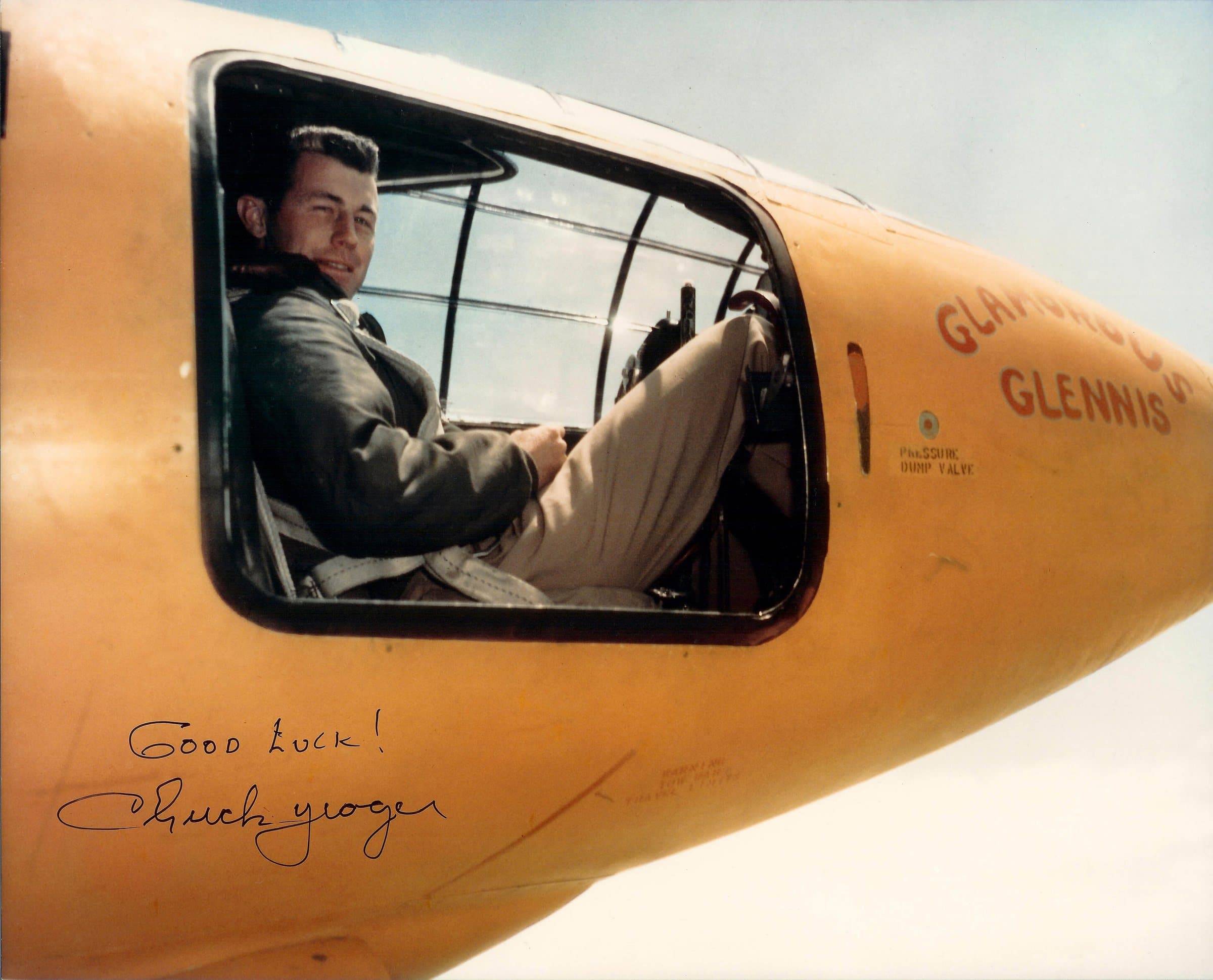
On 14 October 1947, over the Mojave Desert, Captain Chuck Yeager dropped from the bomb bay of a B-29 in the rocket-powered Bell X-1 and reached Mach 1.06, the first manned supersonic flight. The aircraft he flew, number 46-062, he had named Glamorous Glennis for his wife.
On 14 October 1947, over the Mojave Desert in California, a rocket aeroplane dropped from the bomb bay of a Boeing B-29 at 23,000 ft, lit its engine, climbed, and went faster than sound. Captain Charles E. Yeager of the United States Army Air Forces reached Mach 1.06 at 43,000 ft, about 610 kt, and in doing so settled an argument that had been killing pilots for most of a decade.
The aircraft was a Bell X-1, orange, blunt-nosed, and shaped deliberately like a .50 calibre machine gun bullet. Yeager had named it Glamorous Glennis, after his wife. It was not a prototype fighter or a record-breaking racer. It was a research instrument built for one purpose, to gather data in a region of flight that wind tunnels of the period could not reproduce and that aircraft of the period could not survive.
What makes the flight important is not the number. Mach 1 is not a physical boundary and nothing in the air changes at it. What was broken that day was a belief, widely and reasonably held, that the behaviour of an aeroplane approaching the speed of sound was a wall rather than a problem: that control reversal, violent buffeting and the loss of elevator authority were properties of the air itself and could not be engineered around.
They could. The X-1 demonstrated it by flying through, and the aircraft that followed were designed by people who knew it was possible. Within a decade supersonic flight was routine military practice.
Background
The problem appeared in the late 1930s and became urgent during the Second World War, as fighters grew powerful enough that a steep dive could take parts of the aeroplane into a flow regime the rest of it was not designed for.
The physics is this. Air flowing over a wing accelerates as it passes the curved upper surface. An aircraft travelling well below the speed of sound can therefore still have air moving at the speed of sound over parts of its wing, and where that happens a shock wave forms. The shock disturbs the flow behind it, which can separate from the surface, and the consequences arrive without warning: heavy buffeting as disturbed air strikes the tail, a sudden nose-down pitching tendency, and controls that grow immovable or reverse their effect entirely.
Pilots who met this in a dive found the aircraft would not answer. Some recovered as they descended into denser, warmer air where the local speed of sound is higher. Some did not. The accumulating losses gave the phenomenon its popular name, and the name did a great deal of harm: calling it a barrier implied a wall standing at a particular speed, which is not what it was.
What made it genuinely hard to solve was that it could not be studied properly. Wind tunnels of the period choked at transonic speeds, the shock waves reflecting from the tunnel walls and corrupting the measurements precisely in the range that mattered. Theory could not yet predict the behaviour reliably, and the only remaining instrument was an aeroplane with a pilot in it.
Three men reached that conclusion independently and pushed for it: John Stack at the NACA, Ezra Kotcher of the Army Air Forces, and Walter Diehl of the Navy. A specialised research aircraft, they argued, was the only feasible means of getting supersonic aeronautical data.
Development
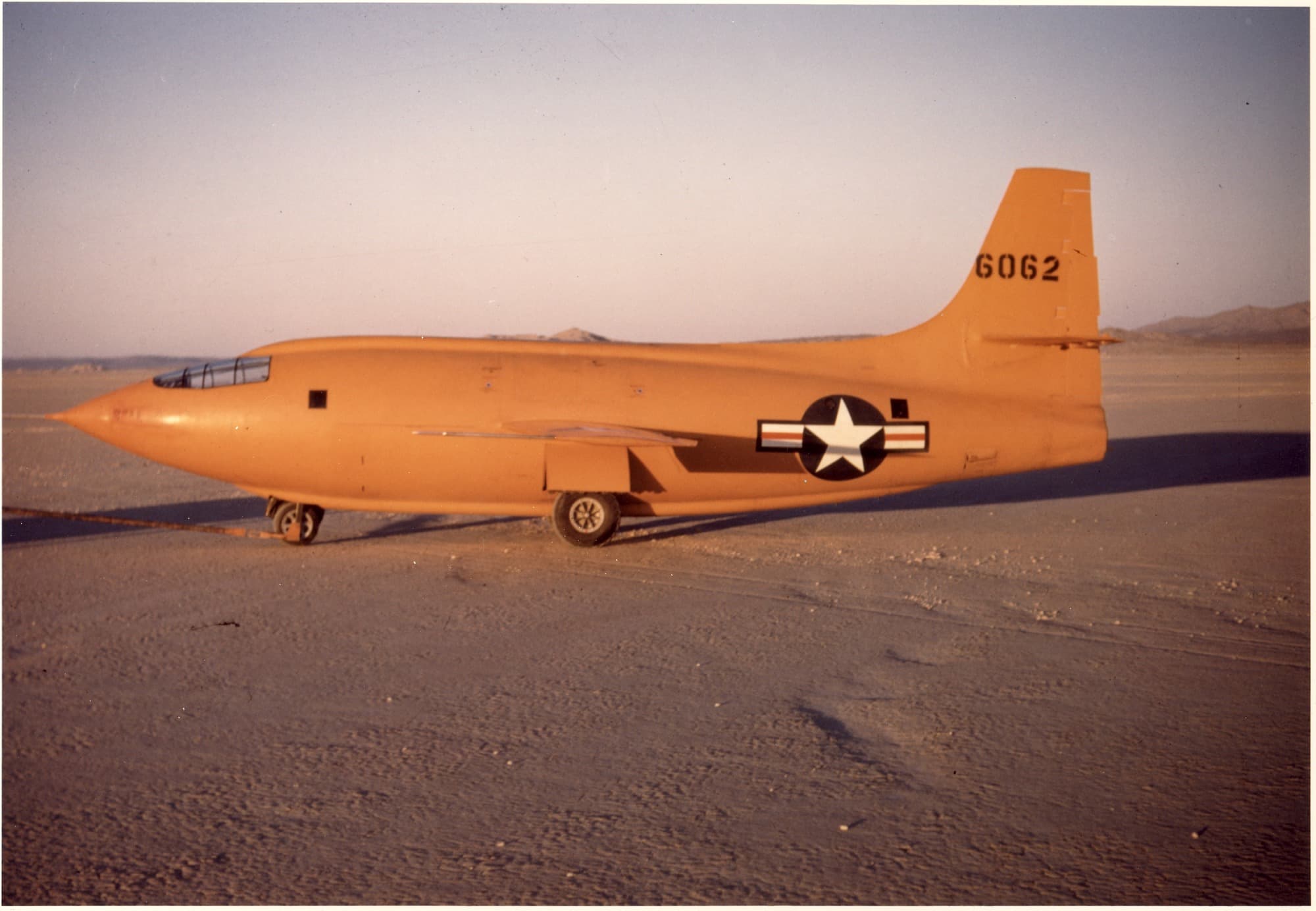
The Army Air Forces selected the Bell Aircraft Corporation to build three aircraft, to a specification drawn largely by the NACA and paid for by the Army.
The shape came from ballistics. Nobody knew what a stable supersonic aeroplane looked like, but a great deal was known about objects that had been travelling faster than sound for a century, namely bullets. The fuselage was given the profile of a .50 calibre machine gun round, a form already demonstrated to be stable in supersonic flight. It is a blunt, unlovely shape by the standards of the swept-wing aircraft that followed, and it was arrived at by reasoning from the only available evidence.
The wings were made thin, which is the other half of the answer: a thinner section delays the formation of shock waves. Two of the aircraft were built with different wings so the effect could be measured. The X-1-1 had a thickness to chord ratio of 8 per cent, the X-1-2 a ratio of 10 per cent. Comparing them was part of the point of building more than one.
Power came from a Reaction Motors XLR-11 rocket engine of 6,000 lbf thrust, burning liquid oxygen and a mixture of alcohol and water, fed from tanks pressurised by nitrogen. Structure was high-strength aluminium with steel propellant tanks. Rocket propulsion was chosen because no jet engine of the period could produce the thrust needed at those altitudes, and because an engine that burns for a few minutes is acceptable in an aircraft that is carried most of the way to its working altitude by something else.
The first aircraft arrived in December 1945. Glide flights began at Pinecastle Field, Florida, on 19 January 1946 with Bell's test pilot Jack Woolams, and the aeroplane reached Muroc in October 1946.
The machine
The X-1 was small. It measured 30.7 ft long with a wingspan of 28 ft, and empty it weighed about 6,131 lb. Most of its internal volume was propellant, and most of its flight time was spent without any.
The decision that shaped the whole programme was to launch it from another aircraft. Rather than taking off under its own power, the X-1 was carried aloft in the modified bomb bay of a Boeing B-29 and released at around 23,000 ft. The reasoning was arithmetic: a rocket engine burning for a few minutes cannot spend that time climbing and still have fuel left for the experiment. Air-launching put the aircraft where the work was, with its tanks full.
It also meant the pilot climbed down into the X-1 in flight, through a hatch in the side, in a cold and crowded bomb bay, and was then dropped. Nothing about the arrangement was comfortable and that was not the point.
The tail is the detail that mattered most and is least often mentioned. Conventional elevators lose effectiveness in transonic flight as shock waves form ahead of the hinge line, which is precisely the control reversal that had killed pilots. The X-1 was fitted with a stabiliser whose whole incidence could be adjusted in flight, moving the entire horizontal tail rather than a flap on the back of it. This gave pitch control when the elevator had none.
That one feature is arguably the most directly useful thing the programme produced. The all-moving tailplane went on to become standard on supersonic aircraft, and remains so. The aeroplane that proved it looked like a bullet with wings, and the idea it proved is on every fast aircraft since.
Preparation
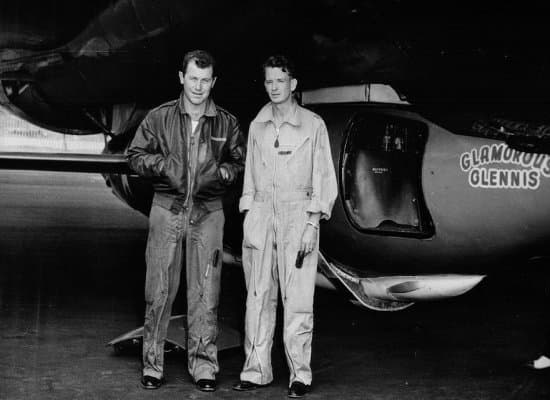
On 30 June 1947 the Army Air Forces and the NACA agreed how the programme would be divided, and the agreement is worth understanding because it explains what the 14 October flight was and what it was not.
The Army Air Forces would fly the X-1-1, the aircraft with the thinner 8 per cent wing, on an accelerated programme aimed at reaching Mach 1.1 as quickly as possible. The NACA would support it with technical advice and data analysis. The NACA would then conduct its own slower, more detailed series of research flights at transonic speeds using the X-1-2 and its thicker wing.
That is a division between a demonstration and an investigation, and both parties understood it as such. The Army wanted to get there. The NACA wanted to know what happened on the way, in enough detail to be useful to designers. The famous flight belongs to the first programme; a great deal of the scientific value came from the second.
Captain Charles E. Yeager was selected to fly the Mach 1 attempts. He made his first glide flights in the X-1 on 6, 7 and 8 August 1947, and the powered programme then worked upward in increments, each flight going slightly faster than the last and returning with data about what the aircraft had done.
This incremental approach is the opposite of how the event is usually remembered. There was no single leap at a wall. There was a methodical climb through Mach 0.85, 0.9, 0.94 and beyond, with the buffeting and the control difficulties appearing where predicted, being measured, and being flown through.
The event
On the morning of 14 October 1947 the B-29 carried Glamorous Glennis up over Muroc and released it at about 23,000 ft.
Yeager lit the rocket chambers and climbed. The X-1 passed through the speeds where the buffeting had been worst on earlier flights, and this time the shaking eased rather than worsening as the aircraft accelerated. The needle on the machmeter moved up, hesitated, and then jumped off the scale, and a sharp report rolled across the desert floor below, which nobody on the ground immediately recognised for what it was.
He had reached Mach 1.06 at 43,000 ft, about 610 kt. The aeroplane was steady. The all-moving tail gave him control where the elevator alone would have given him none. Having gone supersonic, he shut down the engine, slowed, and glided back down to the dry lake bed to land, which is how every X-1 flight ended.
The detail most worth holding onto is that nothing dramatic happened. The transition was smooth, the aircraft remained controllable, and the moment of crossing was marked chiefly by an instrument reading and a noise heard by people who were not expecting it. A decade of accumulated fear about what lay at Mach 1 was answered by an aeroplane flying through it in an orderly fashion and coming home.
That is what a research programme is for. The danger had been real, the aircraft lost to compressibility had been real, and the pilots killed had been real. What the X-1 established is that the cause was a set of aerodynamic effects that could be understood, designed for and flown through, rather than a limit.
Aftermath
The Air Force classified the flight Top Secret immediately, and the most significant aeronautical result of the decade went unannounced.
Word leaked to the press in December 1947. The United States Air Force did not officially confirm the achievement until March 1948, some five months after it happened. The reasons were the ordinary ones of the period: the X-1 was a military research programme at the opening of the Cold War, and the knowledge that supersonic flight was practical was itself worth withholding.
The research continued regardless, and the part that mattered scientifically now began. Herbert H. Hoover made the first NACA supersonic flight on 4 March 1948, reaching Mach 1.029, and Howard C. Lilly followed at Mach 1.1 on 31 March. These were the detailed investigation flights the June 1947 agreement had set aside for the NACA, and the data they produced went to the designers who were already drawing the aircraft of the 1950s.
The X-1 itself went faster. It reached Mach 1.45 on 26 March 1948. The first aircraft made its final flight on 12 May 1950 and went to the Smithsonian, where it hangs today in the Boeing Milestones of Flight Hall in Washington. The X-1-2 flew on until fatigue in a nitrogen tank grounded it. The X-1-3, intended to reach Mach 2.4, was destroyed in an explosion on 9 November 1951.
Recognition followed confirmation. The Collier Trophy for 1947 was shared between Bell Aircraft, Yeager and the NACA's John Stack: the builder, the pilot and the man who had argued that a research aircraft was the only way to find out.
Legacy
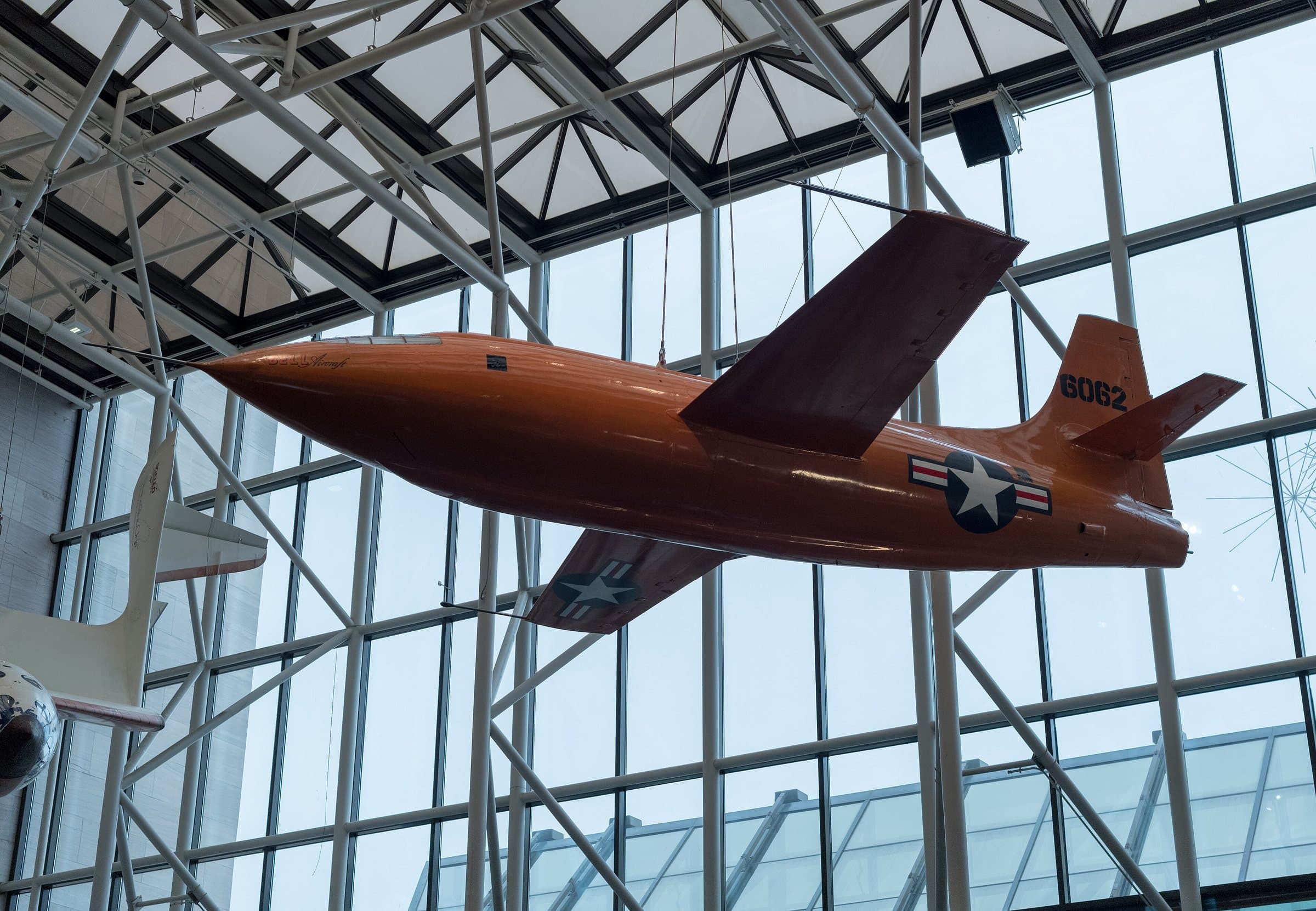
The sound barrier was never a barrier, and the X-1 programme is the reason everyone now knows that.
What it left behind is concrete rather than symbolic. The all-moving tailplane, fitted to the X-1 because conventional elevators stopped working near Mach 1, became standard equipment on supersonic aircraft and remains so. The data from the NACA research flights went directly into the design of the generation that followed, and the swept and thin wings of the 1950s were drawn by engineers who finally had measurements from the region that mattered.
The programme also established a way of working. A purpose-built research aircraft, flown incrementally, instrumented heavily, operated jointly by a military service and a civilian research agency, became the template for the X-plane series that followed: a line running from the X-1 through the X-15 to the lifting bodies that informed the Space Shuttle. Muroc, where it happened, is now Edwards Air Force Base, and the NACA unit there is now NASA's Armstrong Flight Research Center.
There is a cautionary half to the legacy as well. The flight was classified for five months, celebrated for decades afterwards as a single heroic moment, and remembered in a way that obscures what actually produced it: a specification argued for by three officials, an aircraft shaped like a bullet because bullets were the available evidence, a methodical series of flights each slightly faster than the last, and a second research programme that did the detailed work after the headline had been earned.
Yeager flew the aeroplane and flew it well. The achievement was the programme.
Who was there
- Chuck Yeager1923 to 2020
- PilotThe US Air Force captain who flew the first supersonic flight.
- Jack Ridley
- Flight test engineerWorked out that the moving horizontal stabiliser could give control when the elevator lost authority near Mach 1.
Related entries
- First Generation X-1, NASA
- Bell X-1 ‘Glamorous Glennis’, Smithsonian National Air and Space Museum
- Bell X-1, Wikipedia
Checked October 6, 2026