Engine
Rolls-Royce Merlin
Rolls-RoyceUnited Kingdom
- Type
- Supercharged liquid-cooled V-12 piston aero engine
- First run
- 1933
27.02L
Displacement
2,060hp
Peak output
General
- Type
- Supercharged liquid-cooled V-12 piston aero engine
- Status
- Retired
Programme
- First run
- October 15, 1933
- First flight
- February 21, 1935
- Introduced
- 1937
- Produced
- 1936 to 1950
- Built
- 149,659
Architecture
- Configuration
- 60° V-12, supercharged, liquid-cooled, single overhead camshaft per bank
- Cylinders
- 12
- Bank angle
- 60°
- Bore
- 5.4 in
- Stroke
- 6 in
- Compression ratio
- 6:1
- Valves per cylinder
- 4
- Valve gear
- Single overhead camshaft per bank; two inlet and two exhaust valves per cylinder, with sodium-cooled exhaust valve stems
- Cooling
- Pressurised 70% water / 30% ethylene glycol
Induction and fuel
- Supercharger
- Single-stage single-speed on early marks; single-stage two-speed from the Merlin XX; two-stage two-speed with charge intercooler from the Merlin 61
- Fuel system
- Twin-choke updraught Rolls-Royce/S.U. carburettor with automatic mixture control; Bendix-Stromberg pressure carburettor on several two-stage marks; S.U. injection carburettor on the 100 series
- Fuel
- 87 octane initially; 100 octane from 1940; 150 grade from 1944 on selected marks
- Reduction gear
- 0.42:1 (Merlin 61)
Weight and size
- Dry weight
- 1,640 lb
Performance
- Maximum speed
- 3,000 rpm
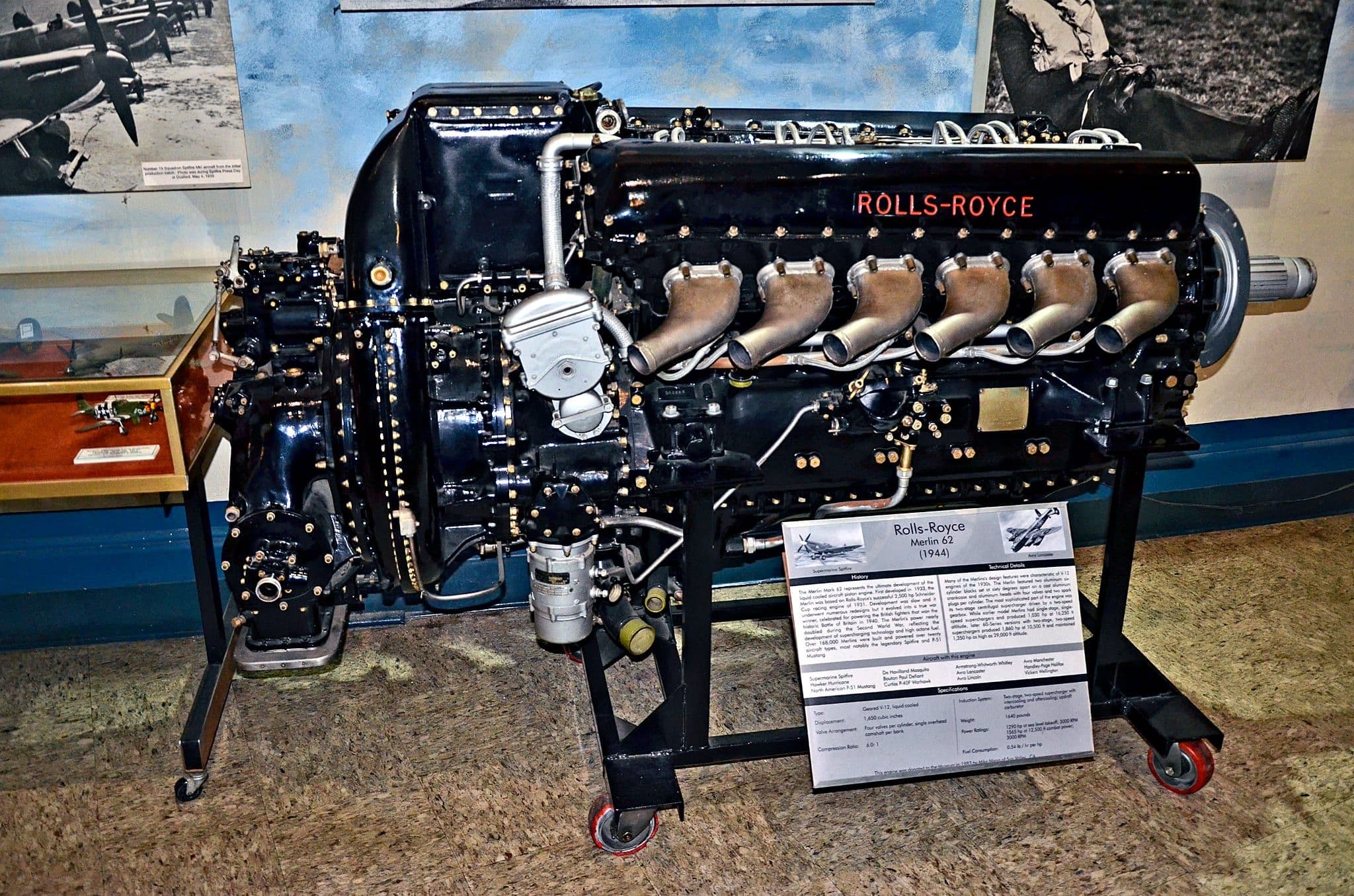
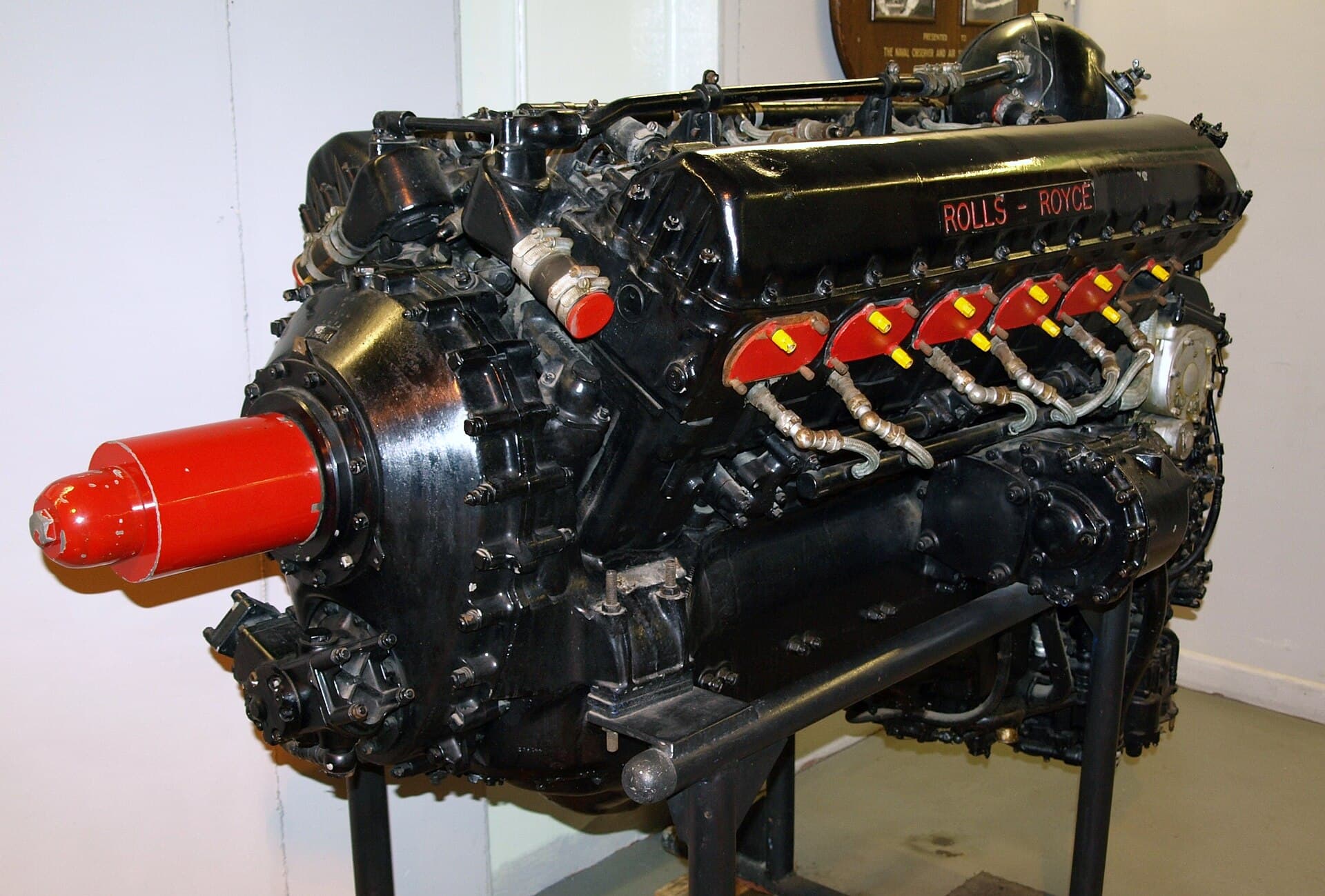
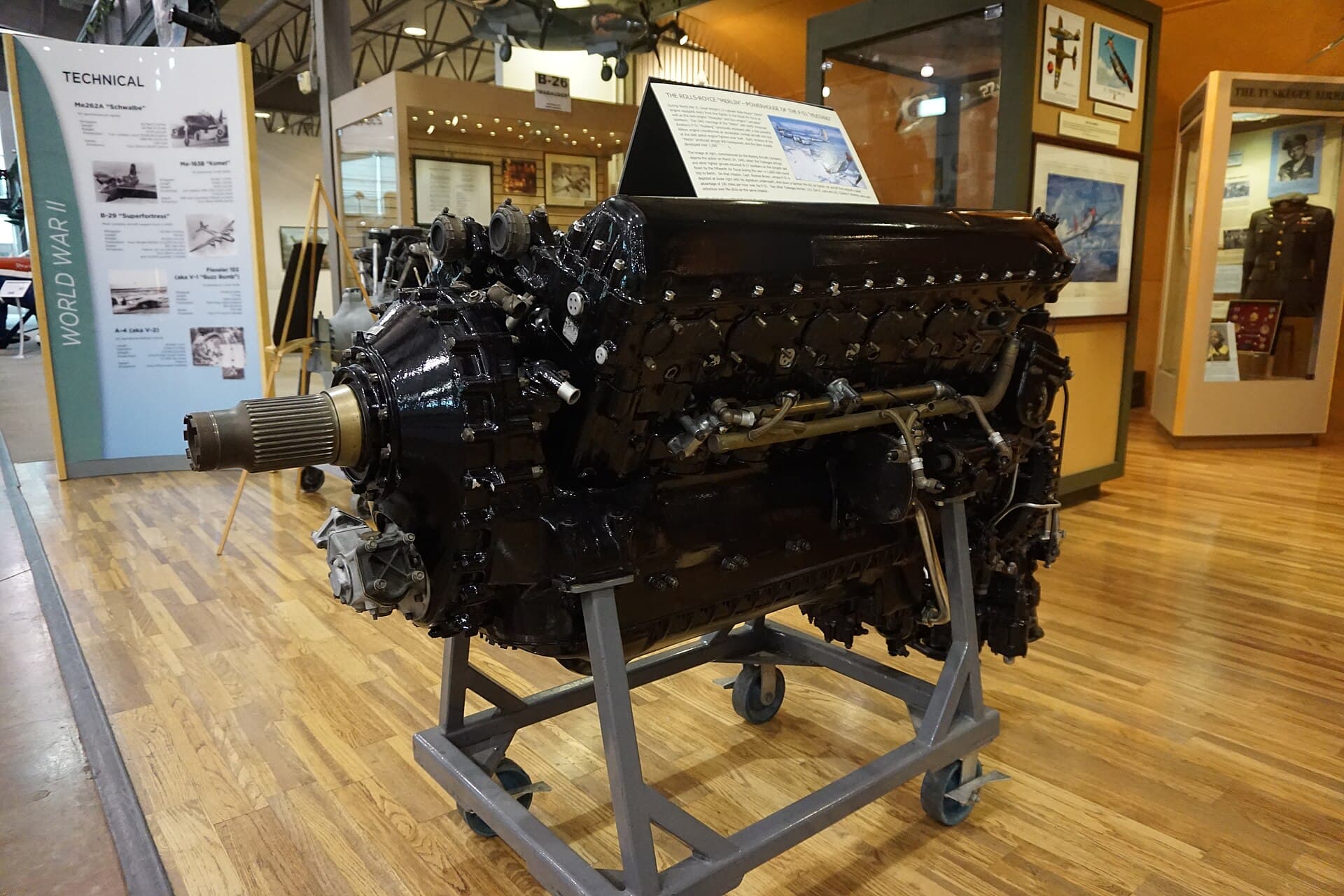
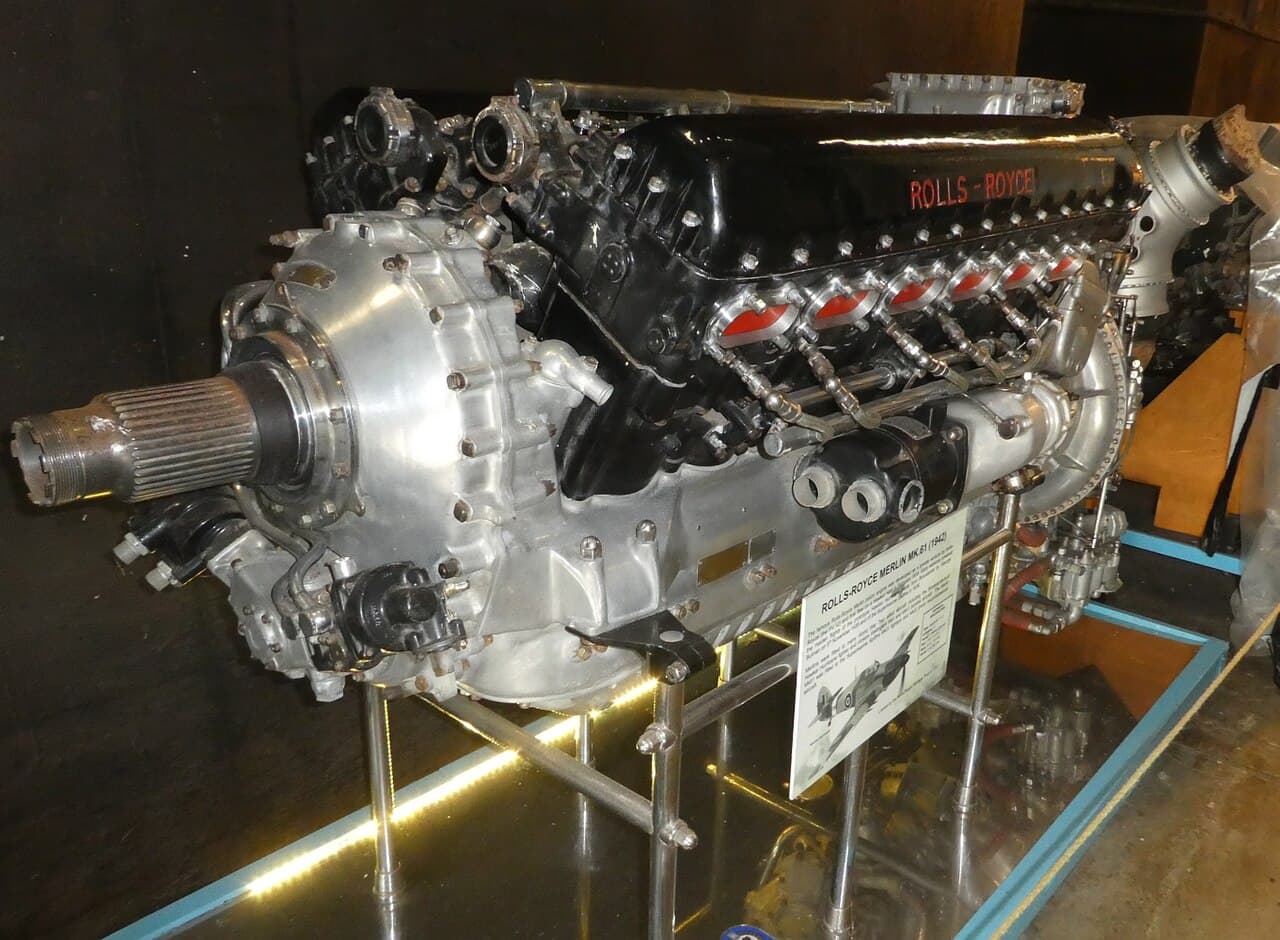
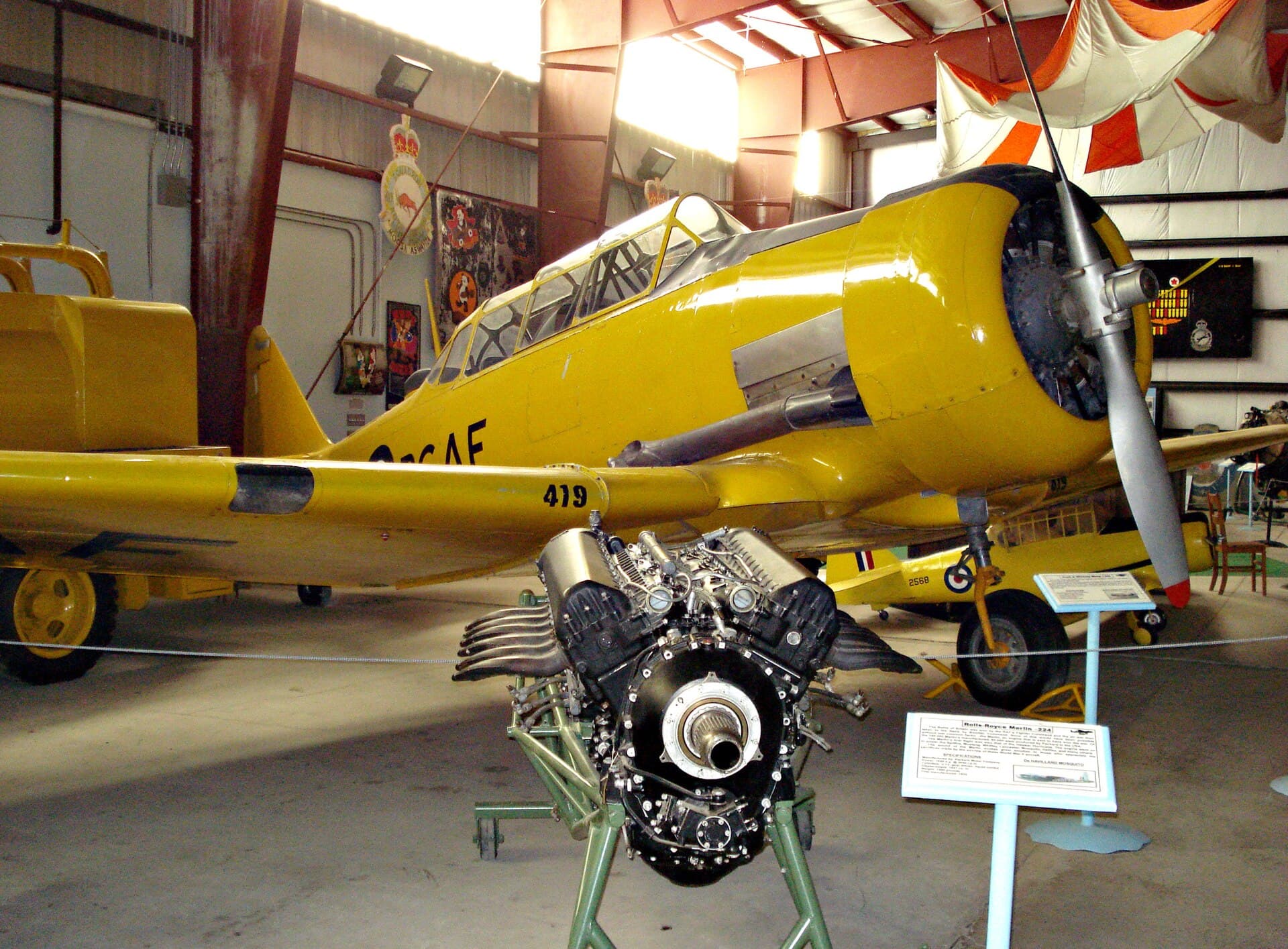
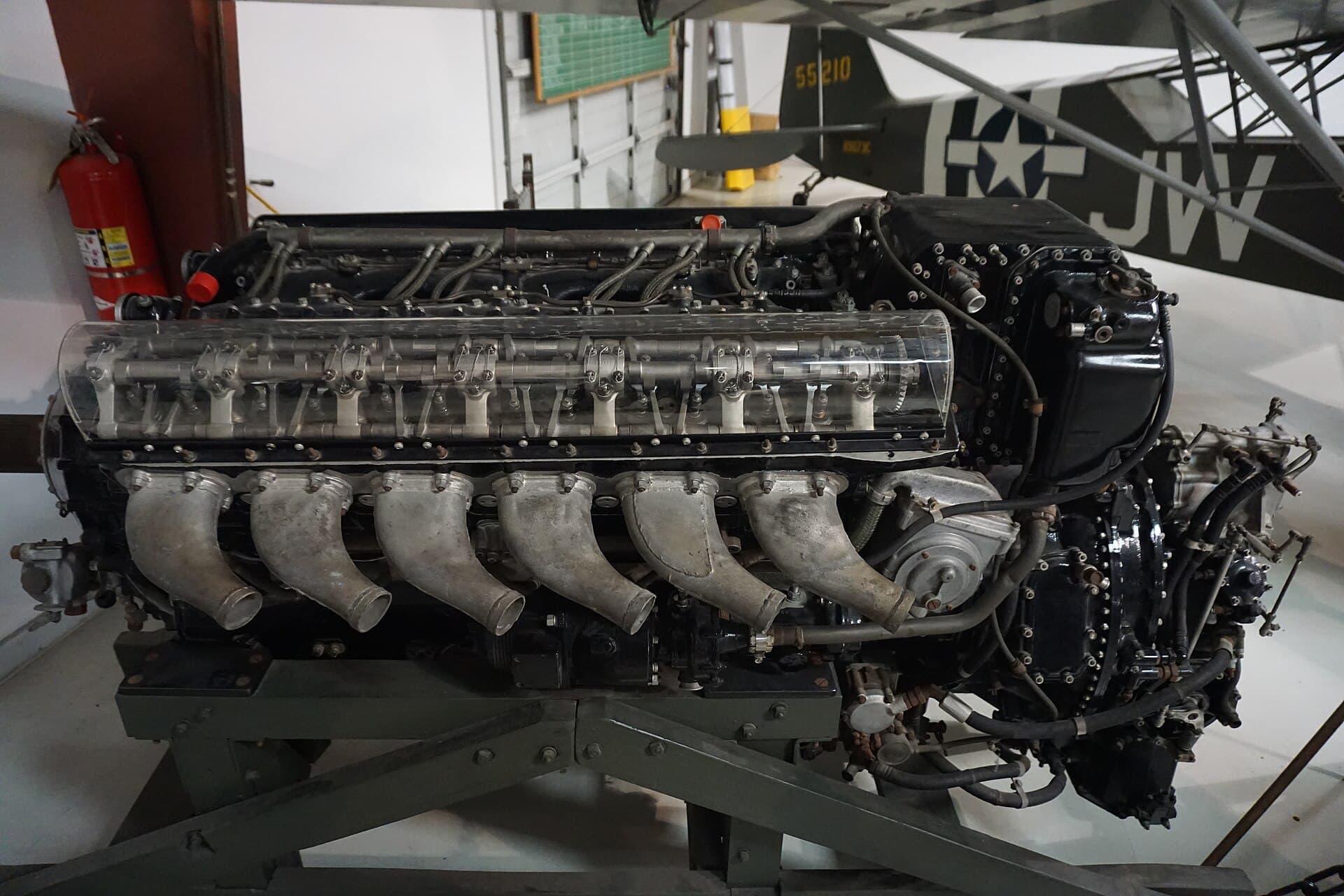
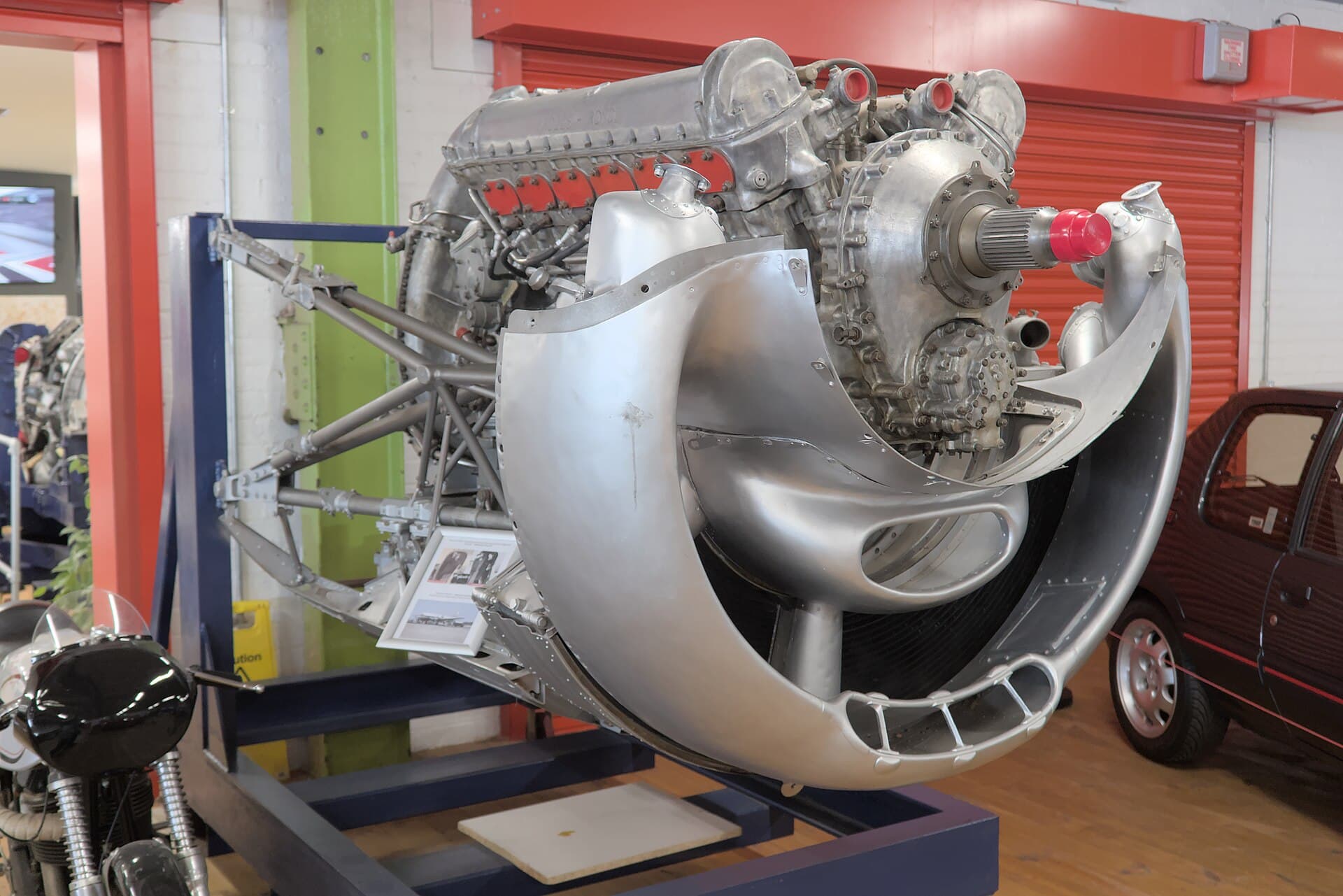
The Rolls-Royce Merlin is a supercharged 7 US gal V-12 aero engine, designed as a private venture in the early 1930s and built in greater numbers than any other British aero engine. It first ran on 15 October 1933 as the PV-12, first flew in a Hawker Hart on 21 February 1935, entered production in 1936 and was still being delivered in 1950. Rolls-Royce named it, following the company's convention for piston aero engines, after a bird of prey rather than the wizard.
It is the engine of the Spitfire and the Hurricane, and of the Lancaster, the Mosquito and the Halifax; from 1943 it was also the engine that turned the North American Mustang from a competent low-level fighter into the escort that could follow a bomber stream to Berlin. Four of the six most-produced British combat aircraft of the Second World War were Merlin-powered, and one engine family therefore sat behind both halves of the British air war, the defensive fighter battle of 1940 and the strategic bombing offensive that followed.
What makes the Merlin remarkable is not its layout, which was conventional, but its development. The engine that entered service produced 1,030 hp; the last production marks produced more than twice that from the same 7 US gal, the same bore and the same stroke. Nearly all of that came from two things: supercharging, and the fuel it was allowed to burn. The airframes changed around it, but the crankcase did not.
Around 150,000 Merlins were built, roughly a third of them under licence in the United States by the Packard Motor Car Company as the V-1650. A working population survives today, overhauled and flown by museum and memorial flights on both sides of the Atlantic.
Aircraft fitted with this engine
Year each aircraft entered service with this engine.
- 1937Merlin III, XX
Hawker Hurricane
Shot down more enemy aircraft in the Battle of Britain than every other British defence combined.
- 1937Merlin I, II, III
Fairey Battle
- 1938Merlin II, III, 45, 61, 66 and others
Supermarine Spitfire
Merlin-powered from the Mk I to the Mk XVI; the Griffon took over from the Mk XII onward.
- 1939Merlin III, XX
Boulton Paul Defiant
- 1940Merlin X, XX, 22
Handley Page Halifax
- 1941Merlin 21, 61, 72/73, 76/77
de Havilland Mosquito
Received the two-stage engines early, and stayed faster than most fighters until the jets.
- 1942Merlin XX, 22, 24, Packard Merlin 28
Avro Lancaster
Four Merlins per aircraft, the single largest consumer of the engine.
- 1942Packard V-1650-1
Curtiss P-40F Warhawk
The first American aircraft to fly with a Packard-built Merlin.
- 1943Packard V-1650-3, V-1650-7
North American P-51 Mustang
The Merlin replaced the Allison V-1710 from the P-51B and made the aircraft a high-altitude escort fighter.
- 1943Merlin 24, 500 series
Avro York and Avro Lancastrian
- 1947Merlin 620, 724
Canadair North Star
A postwar airliner whose unsilenced Merlins made it notoriously loud in the cabin.
11 aircraft
Development
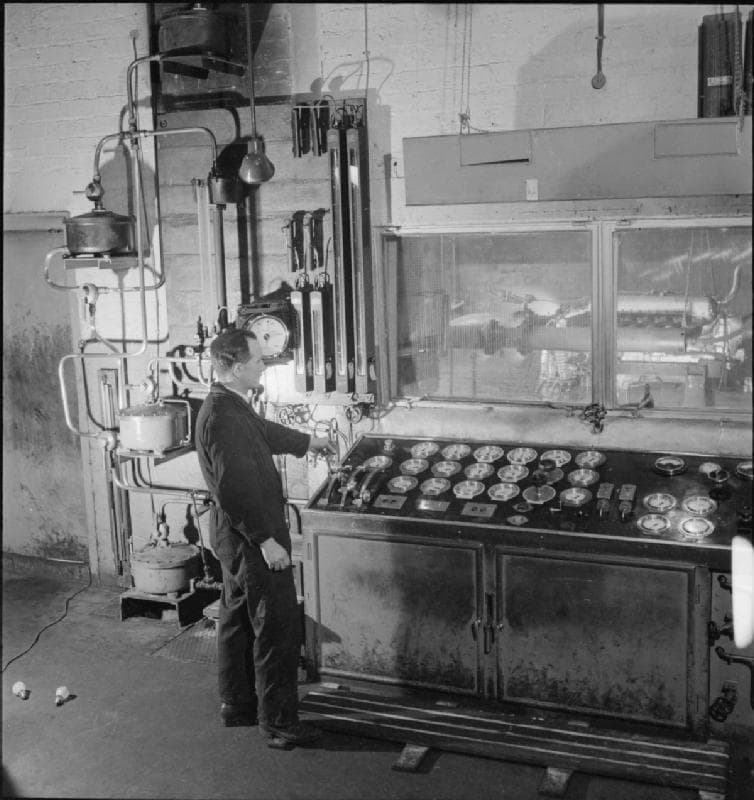
The Merlin began as the PV-12 (Private Venture, twelve cylinders) because the Air Ministry was not funding it. Rolls-Royce had the Kestrel in service and the enormous Buzzard above it, and judged that what the next generation of fighters would need was something in the 1,000 hp class: bigger than a Kestrel, far smaller than a Buzzard. Work started in 1932 and the first engine ran on 15 October 1933.
It was designed around evaporative cooling, in which the coolant is allowed to boil and the steam is condensed in the aircraft's own skin. Rolls-Royce had already flown the idea on the Goshawk and knew its faults: the condensers were vulnerable, the system was intolerant of attitude, and a single bullet could empty it. When ethylene glycol became available from the United States, the engine was reworked around a conventional pressurised liquid system using a 70/30 water-glycol mixture, and the evaporative apparatus disappeared for good.
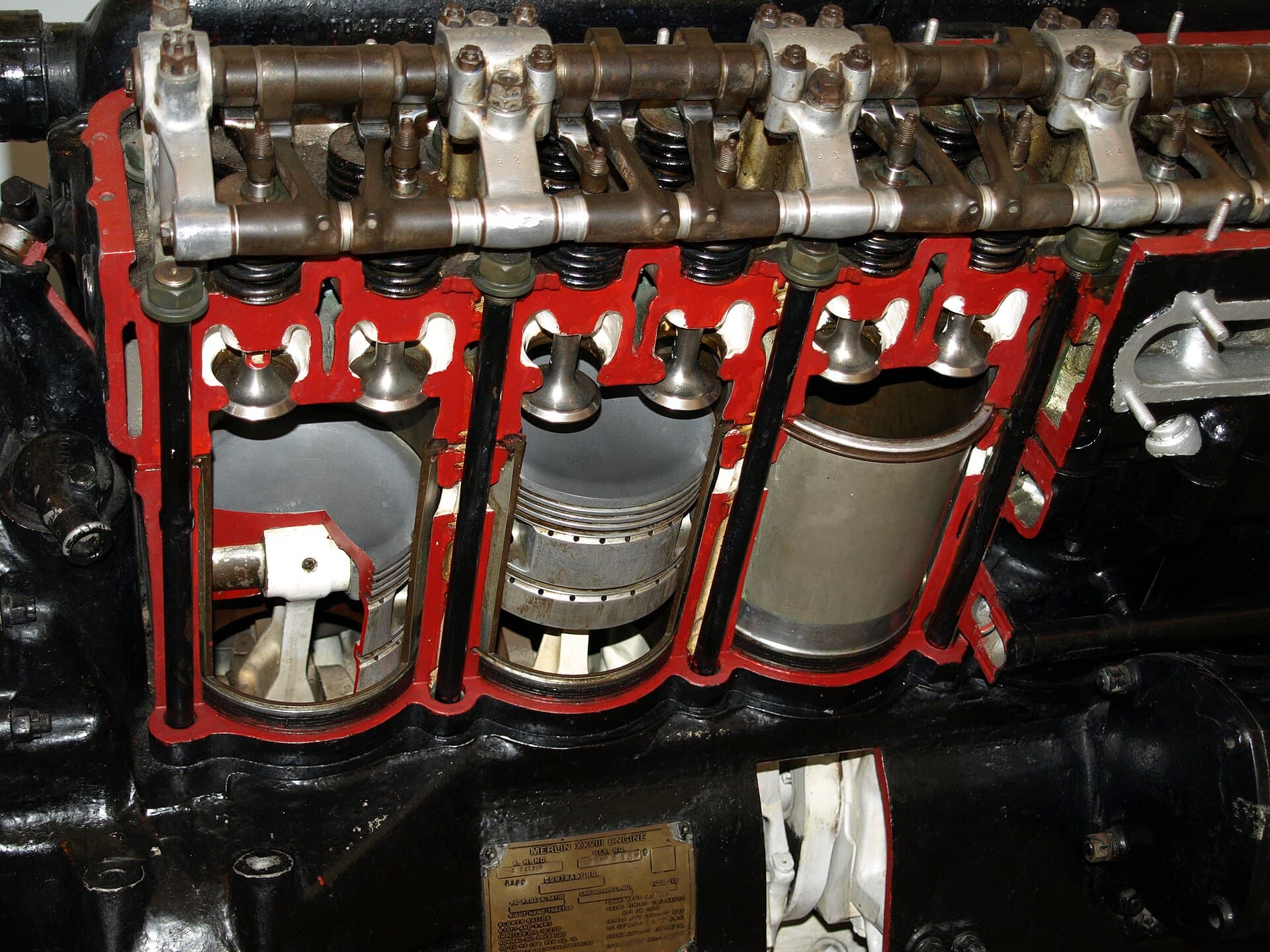
The PV-12 first flew on 21 February 1935 in a Hawker Hart biplane, and the early development was difficult. The first cylinder head design (the so-called ramp head, with the valves set at an angle to the cylinder axis) refused to deliver the expected output and was abandoned in favour of a flat, parallel-valve head derived from the Kestrel's. Merlin C, E, F and G development engines followed in quick succession; the Merlin G passed its type test at 1,030 hp in 1936 and became the Merlin II.
By then two aircraft had been designed around it. The Air Ministry's F.10/35 requirement produced the Hurricane and the Spitfire, both drawn to take the PV-12 and both effectively unbuildable without it. An engine that had received no government money became the engine on which British air defence depended, and the reliability problems that had dogged its first three years had to be solved on a production line that was already running.
Design
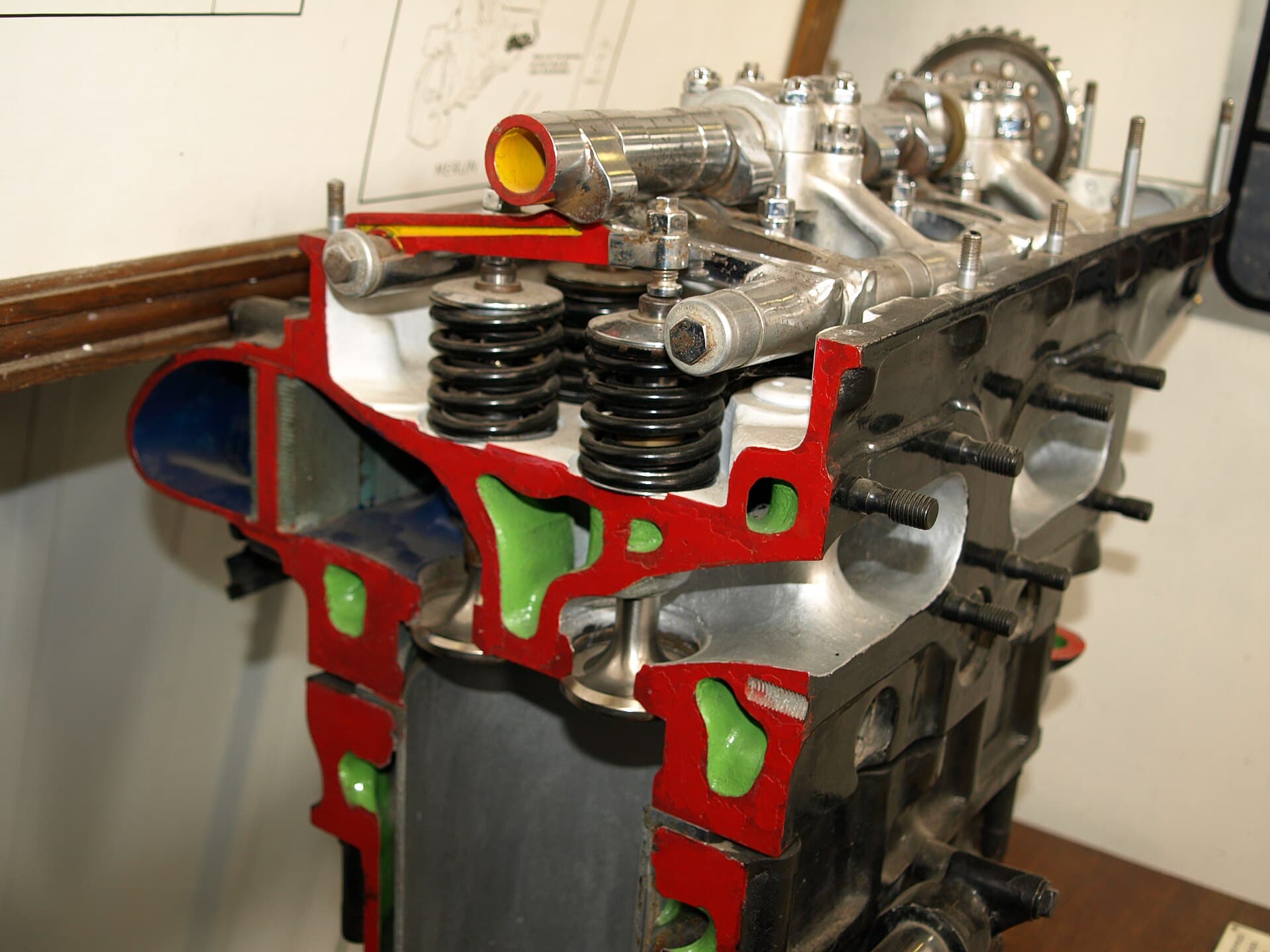
The Merlin is a 60° V-12 of 7.14 US gal, with a bore of 137.2 mm and a stroke of 152.4 mm, figures that never changed across seventeen years of production. Compression ratio was 6:1 throughout, low by the standards of an unsupercharged engine and deliberately so: the Merlin's charge arrived already compressed, and the ratio had to leave room for it.
Each bank carries a single overhead camshaft driving four valves per cylinder, two inlet and two exhaust, with sodium-filled exhaust valve stems to carry heat away from the head. The cylinder blocks are aluminium alloy with steel liners, mounted on a two-piece aluminium crankcase carrying a seven-bearing crankshaft. Lubrication is dry-sump, with one pressure pump and two scavenge pumps, so the engine keeps oil pressure through the attitudes a fighter actually flies in.
Cooling is a pressurised 70% water, 30% ethylene glycol mixture. Glycol raises the boiling point, which lets the radiator run hotter and therefore smaller: a smaller radiator is less drag, and on a fighter that is speed. It is also flammable and, in a shot-up aeroplane, was one of the more common reasons a Merlin stopped.
The engine was delivered not as a bare unit but, from 1940, increasingly as a power plant: engine, bearer frame, cowlings, radiator and ancillaries as one interchangeable assembly that a squadron could lift out and replace. The Beaufighter II and later the Lancaster used a fully standardised version of this idea, and it is the reason a Merlin change at a dispersal was measured in hours rather than days.
What the design did not have was fuel injection. That single omission produced the Merlin's most famous fault, and the fix for it is described below.
Supercharging
 Merlin 61
Everything the Merlin gained, it gained through its supercharger. A piston engine loses power with altitude because there is less air to burn; a supercharger puts the air back, and how well it does so decides at what height the engine is any use.
The Merlin II and III carried a single-stage, single-speed centrifugal blower geared at a fixed ratio to the crankshaft. It was competent and inflexible: full power arrived at one altitude and fell away on either side of it. In 1938 Stanley Hooker, a young mathematician newly arrived at Derby, analysed the intake and diffuser and found that the losses were not in the impeller at all but in the ducting around it. Redesigning the entry raised the engine's full-throttle height from around 16,000 ft to over 19,000 ft for no extra fuel, no extra weight and no change to the rotating parts, arguably the single most valuable piece of engineering work done on the Merlin.
 Packard V-1650-7
Hooker's work led to two lines of development. The Merlin XX of 1940 introduced a two-speed drive, so the blower could be geared low for take-off and climb and high for altitude, giving the engine two full-throttle heights instead of one. The Merlin 45 of 1941 took the improved single-stage blower into the Spitfire V.
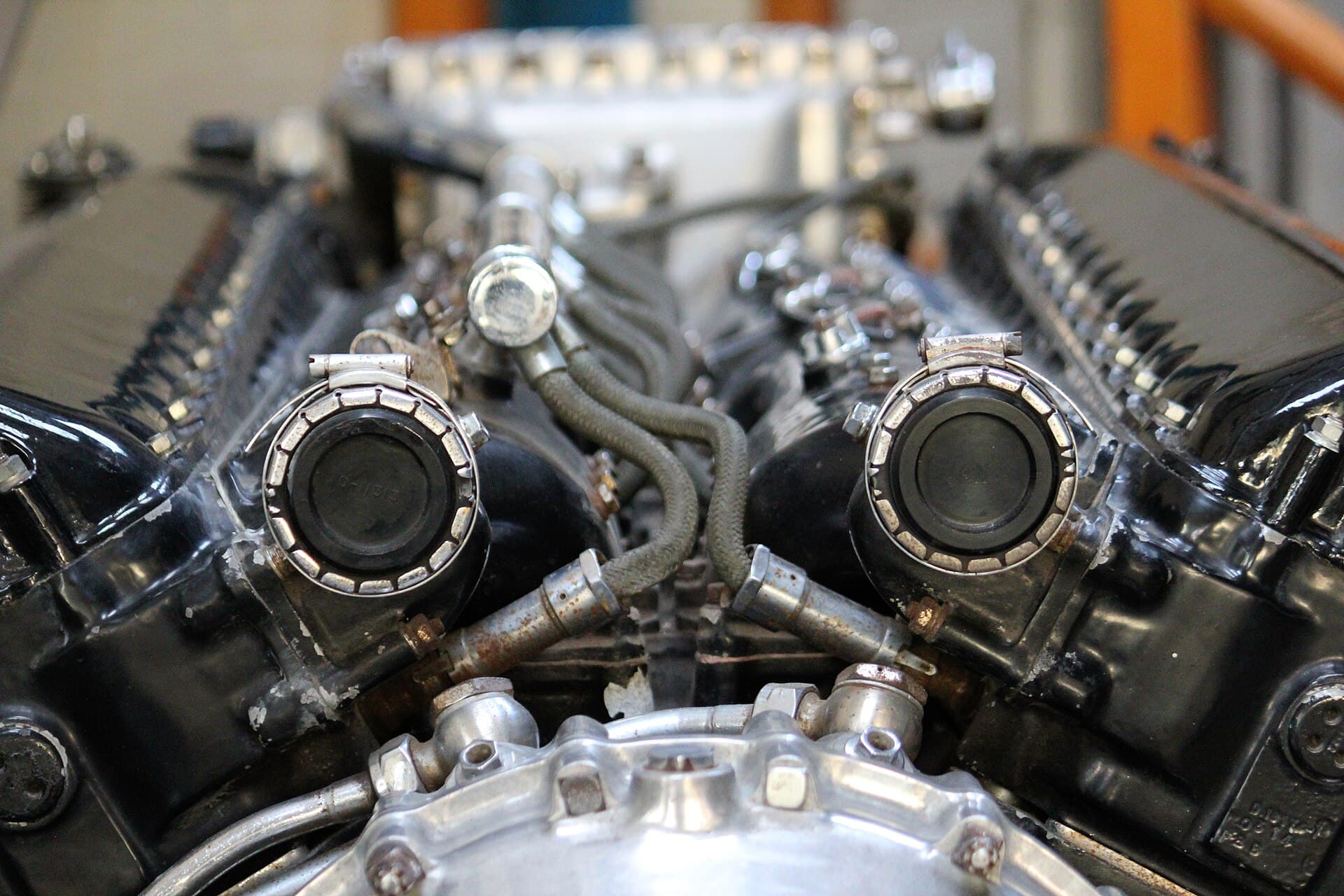
The decisive step was the Merlin 61. Bench-tested from 1941, it put two impellers in series (the first stage taken from the Vulture, the second from the Merlin 46) with a liquid-cooled intercooler between the second stage and the cylinders to cool the charge that compression had heated. Two speeds and two stages together gave the engine around 300 hp more at 30,000 ft than a Merlin 45. Fitted to the Spitfire it produced the Mk IX, roughly 61 kt faster than the Mk V at altitude, and it was the two-stage engine, not the airframe, that answered the Focke-Wulf Fw 190.
Fuel and carburation
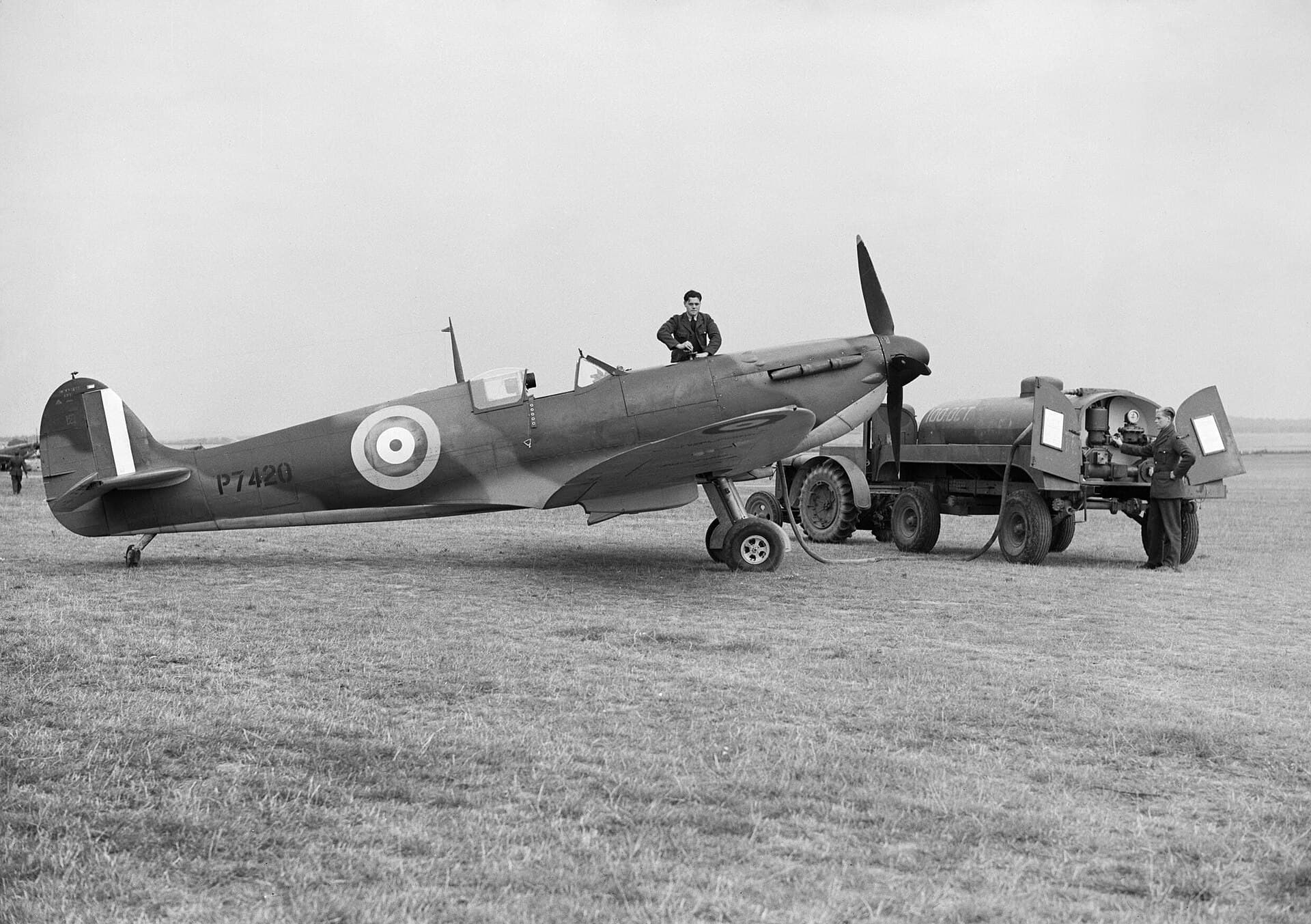
The Merlin's other half of the story is in the tank. On the 87 octane fuel available in 1938 the Merlin III was limited to +6¼ lb of boost and 1,030 hp; detonation, not the engine's structure, set the ceiling. From the winter of 1939 100 octane fuel began arriving from the United States, the West Indies and Persia, and during the first half of 1940 the RAF converted its Hurricane and Spitfire squadrons to it. The same engines, cleared to +12 lb as a five-minute emergency rating, gave 1,310 hp at 9,000 ft, nearly 30 per cent more power for a fuel change and a modified boost control.
The pattern repeated. From March 1944 Spitfire IXs with the Merlin 66 ran operationally on 150-grade fuel, dyed bright green, and were cleared to +25 lb: 2,000 hp at sea level from the same 7 US gal that had given 1,030 in 1938. The additive that made it work was not straightforward: extra tetraethyl lead fouled plugs badly, and 2.5% mono methyl aniline proved the better answer.
The Merlin's most notorious defect belongs here too. Its S.U. carburettor was float-controlled, and under negative g the fuel in the float chamber left the jets: pushing the nose down cut the engine, and if the pilot persisted the flooded chamber then ran it briefly rich enough to stop it again. A Messerschmitt Bf 109E, with direct injection, simply dived away. RAF pilots learned to half-roll before following, which cost seconds they did not have.
The fix came from Beatrice Shilling, an engineer at the Royal Aircraft Establishment at Farnborough. Her answer was not an injection system but a metal washer with a calibrated hole, fitted in the fuel line, restricting flow to a little more than the engine needed at full power and so preventing the flooding half of the failure. Squadrons were fitted from early 1941, and the R.A.E. restrictor became universally known as Miss Shilling's orifice. It was a palliative, and everyone knew it: later carburettors moved the outlet to the side of the float chamber to give equal flow under either sign of g, the Bendix-Stromberg pressure carburettor of 1943 injected fuel at 5 psi into the supercharger eye on the Merlin 66, 70, 76, 77 and 85, and the 100 series finally received an S.U. injection carburettor.
Production
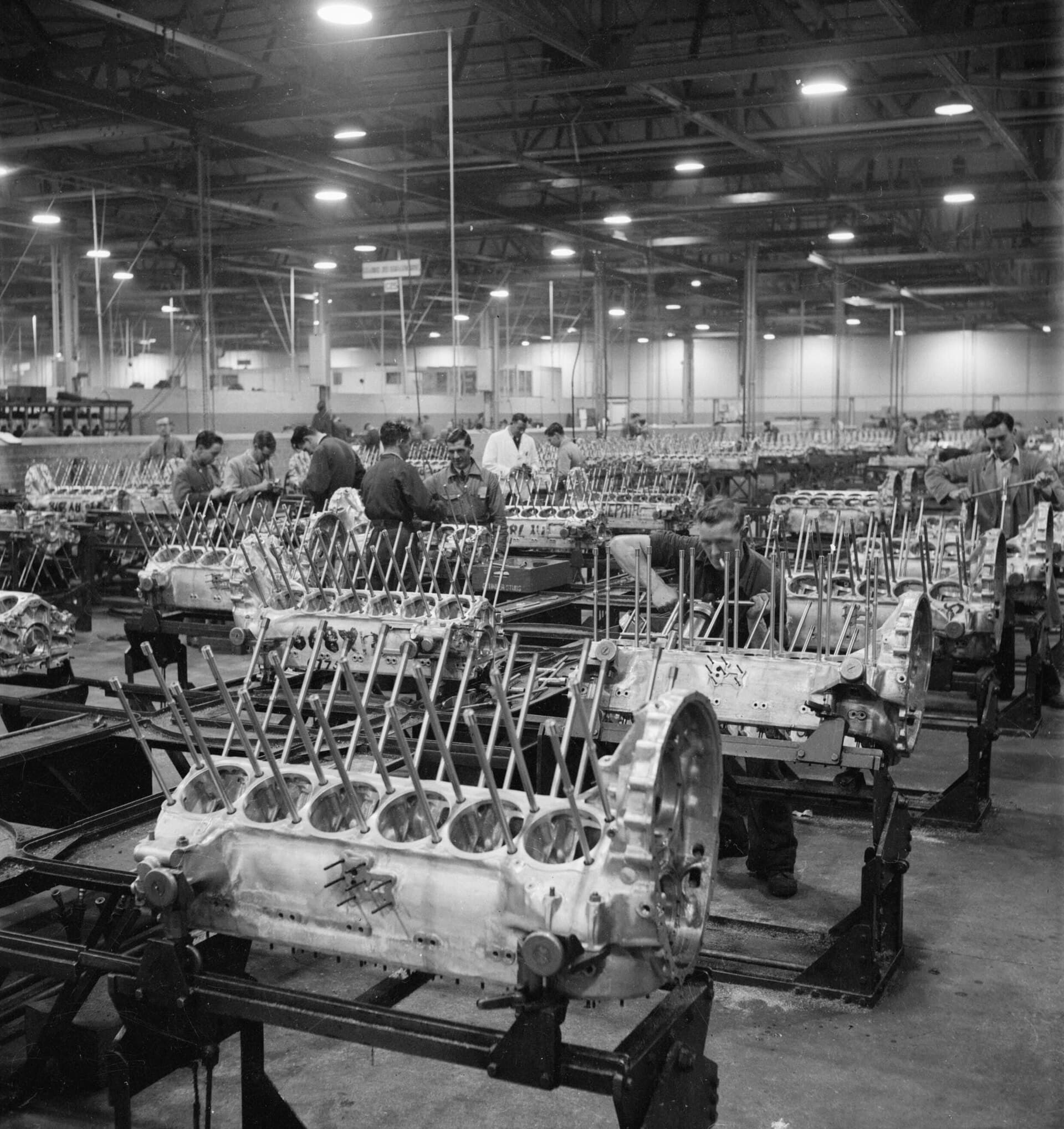
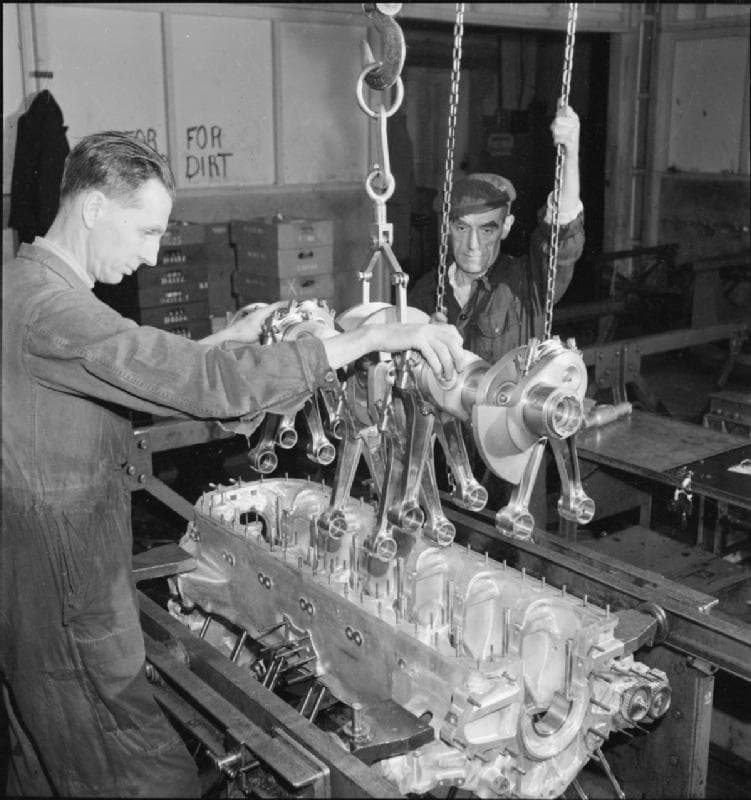
Merlin production was a national programme rather than a factory. Rolls-Royce built the engine at Derby, at a shadow factory at Crewe from 1939 and at Hillington near Glasgow from 1940; the Ford Motor Company built it at Trafford Park in Manchester. The commonly cited outputs are 32,377 engines from Derby, 26,065 from Crewe, 23,675 from Glasgow and 30,428 from Ford (around 112,000 in Britain) with Packard adding 55,523 in Detroit.
The totals quoted for the programme differ depending on what is counted. The figure usually given for the Merlin is 149,659; sources that add every licence-built and development engine reach about 168,000. FLYPEDIA records the lower, more commonly cited number and notes the discrepancy rather than choosing silently between them.
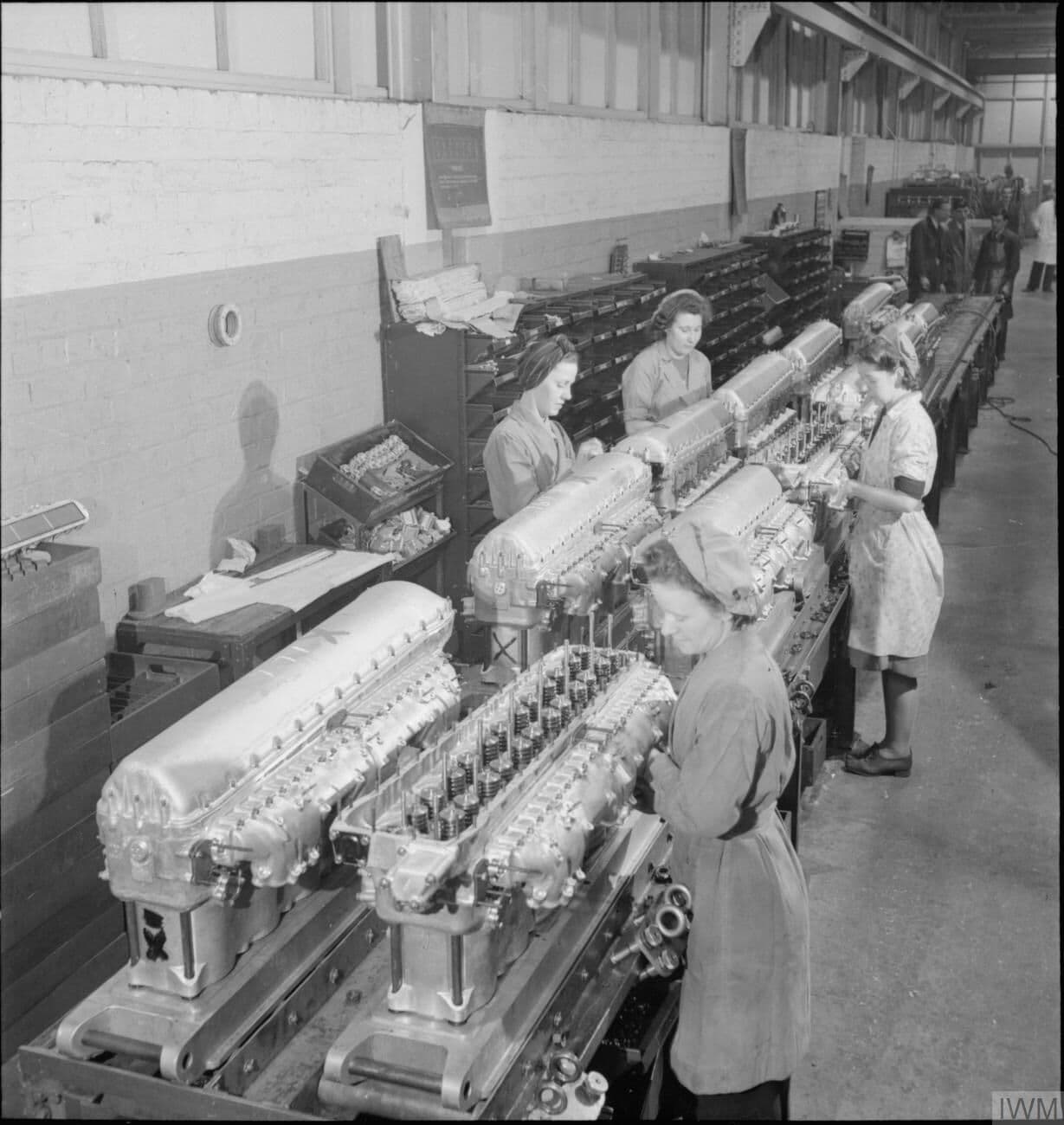
The two British approaches were genuinely different. Rolls-Royce worked to fits and finishes, with skilled fitters selecting and matching parts; Ford, asked to build the same engine, first re-drew the entire set of drawings to closer tolerances so that any part would fit any engine without hand work. Both delivered, and the argument about which method was right outlived the engine.
Output at Hillington peaked at more than 400 engines a month by March 1942, with a record of 100 completed in a single day. A large proportion of that workforce was female, recruited and trained from 1940 onward, and the Glasgow factory became one of the standard illustrations of wartime production in Britain. Manufacture continued after the war for civil and transport marks, and ended in 1950.
Licence production
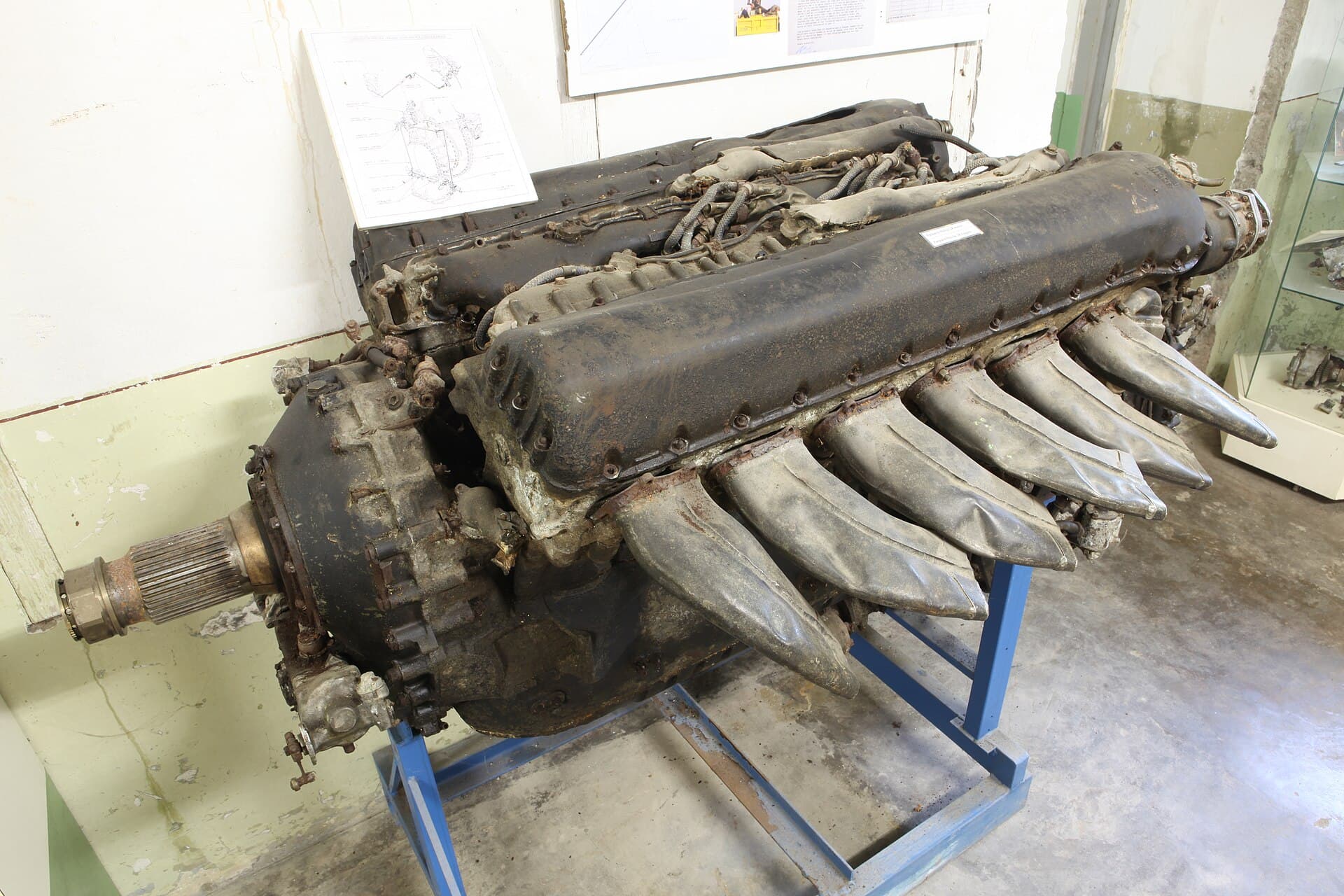 Packard Merlin 28
By 1940 British capacity was the binding constraint, and the answer was to build the Merlin in the United States. Rolls-Royce and the Packard Motor Car Company reached agreement in September 1940 against an order worth around $130 million, and the first Packard-built engine ran in August 1941. American-built Merlins carried the designation V-1650 in United States service and continued the Rolls-Royce mark numbers from 28 upward in British service.
Packard did not simply copy the drawings. The company re-engineered the engine for volume production by a workforce that had never built an aero engine, standardising tolerances so that parts were interchangeable without fitting, converting fasteners to American threads, and substituting a silver-lead bearing material with indium plating for the British copper-lead. The result was an engine that could be built quickly and repaired anywhere, and Rolls-Royce adopted several of the changes in return.
The first version, the V-1650-1 or Merlin 28, used the single-stage two-speed supercharger of the Merlin XX and went into the Curtiss P-40F and into Lancaster IIIs. The versions that mattered most were the two-stage V-1650-3 and V-1650-7, built for the Mustang.
Packard delivered 55,523 Merlins, about a third of all production. It is an unusual case in aero-engine history: not a second source of an obsolescent design, but the concurrent manufacture of a front-line engine on another continent, with the two production lines feeding each other's improvements throughout the war.
In service
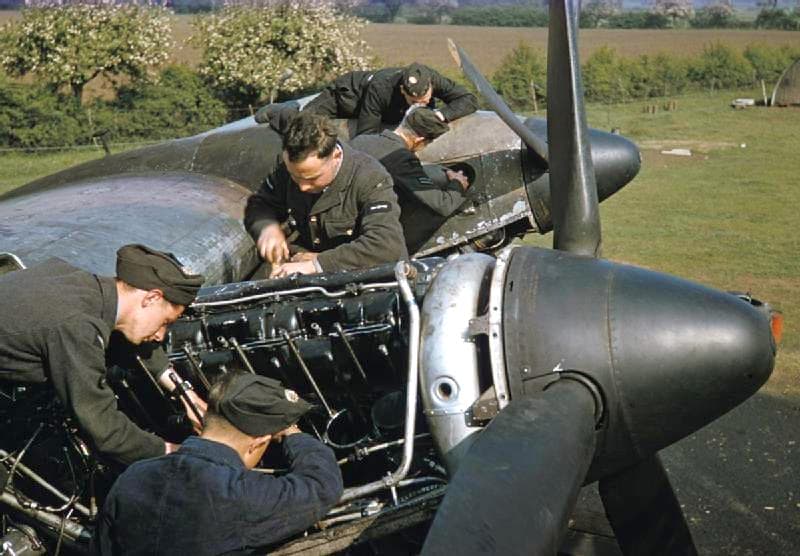
In the summer of 1940 the Merlin III was the only engine in RAF Fighter Command. Every Spitfire I and every Hurricane I that fought the Battle of Britain had one, and the Defiant and the Battle carried it too. Its 1,030 hp was not exceptional, the Daimler-Benz DB 601 in the Bf 109E was broadly comparable, and the tactical difference between them came down to details: fuel injection against a float carburettor, and 100 octane against 87.
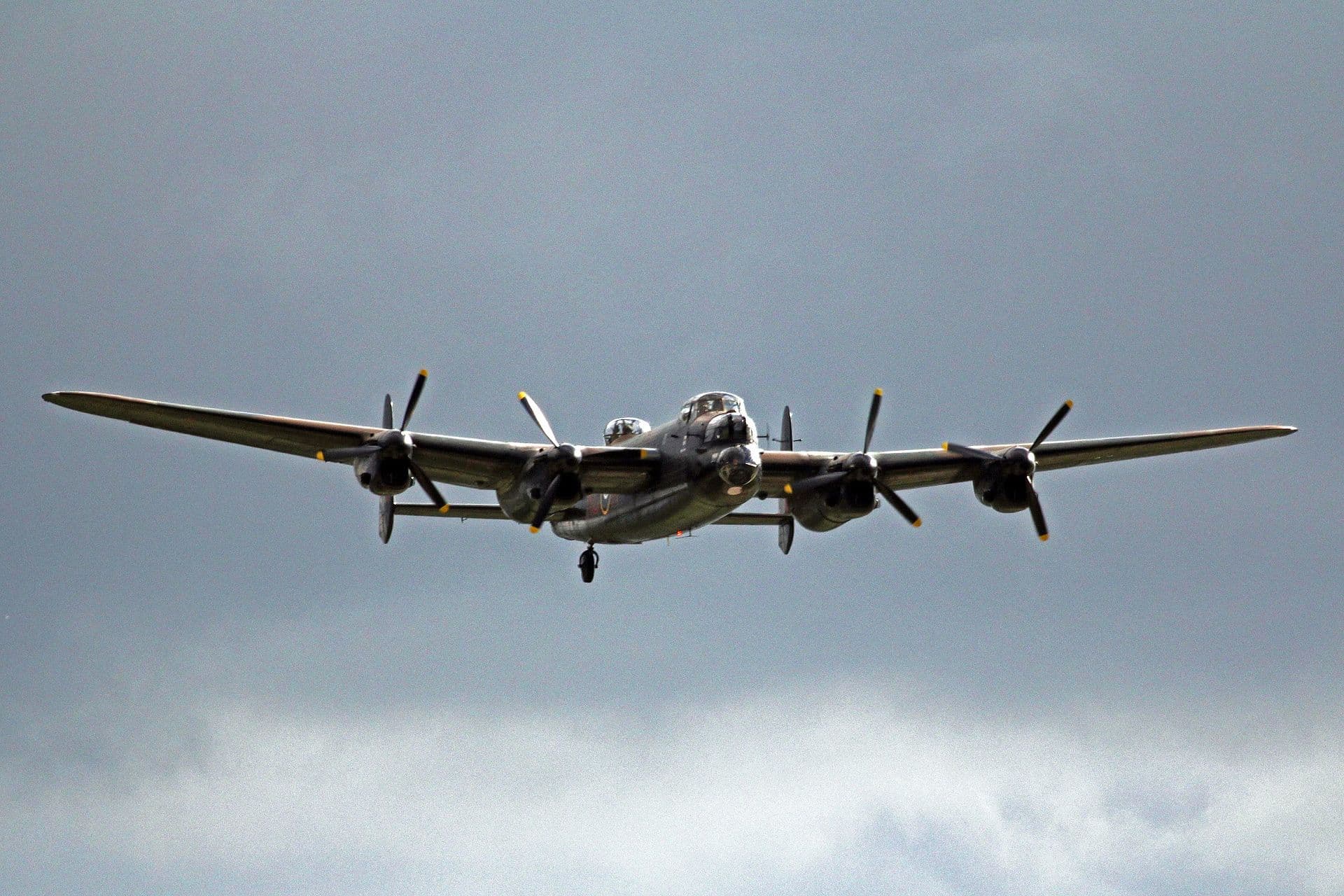
The engine's second war was the bomber offensive. The Merlin XX and its Ford-built equivalents powered the Halifax and, from 1942, the Avro Lancaster, which used four of them. The Lancaster alone accounted for tens of thousands of Merlins, and because a bomber flies long sorties at continuous high power, it was the bombers rather than the fighters that exposed the engine's endurance limits and drove the bearing, valve and coolant work of the middle war years.
The de Havilland Mosquito is the third case, and the most demanding. Built of wood and unarmed, it depended entirely on speed, so it received the two-stage engines as soon as they existed (Merlin 61, 72/73, 76/77) and remained faster than most single-seat fighters until the jets arrived.
Operationally the Merlin was maintained rather than nursed. Squadron records show engine changes as routine work, done outdoors in bad weather with a gantry and a small team, and the standardised power plant made it possible. That, more than any single figure of merit, is what an engine built in six-figure quantities has to be good at.
Applications
The Merlin's most consequential application was not British. The North American Mustang had been designed for the RAF around an Allison V-1710 with a single-stage supercharger: fast and long-ranged at low level, and useless above about 15,000 ft, where the bomber war was being fought.
On 30 April 1942 Ronald Harker, a Rolls-Royce test pilot, flew a Mustang I at Duxford and wrote a report arguing that the airframe deserved a Merlin 61. Every 60-series engine was spoken for by Spitfire IX production, but Harker and Ray Dorey at Rolls-Royce's Hucknall flight establishment obtained approval for a small conversion programme. Five airframes were taken in hand and the first Mustang X flew from Hucknall on 13 October 1942.
In the United States the same conclusion was reached in parallel: the XP-51B, with a Packard V-1650-3, flew on 30 November 1942. The transformation was total. The Merlin Mustang held its power to altitudes where the escort mission actually happened, and combined that with the original airframe's exceptional range and low drag. From late 1943 it could accompany Eighth Air Force bombers to targets deep in Germany and fight on arrival: something no other Allied fighter could then do.
It is the clearest demonstration of the encyclopedia's own point about engines. Nothing structural about the Mustang changed; a different powerplant changed what the aeroplane was for.
Preservation
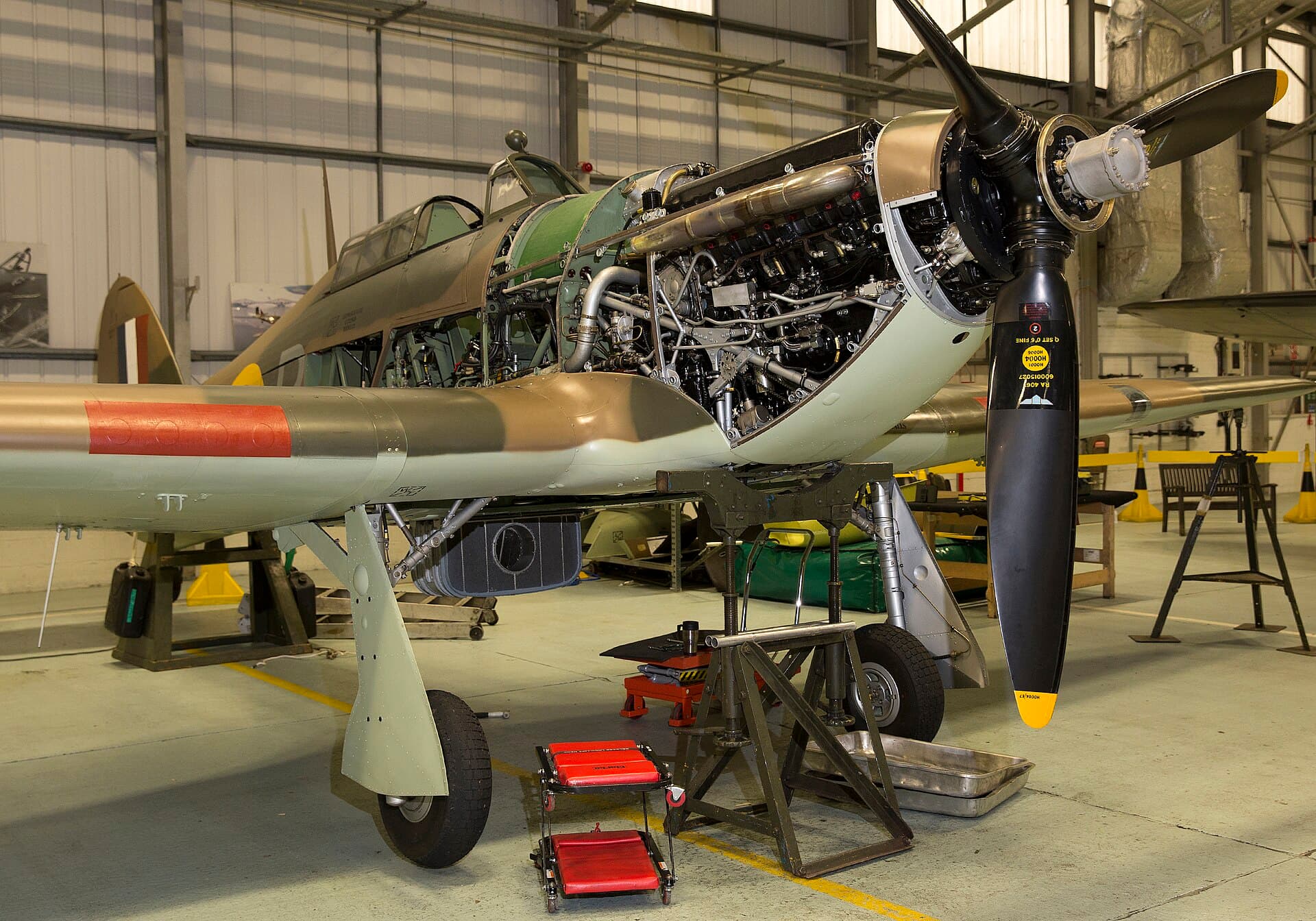
A working Merlin population still exists. The Royal Air Force's Battle of Britain Memorial Flight operates Spitfires, Hurricanes and the Lancaster PA474, four Merlins on that airframe alone, and flies them through a public display season each year. The Shuttleworth Collection at Old Warden flies a Sea Hurricane and a Spitfire Vc, and comparable fleets fly in the United States, Canada, France and Australia.
Keeping them flying is a specialist industry rather than a hobby. Overhaul intervals are measured in low hundreds of hours; crankshafts, cylinder blocks and supercharger casings are life-limited items with no production source, so the surviving stock of parts is finite and increasingly remanufactured to original drawings. Modern operators run on avgas with additives rather than wartime fuel, at boost settings well below wartime ratings, which is one reason a preserved Merlin outlasts an operational one by a wide margin.
Static examples are common in museums, and several are kept as running exhibits mounted on trailers or test frames so that visitors can hear one under load. That is the honest form of preservation for an engine: an airframe can be understood from a photograph, but a Merlin has to be started.
Legacy
The Merlin outlived the war by only a few years, and it was the jet that ended it rather than any failure of the design. Rolls-Royce's own attention had already moved: the company that built the Merlin built the Welland and the Nene, and the Merlin's last new marks were being certificated while turbine airliners were being drawn.
Its postwar career was civil and transport. The 500, 600 and 700 series were built for airline and military transport use: the Avro Lancastrian and Avro York, the Avro Tudor, and the Canadair North Star, whose unsilenced exhausts made it one of the noisiest airliners ever to carry passengers. Merlins also powered rebuilt foreign types, among them the Hispano Aviación HA-1112 that gave post-war cinema its Bf 109s, and the CASA 2.111 development of the Heinkel He 111.
Production ended in 1950. What survived was less the engine than the method: a private-venture design taken to twice its original output within one displacement, by attacking induction and fuel rather than size, and a manufacturing programme that proved a precision engine could be made in six-figure quantities on two continents at once.
The cultural afterlife is real too. The Merlin's sound is one of the small number of mechanical noises that a general audience recognises without being told what it is: which is why almost every airshow that has one runs it, and why museums that own one keep it able to start.
Output by altitude
A piston engine has no single power figure. Each rating below is what the sources publish for one mark under one set of conditions, at the altitude it was measured at.
| Mark and conditions | Altitude | Output |
|---|---|---|
| Merlin 66, +25 lb boost, 150 grade+25 lb boost · 3,000 rpm · 150 grade | Sea level | 2,000hp |
| Merlin 130, de Havilland Hornet3,000 rpm · 150 grade | Sea level | 2,060hp |
| Merlin 66, +18 lb boost+18 lb boost · 3,000 rpm · 100/130 grade | 5,791 ft | 1,720hp |
| Merlin XX, medium supercharger gear+14 lb boost · 3,000 rpm · 100 octane | 6,004 ft | 1,480hp |
| Merlin III, +12 lb emergency boost, 100 octane+12 lb boost · 3,000 rpm · 100 octane | 8,990 ft | 1,310hp |
| Merlin 453,000 rpm · 100 octane | 10,991 ft | 1,515hp |
| Merlin 61, medium supercharger gear+15 lb boost · 3,000 rpm · 100 octane | 12,238 ft | 1,565hp |
| Merlin III, +6¼ lb boost, 87 octane+6.25 lb boost · 3,000 rpm · 87 octane | 16,240 ft | 1,030hp |
| Merlin 61, full supercharger gear+15 lb boost · 3,000 rpm · 100 octane | 23,491 ft | 1,390hp |
Mark evolution
PV-12
1933790 hpThe private-venture prototype, first run on 15 October 1933 and first flown in a Hawker Hart on 21 February 1935.
Designed for evaporative cooling and later reworked around a pressurised water-glycol system; the original ramp cylinder head was abandoned for a flat, parallel-valve head.
 Merlin III
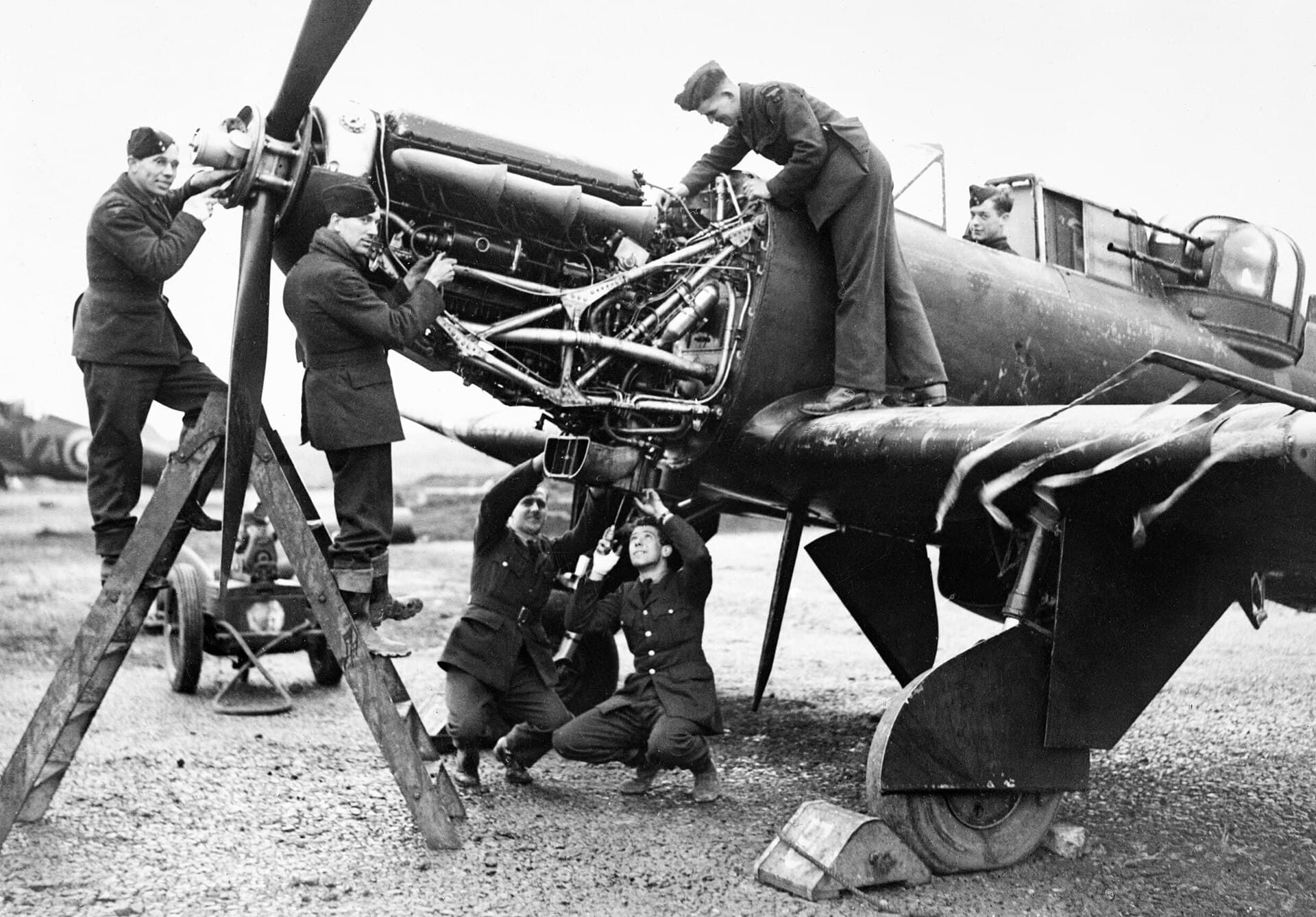
RAF fitters working on the Merlin III of a Boulton Paul Defiant at Fairwood Common, Wales, in January 1942, with the cowling panels removed Merlin II / III
19381,030 hp at 16,240 ftThe first mass-production marks, and the engine of the Battle of Britain in the Spitfire I, Hurricane I, Defiant and Battle.
Single-stage, single-speed supercharger; the Merlin III introduced a universal propeller shaft accepting de Havilland or Rotol propellers.
Rated at 1,030 hp on 87 octane; cleared to +12 lb boost and 1,310 hp once 100 octane fuel reached the squadrons in 1940.
 Merlin XX
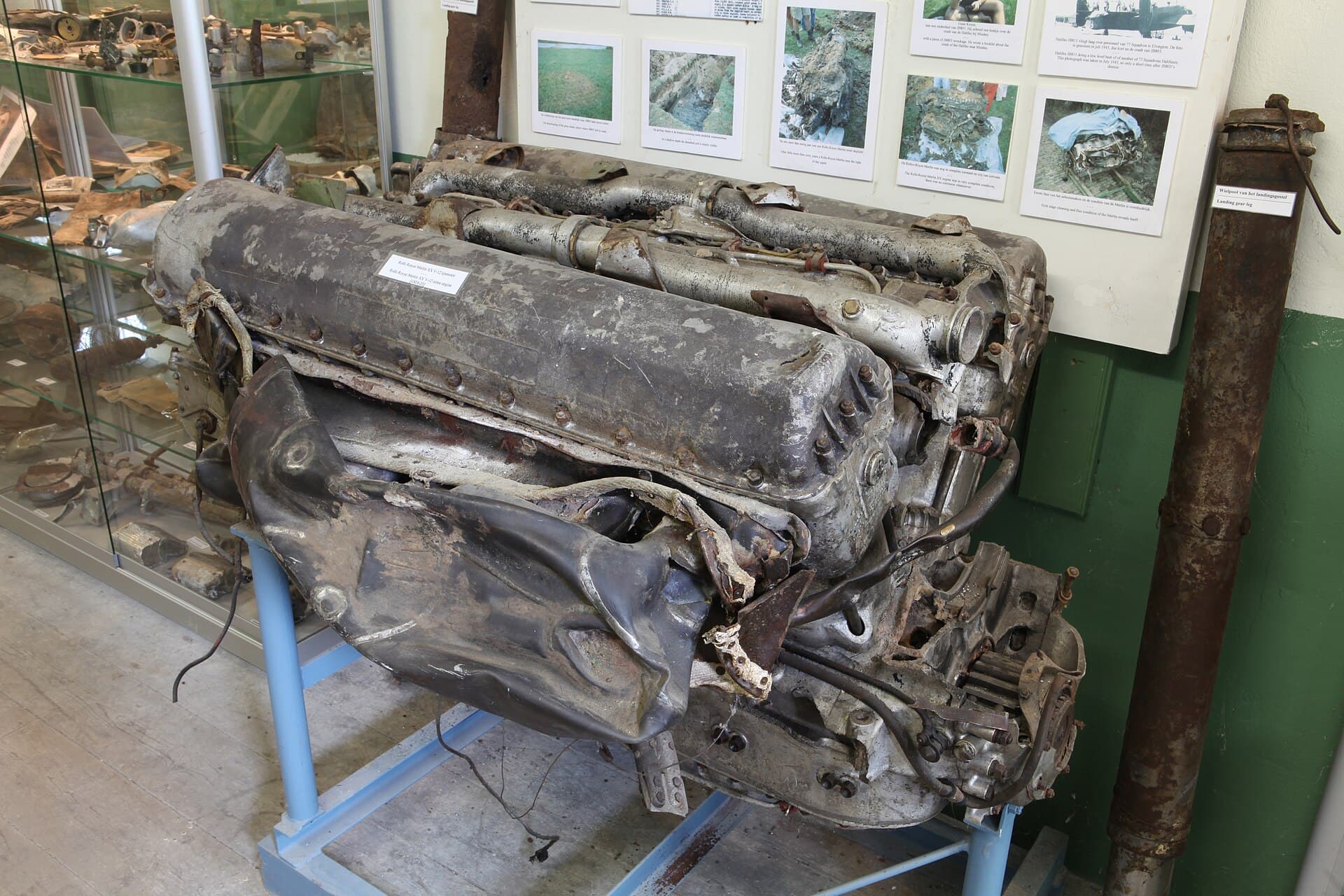
A corroded Merlin XX recovered from Handley Page Halifax JB803, displayed at the Fort bij Veldhuis air war museum in the Netherlands Merlin XX
19401,480 hp at 6,004 ftThe first production two-speed engine, and the standard bomber Merlin: Hurricane II, Halifax, Lancaster I and Beaufighter II.
Two-speed drive to the single-stage supercharger, giving the engine two full-throttle heights instead of one.
Merlin 45
19411,515 hp at 10,991 ftA single-speed engine with the improved supercharger, built in very large numbers for the Spitfire V.
Supercharger intake and diffuser redesigned following Stanley Hooker's 1938 analysis; the two-speed gear of the XX was deleted to simplify production.
Merlin 61
19421,565 hp at 12,238 ftThe two-stage engine, and the turning point of the whole programme. Fitted to the Spitfire IX and the high-altitude Mosquitos.
Two impellers in series with a liquid-cooled intercooler between the second stage and the cylinders, on a two-speed drive. To restore power above 20,000 ft, where the single-stage marks fell away and the Focke-Wulf Fw 190 did not.
About 300 hp more than a Merlin 45 at 30,000 ft, and roughly 61 kt on the Spitfire's altitude performance.
 Merlin 66
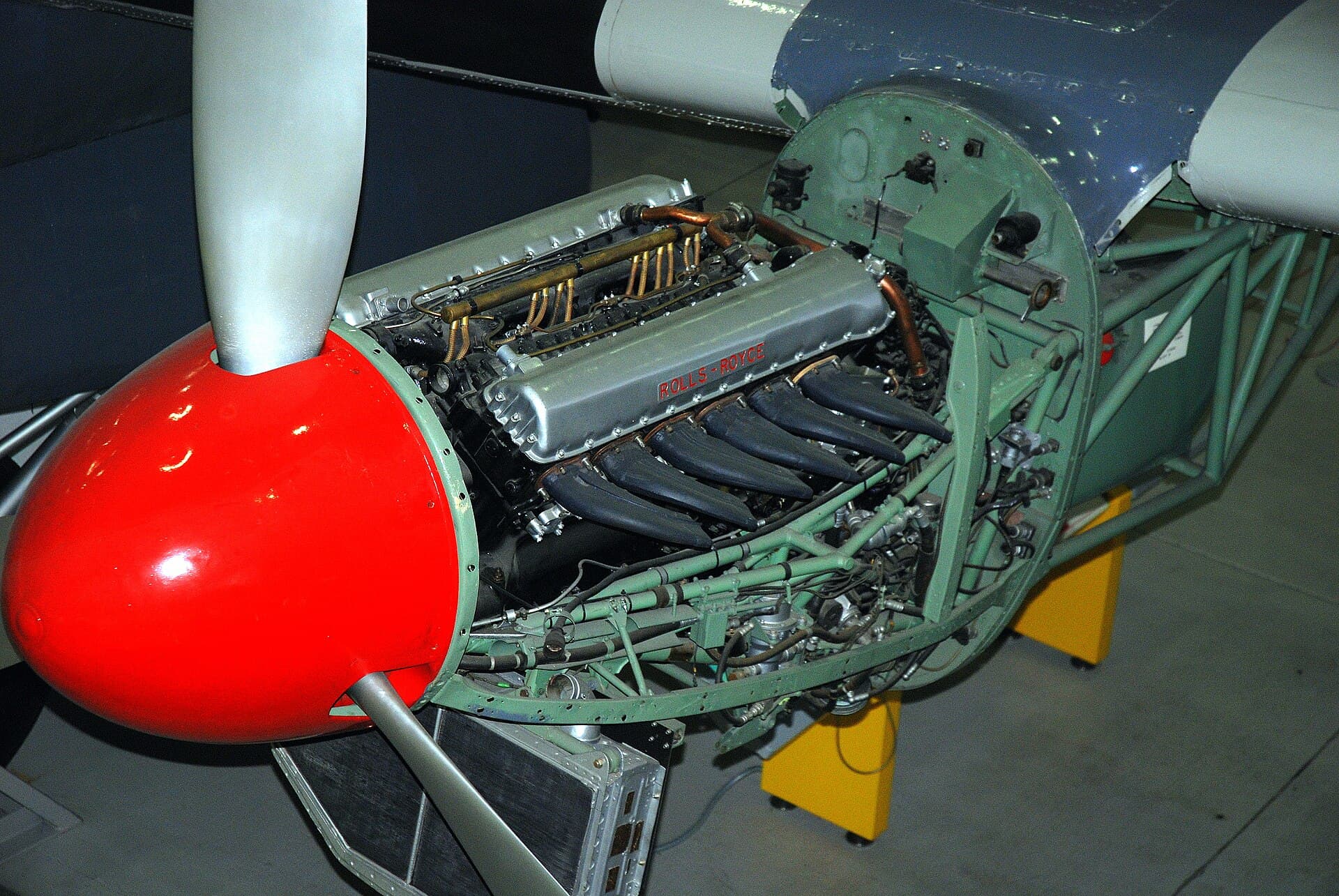
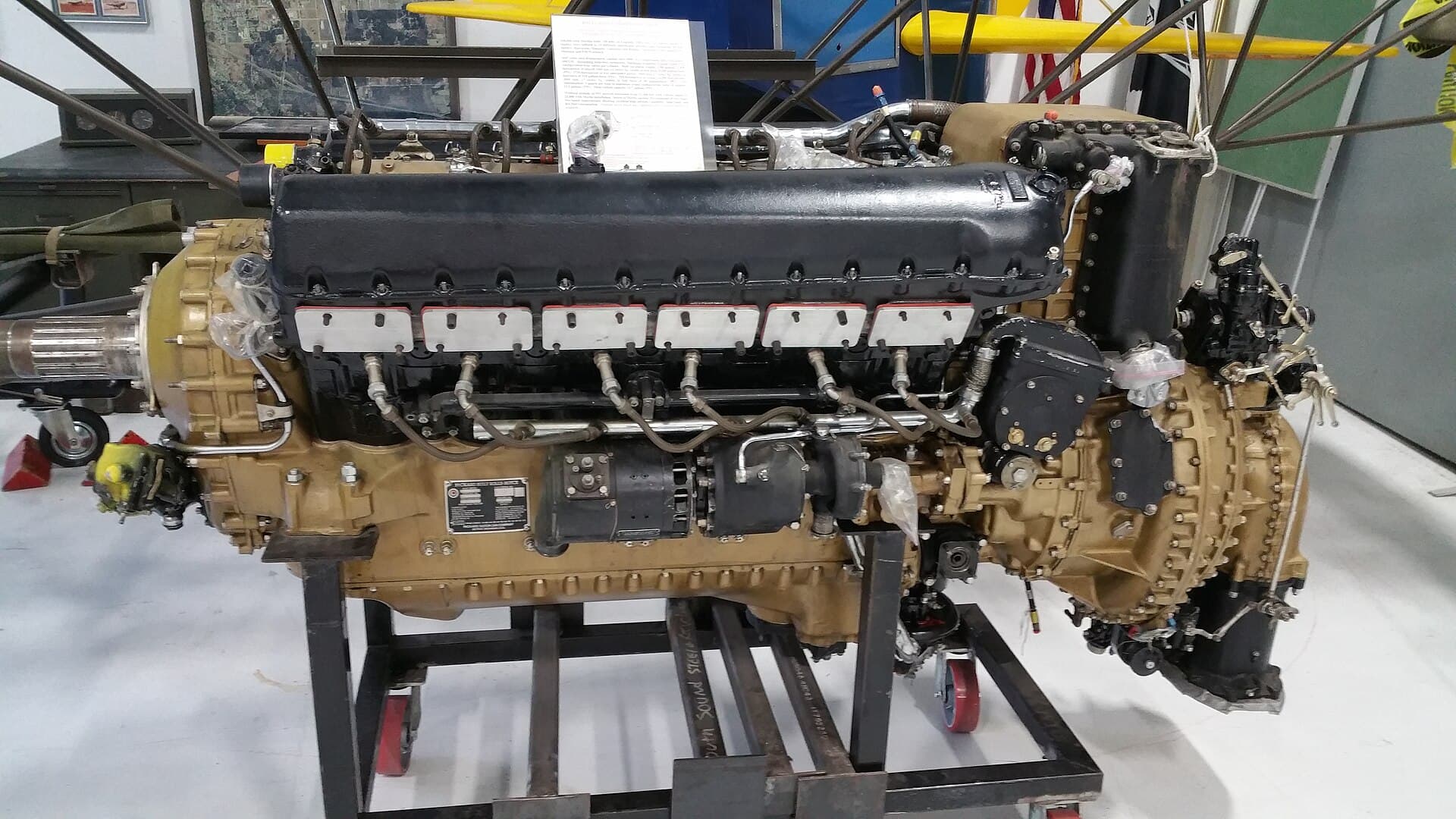
A Rolls-Royce Merlin 66 displayed on a stand, seen from the side with its cylinder blocks, exhaust stubs and supercharger casing visible Merlin 66
19431,720 hp at 5,791 ftA two-stage mark geared for lower altitudes, for the Spitfire LF IX, the mark most often flown today.
Bendix-Stromberg pressure carburettor injecting fuel into the supercharger eye, ending the negative-g cut for good on this mark.
1,720 hp at +18 lb; cleared to +25 lb and about 2,000 hp at sea level on 150-grade fuel from March 1944.
 Packard V-1650-7
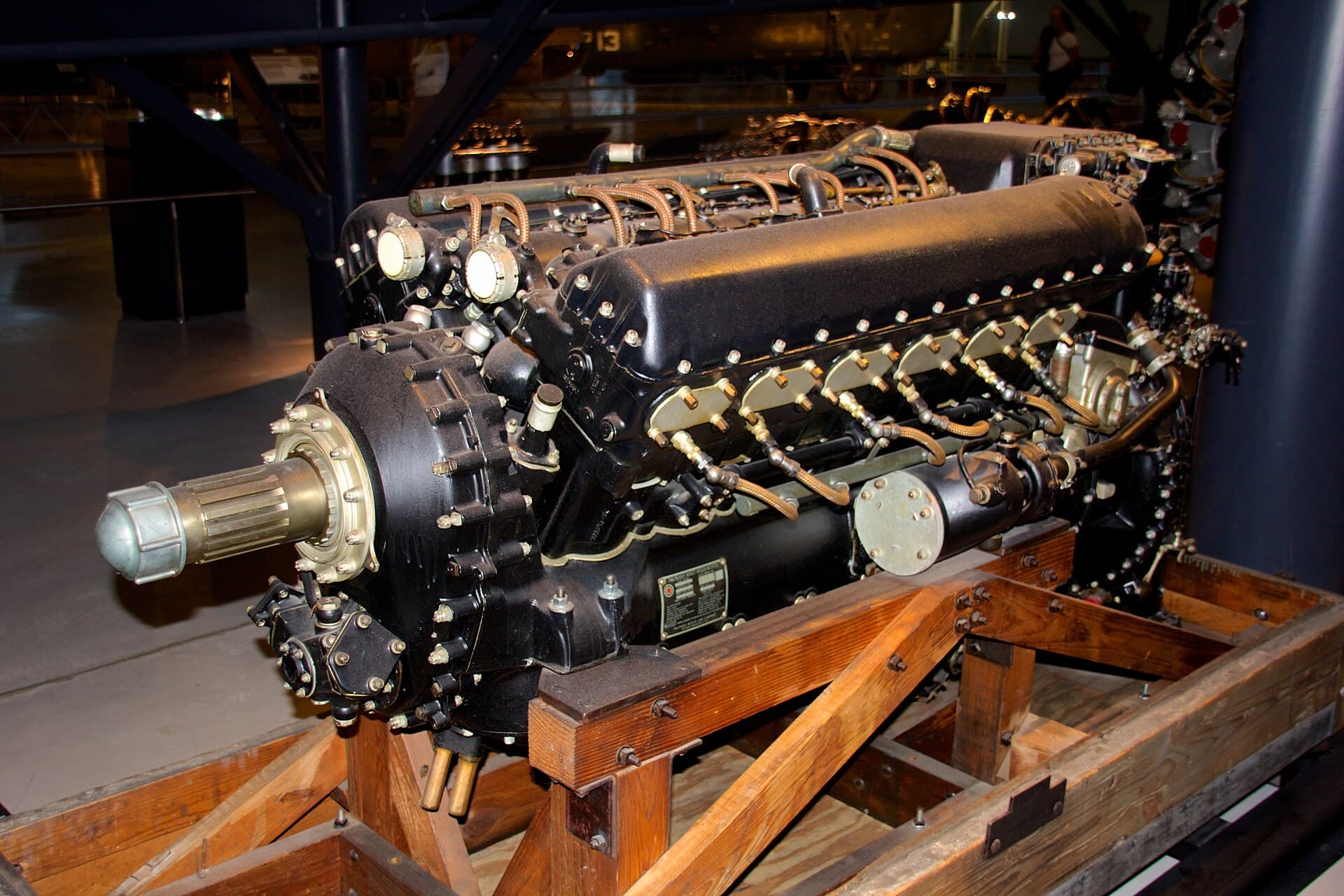
A Packard-built Merlin, designated V-1650-7, on its shipping cradle at the Smithsonian's Steven F. Udvar-Hazy Center Packard V-1650 (Merlin 28 onward)
19411,490 hpThe American licence-built family, 55,523 engines from Detroit, running from the single-stage V-1650-1 to the two-stage V-1650-7 of the P-51D.
Re-engineered for interchangeable mass production: closer tolerances, American threads and silver-lead bearings with indium plating.
Merlin 130 / 131
19442,060 hpThe slimline marks designed for the de Havilland Hornet, with handed rotation so the two engines turned opposite ways.
Reduced frontal area, downdraught induction and an S.U. injection carburettor; the highest-rated Merlins built.
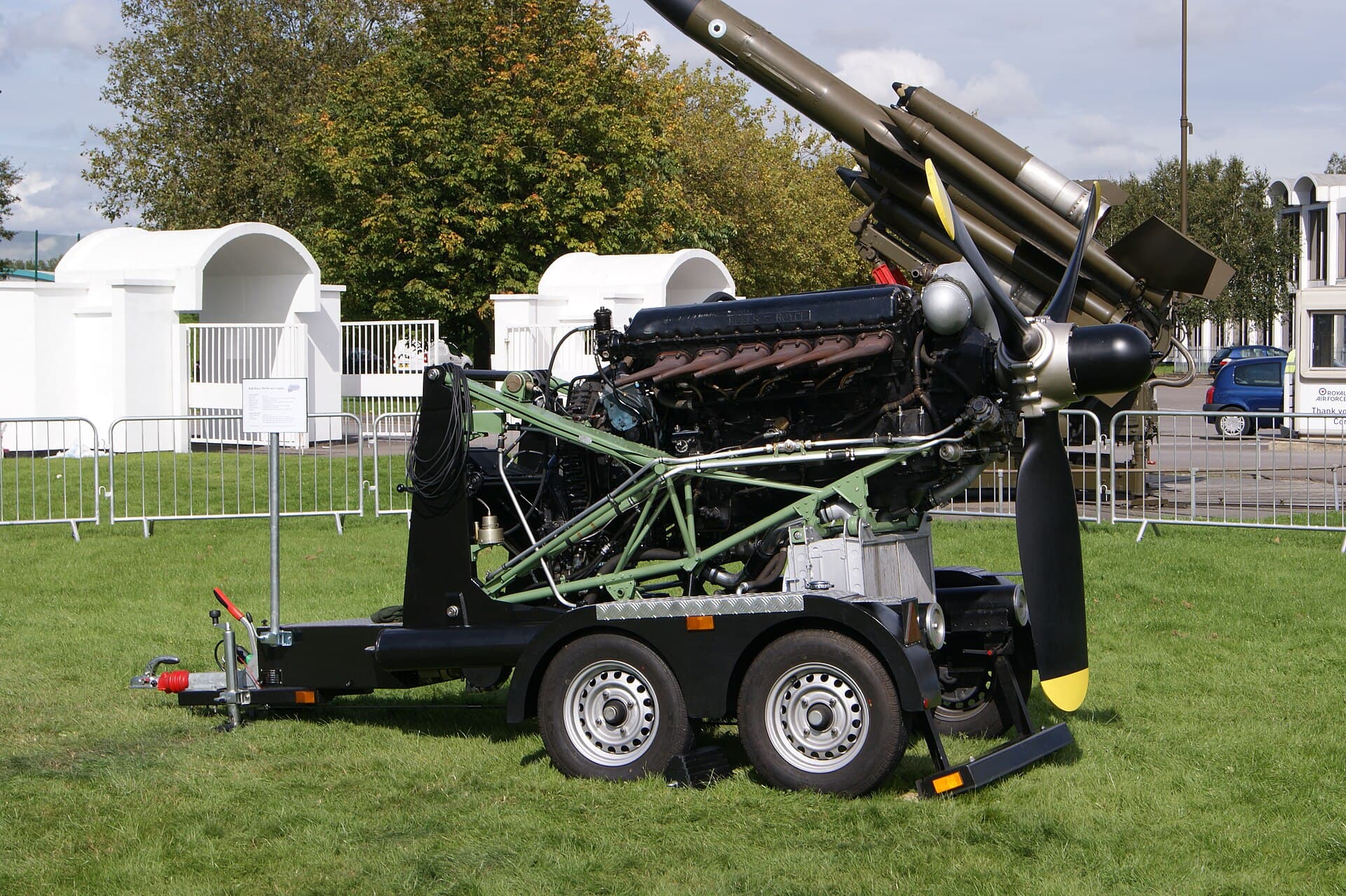 Merlin 500-29
A Merlin 500-29 mounted on a trailer with propeller fitted as a running exhibit at the Royal Air Force Museum, Hendon Merlin 500 / 600 / 700 series
1946The civil and transport marks, built until 1950 for the Lancastrian, York, Tudor and Canadair North Star.
Rated for long periods at cruise power rather than short emergency ratings, with airline overhaul lives in mind.
- Engine — Rolls-Royce Merlin 28 12-cylinder, Royal Air Force Museum
- Rolls-Royce 'Merlin III' aero engine, Science Museum Group Collection
- Merlin 45 aeroplane engine, Science Museum Group Collection
- The Rolls-Royce Merlin engine, Imperial War Museums
- Rolls-Royce Merlin R.M. 14 S.M. Mk 100 V-12 engine, Smithsonian National Air and Space Museum
- Battle of Britain Memorial Flight — our aircraft, Royal Air Force
- Rolls-Royce Engines: Merlin, Grace's Guide to British Industrial History
- Rolls-Royce Merlin, Wikipedia
- Packard V-1650 Merlin, Wikipedia
- North American Mustang Mk.X, Wikipedia
Checked September 3, 2026