Engine
Wright R-1820 Cyclone
Wright AeronauticalUnited States
- Type
- Nine-cylinder single-row radial piston engine
- Introduced
- 1931
29.87L
Displacement
1,425hp
Peak output
Figures for the R-1820, typical specification (Jane's)
General
- Type
- Nine-cylinder single-row radial piston engine
- Status
- Retired
Programme
- Introduced
- 1931
- Produced
- 1932 to 1963
- Built
- 119,975
Architecture
- Configuration
- Nine cylinders in a single row, air-cooled, single-speed supercharged
- Cylinders
- 9
- Bore
- 6.13 in
- Stroke
- 6.87 in
- Compression ratio
- 6.45:1
- Valves per cylinder
- 2
- Valve gear
- Two overhead valves per cylinder, sodium-filled exhaust valve
- Cooling
- Air-cooled
Induction and fuel
- Supercharger
- Single-speed General Electric centrifugal supercharger
- Fuel system
- Stromberg downdraft carburettor with automatic mixture control
- Fuel
- 87 octane petrol
Weight and size
- Dry weight
- 1,184 lb
- Length
- 47.76 in
- Width
- 54.25 in
Performance
- Maximum speed
- 2,200 rpm
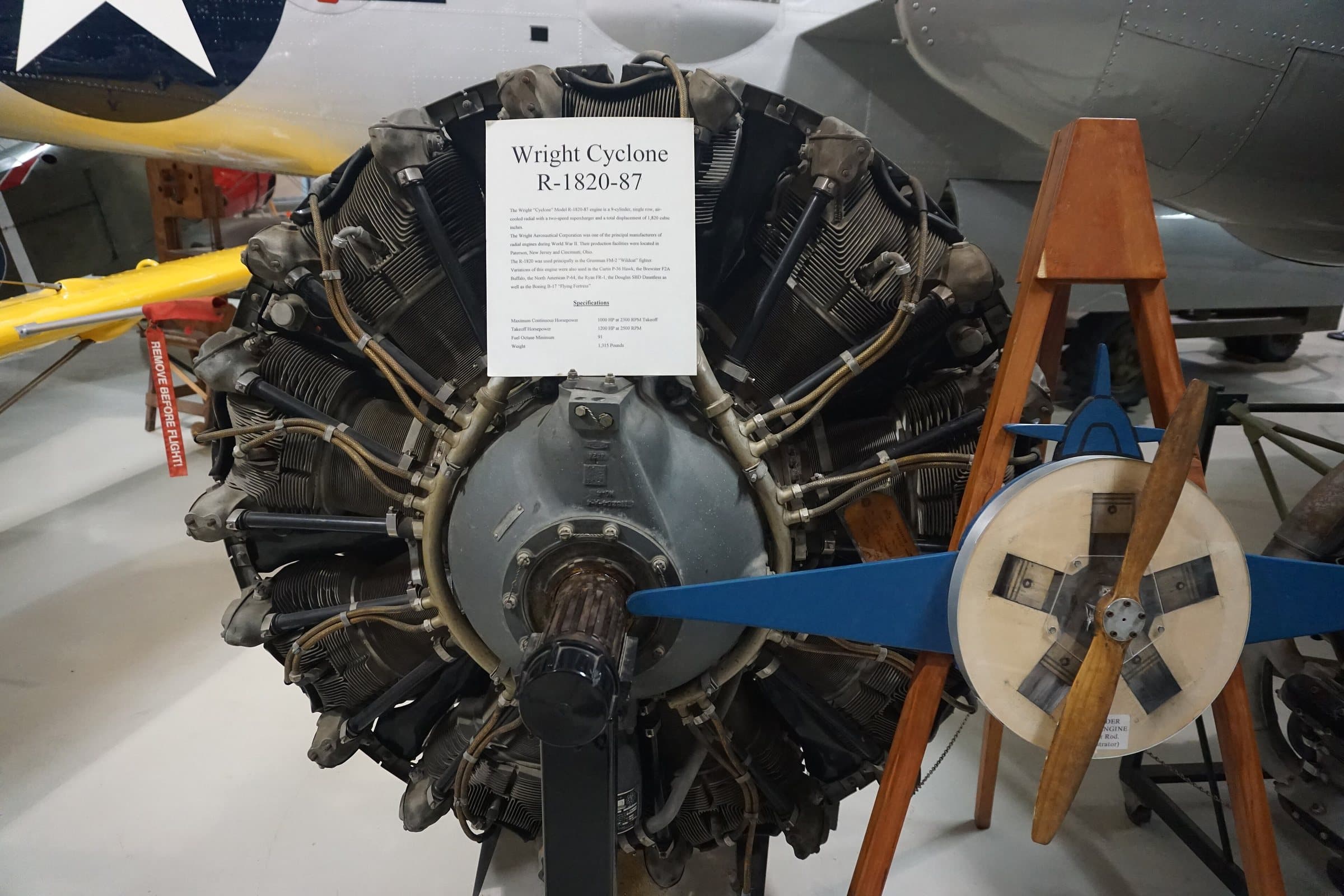
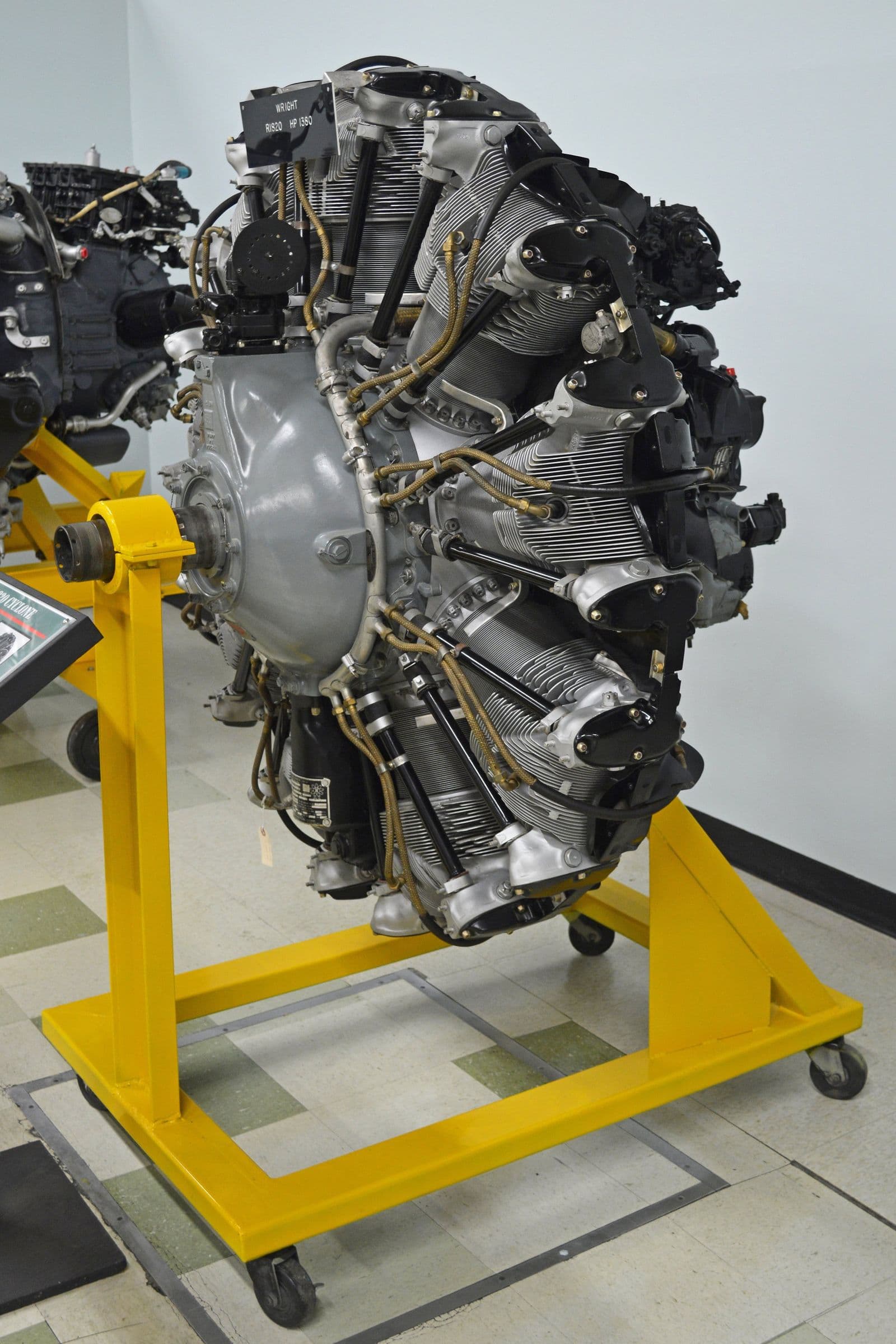
The Wright R-1820 Cyclone is a nine-cylinder, single-row, air-cooled radial of 29.87 litres, and it is one of the most-built aero engines in history: 119,975 were completed between June 1932 and December 1963, a production run of thirty-one years. It began as a 575 hp engine and ended as a 1,425 hp one without ever changing its bore, its stroke or its cylinder count, which is the whole story of piston-engine development in the 1930s and 1940s compressed into one crankcase.
It is best known for the Boeing B-17 Flying Fortress, whose four turbo-supercharged Cyclones took it to 38,000 ft and which was built 12,731 times, some fifty thousand engines in that one application alone. But the Cyclone's range is wider than any single aircraft suggests. It powered the Douglas SBD Dauntless dive bombers that broke the Japanese carrier fleet at Midway, the early civil DC-2 and DC-3 airliners, the Boeing 307 Stratoliner, the Curtiss P-36, the FM-2 Wildcat, the Lockheed Hudson, the post-war T-28 Trojan trainer, and helicopters including the Sikorsky H-34 and the Piasecki H-21. It was converted into a diesel and put into a Sherman tank. And it was built under licence in the Soviet Union, where it became the Shvetsov M-25 and then the ASh-62.
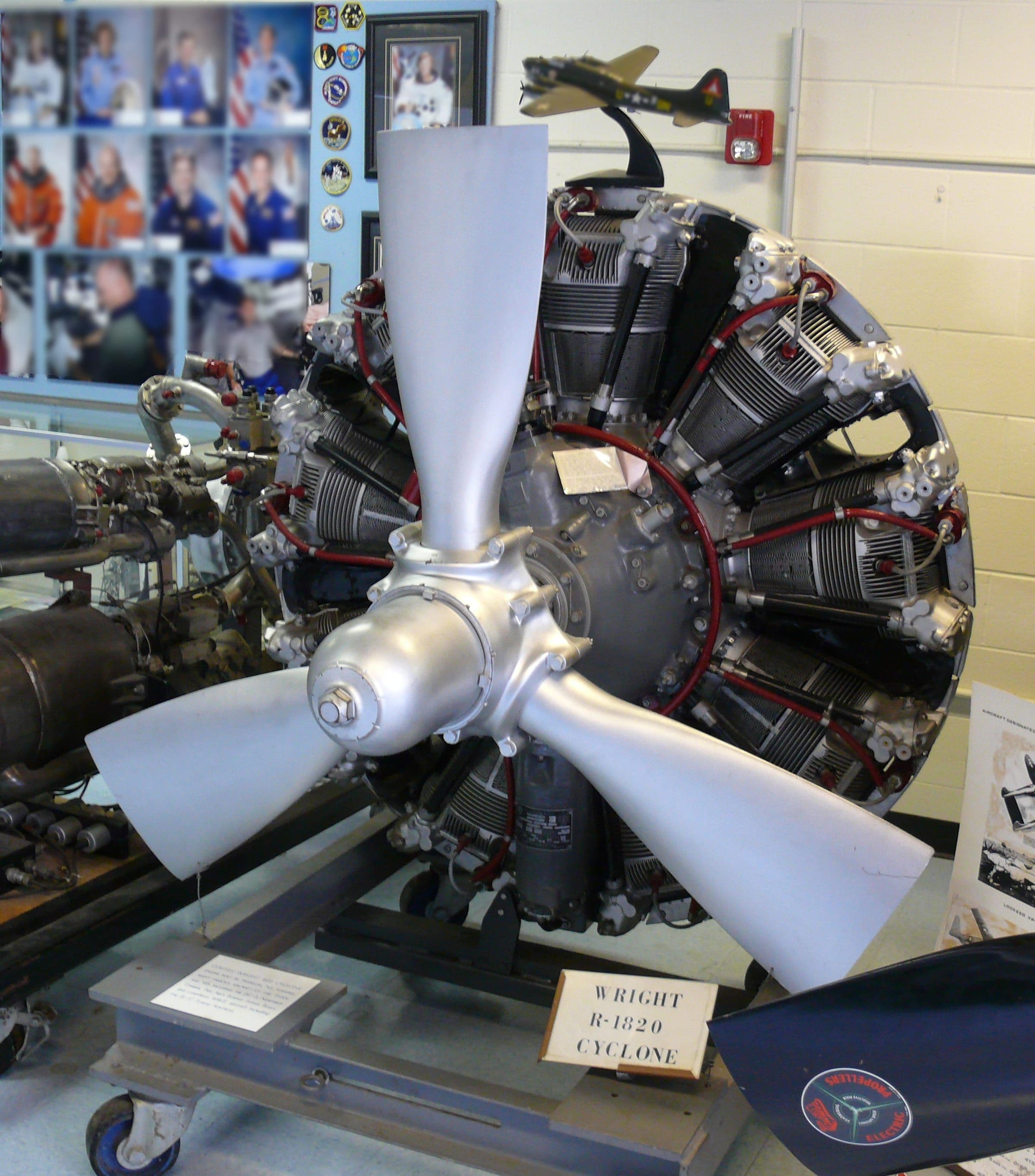
That last fact is why the Cyclone is not quite finished. The ASh-62IR is still in production today at WSK PZL-Kalisz in Poland, in a fuel-injected form introduced in 2015, for the Antonov An-2 biplanes that are still flying. The Wright R-1820 itself is retired; the engine that descends directly from it, sharing its architecture and its origins in a 1930 American type certificate, has been in continuous manufacture for more than ninety years.
One detail of the name is worth settling, because it is usually either assumed or denied. Wright Aeronautical was a direct corporate descendant of the Wright brothers' own business: the Wright Company, founded on 22 November 1909, merged with Glenn L. Martin's firm and the Simplex Automobile Company in September 1916 to form Wright-Martin, which was renamed Wright Aeronautical in 1919 after Martin left. Orville Wright had sold his interest before that merger and had nothing to do with the Cyclone. So the engine that carried the Eighth Air Force over Germany was built by a company descended from the one that built the Wright Flyer, by people who had never worked with either brother.
Aircraft fitted with this engine
Year each aircraft entered service with this engine.
- 1934SGR-1820-F series
Douglas DC-2
KLM's DC-2 Uiver won the handicap division of the 1934 MacRobertson race on two Cyclones.
- 1936Cyclone 9 on the DST, DC-3 and DC-3B
Douglas DC-3
One of two engine choices: the DC-3A and almost every military C-47 used the Pratt & Whitney Twin Wasp instead.
- 1937R-1820-45, -53
Douglas B-18 Bolo
- 1938GR-1820-39, R-1820-65, -67, -69, -97
Boeing B-17 Flying Fortress
12,731 built by Boeing, Douglas and Vega to May 1945. Four turbo-supercharged Cyclones gave it a service ceiling of {{altitude:38000ft}}.
- 1938R-1820-G5
Curtiss P-36 Hawk
- 1939R-1820-34, -40
Brewster F2A Buffalo
- 1939GR-1820-G102A, -G205A
Lockheed Hudson
Maritime patrol aircraft derived from the Lockheed Model 14.
- 1940R-1820-32, -52, -60
Douglas SBD Dauntless
The dive bomber that sank four Japanese carriers at Midway in June 1942.
- 1940GR-1820-G102
Boeing 307 Stratoliner
The first airliner with a pressurised cabin.
- 1943R-1820-56
General Motors FM-2 Wildcat
The lightweight Wildcat for escort carriers, which swapped Grumman's Twin Wasp for a single-row Cyclone.
- 1943Caterpillar RD-1820 diesel
M4A6 Sherman tank
75 built between October 1943 and February 1944 with the Caterpillar diesel conversion of the Cyclone.
- 1953R-1820-103
Piasecki H-21
- 1954R-1820-56S, -86, -103
North American T-28 Trojan
A 1,425 hp Cyclone in front of generations of American military pilots into the 1980s.
- 1955R-1820-84
Sikorsky H-34
Mounted at an angle in the nose and driving upwards through a gearbox, because no turboshaft of this power yet existed.
- Shvetsov ASh-62IR
Antonov An-2
Powered by the Cyclone's Soviet descendant, which is still manufactured new in Poland.
- Shvetsov M-25
Polikarpov I-16
The Soviet fighter that flew on the licence-built Cyclone.
- Shvetsov ASh-62IR
Lisunov Li-2
The Soviet licence-built DC-3, powered by the Soviet licence-developed Cyclone.
17 aircraft
Development
The Cyclone's ancestry runs through the whole of American air-cooled radial practice. Wright Aeronautical was itself a reorganisation: the Wright-Martin Aircraft Corporation, renamed Wright Aeronautical in 1919 after Glenn Martin left to found his own company, and moved to Paterson, New Jersey. In May 1923 it bought the Lawrance Aero Engine Company, and Charles Lawrance's air-cooled radial became the basis of the Whirlwind series: the engines that carried Lindbergh to Paris in 1927 in the shape of a J-5C, and that Amelia Earhart and Richard Byrd also used.
The Cyclone is the next size up. The line begins in 1924, when the US Navy contracted Wright Aeronautical for a nine-cylinder air-cooled radial; the first of them, the P-1, earned a reputation for fuel economy, long life, cheap maintenance and a good power-to-weight ratio. The R-1820 descends from its successor, the Wright P-2 of 1925, by way of the R-1750 Cyclone, gaining displacement and a long list of detailed improvements at each step. The R-1820-E received its approved type certificate in September 1930, production began in 1931, and series manufacture ran from June 1932. By then Wright Aeronautical no longer existed as an independent firm: it had merged with the Curtiss Aeroplane and Motor Company on 5 July 1929 to form the Curtiss-Wright Corporation, and every Cyclone was in strict fact a Curtiss-Wright product built to a Wright design in a Wright factory.
What followed was two decades of steady, unspectacular development along one axis: more power from the same engine. The E series of the early 1930s gave 575 to 775 hp. The F series took over in the middle of the decade: the SGR-1820-F2 of 750 hp was a 1934 airline engine. The G series brought the 1,000 hp figure that became the Cyclone's standard rating. The wartime military marks, running from the R-1820-56 to the R-1820-84, reached 1,200 to 1,550 hp, and the late R-1820-103 was rated at 1,425 hp. The most-produced single variant was the turbo-supercharged R-1820-97 of the B-17G, of which 64,093 were built, more than half the entire Cyclone output.
The engine also gave rise to Wright's larger radials by the simple method of adding rows. The Cyclone 14, the R-2600, is two rows of seven; the Cyclone 18, the R-3350, is two rows of nine. The nine-cylinder R-1820 is therefore both an engine in its own right and the cylinder standard from which Wright's entire wartime catalogue was assembled.
Design
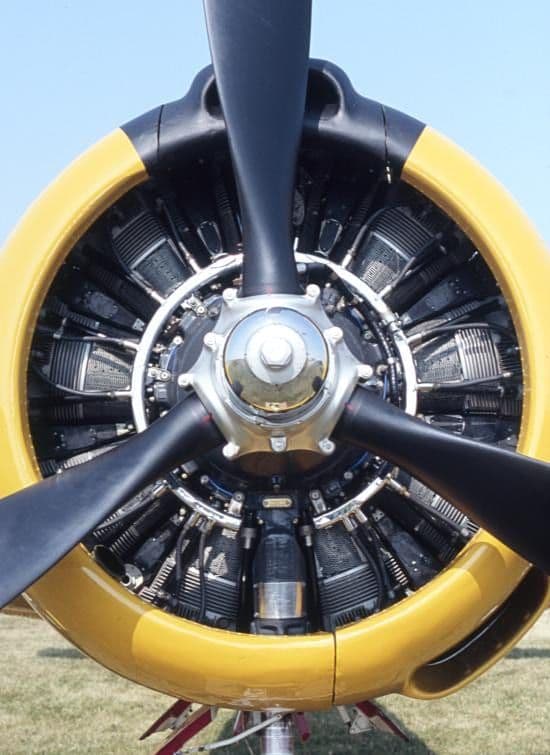
Nine cylinders arranged in a single circle around a crankcase, each of 155.6 mm bore and 174.6 mm stroke, giving 29.87 litres on a compression ratio of 6.45:1. Dry weight is 1,184 lb, length about 3.97 ft, and the frontal circle 4.53 ft across: which is the defining figure of any radial, because it is the frontal area the aeroplane has to drag through the air. A single-row nine is the classic compromise: enough cylinders for smooth running and reasonable power, few enough that every one of them sits directly in the cooling airflow.
That last point is what an air-cooled radial is for. There is no radiator, no coolant, no pump and no plumbing to be holed by gunfire; the cylinders have fins and the propeller and forward motion do the rest. The cost is drag and a certain crudeness of thermal control, and the benefit is an engine that will keep running with damage that would empty the cooling system of a liquid-cooled V-12. It is not a coincidence that the aircraft most famous for coming home shot to pieces had four of these.
Each cylinder has two overhead valves worked by pushrods, the exhaust valve sodium-filled so that the metal's own internal circulation carries heat away from the valve head: a small piece of metallurgy that does more for the reliability of a high-output air-cooled engine than almost anything else. Lubrication is dry-sump, which a radial requires: with cylinders pointing in every direction including straight down, oil cannot be allowed to collect in a pan. Fuel is metered by a Stromberg PD12K10 downdraught carburettor with automatic mixture control.
A typical Cyclone gave 1,000 hp for take-off at 2,200 rpm, at a specific fuel consumption of about 0.6 lb per horsepower-hour. Those figures are unremarkable in isolation; the point of the design is that they were achieved in an engine simple enough to be built a hundred and twenty thousand times, by several different companies in several different countries, and maintained by conscripts in a field.
One piece of radial architecture deserves spelling out, because it is what makes nine cylinders possible at all. All nine connecting rods work on a single crankpin. One of them, the master rod, is bolted to the crankpin proper and carries a ring of bearings around its big end; the other eight are articulated rods hinged to that ring. It is an elegant solution and an unforgiving one: the master rod and its bearing carry the loads of the whole engine, and a radial's overhaul life is largely a question of that one component. It is also why a radial is short and fat where an inline engine is long and thin, and why the Cyclone's crankcase is a machined forging of considerable complexity for 1930.
Supercharging
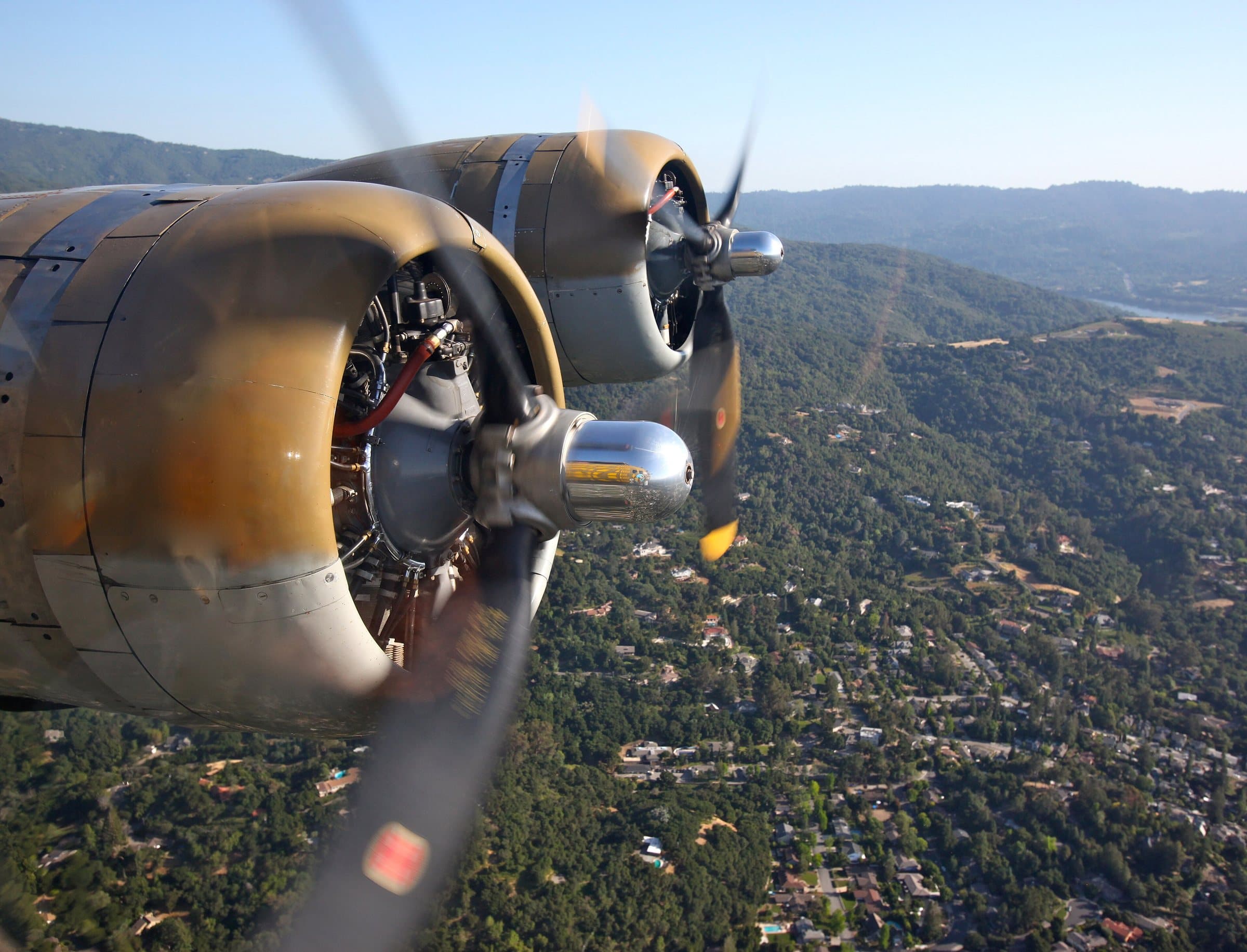 GR-1820-65
Every production Cyclone had a gear-driven supercharger: a General Electric centrifugal blower turning at 7.134 times crankshaft speed, single-speed on the standard engine, which recovers some of the power an engine loses as the air thins with altitude. That alone is ordinary. What made the Cyclone historically important is the second stage that the United States Army Air Corps bolted in front of it.
The idea was Sanford Moss's, at General Electric: use the engine's own exhaust, which is otherwise wasted energy, to spin a turbine, and use the turbine to drive a compressor that force-feeds the engine's carburettor with high-pressure air. A turbo-supercharger costs nothing in shaft power because the gas driving it has already done its work in the cylinders, and unlike a gear-driven blower its output does not fall away with height. The price is complexity, plumbing, and a turbine wheel spinning in exhaust gas at temperatures that were at the edge of 1930s metallurgy.
The fourteenth Y1B-17 was fitted with exhaust-driven GE turbo-superchargers feeding its Wright Cyclone GR-1820-39s, and the results settled the argument. The unsupercharged Y1B-17 managed 208 kt and a service ceiling of 27,800 ft. The turbo-supercharged Y1B-17A reached 270 kt and 38,000 ft. Those ten thousand extra feet and that extra speed came from recycling exhaust gas, and the whole American doctrine of high-altitude daylight precision bombing rests on that installation.
The turbo-supercharged marks are therefore the Cyclones that matter most in the record. The R-1820-65 powered earlier Fortresses, the -67 and -69 followed, and the R-1820-97 of the B-17G became the most-produced Cyclone of all. Later variants added water-methanol injection, marked with a W, which cools the charge chemically and allows a burst of extra power for take-off and emergencies without detonation. Between the gear-driven blower, the turbine and the water-methanol tank, a late Cyclone carried three separate systems whose only purpose was to put more air and less heat into a nine-cylinder engine designed in 1930.
The installation on a B-17 is worth picturing, because it explains why turbo-supercharging was so rarely done. Each engine's exhaust had to be collected and piped to a turbine mounted remotely (on the Fortress, in the underside of the nacelle) then the compressed air piped forward again through an intercooler to shed the heat of compression, then to the carburettor, with a waste gate to dump exhaust overboard whenever full boost was not wanted. That is four separate lots of ducting per engine, sixteen on the aeroplane, carrying either exhaust gas or hot compressed air through a wing full of fuel. Britain and Germany both looked at turbo-supercharging and largely declined it; the United States committed to it, and had the alloys, the manufacturing tolerances and the General Electric turbine experience to make it work.
Fuel and carburation
The standard Cyclone was certificated on 87-octane petrol, which is a low grade by the standards of late-war engines and a deliberate choice: an engine intended for airline and general military use has to run on the fuel that is actually available at the far end of a supply chain, and the compression ratio of 6.45:1 is set accordingly. A Stromberg PD12K10 downdraught carburettor with automatic mixture control does the metering, and that automatic control matters more than it sounds: it is what allows a pilot without an engineer's training to climb through twenty thousand feet without leaning the engine into detonation or drowning it.
The interesting fuel story is at the top of the range. Late marks were offered with water-methanol injection, designated by a W in the variant number. Spraying a water-methanol mixture into the induction air cools the charge by evaporation, which suppresses detonation and allows manifold pressure to be raised well above the engine's dry limit for a few minutes at a time. The methanol is there to stop the water freezing and to contribute a little energy of its own. The result is an emergency and take-off power rating that the engine could not otherwise survive, available for as long as the tank lasts, which is typically a matter of minutes.
Specific fuel consumption was around 0.6 lb per horsepower-hour, which on a four-engined bomber is an enormous quantity of petrol. The 1930s and 1940s solution was simply to carry it: a large part of what the B-17's designers were doing was arranging fuel around an engine that would burn it at that rate for eight or nine hours.
The Cyclone also proved capable of something no petrol aero engine is supposed to be. Caterpillar converted it to a fuel-injected diesel, keeping the cylinders, the crankshaft and the supercharger and designing new pistons, cylinder heads and lubrication. The result, the D200A and then the RD-1820, made 450 hp at 2,000 rpm and would run on anything from diesel oil to 100-octane petrol. That is an unusual property for a 1930 aero engine, and it is why the Cyclone ended up in a tank.
Production
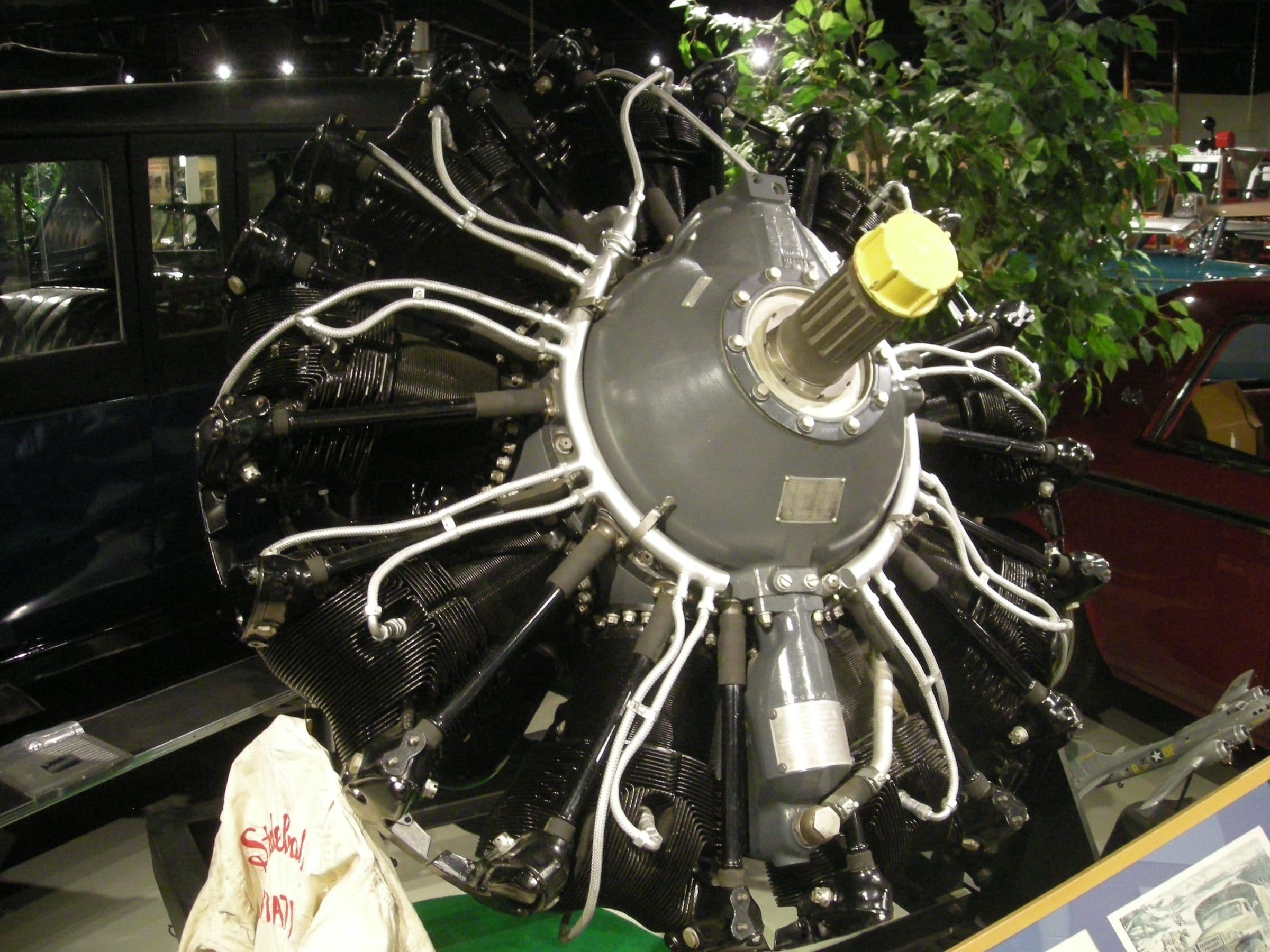
Cyclones were built at Paterson, New Jersey, from June 1932 to December 1963, and 119,975 of them were completed. Setting that number beside almost any other aero engine puts it in perspective: it is comparable with the Rolls-Royce Merlin's total, achieved by a single-row nine rather than a supercharged V-12, and spread over three decades rather than compressed into one war.
The wartime peak is the part worth describing. The Paterson plant ran three shifts with 24,000 workers and turned out something like 75,000 engines for the B-17, the B-25 and other Allied aircraft. That is a factory built around one product, staffed at a scale that no peacetime engine programme would ever justify, and it is the reason the R-1820's production figures look the way they do. The plant closed in 1946, almost immediately after the demand that had built it disappeared.
Wright could not build them all, and did not try. During the Second World War the Cyclone was also manufactured by Lycoming, by Pratt & Whitney Canada: a competitor building a rival's engine, which tells you how the war reorganised American industry: and by Studebaker, the South Bend car maker, which produced Cyclones for the B-17. A Studebaker-built B-17 engine is preserved at the Studebaker National Museum in Indiana, which is a fair summary of what happened to the American motor industry between 1941 and 1945.
The distribution of that output across variants is lopsided in a way that reflects the war rather than the engine. The single most-produced mark, the turbo-supercharged R-1820-97 of the B-17G, accounts for 64,093 engines: more than half of every Cyclone ever built, for one version of one bomber. Everything else in a thirty-one-year production run, every airliner engine and trainer engine and helicopter engine and every variant from the 575 hp -1 onwards, shares the remaining half between them.
It is worth putting the Cyclone beside the engine it is most often compared with. Rolls-Royce and its licensees built roughly 150,000 Merlins; Wright and its licensees built 119,975 R-1820s and then a further 40,361 ASh-62s came out of Soviet factories. On the American side the totals are genuinely industrial rather than military: the Cyclone was in production for a decade before the war and for eighteen years after it, selling to airlines, trainers, helicopter builders and export customers throughout. The Merlin's production curve is a spike; the Cyclone's is a plateau with a spike on it.
Licence production
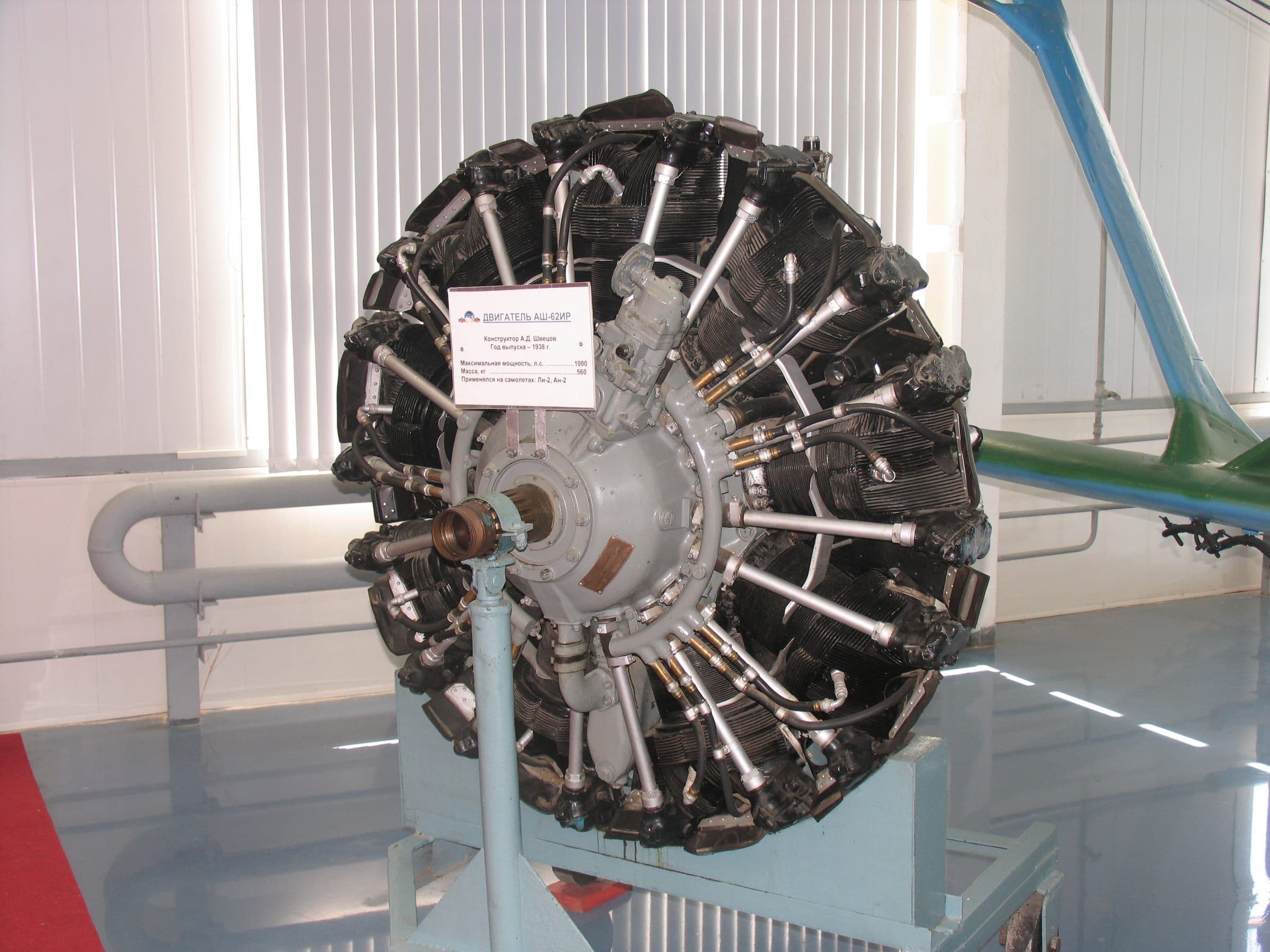
The Cyclone was licensed more widely than almost any other American engine of its era, and one of those licences outlived the original.
In Spain, Hispano-Suiza built it as the 9V, in a long series of sub-variants from the 9Vr, 9Vb and 9Vd through the 9V-10 to the 9V-17. In the Soviet Union, the licence had consequences nobody at Paterson intended. A design bureau was formed under Arkadiy Shvetsov specifically to convert the American specification to metric units for Soviet state-factory production, and the resulting engine was designated the M-25. That bureau then kept going. The M-25 was developed with a two-speed supercharger and a redesigned induction system into the ASh-62, which first ran in 1937 and raised the output from the Cyclone's 775 hp to 1,000. Roughly 40,361 ASh-62s were built in the Soviet Union alone, on top of Wright's own 119,975.
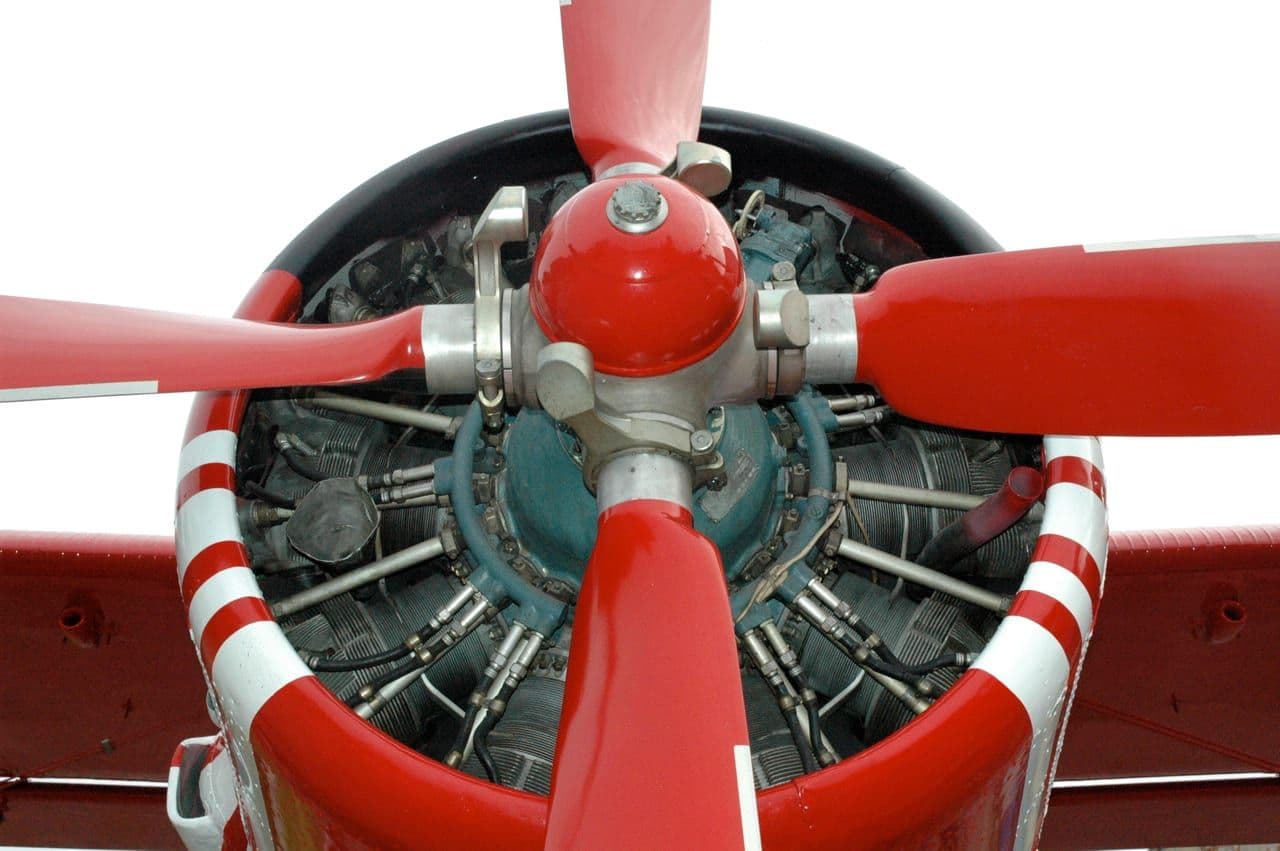
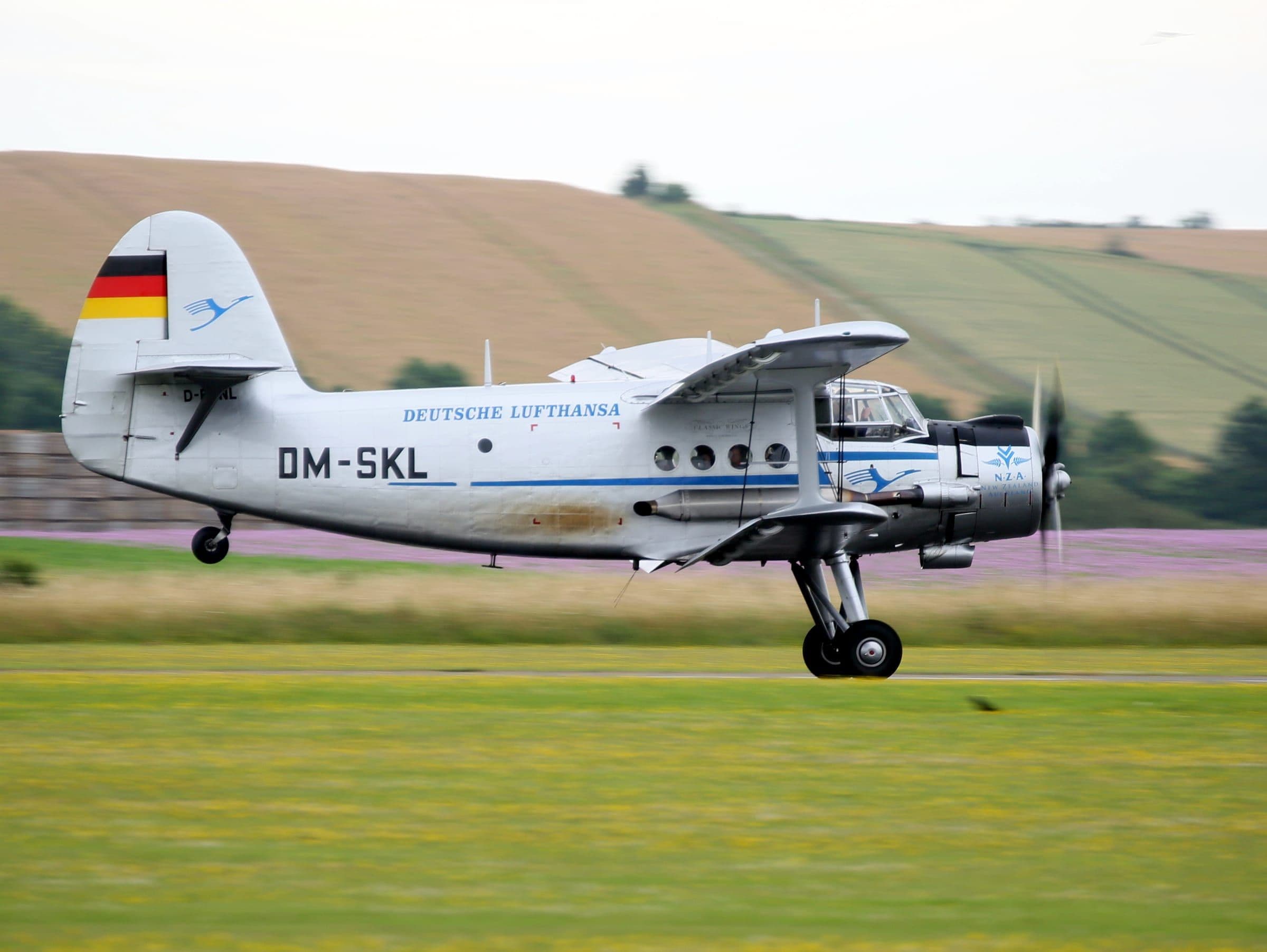
What the ASh-62 powered reads like a separate history of Soviet aviation: the Polikarpov I-16 fighter, the I-153, the Lisunov Li-2, itself a licensed DC-3, and the Antonov An-2, the enormous single-engined biplane utility aircraft that first flew in 1947 and was built in tens of thousands. The People's Republic of China produced its own versions as the HS-5.
And this is where the story does not end. WSK PZL-Kalisz in Poland still manufactures the engine as the ASz-62IR, and in 2015 introduced the ASz-62IR-16E with electronic fuel injection. An An-2 delivered today, or an An-2 overhauled today, can be fitted with a brand-new engine whose bore, stroke and cylinder arrangement were fixed by a Wright type certificate issued in September 1930. Very few pieces of 1930s engineering have had a continuous production life of more than ninety years; this one has, and it got there by being licensed to a country that then never stopped needing it.
There is a political oddity in all this that the engineering records pass over. The Soviet M-25 went into the Polikarpov I-16, and I-16s flew for the Republic in the Spanish Civil War against Nationalist aircraft that included Hispano-Suiza 9Vs: which is to say, licensed Cyclones on both sides of the same war. A few years later, American-designed cylinders were fighting over the Eastern Front in Soviet fighters and over Germany in American bombers simultaneously. Licensing an engine in the 1930s meant losing control of where it ended up, and the Cyclone ended up nearly everywhere.
Reliability and maintenance
The Cyclone's reputation rests on a quality that is hard to measure and easy to recognise: it kept running. The reason is structural rather than a matter of workmanship. An air-cooled radial has no cooling system to lose. There is no radiator to be holed, no coolant to boil away, no pump to seize and no header tank to be punctured by a fragment. A liquid-cooled engine with a hole in its radiator has minutes; an air-cooled radial with a cylinder shot off has nine cylinders less one, and will generally get you home on the remainder.
That property was tested more thoroughly than anyone would have chosen. B-17 crews returned repeatedly in aircraft that had been, as one pilot put it, cut and slashed almost to pieces by enemy fire; engines destroyed, control surfaces shredded, structure missing. The photographs of those aircraft are part of the type's mythology, and the four Cyclones are part of why there were aircraft left to photograph. It is worth being careful about the claim, though: the Fortress's survivability was a matter of its structure and its systems redundancy as much as its engines, and a B-17 with two engines out on one side was in serious trouble whatever the cooling arrangement.
The detailed reliability engineering is in the small things. The sodium-filled exhaust valve carries heat out of the hottest part of the cylinder by internal convection. The dry-sump lubrication system handles an engine whose cylinders point in nine different directions. The automatic mixture control keeps a pilot from destroying the engine by inattention at altitude. None of these is glamorous and all of them are the difference between an engine that reaches overhaul and one that does not.
The converse should be stated honestly. Late Cyclones were being pushed hard: 1,425 hp from a 1930 crankcase, with a turbine in the exhaust and water-methanol in the induction: and high-output air-cooled radials are demanding engines to maintain. Cylinder head temperatures, valve condition and ignition timing all matter continuously rather than occasionally, and the consequence of neglect arrives as a partial power loss at low altitude. Eighty years later, that is still the mode by which these engines hurt people.
Applications
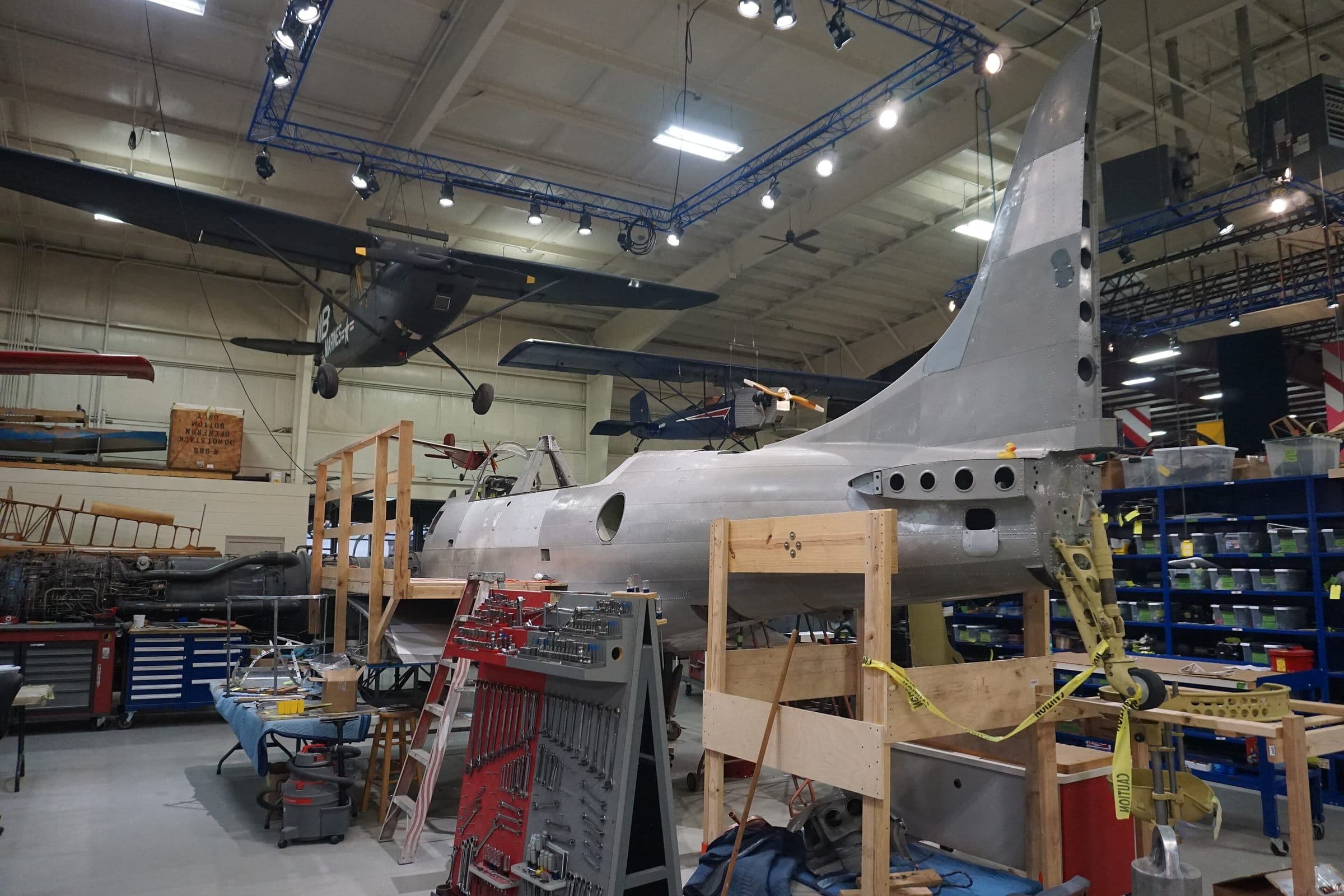
The B-17 is the headline, and it is worth stating what four Cyclones made possible. Boeing, Douglas and Vega together built 12,731 Flying Fortresses by the end of production in May 1945. The prototype Model 299 had actually flown on Pratt & Whitney R-1690 Hornets; the Cyclone arrived with the service aircraft, and the turbo-supercharged installation gave the type the altitude on which the whole American bombing campaign was predicated.
At sea, the Cyclone powered the Douglas SBD Dauntless, the dive bomber that sank four Japanese carriers at Midway in June 1942, and the General Motors FM-2 Wildcat, the lightweight Wildcat built for escort carriers, which swapped Grumman's Twin Wasp for a single-row Cyclone precisely because a lighter, simpler engine suited a smaller deck. The Brewster F2A Buffalo and the Grumman F3F biplane fighter used it too.
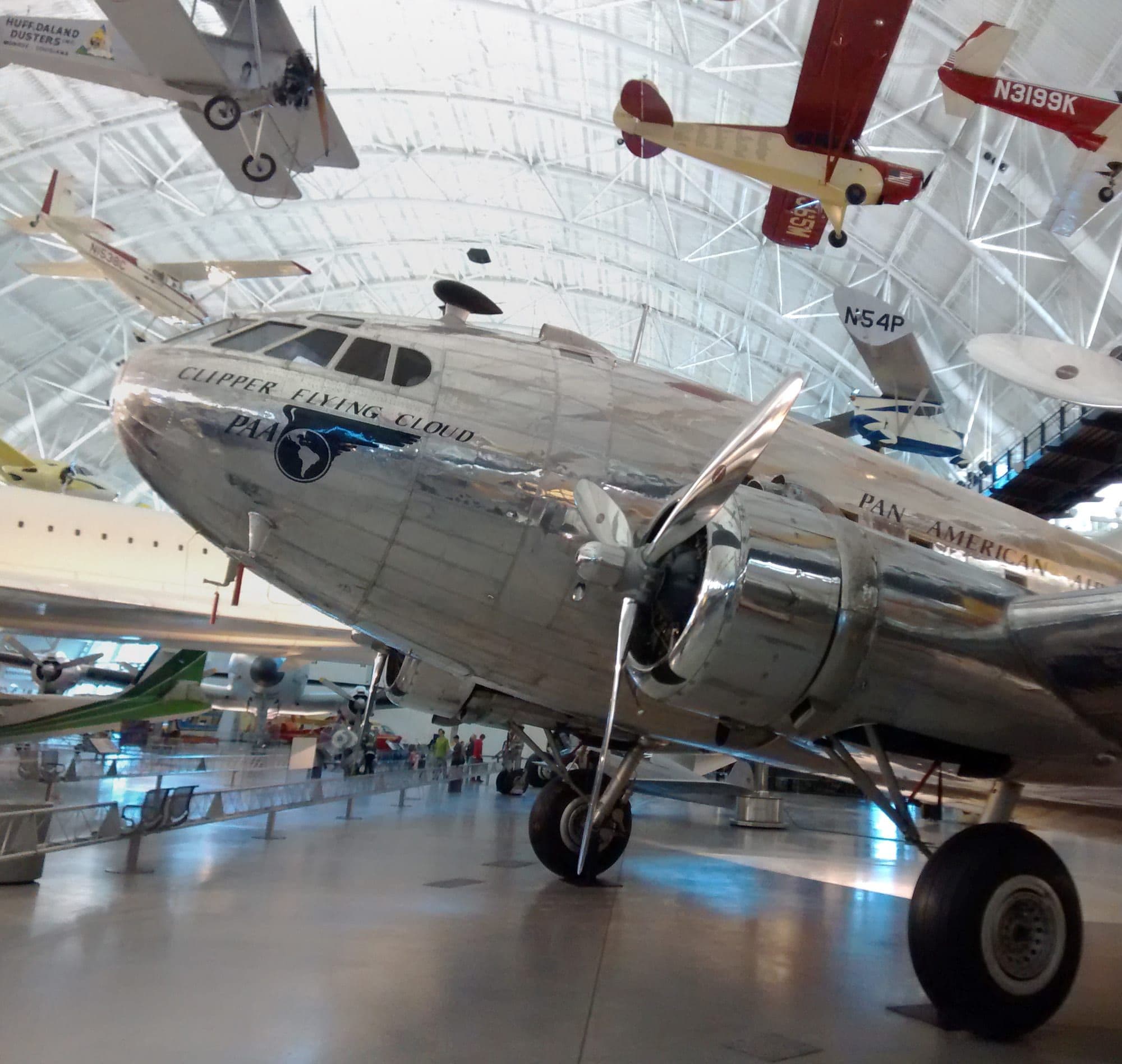
In civil aviation the Cyclone's position was more contested. It powered the Douglas DC-2, and it was one of two choices on the DC-3: the Douglas Sleeper Transport and the baseline DC-3 and DC-3B used Cyclones, while the DC-3A and almost every military C-47 used the Pratt & Whitney R-1830 Twin Wasp instead, which is why the Twin Wasp is the engine most people associate with the type. It also powered the Boeing 307 Stratoliner, the first airliner with a pressurised cabin, and Lockheed's Model 14, Model 18 and the Hudson maritime patrol aircraft derived from them.
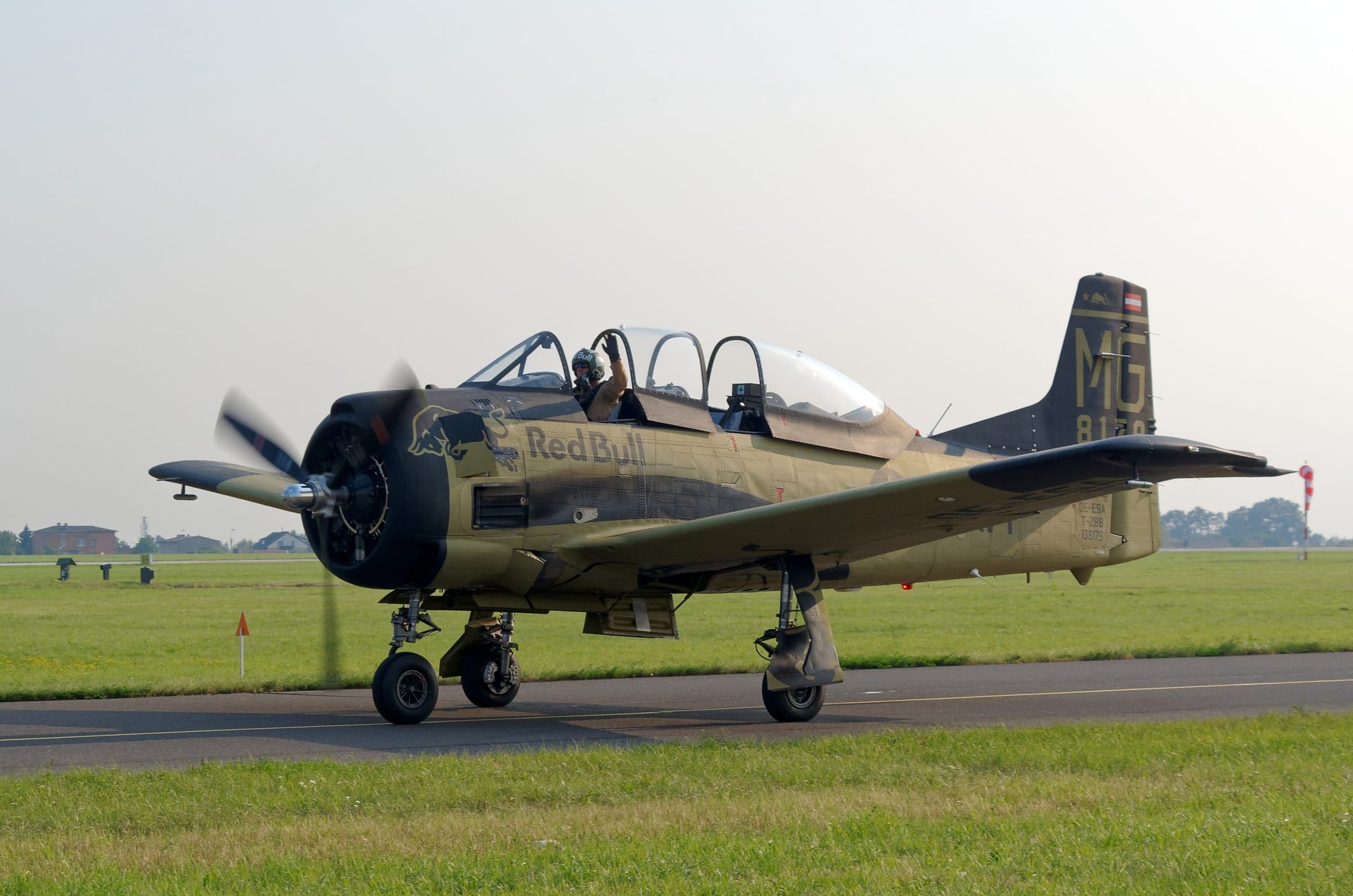
After the war the Cyclone found two second careers. The North American T-28 Trojan trainer put a 1,425 hp Cyclone in front of generations of American military pilots into the 1980s. And the early large helicopters used it because nothing else of the right power existed: the Sikorsky H-34 and the Piasecki H-21 both fly on a Cyclone mounted, unusually, at an angle in the nose or the fuselage and driving upwards through a gearbox.
Then there are the tanks. The Wright G-200, a 900 hp Cyclone derivative, was selected for the M6 heavy tank, though no suitable transmission was available for it. The Caterpillar diesel conversion went further: 75 M4A6 Shermans were built between October 1943 and February 1944 with the RD-1820, making them the only Shermans powered by a converted aero engine of this family. It is a small footnote, and it is also a nine-cylinder radial aircraft engine driving a tank's tracks.
Records
The Cyclone's best claim to a place in the record books was made in 1934, by an airliner, in a race.
The MacRobertson International Centenary Air Race ran from Mildenhall in England to Melbourne, and about twenty aircraft left on 20 October 1934. Most were racers. One was a scheduled airliner: PH-AJU, a KLM Douglas DC-2 named Uiver, with two Wright Cyclone SGR-1820-F2s of 750 hp each, flown by Captain Koene Dirk Parmentier with First Officer Jan Moll, flight engineer Bouwe Prins and radio operator Cornelis van Brugge, carrying three passengers and mail. It covered 10,733 nm in a total elapsed time of 90 hours 17 minutes, of which 71 hours 29 minutes were flying and 18 hours 48 minutes were spent on the ground. It won the handicap division outright and finished second on elapsed time, beaten only by a purpose-built de Havilland DH.88 Comet racer.
The detail that made it famous happened on the last leg. Flying from Charleville in Queensland towards Melbourne, the Uiver was lost in a violent storm at night. The town of Albury in New South Wales improvised an airfield: the racecourse, with the inner field marked out and lit by the headlights of townspeople's cars, and the aircraft put down there at 1:20 in the morning of 24 October on ground saturated by heavy rain. In the morning the townsfolk pulled the airliner bodily out of the mud, the crew stripped it of every removable weight, and it took off from a racecourse and flew on to finish the race.
That is a remarkable performance for a commercial aeroplane on scheduled-airline engines, and it did a great deal for the reputation of both the DC-2 and the Cyclone at exactly the moment the American airliner was displacing everything else in the world. The postscript is grim. The Uiver crashed near Rutbah in Iraq on 20 December 1934, less than two months after Melbourne, on a mail flight; all seven people aboard were killed.
The wider significance of that fortnight in 1934 was commercial rather than sporting. A scheduled airliner on production engines, carrying passengers and mail, had come within hours of a purpose-built racer over nineteen thousand kilometres, and had comfortably beaten every other aircraft in the field. European airlines and European governments drew the obvious conclusion about all-metal American monoplanes with Cyclones on the wings, and the DC-2 and then the DC-3 proceeded to take the world's airline market. The race did not make that happen, but it is the moment at which it became publicly undeniable, and the engines that did it were ordinary 750 hp Wright Cyclone SGR-1820-F2s off the shelf.
Preservation
R-1820s survive in quantity, both as museum objects and as working engines. Preserved examples are displayed at the National Air and Space Museum, the National Museum of the United States Air Force, the San Diego Air and Space Museum, the American Airlines C. R. Smith Museum, the Aviation Hall of Fame and Museum of New Jersey (appropriately, given where they were built) the Cavanaugh Flight Museum in Texas, the Wings of Freedom museum in Pennsylvania, and the Studebaker National Museum in Indiana, which holds one of the B-17 engines its own factory made.
The flying population is a different matter, and a more precarious one. Airworthy B-17s, SBDs, T-28s and An-2s all depend on people who can maintain a high-output air-cooled radial to a standard the engine was designed to demand. Parts are made in small batches, overhaul shops are few, and the knowledge is held by a shrinking number of individuals. For the ASh-62 line the position is much easier, because PZL-Kalisz still builds the engine new; for the Wright marks it means scavenging, remanufacture and careful record-keeping.
The cost of getting that wrong is on the record. The B-17G Nine-O-Nine, operated by the Collings Foundation and photographed on this page in 2009 with its Wright Cyclone GR-1820-65s, crashed at Bradley International Airport in Connecticut on 2 October 2019. It had lost partial power on one right-side engine and then on the second, and the attempt to return to the runway ended about a thousand feet short of it. Seven of the thirteen people aboard were killed, six more and one person on the ground were injured, and the aircraft burned. The subsequent investigation and litigation turned on maintenance. It is the plainest available statement of what these engines ask of the people who keep them flying, eighty years after the factory that built them closed.
The R-1820 itself is retired: no new Wright Cyclone has been built since December 1963. But between the museum collections, the airworthy warbirds and the Polish production line turning out the engine's Soviet-descended cousin, the Cyclone is one of the very few 1930s aero engines a visitor can still reliably hear running.
Legacy
Inside Wright's own catalogue, the R-1820 is the unit of account. The Cyclone 14, the R-2600, is two rows of seven cylinders of essentially this kind, and the Cyclone 18, the R-3350 that powered the B-29, is two rows of nine. Having got one nine-cylinder row right in 1930, Wright spent the next fifteen years multiplying it, and the difficulties of the R-3350, which caught fire with some regularity early in its life, are largely the difficulties of cooling a second row of the same cylinders hidden behind the first. The R-1820's architecture defined what Wright could and could not do for the rest of the piston era.
Its wider legacy is the one visible from an airfield today. The Soviet licence produced the M-25, the M-25 produced the ASh-62, and the ASh-62 is still being manufactured. PZL-Kalisz in Poland builds the ASz-62IR, and since 2015 has offered it with electronic fuel injection. The aircraft it goes into, the Antonov An-2, first flew in 1947 and remains in service in numbers across eastern Europe, central Asia and elsewhere, doing agricultural work, parachute dropping, freight and bush flying. Anyone who watches an An-2 start up is watching the direct descendant of a 1930 Wright type certificate turn over, and hearing very nearly the same noise a DC-2 made.
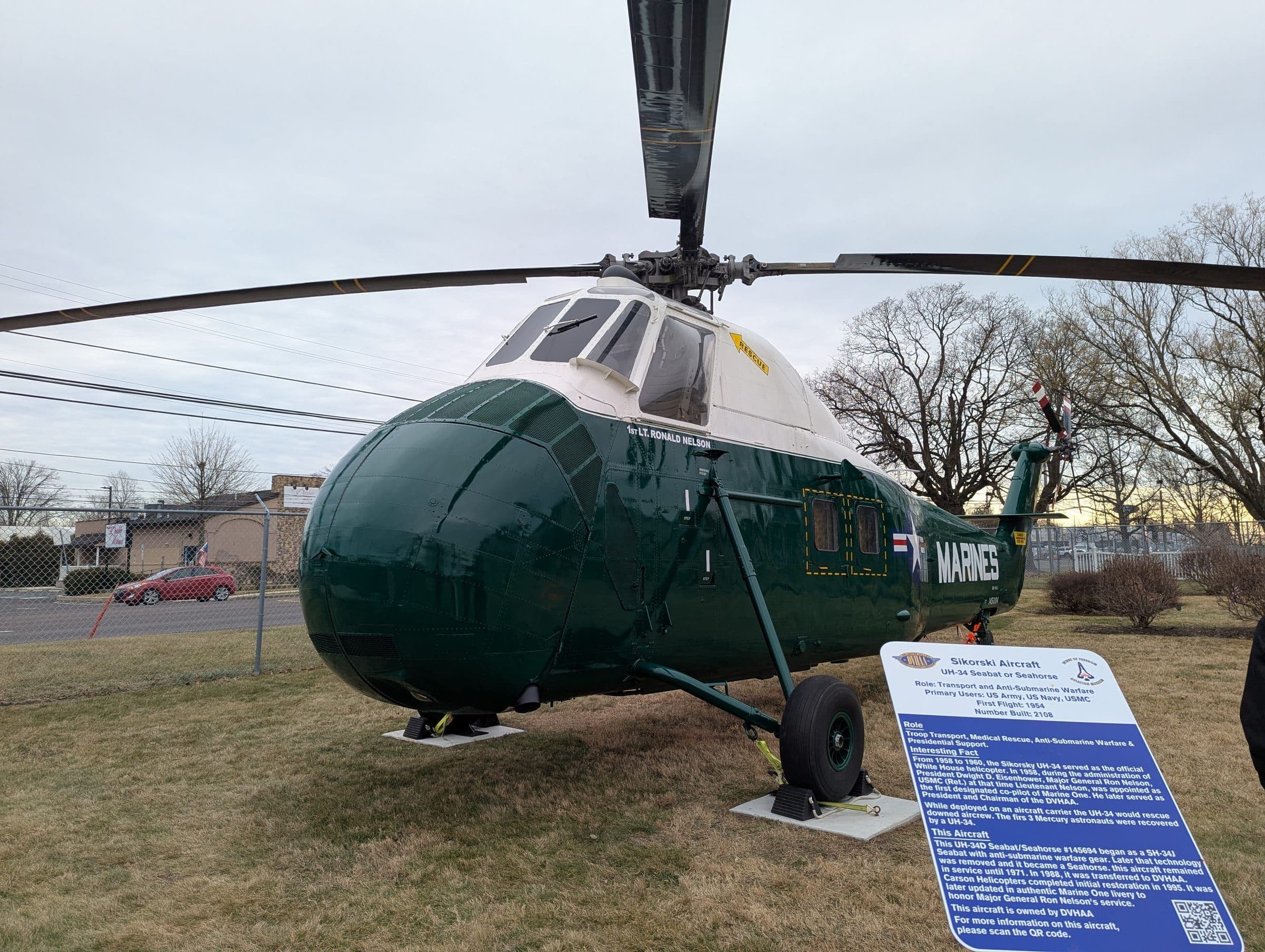
The Cyclone also had a hand in the helicopter. The first generation of genuinely useful transport helicopters (the Sikorsky H-34, the Piasecki H-21) needed several hundred horsepower in a package that could be mounted at an odd angle and driven through a gearbox, at a moment when turbine engines were not yet available in that class. A single-row radial was the answer, and for a few years in the 1950s the Cyclone was quietly the engine on which military rotary-wing aviation was built, before the turboshaft made it obsolete in that role almost overnight.
And the 119,975 figure is itself a kind of legacy. It is the scale on which industrial nations built aero engines in the middle of the twentieth century, and nothing since has come close: a modern airliner engine sells in the low thousands over a thirty-year programme. The Cyclone belongs to the last era in which a single piston engine could be built more than a hundred thousand times.
There is a last, unquantifiable legacy, which is a noise. A nine-cylinder radial at idle has a lumpy, irregular beat quite unlike a V-12 or a flat four, and at full power it produces the hard even roar that is the sound of 1930s and 1940s aviation in every newsreel and every film. Because the Cyclone was built in such numbers and in so many roles, and because its Soviet cousin is still in production, that sound has never entirely left the world's airfields. It is the reason an An-2 starting up draws a crowd at a European airshow, and the reason a B-17 run-up is an event rather than a formality.
Output by altitude
A piston engine has no single power figure. Each rating below is what the sources publish for one mark under one set of conditions, at the altitude it was measured at.
| Mark and conditions | Altitude | Output |
|---|---|---|
| Take-off, typical G-series Cyclone2,200 rpm · 87 octane | Sea level | 1,000hp |
| Early E-series rating1,900 rpm · 87 octane | Sea level | 575hp |
| R-1820-103, late high-output mark2,700 rpm · 100/130 octane | Sea level | 1,425hp |
Mark evolution
R-1820-E
1931575 hpThe first Cyclone, granted its approved type certificate in September 1930.
Developed from the Wright P-2 of 1925 by way of the R-1750 Cyclone, with greater displacement.
R-1820-25
1934775 hpThe upper end of the early E-series ratings.
SGR-1820-F2
1934750 hpThe airline engine of the mid-1930s; two of these carried KLM's DC-2 Uiver to second place on time in the MacRobertson race.
GR-1820-G2
19371,000 hpThe G series brought the 1,000 hp rating that became the Cyclone's standard figure.
1,000 hp at 2,200 rpm on 87 octane, with a single-speed General Electric supercharger geared at 7.134:1.
GR-1820-39
19371,000 hpThe engine of the early Y1B-17s, and the one fitted with General Electric exhaust-driven turbo-superchargers on the fourteenth aircraft.
The turbo-supercharged installation raised the aircraft's service ceiling from 27,800 ft to 38,000 ft and settled American bombing doctrine.
R-1820-32
19401,000 hpA standard military mark of the early war years.
R-1820-34A
19411,200 hpImproved altitude performance.
R-1820-56
19421,350 hpHigh-output wartime mark; the -56 to -84 series covered 1,200 to 1,550 hp.
- GR-1820-65
Two of the four Wright Cyclone GR-1820-65 engines of the B-17G Nine-O-Nine in 2009, the aircraft lost at Bradley in 2019 R-1820-65
19411,200 hpA turbo-supercharged mark for earlier B-17 models.
R-1820-97
19431,200 hpThe turbo-supercharged engine of the B-17G, and the most-produced Cyclone of all: 64,093 built, more than half of total output.
The definitive wartime Cyclone by volume, in the definitive wartime installation.
A North American T-28 Trojan of the Flying Bulls at the Radom Air Show in 2017 R-1820-103
19481,425 hpThe late high-power mark, used in the post-war T-28 Trojan trainer.
Caterpillar D200A / RD-1820
1943450 hpA fuel-injected diesel conversion for tank use, 75 of which went into M4A6 Sherman tanks between October 1943 and February 1944.
Caterpillar kept the Cyclone's cylinders, crankshaft and supercharger and designed new pistons, cylinder heads and lubrication, plus a transfer case stepping shaft speed up to 1.5 times crankshaft speed. A multi-fuel tank engine that would run on anything from diesel oil to 100-octane petrol.
Wright G-200
900 hpA 900 hp Cyclone derivative selected for the M6 heavy tank, for which no suitable transmission was available.
Shvetsov M-25
1934775 hpThe Soviet licence-built Cyclone, converted to metric units by a design bureau formed for the purpose under Arkadiy Shvetsov.
Soviet state-factory production of an American specification.
A Shvetsov ASh-62IR at the Russian Air Force Museum in 2011: the Soviet development of the licence-built Cyclone Shvetsov ASh-62IR (Polish ASz-62IR)
19371,000 hpThe Soviet development of the M-25, and the only member of the family still in production: WSK PZL-Kalisz in Poland builds it today, and added an electronically fuel-injected version in 2015.
A two-speed supercharger and an improved induction system raised output from 775 hp to 1,000.
Roughly 40,361 built in the Soviet Union, and still the engine of the Antonov An-2.
Hispano-Suiza 9V
775 hpSpanish licence production, in sub-variants from the 9Vr, 9Vb and 9Vd through the 9V-10 to the 9V-17.
- Wright Cyclone R-1820-97 (Studebaker), Radial 9 Engine, National Air and Space Museum, Smithsonian Institution
- Engine, Wright Cyclone R-1820-73 (722-C9GC), Radial 9, National Air and Space Museum, Smithsonian Institution
- Wright Cyclone B-17 bomber engine, built by Studebaker, Studebaker National Museum, via Wikimedia Commons
- Medium Tank M4A6, Tank Encyclopedia
- Uiver Memorial — the MacRobertson Trophy Air Race, Uiver Memorial, Albury
- 2019 Boeing B-17 Flying Fortress crash, Wikipedia
- Wright R-1820 Cyclone, Wikipedia
- Wright Aeronautical, Wikipedia
- Shvetsov ASh-62, Wikipedia
- Boeing B-17 Flying Fortress, Wikipedia
Checked September 25, 2026