Airline
Singapore Airlines
SQ · SIA · SINGAPORESingaporeTemasek Holdings (majority)
Identity
- IATA
- SQ
- ICAO
- SIA
- Callsign
- SINGAPORE
- Founded
- May 1, 1947
- First service
- 1972
Company
- Headquarters
- Airline House, Changi, Singapore
- Country
- Singapore
- Parent
- Temasek Holdings (majority)
- Status
- Operating
Network
- Alliance
- Star Alliance, joined 2000
Hubs and bases
Singapore Changi AirportSIN
Hub
Singapore Airlines is the flag carrier of a country roughly the size of a large city, and that single fact explains almost everything about it. Singapore has no domestic market: not one route that begins and ends inside its own borders. Every seat the airline sells must be sold to someone choosing to fly through Singapore rather than somewhere else, which means the airline has never had the cushion of captive traffic that sustained most national carriers through their difficult decades. It competes, or it does not fly.
What it built on that unpromising ground is one of the most consistently admired airlines in the world: a carrier whose name is used as shorthand for a standard of service, whose cabin crew uniform is among the most recognised pieces of corporate design ever commissioned, and which for long stretches has been among the few airlines making money reliably at the premium end of a business that mostly does not.
The airline flies from Changi Airport, is majority owned by the Singapore government's investment company Temasek Holdings, and has been a member of Star Alliance since April 2000. In the financial year ended 31 March 2025 the group carried a record 39.4 million passengers and reported record revenue of S$19,540 million, with a passenger load factor of 86.6 per cent. Its operating fleet stood at 205 aircraft with an average age of seven years and eight months, serving 128 destinations in 36 countries and territories.
That fleet age is not incidental. Running young aeroplanes and selling them before they become old is a deliberate and expensive strategy the airline has followed for most of its existence, and it is the mechanism behind a good deal of what passengers experience as quality.
Formation
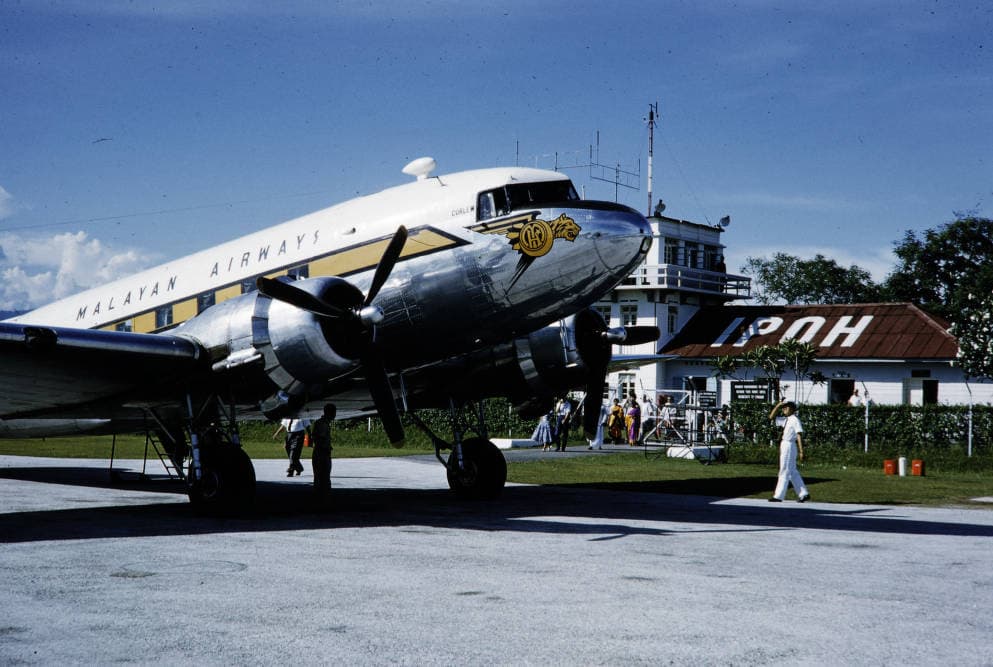
The airline's paperwork begins on 21 October 1937, when Malayan Airways Limited was incorporated in Singapore as a joint venture between Britain's Imperial Airways, the Ocean Steamship Company of Liverpool and the Straits Steamship Company. Two shipping lines and an airline is an unusual combination, and it reflects what air transport was in the region at the time: an extension of the sea routes, run by the people who already moved goods and passengers through the Straits.
Then the war came, and the Japanese occupation of Singapore, and the company that had been incorporated in 1937 did not fly a single fare-paying passenger for almost a decade. Its maiden commercial service finally departed on 1 May 1947, an Airspeed Consul leaving Singapore for Kuala Lumpur, Ipoh and Penang. A twin-engined aeroplane carrying a handful of people up the Malayan peninsula is a modest beginning for a carrier that would later fly the longest scheduled route in the world.
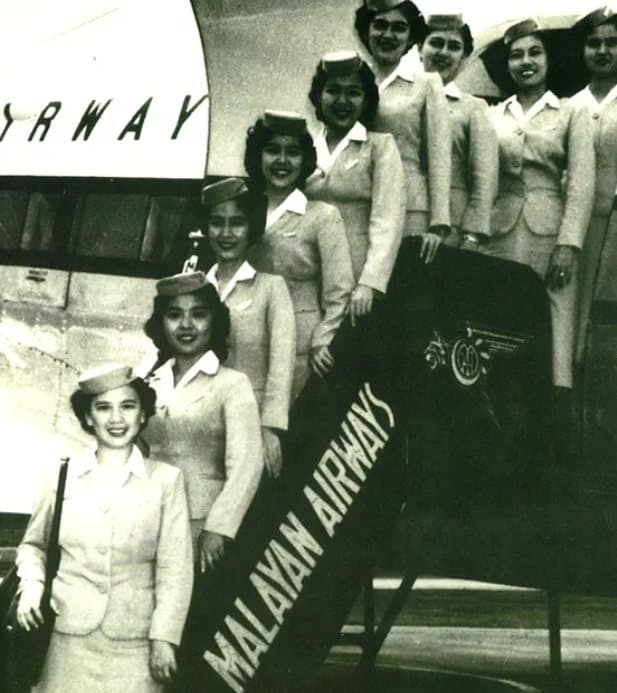
The name changed with the politics beneath it. In 1963 the Federation of Malaysia was formed from Malaya, Singapore, North Borneo and Sarawak, and Malayan Airways became Malaysian Airways. Singapore left the federation in 1965, and in 1966 the airline was renamed again, to Malaysia-Singapore Airlines, a title that was less a brand than a treaty: two governments, one carrier, and a growing disagreement about what it was for.
That disagreement is the hinge on which the whole story turns. Kuala Lumpur wanted a domestic network reaching into the Malaysian interior. Singapore, having no interior to reach into, wanted international routes. Those are not different emphases within one airline; they are two different airlines wearing one set of markings, and by the early 1970s the arrangement had become untenable.
Growth and expansion
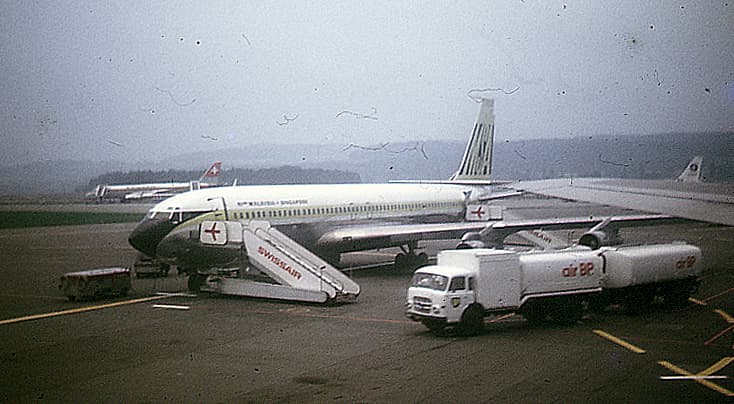
Malaysia-Singapore Airlines was divided in 1972, and the division was unusually clean. Singapore took assets worth more than $180 million: five Boeing 707s, five Boeing 737-112s, two Fokker F-27 Friendships, the Robinson Road headquarters, the Kriscom reservation system, the engineering base and the airport flight kitchen at Paya Lebar. It also took the international routes, which were the thing that mattered. Malaysia took the domestic network and became Malaysian Airline System.
Singapore Airlines began operations on 1 October 1972. Its first service, SQ 108, left for Kuala Lumpur at around a quarter past six that morning, which is a quietly appropriate detail: the new international carrier's first flight went to the city it had just separated from.
What followed was not the cautious consolidation a newly independent airline might have attempted. Landing rights were secured with Indonesia in September 1972 and Pakistan in October, and the airline set about building a network westward toward Europe and eastward across the Pacific, on the simple logic that Singapore sits halfway between them. The geography that denied it a home market handed it something else: a position on the shortest line between Europe and Australasia, at a point where an aeroplane of the period needed to stop anyway.
The strategy that emerged in these years has barely changed since. Fly young aeroplanes. Order early, in quantity, and sell them on while they still have value and before maintenance costs rise. Compete on the quality of the experience rather than on price, because an airline with no captive traffic cannot win a price war against carriers who have some. Spend conspicuously on cabin service, and make that spending the brand.
It is worth being plain that this is an expensive way to run an airline, and that it works only if passengers will pay a premium for it. Singapore Airlines has spent fifty years demonstrating that enough of them will.
The jet age
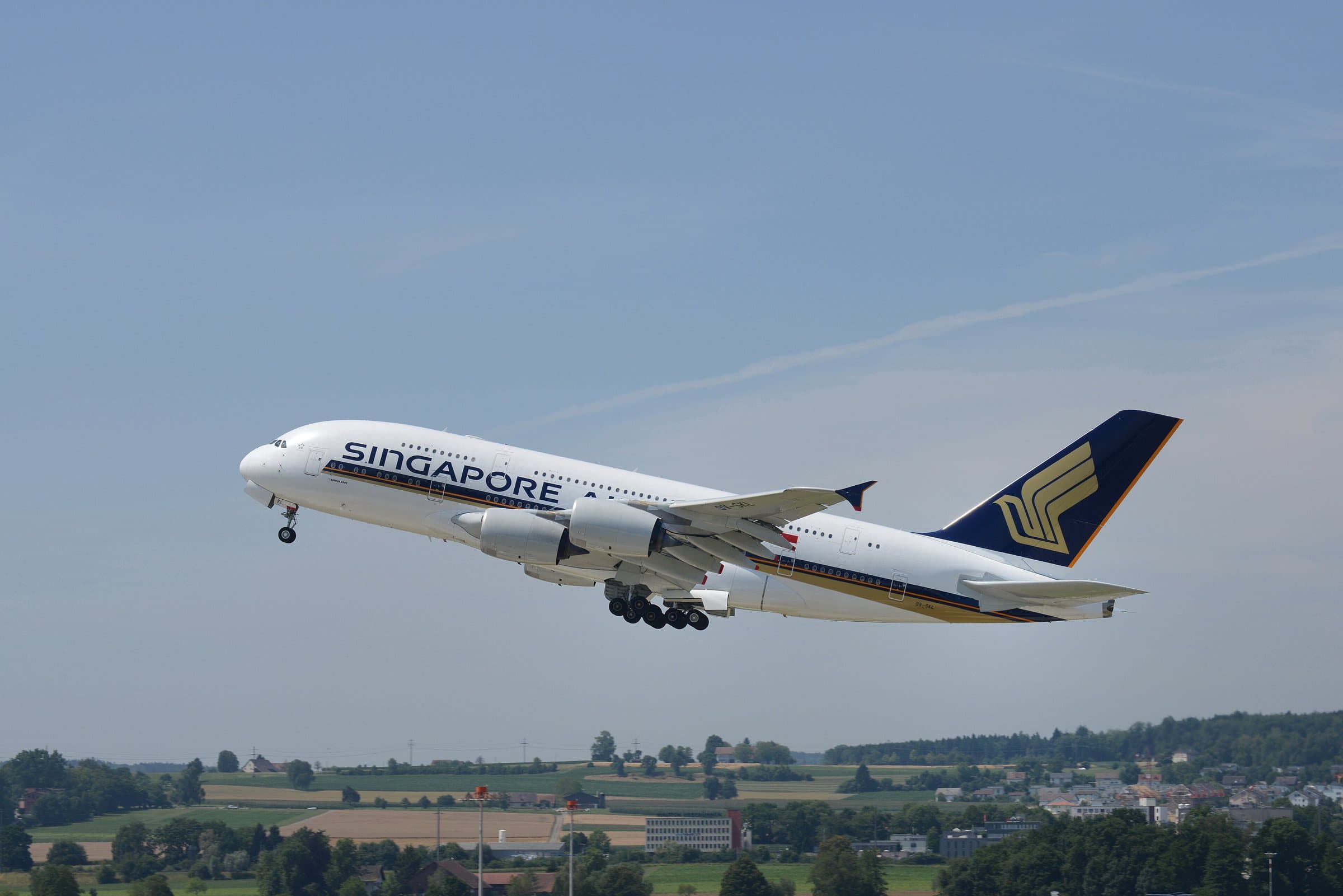
The aeroplane that made the strategy possible was the Boeing 747. A wide-body with the range to cross from Singapore to Europe with one stop, and the capacity to make the economics work, it let a carrier from a city-state of two million people operate at a scale its home market could never have justified. Singapore Airlines became one of the type's most enthusiastic operators, and the 747 remained central to it for three decades.
The pattern of fleet renewal established then is the airline's most durable habit. It has repeatedly been among the first operators of significant new types, and has repeatedly disposed of them while the market still wanted them. Being an early customer buys delivery slots, influence over cabin specification and a marketing claim; selling early avoids the years when an airframe costs the most to keep.
The current fleet shows the same thinking applied to the current generation. At 31 March 2025 Singapore Airlines itself operated 145 passenger aircraft: 65 Airbus A350s, 26 Boeing 787-10s, 22 Boeing 777-300ERs, 12 Airbus A380s, 16 Boeing 737-8s and four 737-800NGs, plus seven freighters. The A350 is now the backbone, as the 747 once was and the 777 was after it.
The A380 deserves a note of its own. Singapore Airlines was the launch customer, and operated the first commercial service by the type on 25 October 2007, from Singapore to Sydney. It is a characteristic piece of the airline's behaviour: take the risk of being first on an aircraft nobody has yet flown in service, extract the attention that comes with it, and fit the cabin out to a standard that makes the aeroplane itself the story. Twelve remain in the fleet, a smaller number than once seemed likely, which says more about the A380 than about Singapore Airlines.
Supersonic service
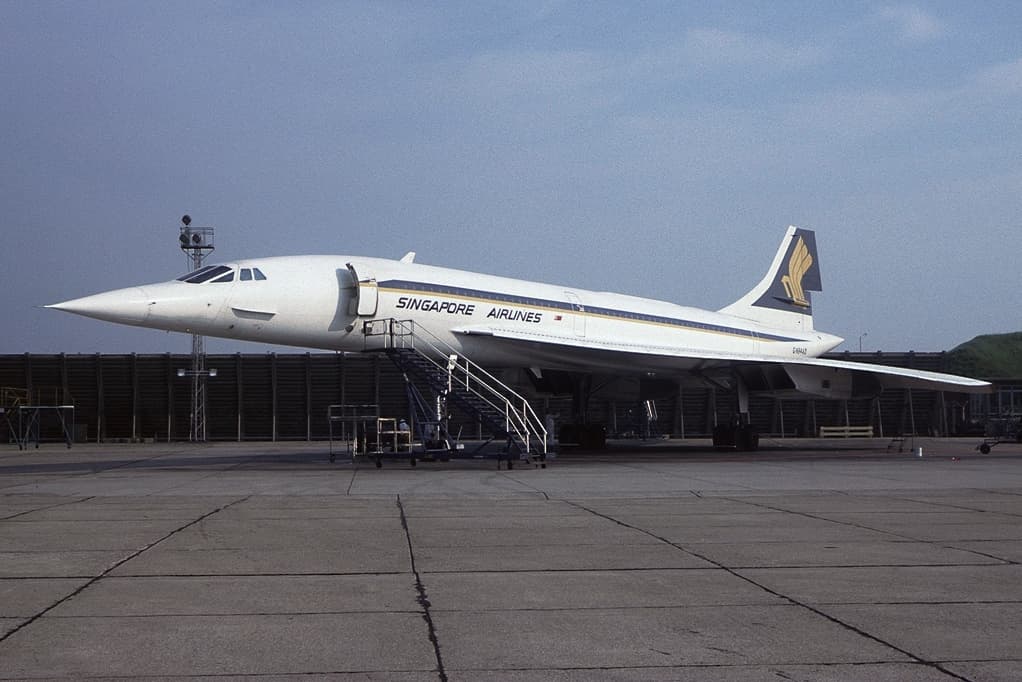
For twenty months Singapore Airlines flew Concorde, and the arrangement behind it was one of the stranger things ever painted on an aeroplane.
British Airways and Singapore Airlines announced a joint thrice-weekly supersonic service between London and Singapore on 26 October 1977, routed via Bahrain with a stop of about an hour. One aircraft was used throughout: G-BOAD, a British Airways Concorde. It carried Singapore Airlines markings down one side of the fuselage and British Airways markings down the other, so that the aeroplane presented a different airline depending on which way you approached it.
The first service operated on 9 December 1977 and was suspended four days later, on 13 December, after three return flights. The Malaysian government had withdrawn permission to cross the Straits of Malacca at supersonic speed, and without that the route did not work. It took more than a year to resolve: the service resumed from London on 24 January 1979.
It did not last. The route was withdrawn on 1 November 1980, reportedly losing around £2 million a year, with westbound load factors the particular problem. The flying time was genuinely remarkable, cutting a journey of around eighteen hours with multiple stops to roughly nine, and the fare was about 15 per cent above a conventional first class ticket. Enough people would pay that eastbound; not enough would pay it coming back.
The episode is a useful corrective to the idea that Concorde failed for want of ambition. Here was the aircraft on exactly the sort of long thin premium route it was built for, operated by two carriers who knew their markets, and it still could not be made to pay. What defeated it was not the aeroplane but the world the aeroplane had to fly through: sovereign airspace that could be closed to it, and a market that would not fill it in both directions.
Consolidation and merger
The group that exists today was assembled rather than grown, and the assembling has been continuous.
Scoot, the group's low-cost subsidiary, flies the routes and the price points the mainline brand cannot serve without damaging itself: a familiar structure, and one Singapore Airlines arrived at after some difficulty. SilkAir, the regional carrier that had operated the shorter routes under its own name since 1989, was folded into the mainline on 6 May 2021, its aircraft and routes absorbed and its brand retired. At 31 March 2025 Scoot operated 53 passenger aircraft.
The largest recent move was not in Singapore at all. In November 2024 Vistara, the Indian carrier Singapore Airlines had run as a joint venture with Tata, was merged into Air India, leaving Singapore Airlines with a minority stake in the enlarged Indian airline rather than a venture of its own. The accounting consequence was substantial: a one-off, non-cash gain of S$1,098 million, which is most of the difference between a good year and the record net profit of S$2,778 million the group reported for the financial year ended 31 March 2025.
It is worth separating those two numbers carefully, because the headline flatters the year. Revenue of S$19,540 million was a genuine record, up 2.8 per cent. Operating profit, which is the measure of whether flying aeroplanes made money, fell to S$1.7 billion: passenger yields dipped 5.5 per cent as capacity grew faster than traffic, and total expenditure rose 9.5 per cent to S$17,831 million. The record profit is real, but a large part of it came from a merger rather than from the business of carrying people.
That pattern, strong revenue under pressure on margins, is the condition most full-service airlines now operate in, and Singapore Airlines is not exempt from it.
Network and hubs
At 31 March 2025 the group's passenger network reached 128 destinations in 36 countries and territories, with the cargo network slightly larger at 132 destinations in 37. Those numbers are modest beside the biggest European and American carriers, and comparing them directly misses the point: Singapore Airlines does not feed a continent, it connects two of them through a single point.
The shape of the network follows from that. Heavy capacity westward to Europe and the Gulf, heavy capacity south and east to Australia and New Zealand, a dense web across Southeast Asia, and long thin routes across the Pacific to North America. Changi exists to make those connections work, and the airline and the airport have been developed in concert for decades in a way few countries have managed.
The most distinctive thing the network does is fly extremely long sectors non-stop. Singapore to New York is the signature: a route that for most of aviation history simply could not be flown directly with a useful payload, operated with Airbus A350s configured for the purpose. These ultra-long services carry fewer passengers in more space, and they exist because the alternative, making a stop, hands the passenger a reason to choose a different airline at the stopping point.
This is the same logic that has driven the airline since 1972, pushed to its limit. With no domestic market and no captive traffic, every improvement must be one a passenger would actively choose. A flight that removes a stop entirely is the purest form of that argument, and Singapore Airlines has pursued it harder and longer than anyone.
Fleet
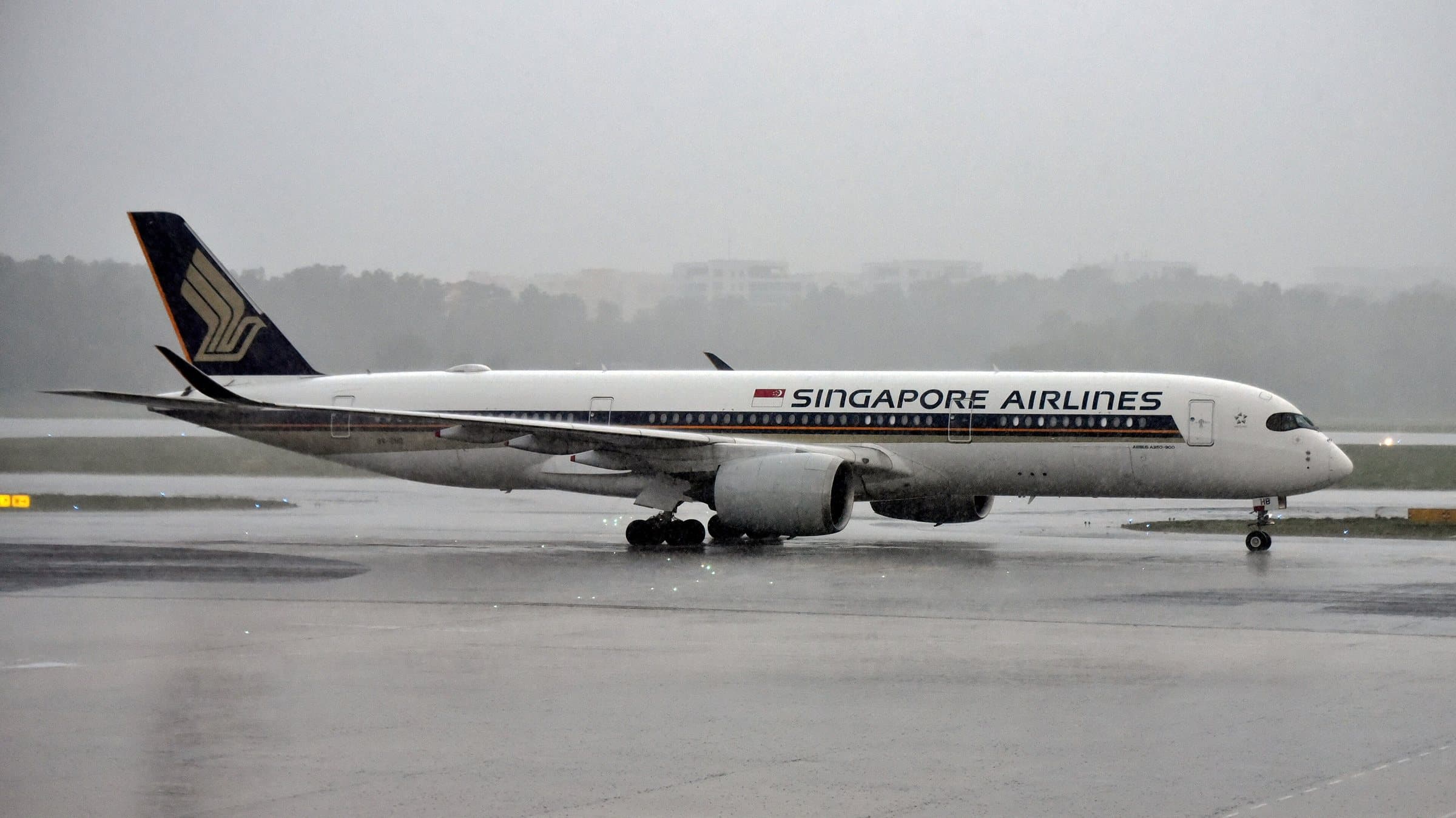
The group's operating fleet at 31 March 2025 comprised 205 aircraft with an average age of seven years and eight months. For comparison, many large full-service carriers run fleets with average ages well into double figures, and some flag carriers considerably older than that.
Singapore Airlines itself operated 145 passenger aircraft and seven freighters. The passenger fleet divided into 65 Airbus A350s, 26 Boeing 787-10s, 22 Boeing 777-300ERs, 12 Airbus A380s, 16 Boeing 737-8s and four Boeing 737-800NGs. Scoot operated a further 53 passenger aircraft.
Two things stand out in that list. The first is concentration: the A350 alone accounts for nearly half the mainline passenger fleet, which simplifies crew training, spares holding and maintenance in ways that show up directly in costs. The second is the narrow-body presence. The 737s came largely from the absorption of SilkAir, and they let the airline serve regional routes that cannot support a wide-body without handing them to a subsidiary or abandoning them.
The young fleet is a choice with a bill attached. Buying early and selling before mid-life means paying for aircraft during their most expensive years of depreciation and forgoing the cheap late years that other airlines rely on. What it buys is fuel efficiency, maintenance predictability, and cabins that are current rather than refurbished. Whether that trade is worth making depends entirely on whether passengers will pay for the result, which is the same question the airline has been answering since the split from Malaysia.
The group has substantial orders outstanding, including Boeing 777-9s and 787s for Scoot alongside Embraer E190-E2s, which indicates the renewal cycle continuing rather than pausing.
Cabins and service
Cabin product is where Singapore Airlines spends the money that the rest of its strategy is designed to earn, and it has been consistently ahead of the industry in ways that competitors have copied rather than bettered.
The airline offers four classes on its long-haul aircraft, and the top one is unusual enough to need its own description. Suites on the A380 are enclosed private compartments rather than seats, with a separate bed and chair, a configuration that treats the question of first class as a problem of accommodation rather than of reclining further than the person in front. Below that sit Business, Premium Economy and Economy, each refreshed on a cycle that owes a good deal to the young fleet: a cabin fitted to a new aircraft in 2020 is still a 2020 cabin, whereas a competitor retrofitting a twenty-year-old airframe is working within what that airframe allows.
The pattern goes back a long way. The airline was offering free drinks, hot towels and a choice of meals in economy when most carriers treated the back of the aircraft as freight that complained, and it has generally understood that the perception of generosity is built in economy rather than in first, because that is where most people form their opinion.
It is reasonable to be sceptical about how much any of this matters, and plenty of profitable airlines have concluded it does not. The counter-argument is the one the balance sheet makes: an airline with no home market, competing against carriers subsidised by geography or by state, has sustained premium pricing for five decades. Something is producing that, and cabin product is the most visible candidate.
Livery and identity
In 1968, while the airline was still Malaysia-Singapore Airlines, the French couturier Pierre Balmain was commissioned to design a uniform for the cabin crew. What he produced was a sarong kebaya in batik, a garment drawn from Malay and Peranakan dress rather than from the tailored Western suiting that every other airline of the period put its crew in.
It is difficult to overstate how durable that decision proved. The uniform has been revised, notably in 1974 when three-piece outfits were introduced for ground staff, but it has never been replaced, and it is now among the most recognisable pieces of corporate design in commercial aviation. The figure wearing it, marketed as the Singapore Girl, became the airline's central advertising device and has remained so across changes of fashion, management and advertising agency that have seen most airlines through several complete rebrands.
The choice is worth examining rather than simply admiring. A uniform rooted in local dress made an argument that a Western suit could not: that the service was specific to this airline and this region, and could not be obtained by flying someone else. For a carrier with no domestic market, trying to persuade travellers to route through Singapore by choice, that is a precisely targeted piece of positioning.
The campaign has also drawn sustained criticism, on the grounds that it sells an idea of deferential Asian femininity, and that criticism has been made for decades by people who are not merely being difficult. Both things are true at once: it is an unusually effective piece of brand-building, and it rests on an image that a good many people find uncomfortable. An encyclopedia that recorded only the first half would be telling half the story.
Safety record
Singapore Airlines has one fatal accident in its own operations and one fatal in-flight event, and the two are instructive in different ways.
On 31 October 2000, flight SQ006 attempted to take off from a partially closed runway at Chiang Kai-shek International Airport in Taipei, during a typhoon, and struck construction equipment. Taiwan's Aviation Safety Council investigated and published its final report in 2002. It identified eight probable causes, of which seven implicated the flight crew and the eighth the weather. Eighty-three people were killed.
The report was contested. Singapore's Ministry of Transport argued that deficiencies at the airport, including confusing runway markings and unserviceable taxiway lighting, belonged among the probable causes rather than being listed separately as findings related to risk. That disagreement was never fully resolved, and it is worth recording as a disagreement rather than adopting either side's framing: a crew took off on the wrong runway, and the airport they did it at made the error easier to make than it should have been.
On 21 May 2024, flight SQ321, a Boeing 777-300ER from London to Singapore, encountered convectively induced turbulence while cruising at 37,000 ft over south-western Myanmar. The aircraft went through drastic altitude changes within 4.6 seconds; the pilots flew manually for 21 seconds before re-engaging the autopilot, declared an emergency and diverted to Bangkok. One passenger died and 51 passengers and five cabin crew were seriously injured, with 22 further passengers hurt less badly.
Singapore's Transport Safety Investigation Bureau published its final report on 19 May 2026. It found that the aircraft's weather radar had shown no returns four minutes before the encounter, despite satellite imagery showing cloud development reaching approximately 40,000 ft, and that the possibility of a radar malfunction could not be ruled out. The crew's actions were assessed as understandable and appropriate. The finding that matters beyond this one flight is that the instrument the industry relies on to see weather ahead did not, on this occasion, show what was there.
Legacy
Singapore Airlines matters out of proportion to its size, and the reason is that it demonstrated something the industry did not believe.
The conventional view when it began was that a flag carrier needed a nation behind it: a domestic network to provide baseline traffic, a population large enough to fill aircraft, and ideally a government willing to cover losses. Singapore had none of those. What it had was a position on a map, a new airport built with intent, and a decision to compete on the quality of the thing being sold rather than on its price.
That the approach worked has shaped the airlines that came after it. The Gulf carriers built their businesses on the same basic insight, that a small state at a geographic crossroads can run a large airline by selling connections rather than domestic seats, and they have been explicit about learning from Singapore. The ultra-long-haul routes that now join cities once thought too far apart were pioneered in substantial part by an airline looking for ways to remove the stop at which a passenger might choose somebody else.
The airline enters its sixth decade in a harder market than it has known for some time. Operating profit fell to S$1.7 billion in the financial year ended 31 March 2025 as capacity grew faster than traffic and yields softened, and the record net profit that year rested substantially on a one-off accounting gain from the Air India merger. Competition from Gulf and Chinese carriers on the routes it once effectively owned is sustained and well funded.
What has not changed is the underlying position. There is still no domestic market, still no captive traffic, and still nothing to sell except a reason to fly through Singapore rather than past it. The airline has been answering that question since 1 October 1972, and the answer has been substantially the same every time.
Subsidiaries
- Scoot
- A wholly owned low-cost carrier.
Genealogy
The line of Singapore Airlines: Malayan Airways, launched in 1947, renamed Malaysian Airways in 1963 and Malaysia-Singapore Airlines in 1966, which split in 1972 into Singapore Airlines and Malaysian Airline System.
Scroll to see the full diagram
Timeline
October 21, 1937
Malayan Airways Limited is incorporated
May 1, 1947
Malayan Airways is launched
1963
Renamed Malaysian Airways
1966
Renamed Malaysia-Singapore Airlines
1972
The airline splits; Singapore Airlines begins operations
December 1977
Concorde shared with British Airways between London and Singapore
April 1979
Services to the United States begin
April 2000
Joins Star Alliance
November 12, 2024
Vistara, its joint venture with Tata, merges into Air India
In the catalogue
Aircraft central to this airline's story, as the encyclopedia records them.
Related airlines
- SIA Group Announces Record Full Year Revenue and Net Profit (News Release No. 02/25, 15 May 2025), Singapore Airlines
- A Great Way to Fly: The Singapore Airlines Story, BiblioAsia, National Library Board Singapore
- Singapore Airlines Concorde Operations, Heritage Concorde
- Actions of flight crew appropriate for unexpected turbulence, cannot rule out weather radar malfunction: TSIB report on SQ321, Mothership
- Crash report on SQ006 not wrong, Taipei Times
- Singapore Airlines, Wikipedia
Checked October 6, 2026