Skip to content

Settings

Preferences for this browser. There is no account.

Language

Card size

Category cards

Prices

Units

Speed

Range

Altitude and dimensions

Weather

Privacy notice
FLYPEDIA

Settings

Preferences for this browser. There is no account.

Language

Card size

Category cards

Prices

Units

Speed

Range

Altitude and dimensions

Weather

Privacy notice

Airport

Heathrow

LHR · EGLL

LondonUnited Kingdom

London Heathrow Airport

84,463,000a year

Passengers

477,883a year

Aircraft movements

1,592,931t

Cargo

Figures for 2025

Identification

IATA code
LHR
ICAO code
EGLL
Status
In operation
Opened
January 1, 1946

Location

Serves
London
Country
United Kingdom
Coordinates
51.4775° N, 0.4614° W
Elevation
82 ft
Distance to city
12 nm
Time zone
Europe/London

Airfield

Runways
2
Longest runway
12,802 ft
Terminals in use
4

Network

Destinations
214
Countries
84
Airlines
89
Hub for
British Airways · Virgin Atlantic

Ownership

Operator
Heathrow Airport Limited, part of Heathrow Airport Holdings
Owner
Held through FGP Topco by a consortium of institutional investors. Ardian became the largest shareholder in December 2024; Saudi Arabia's Public Investment Fund holds 15%, alongside the Qatar Investment Authority, GIC, the Australian Retirement Trust, China Investment Corporation and a residual holding by Ferrovial, which controlled the airport from 2006.

Ownership as of 2025

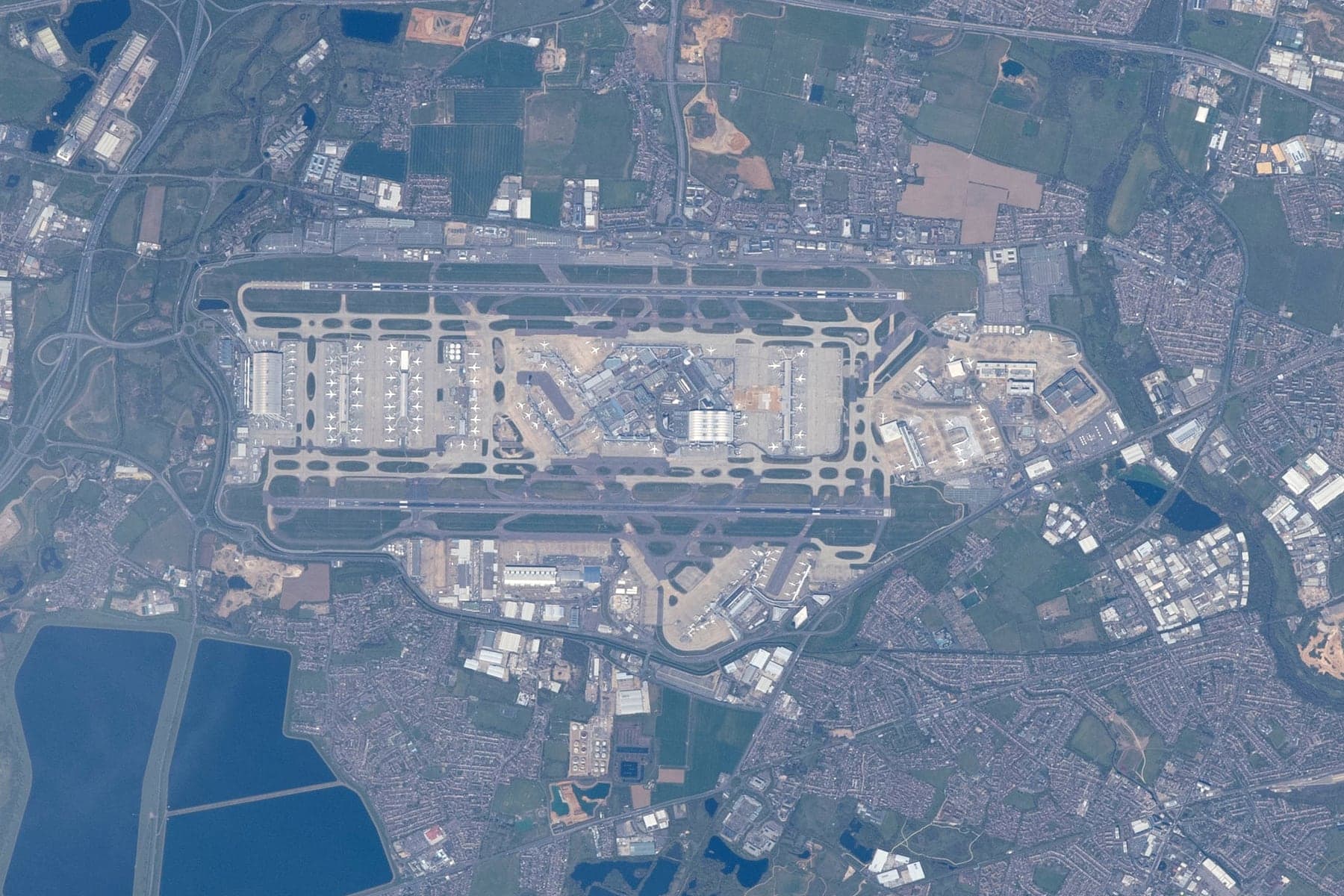
Vertical colour photograph of Heathrow taken from the International Space Station in April 2021: the two parallel east-west runways with the central terminal area between them, Terminal 5 at the western end and the cargo area to the south and Terminal 4 to the south-east, surrounded by west London suburbs and, to the west and south-west, the reservoirs of the Colne Valley
20211 / 6

London Heathrow occupies a flat rectangle of former market garden in the London Borough of Hillingdon, some twenty-three kilometres west of the middle of London, and moves more people than any other airport in Europe. In 2025 it handled 84,463,000 passengers on 477,883 aircraft movements, together with 1,592,931 tonnes of freight: the first year it passed eighty-four million, and a record set on an airfield that has had exactly two runways since the 1970s.

That constraint is the whole of Heathrow's character. An airport of its size would normally answer demand by pouring more concrete; Heathrow answers it by filling the concrete it has. Its parallel runways run close to their declared capacity for most of the operating day, its take-off and landing slots are among the most valuable assets in commercial aviation, and its terminals have been demolished and rebuilt around a runway pair that has not moved in half a century.

It is also, more than most airports, a place where civil aviation happened first. The world's first scheduled jet passenger service left here in May 1952; the first Boeing 747 in commercial service landed here in January 1970; Concorde flew from here for twenty-seven years. The airport that hosted all three began, on New Year's Day 1946, as a line of army tents pitched on duckboards beside the Bath Road.

History

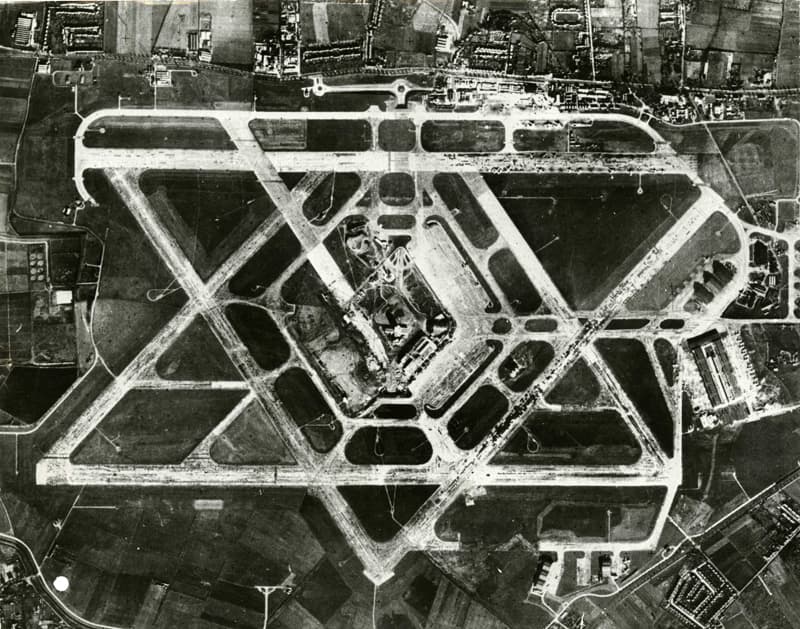
Vertical aerial photograph of Heathrow in 1955, showing the six-runway Star of David pattern with the central area building site at its heart
Vertical aerial photograph of Heathrow in 1955, showing the six-runway Star of David pattern with the central area building site at its heart (1955)

Before there was an airport there was Heath Row: a single lane of cottages and orchards on the western edge of Middlesex, in country given over to fruit and vegetables for the London markets. In 1929 the Fairey Aviation Company began buying land beside it, at about ten pounds an acre, and laid out a grass field for assembling and testing its own aircraft. The Great West Aerodrome was private, small, and entirely unremarkable.

In 1944 the Air Ministry took it. The stated purpose was a base for long-range transports flying to the Far East; the real one, as Harold Balfour, Under-Secretary of State for Air at the time, admitted in his memoirs, was to secure a site for London's post-war civil airport before anyone could object. He wrote that he had deliberately misled the committee that approved it. Around 1,300 acres were acquired, twenty farming families were moved off, and Fairey was displaced to Heston and eventually to White Waltham, more than twenty miles away.

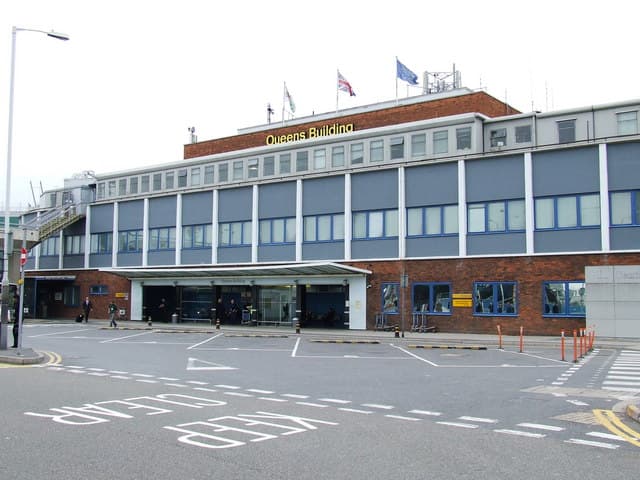
The Queens Building of 1955 still standing in the central area in 2007, a few years before it was demolished for the new Terminal 2
The Queens Building of 1955 still standing in the central area in 2007, a few years before it was demolished for the new Terminal 2 (2007)

The war ended before RAF Heathrow flew anything. On 1 January 1946 the site passed to the Ministry of Civil Aviation and a British South American Airways Avro Lancastrian named Star Light left for Buenos Aires. There was no terminal: passengers were processed in army marquees on duckboarding along the Bath Road, with a telephone box and a WVSserving tea. The airport opened fully to civil traffic on 31 May.

What was built over the next decade was extraordinary and short-lived. Six runways were laid out in two overlapping triangles, the pattern that reads on an aerial photograph as a Star of David, so that aircraft could always take off into wind. The design assumed slow, light aeroplanes with narrow crosswind limits, and the jets that arrived within a few years did not need it. Four of the six runways were surplus almost immediately; today's two parallel strips are the northern and southern edges of that hexagram, and the rest has been built over.

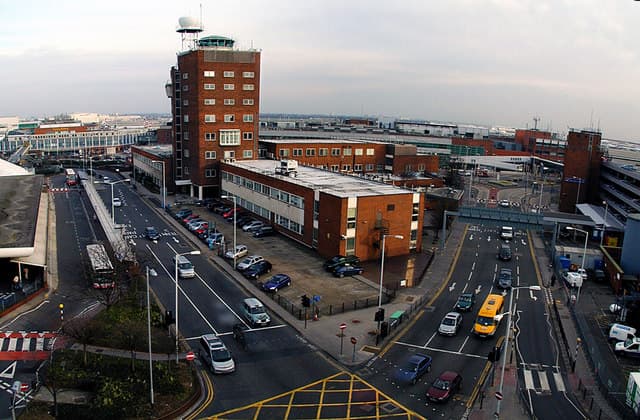
The 1955 control tower still standing among the central area's roads and car parks in 2006, long overtaken in height by the buildings around it
The 1955 control tower still standing among the central area's roads and car parks in 2006, long overtaken in height by the buildings around it (2006)

Inside the ring, the ground crews worked out of huts for nine years. Queen Elizabeth II laid the first slab of the permanent central area in 1953 and returned in 1955 to open the Europa Building, the airport's first real terminal, alongside the Queens Building and a new 127 ft control tower reached by a tunnel under the northern runway. The Oceanic Terminal followed in November 1961 for the transatlantic fleets; Terminal 1 opened in November 1968.

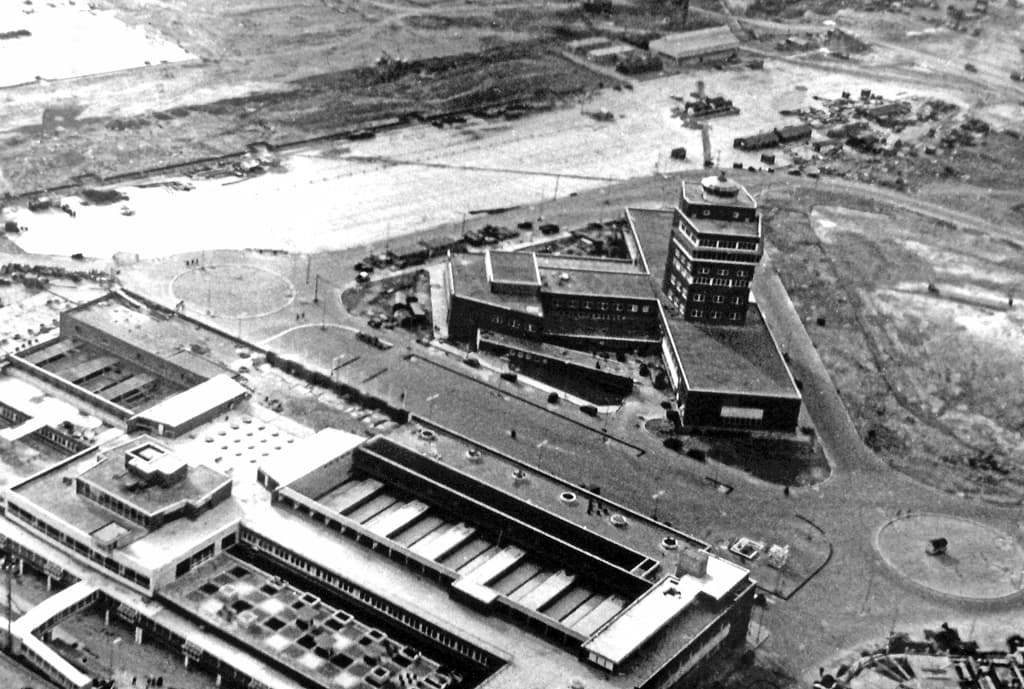
Heathrow's central area under construction in April 1955, with the new control tower and the Europa and Queens Buildings taking shape
Heathrow's central area under construction in April 1955, with the new control tower and the Europa and Queens Buildings taking shape (1955)

In September 1966 the newly created British Airports Authority took over London Airport along with Gatwick, Stansted and Prestwick, and renamed the first of them Heathrow so the four could be told apart. BAA was privatised in 1987, bought by a Ferrovial-led consortium in 2006, and forced by the Competition Commission to sell Gatwick and Stansted at the end of the decade. Ownership has kept moving: Ferrovial's stake fell to around five per cent in 2024 as Ardian became the largest shareholder and Saudi Arabia's Public Investment Fund took fifteen, alongside Qatari, Singaporean, Australian, Canadian and Chinese funds.

The airfield

Two parallel runways run east-west across the site: 09L/27R to the north, 12,800 ft long, and 09R/27L to the south, 12,000 ft. Both are 160 ft wide, both are asphalt, and both are equipped for CAT IIIB approaches, which is what allows the airport to keep landing aircraft in the fog that closed it repeatedly in its first decades. The prevailing wind is westerly, so most days aircraft land and depart on the 27 headings, over London.

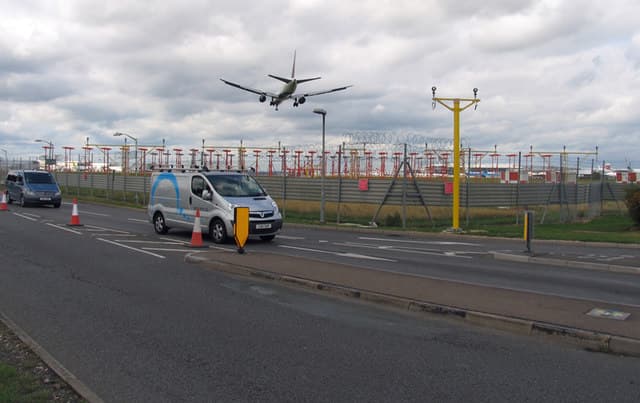
An airliner on short final for runway 27L over the approach lighting and the airport's northern perimeter road
An airliner on short final for runway 27L over the approach lighting and the airport's northern perimeter road (2015)

The runways are not used interchangeably. Under the airport's alternation scheme, one takes arrivals and the other departures, and the two swap at three in the afternoon, so that each of the communities under the two approach paths gets half a day without aircraft overhead. Alternation costs capacity; it is the price of operating a runway pair whose approaches pass over one of the most densely populated cities in Europe.

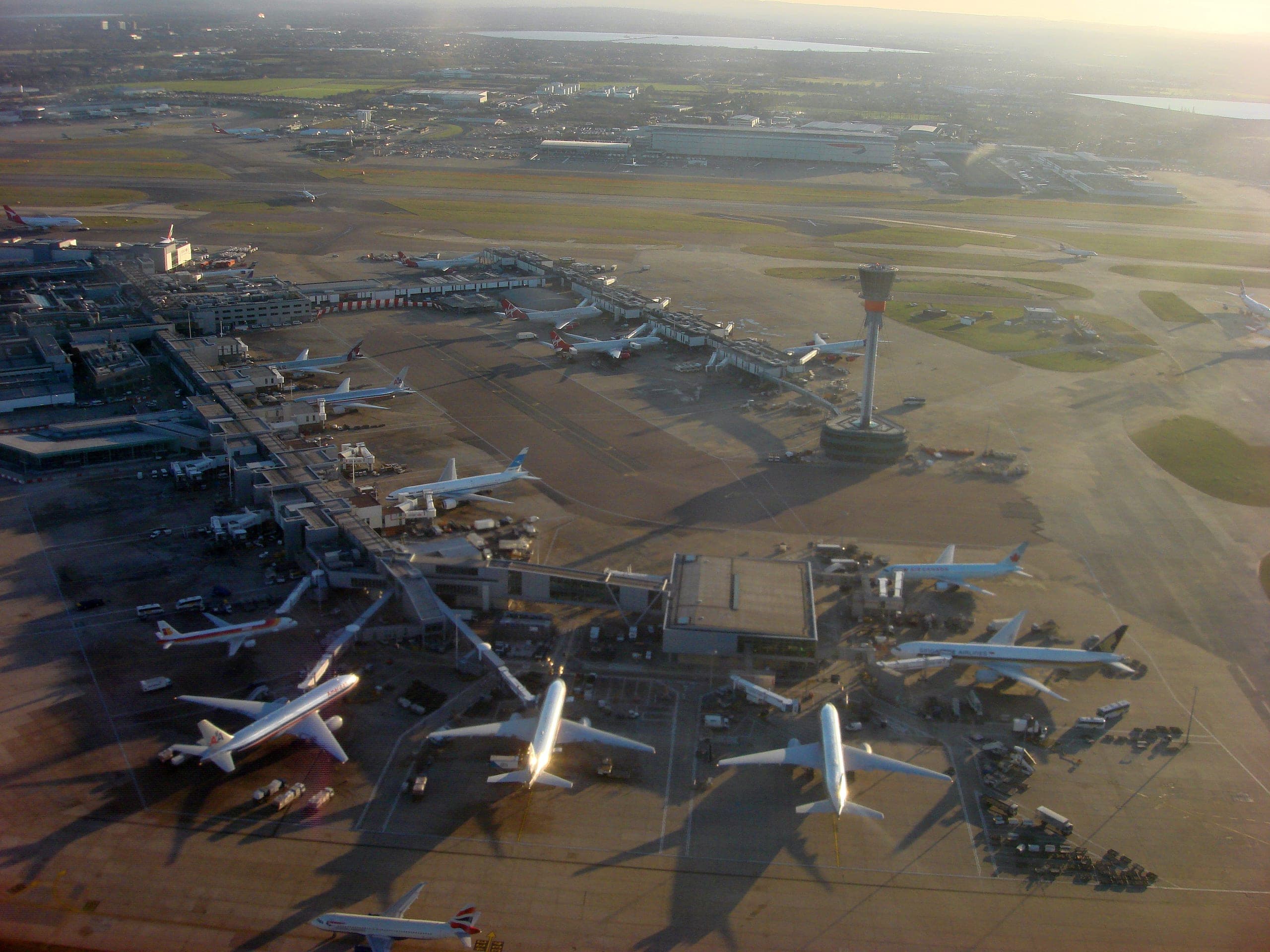
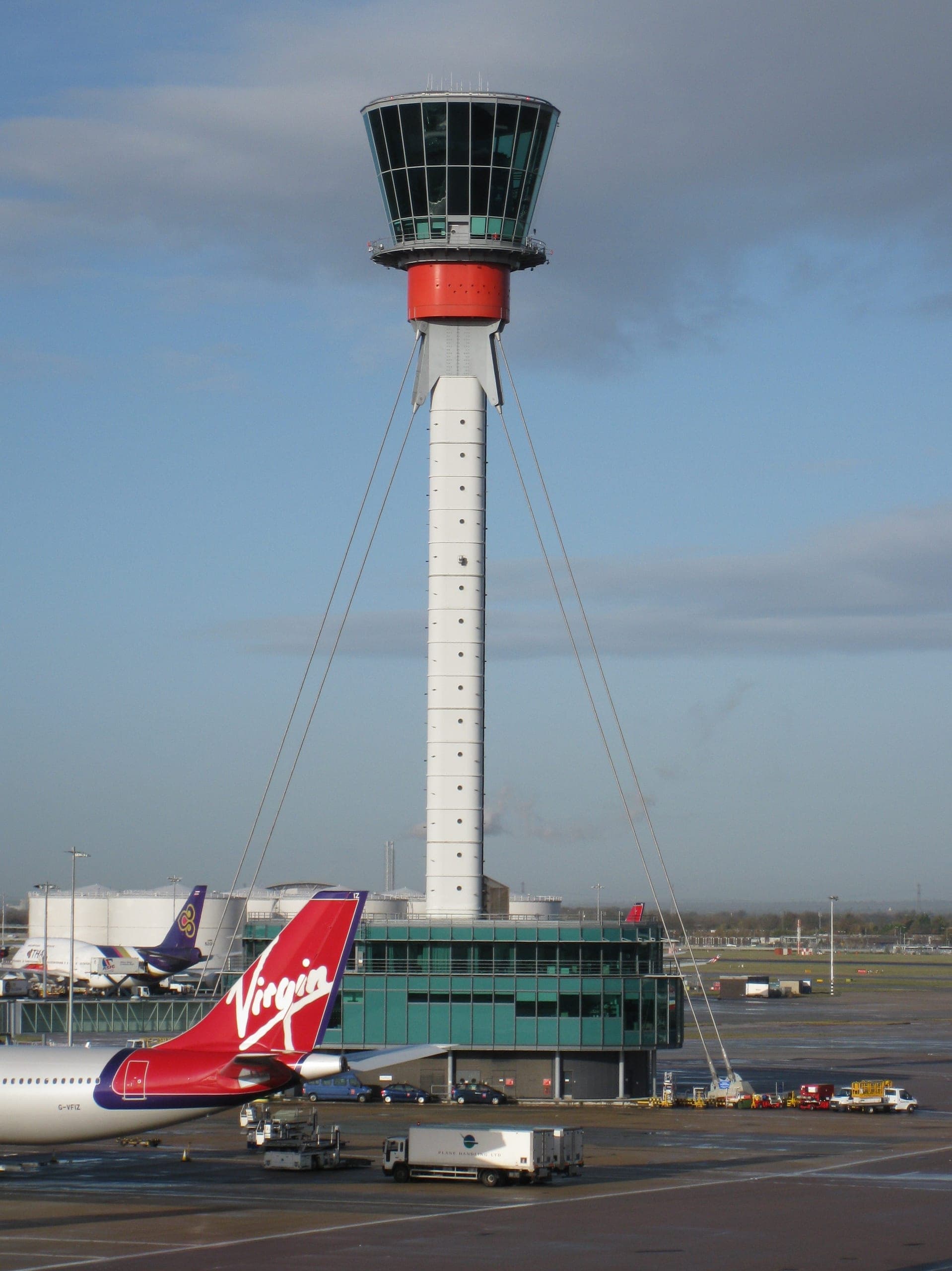
The 87-metre Heathrow control tower, designed by Richard Rogers Partnership, rising above the Terminal 3 apron
The 87-metre Heathrow control tower, designed by Richard Rogers Partnership, rising above the Terminal 3 apron (2009)

Control comes from an 290 ft tower designed by Richard Rogers Partnership and commissioned in 2007, standing at the end of Terminal 3's Pier 7. It replaced the 1955 tower, which had long since been overtaken by the buildings around it: the airport had grown taller than its own view of itself. The visual control room was assembled at ground level and jacked up the mast in sections, a technique chosen because the site could not be closed while it was built.

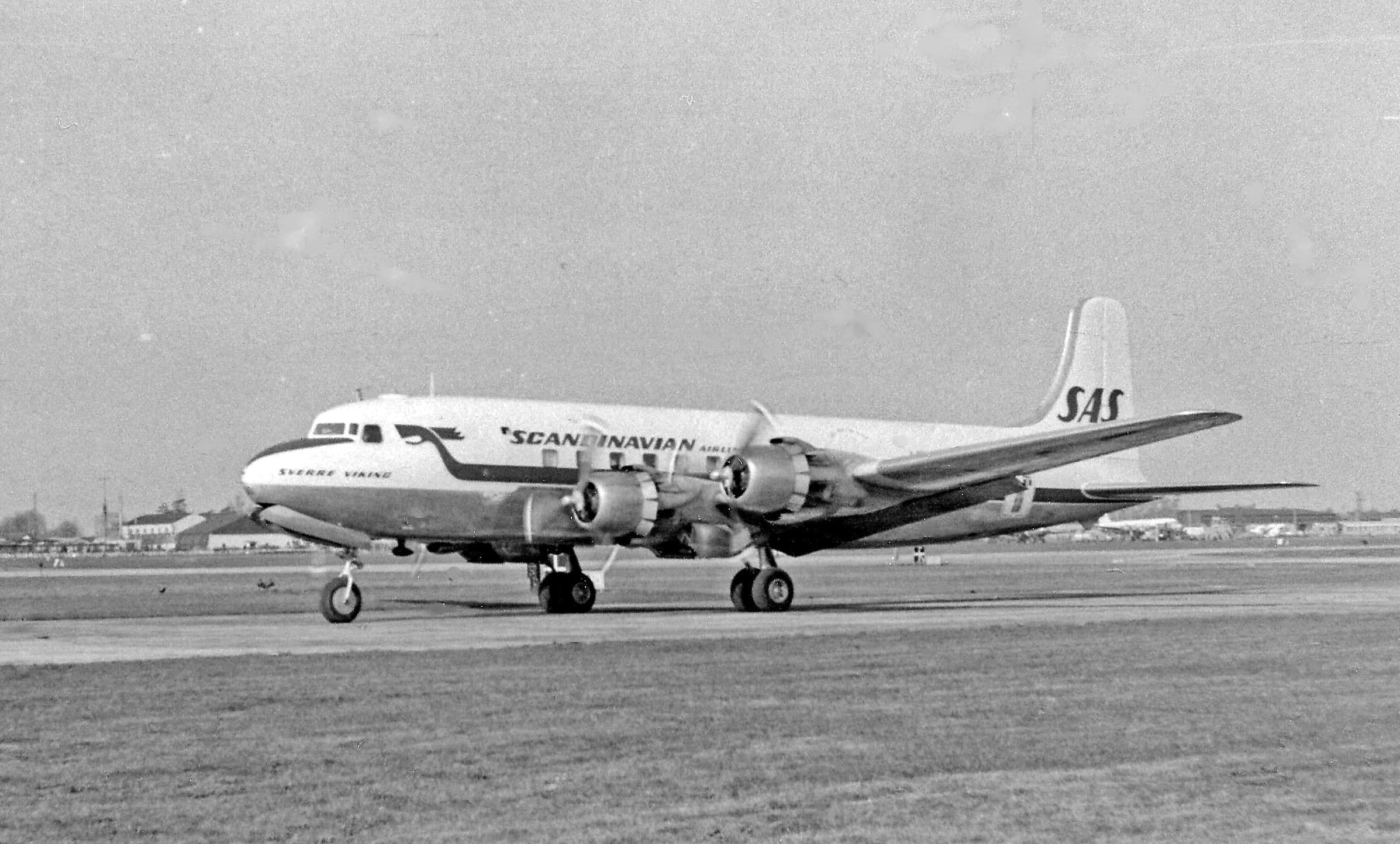
A Scandinavian Airlines airliner taking off from Heathrow in April 1955, watched from the Queen's Building
A Scandinavian Airlines airliner taking off from Heathrow in April 1955, watched from the Queen's Building (1955)

Heathrow's cargo operation sits in a dedicated area on the south side, and moved 1,592,931 tonnes in 2025. Almost all of it travels in the holds of passenger aircraft rather than in freighters, which is a direct consequence of the slot constraint: at an airport where a movement is this scarce, a dedicated freighter has to earn its slot against a fully loaded widebody carrying both passengers and belly freight, and usually cannot.

Terminals

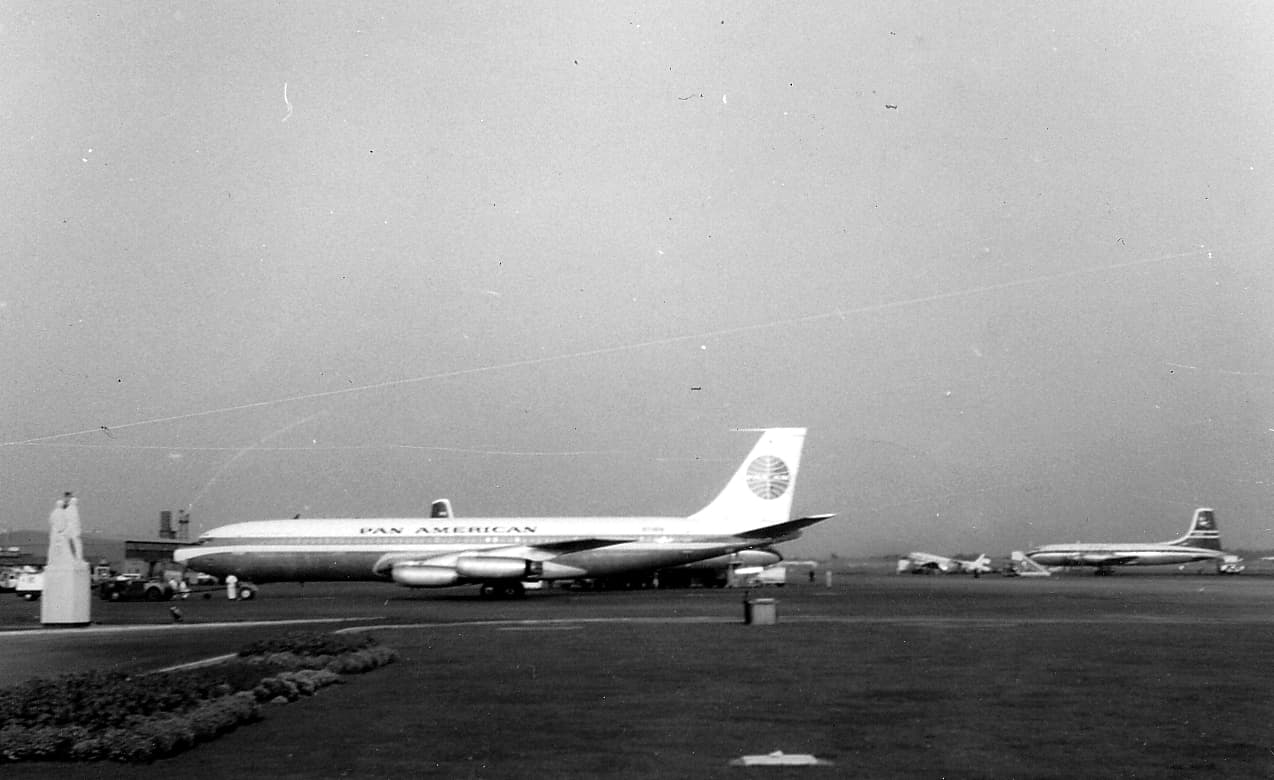
A Pan Am Boeing 707 at London Airport's intercontinental terminal in 1960
A Pan Am Boeing 707 at London Airport's intercontinental terminal in 1960 (1960)

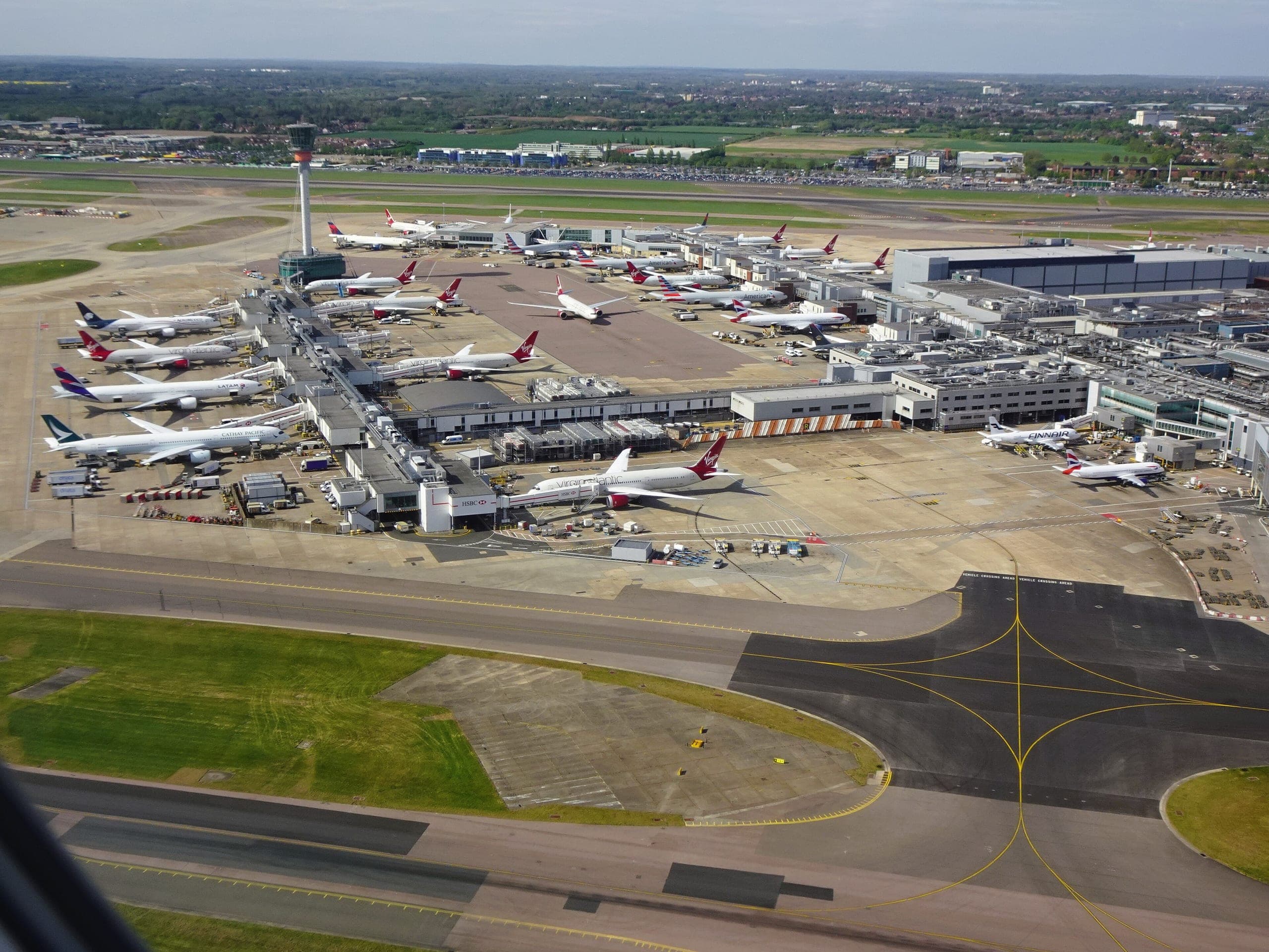
Heathrow has opened five passenger terminals and closed one. Four are in use: Terminals 2 and 3 on the central island between the runways, Terminal 4 on the south side, and Terminal 5 at the western end of the airfield.

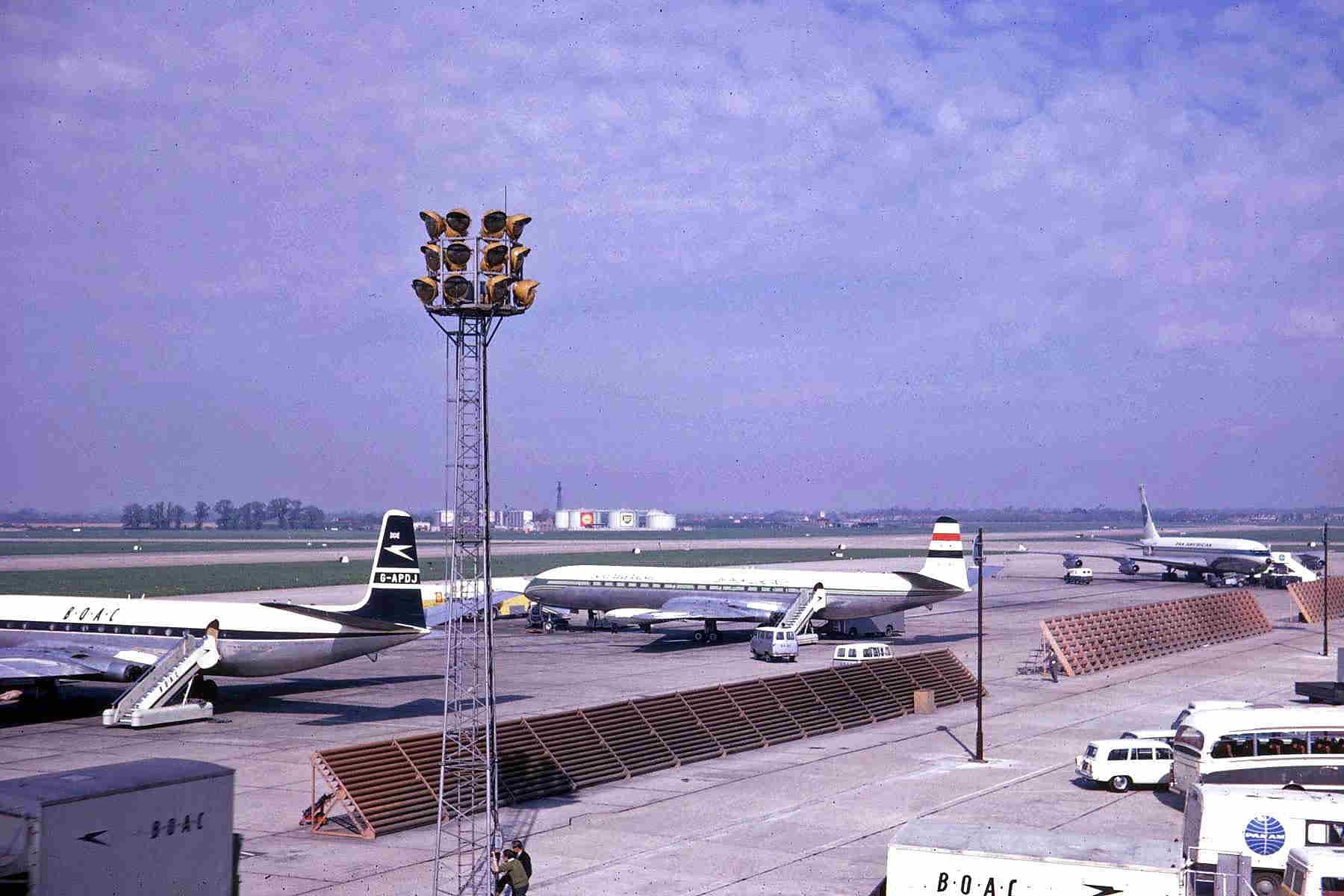
The apron seen from Terminal 3 in May 1963, with a United Arab Airlines Comet 4C among the aircraft
The apron seen from Terminal 3 in May 1963, with a United Arab Airlines Comet 4C among the aircraft (1963)

Terminal 5 is the largest single building any British airport has ever put up. Richard Rogers Partnership designed it as one clear span under a waveform roof, 1,300 ft long and 130 ft tall, with the messy business of car parks, roads and rail buried beneath and two satellite piers reached by an underground transit. It cost £4.2 billion and took almost twenty years from proposal to opening, including a public inquiry that sat for 525 days between 1995 and 1999, the longest planning inquiry in British history. Queen Elizabeth II opened it on 14 March 2008.

Thirteen days later it opened to passengers and stopped working. Staff could not find the car parks or clear security in time, stands filled with aircraft whose bags could not be unloaded, and the baggage system seized. British Airways cancelled more than five hundred flights over the following ten days and some 42,000 bags travelled without their owners. It remains the standard cautionary tale about commissioning a complex building and its operating procedures on the same morning; Terminal 5 has since become, quietly, one of the better-liked large terminals in Europe.

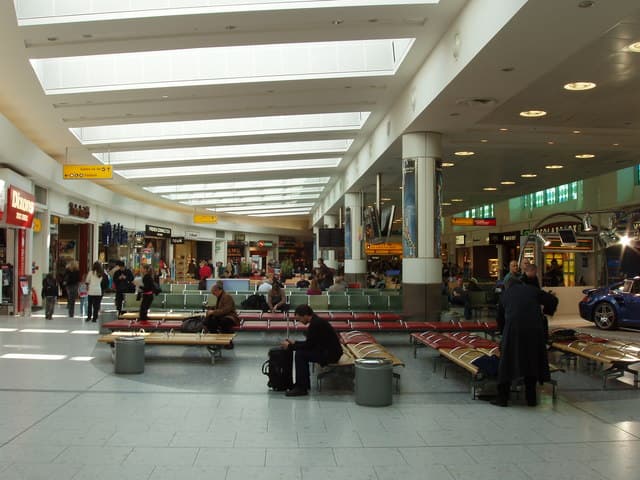
The international departures lounge of Terminal 1 in 2007, eight years before the building closed and was demolished
The international departures lounge of Terminal 1 in 2007, eight years before the building closed and was demolished (2007)

Terminal 2 answers a different problem. The Europa Building of 1955 had become the oldest passenger terminal at the airport and could not be brought up to standard, so it was demolished and replaced in place. The new Terminal 2, formally the Queen's Terminal, opened in June 2014 to a design by Luis Vidal + Architects, its north-lit wave roof daylighting the departures concourse almost completely. Terminal 1, next door, closed on 30 June 2015 and was demolished so that Terminal 2 could grow into its footprint. That closure is the clearest illustration of how the airport works: with no room to expand outward, Heathrow renews itself by consuming its own older buildings.

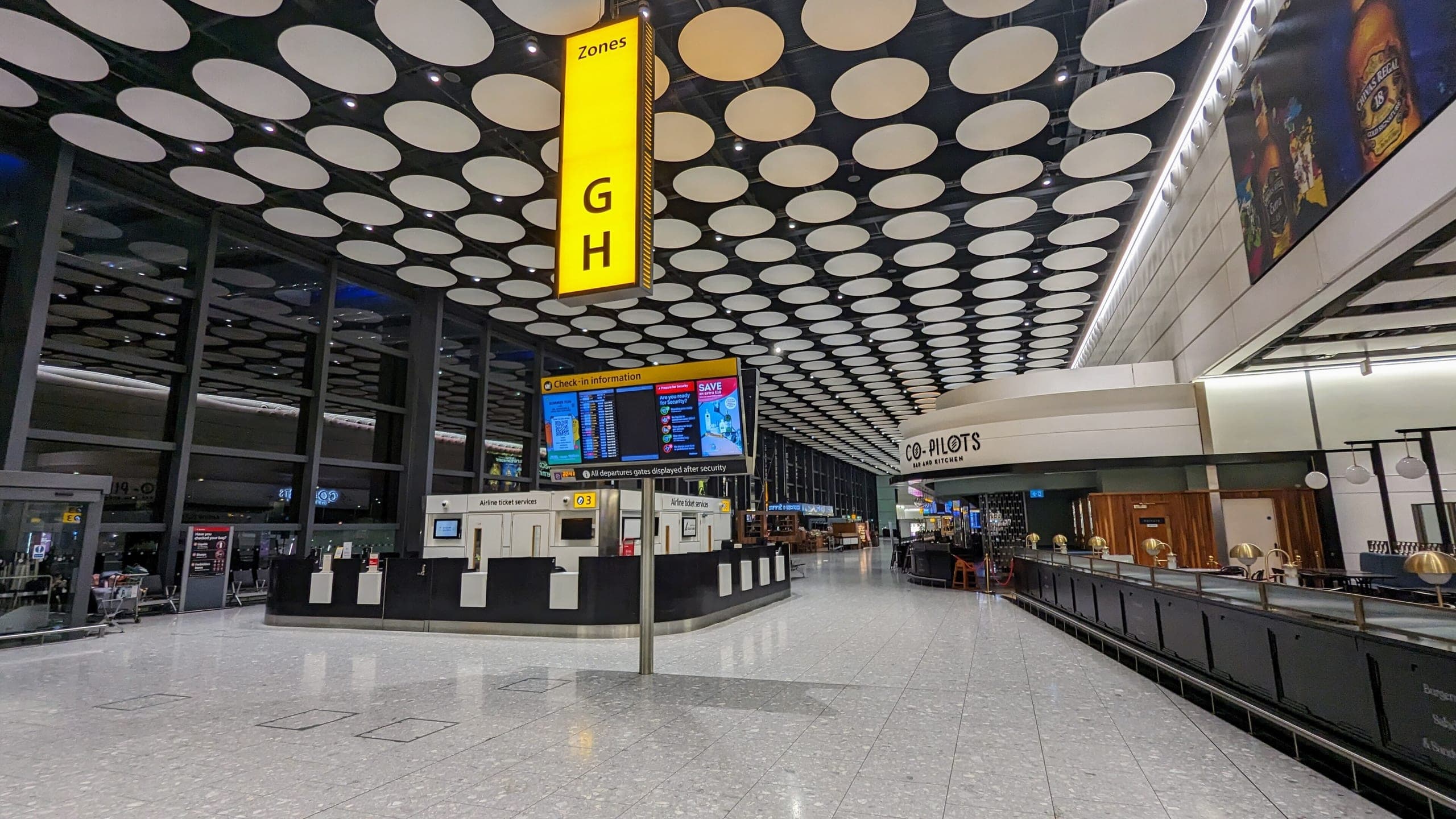
The pre-security concourse of Terminal 4 under its perforated disc ceiling, check-in zone G and H signed overhead
The pre-security concourse of Terminal 4 under its perforated disc ceiling, check-in zone G and H signed overhead (2023)

Terminal 3 opened in 1961 as the Oceanic Terminal and has been extended repeatedly since; Terminal 4, opened in April 1986, was the airport's first move off the central island and remains the only terminal reached without passing under a runway.

Operations

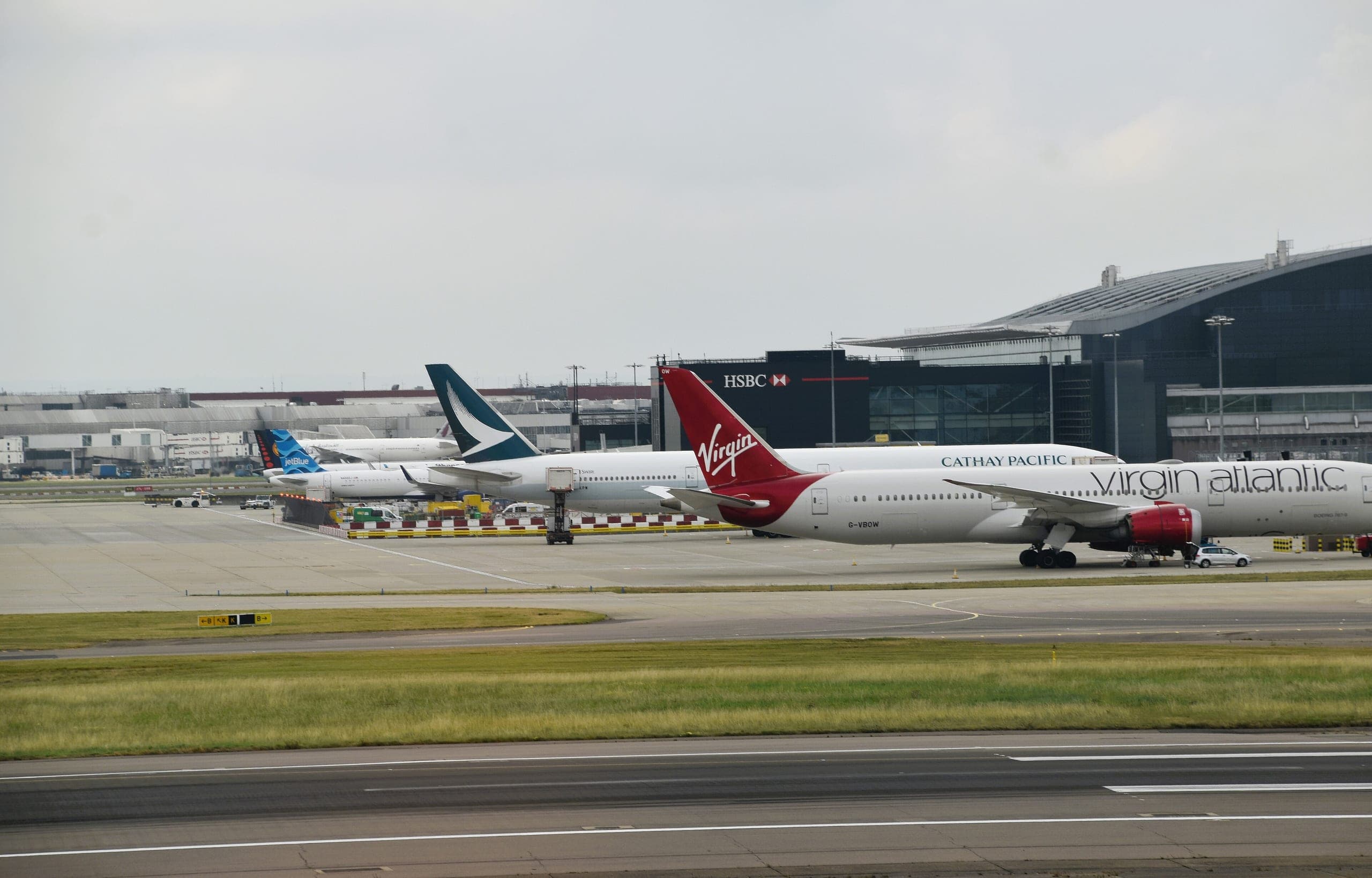
Heathrow is a hub before it is an airport. Roughly a third of its passengers are connecting rather than beginning or ending a journey in London, and the whole shape of the operation, the bank structure of arrivals and departures, the transfer corridors, the terminal allocation by alliance, exists to serve them. British Airways, which occupies Terminal 5 and part of Terminal 3, is the largest operator by a wide margin; Virgin Atlantic is the other home carrier. In total the airport is served by around 89 airlines flying to 214 destinations in 84 countries.

The airport is fully slot-coordinated, and its movement total is capped by planning condition at 480,000 a year. In 2025 it used 477,883 of them. That is the single number that explains almost everything else about Heathrow: with essentially no spare movements, growth can come only from bigger aircraft, fuller aircraft, or longer, more valuable routes. Slot pairs at Heathrow have changed hands for tens of millions of dollars, which happens nowhere else in Europe at that scale, and airlines have bought other airlines largely to acquire them.

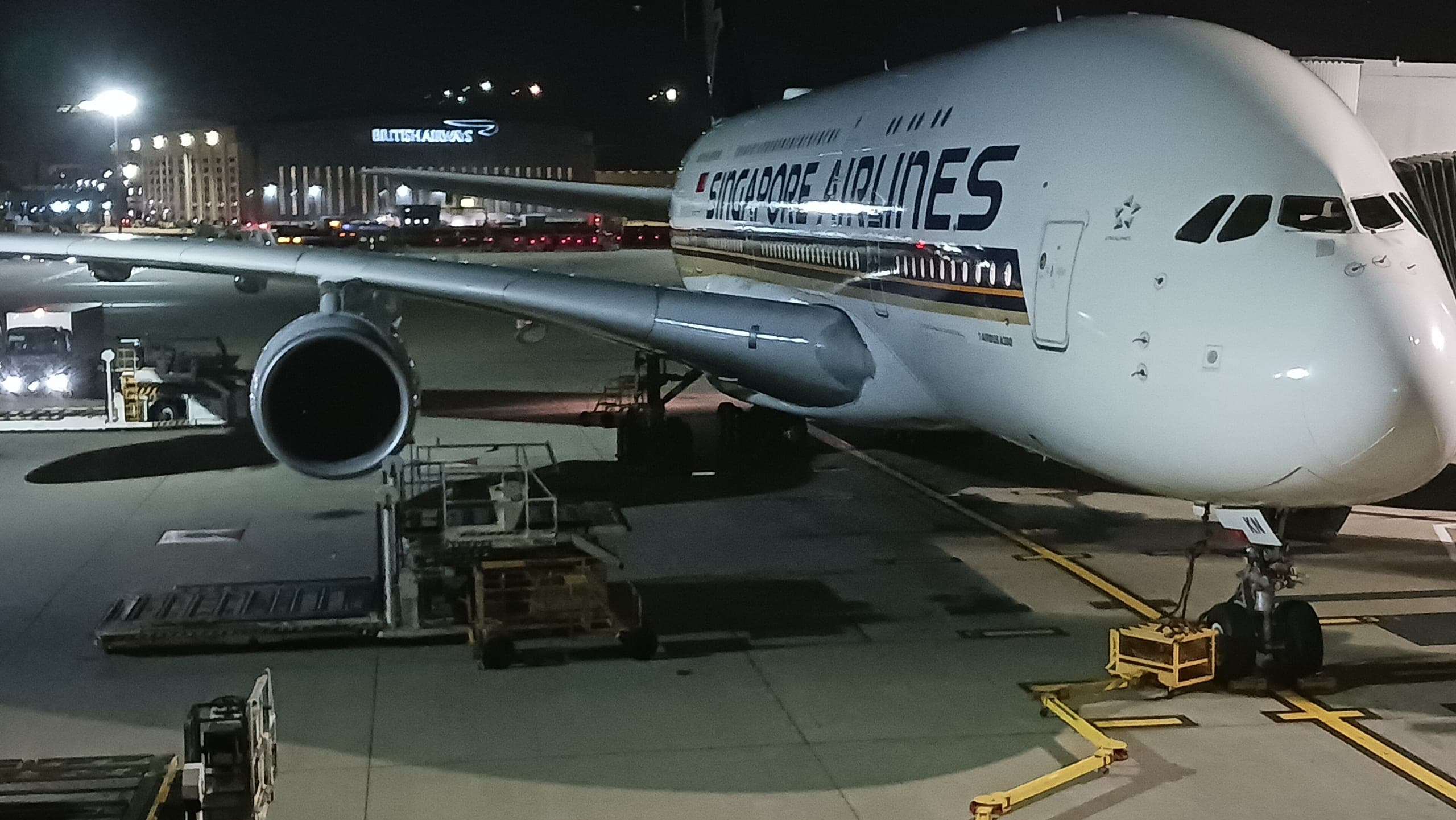
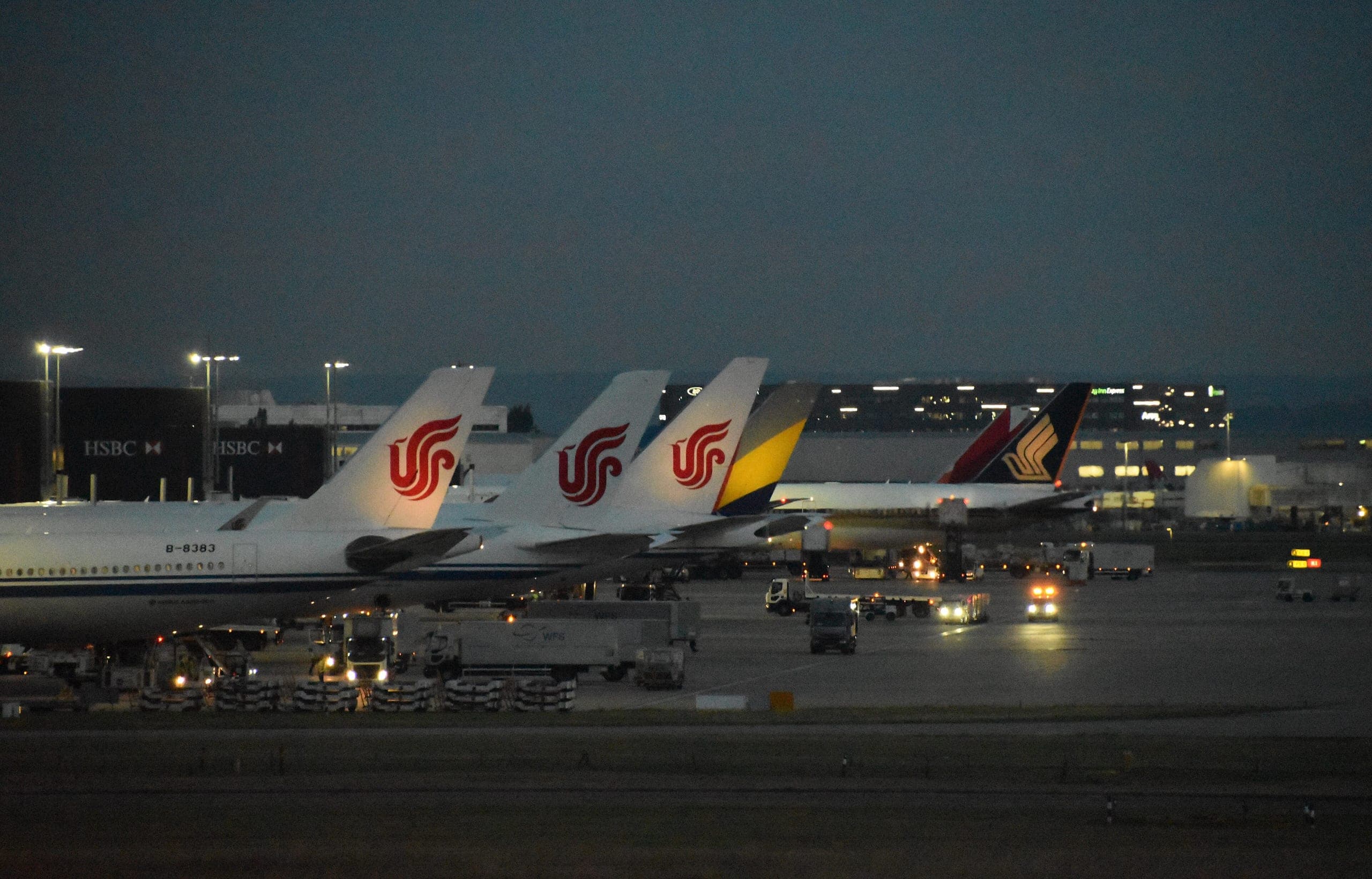
Air China and Singapore Airlines tails on the Terminal 2 apron at dusk, ground vehicles working beneath the floodlights
Air China and Singapore Airlines tails on the Terminal 2 apron at dusk, ground vehicles working beneath the floodlights (2023)

The European Union remains the airport's largest market, 28.4 million passengers in 2025, followed by North America with 20.6 million, then Asia-Pacific, the Middle East, non-EU Europe, Africa and Latin America. The domestic market is small and shrinking, at 4.6 million: a short flight from Manchester to London cannot compete with the train, but it can be worth a great deal as a feeder into a long-haul bank, which is exactly the tension that makes a Heathrow slot valuable.

Operating this close to the ceiling leaves little recovery capacity. A morning of fog, a runway incursion or a single disabled aircraft on a stand propagates through the day in a way it would not at an airport running at seventy per cent, and Heathrow's punctuality figures are watched accordingly. The airport reported that in 2025 more than 97% of passengers waited under five minutes at security and that 98% of bags travelled with their owners: measures it publishes precisely because the margin for error is so thin.

Ground access

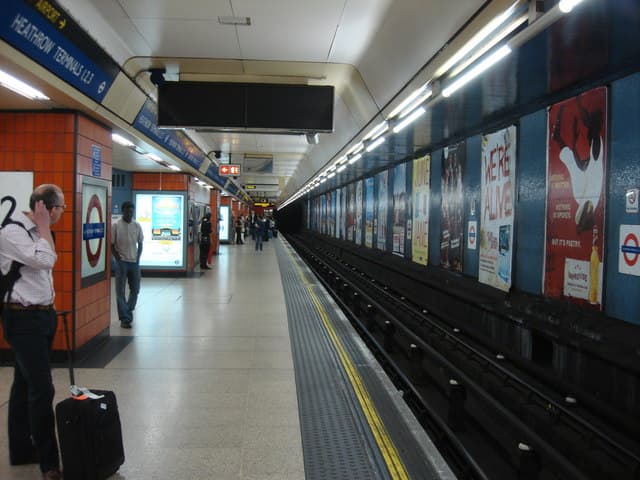
The Piccadilly line platform at Heathrow Terminals 1, 2, 3, the Underground station that opened in December 1977
The Piccadilly line platform at Heathrow Terminals 1, 2, 3, the Underground station that opened in December 1977 (2008)

Heathrow was among the first major airports in the world to be joined to its city by a metro. The Piccadilly line reached Heathrow Central in December 1977, and still runs from the terminals into the West End for the price of an ordinary Underground fare, slow, at around fifty minutes, and by a distance the cheapest way in.

Heathrow Express opened in June 1998 on a dedicated spur from the Great Western main line, running non-stop to London Paddington in fifteen minutes. The Elizabeth line joined the terminals to the same tunnels beneath central London in 2022, giving direct trains to Bond Street, Farringdon, Liverpool Street and Canary Wharf without a change.

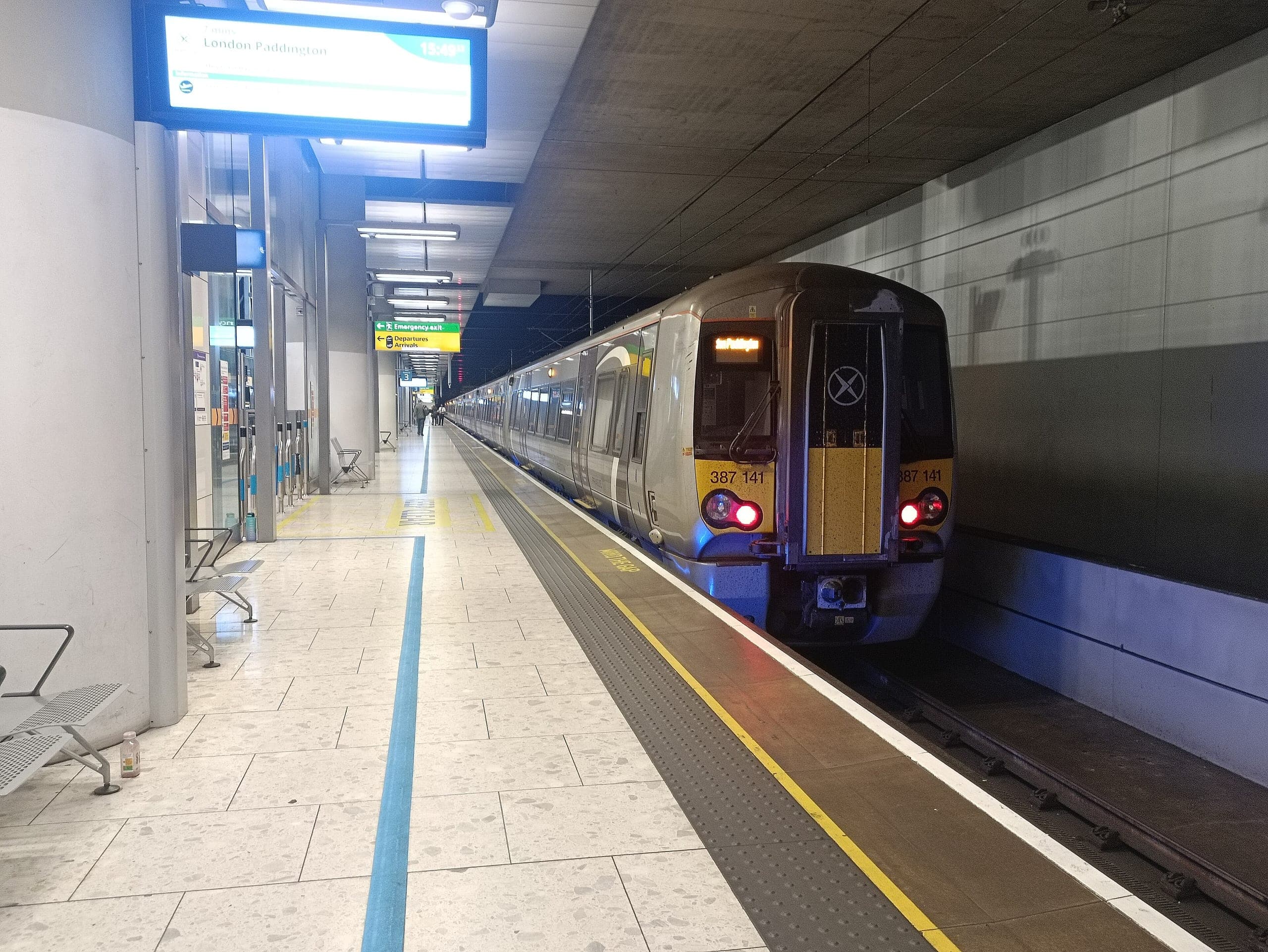
A Heathrow Express train at the Terminal 5 platform, the next departure for London Paddington shown on the indicator
A Heathrow Express train at the Terminal 5 platform, the next departure for London Paddington shown on the indicator (2025)

By road the airport sits in the angle between the M4 and the M25. The central terminal area is reached through a tunnel bored under the northern runway in the 1950s, the reason the middle of Heathrow feels like an island, while Terminals 4 and 5 have their own spurs. The proposed third runway would require the M25 itself to be put in a tunnel beneath it, which is the single largest civil engineering item in the expansion scheme.

Expansion

No infrastructure question in Britain has been argued about for longer than a third runway at Heathrow. The airport has been effectively full since the 2000s; every government since has had to decide whether to add capacity in west London, move it to the Thames Estuary or to Gatwick, or accept that Britain's hub will keep shrinking relative to Paris, Amsterdam, Frankfurt and Istanbul.

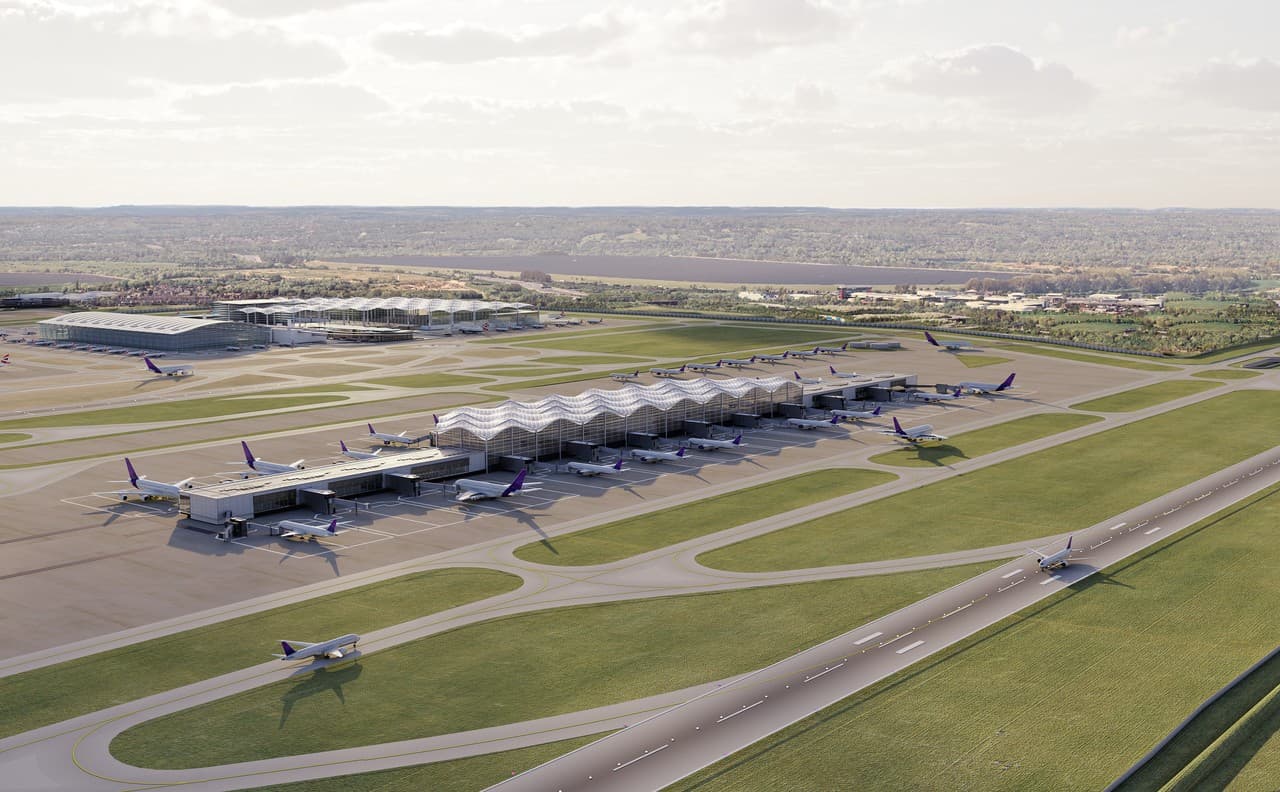
Heathrow's own visualisation of the proposed Terminal 5X satellite: a computer-generated view of a new pier under a wave roof, with the existing Terminal 5 behind

A third runway was approved in 2009 and cancelled in 2010 by the incoming coalition. The Airports Commission under Sir Howard Davies reported on 1 July 2015 and recommended a new north-west runway at Heathrow over the alternatives; the government adopted that recommendation in October 2016; the House of Commons approved the Airports National Policy Statement on 25 June 2018 by 415 votes to 119.

In February 2020 the Court of Appeal ruled that policy unlawful, because ministers had not taken the government's own commitments under the Paris Agreement into account when designating it. It was the first time a major British infrastructure decision had been struck down on climate grounds. The Supreme Court overturned that judgment on 16 December 2020, restoring the policy and allowing a planning application to be brought: without, it stressed, deciding whether the runway should be built.

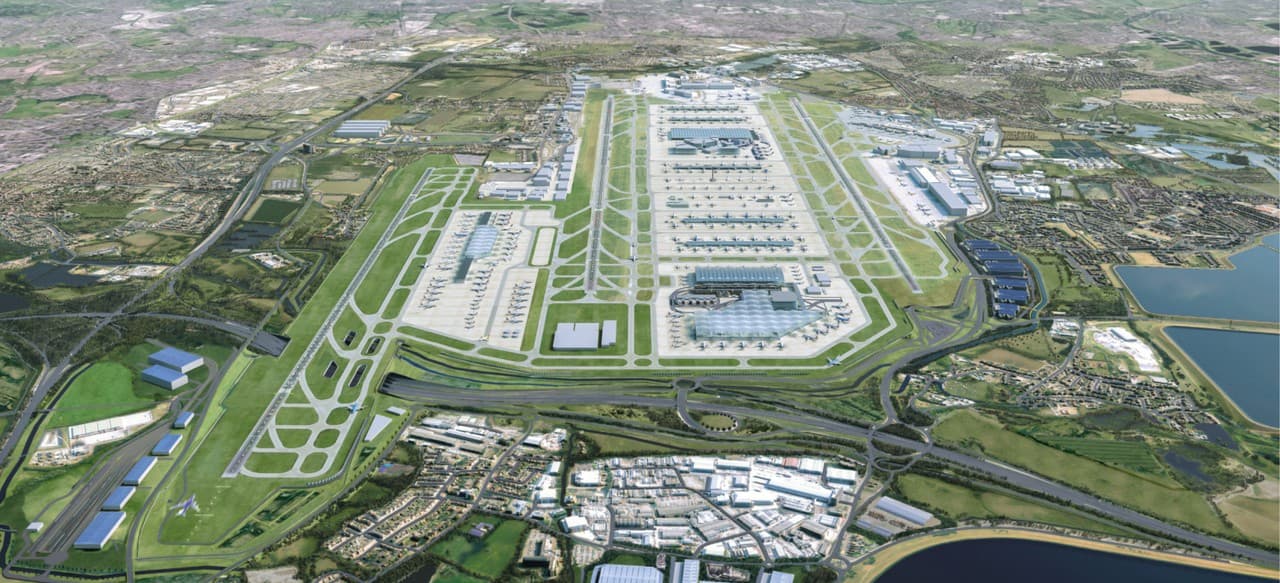
Heathrow's own visualisation of the expanded airport: a computer-generated aerial view showing the proposed third runway north of the existing pair, with a new terminal between them

The argument resumed in January 2025, when the Chancellor confirmed government support for expansion. In November 2025 ministers selected the airport's own north-west runway proposal over a rival third-party scheme as the basis for review, and a public consultation on the framework for the decision opened in June 2026. The scheme as costed would give a runway of up to 11,000 ft, a new terminal, the M25 in tunnel, and a capacity of around 150 million passengers a year, for a figure quoted at £49 billion. The planning permission is targeted for 2029 and the runway for the decade after: dates which, on the record of the previous twenty years, should be read as intentions rather than schedules.

Noise and environment

Heathrow's approaches pass over more people than those of any other airport in Europe, and noise is the constraint that has shaped nearly every operational decision the airport has taken. Runway alternation exists for it. So do the continuous descent approaches, the steeper glide slopes trialled on the southern runway, the noise-related landing charges, and the tightly limited quota of movements in the night period.

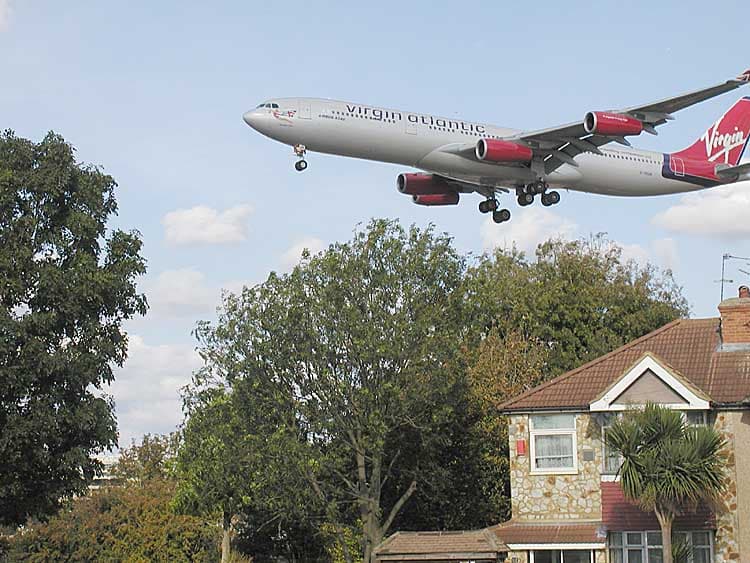
A Virgin Atlantic Airbus A340 crossing the rooftops on final approach, seen from Myrtle Avenue beside the airport's south-eastern boundary
A Virgin Atlantic Airbus A340 crossing the rooftops on final approach, seen from Myrtle Avenue beside the airport's south-eastern boundary (2003)

Air quality is the second front. The airport sits beside the M4 and the M25, and the roads contribute more nitrogen dioxide locally than the aircraft do: which is why the expansion case has always turned as much on surface access as on the runway itself, and why the airport's own targets are written in terms of passengers arriving by public transport.

The third front is climate, and it is the newest. The 2020 Court of Appeal ruling made Heathrow the first major British infrastructure project to be stopped, however briefly, because a government had not reconciled it with its own carbon commitments. The Supreme Court reversed the judgment on a point of administrative law rather than of climate policy, and the underlying question: whether a country with a legislated net-zero target can add a runway to its busiest airport: has not been settled by any court. It will be argued again through the current planning process.

Notable events

On 2 May 1952 BOAC's de Havilland Comet 1 G-ALYP left London for Johannesburg with thirty-six passengers aboard, by way of Rome, Beirut, Khartoum, Entebbe and Livingstone. It was the first scheduled passenger service anywhere flown by a jet airliner, and it left from here. The Comet's subsequent structural failures ended the type's early career, but the date stands.

On 22 January 1970 Pan American's Boeing 747-121 N736PA landed after six hours and fourteen minutes from New York, carrying 335 passengers on the 747's inaugural commercial service. The scheduled aircraft had gone unserviceable at the gate and a second was substituted; the delay was long enough that the flight has been remembered ever since as much for its start as its arrival. Heathrow spent the following years lengthening runways, strengthening pavements and rebuilding stands around an aeroplane twice the size of anything it had handled.

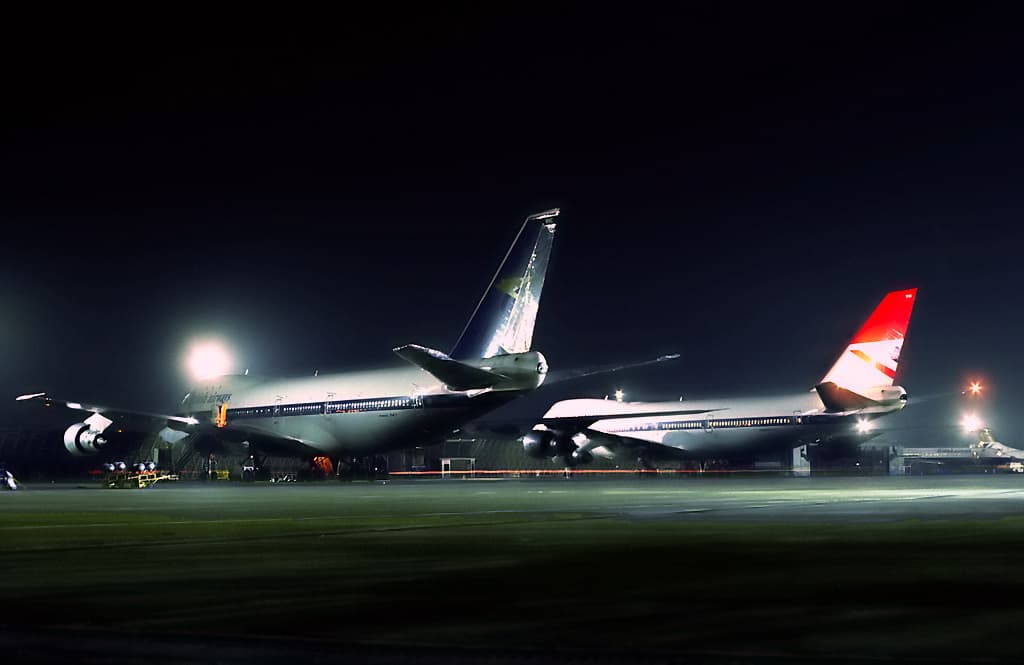
Two early Boeing 747s at Heathrow's maintenance base at night in 1977, one still wearing basic BOAC colours and the other in transitional British Airways livery
Two early Boeing 747s at Heathrow's maintenance base at night in 1977, one still wearing basic BOAC colours and the other in transitional British Airways livery (1977)

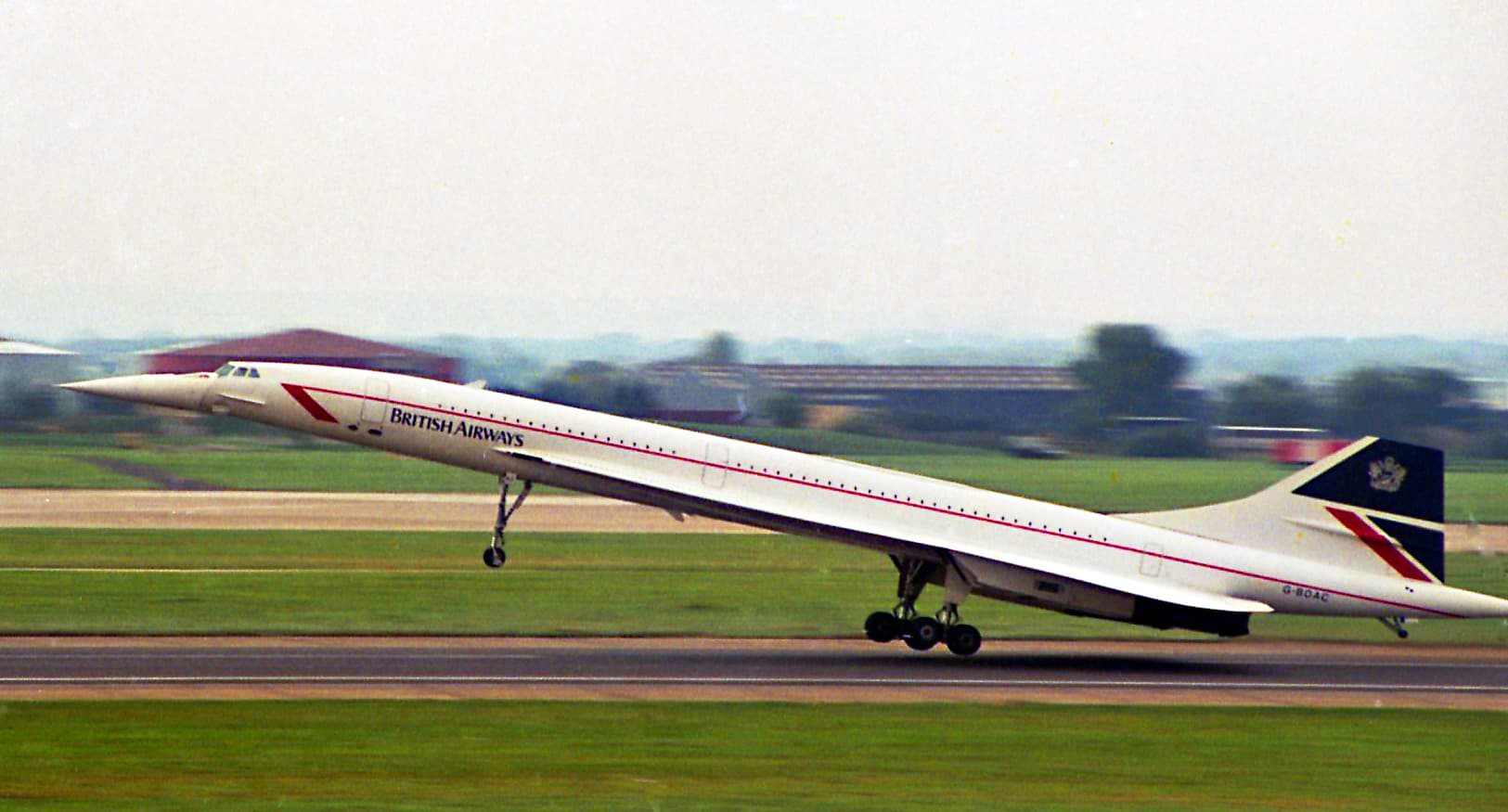
Concorde flew from Heathrow for twenty-seven years. British Airways flight BA300 left for Bahrain on 21 January 1976 at the same moment an Air France Concorde left Paris for Rio, and the route that mattered, Heathrow to New York, opened in November 1977 after a long fight over noise at the American end. On 24 October 2003 three Concordes landed within minutes of one another on the last day of supersonic passenger service, watched by crowds along the perimeter road.

On 17 January 2008 British Airways flight 38, a Boeing 777-200ER inbound from Beijing, lost thrust on both engines on short final and came down inside the airport boundary short of runway 27L. Ice released from the fuel had restricted the fuel-oil heat exchangers. All 152 people aboard evacuated; one was seriously injured. It was the 777's first hull loss, and it produced a redesign of the heat exchanger across the fleet.

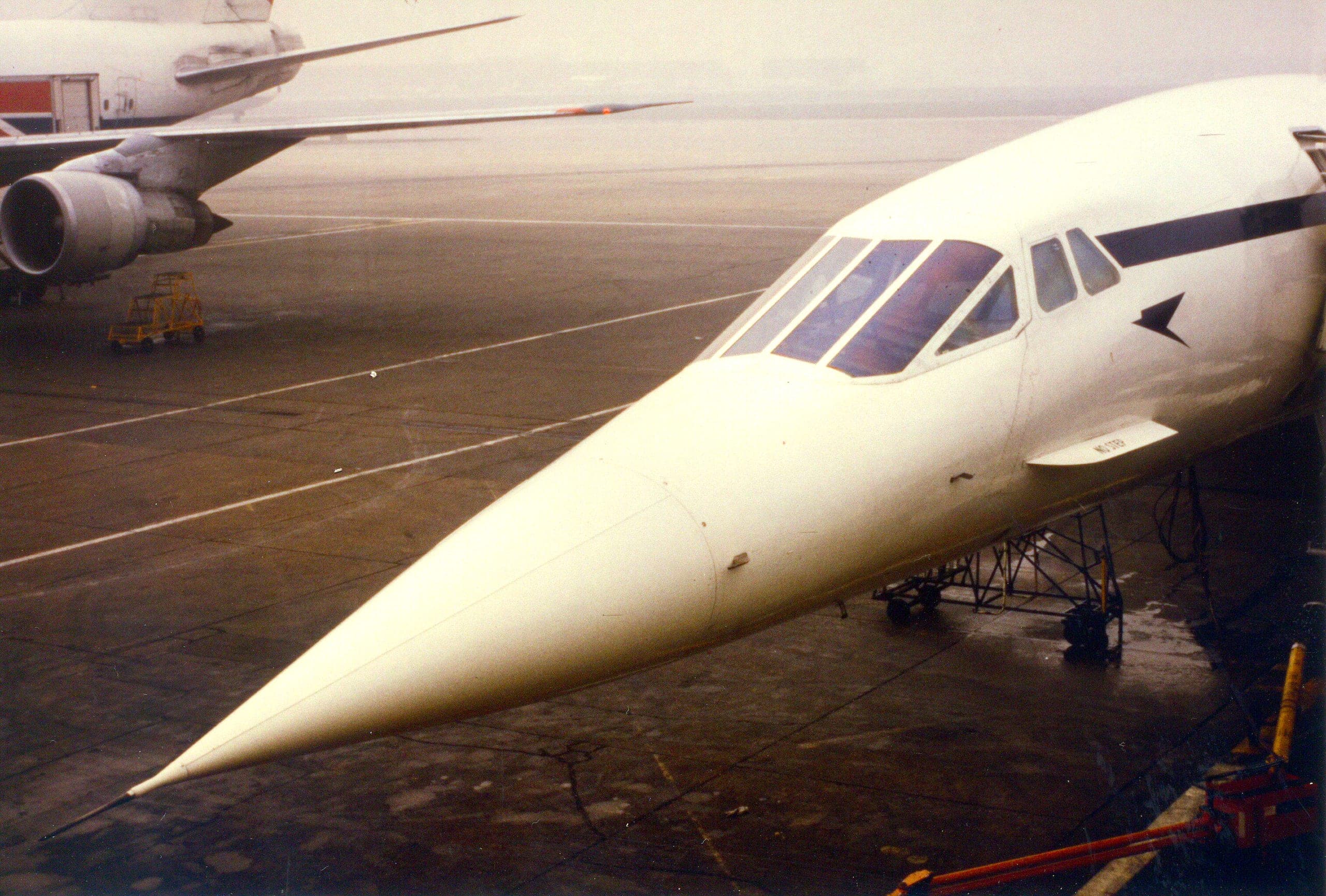
British Airways Concorde G-BOAB on a wet Heathrow stand in 1984, nose drooped, with a widebody parked behind
British Airways Concorde G-BOAB on a wet Heathrow stand in 1984, nose drooped, with a widebody parked behind (1984)

On 20 March 2025 a fire at the North Hyde substation in Hayes cut the airport's power. Heathrow closed for about sixteen hours (more than a thousand flights cancelled or disrupted, around 200,000 passengers stranded) and did not return to normal operations until 22 March. The subsequent reviews found a fault identified at the substation in 2018 and never repaired, a fire suppression system out of service since at least 2022, and back-up arrangements that had never been designed to run the whole airport. For an airport whose defining characteristic is that it has no slack, it was an unusually literal demonstration of the point.

Place in world aviation

Heathrow's place in world aviation is not that of the largest airport (Atlanta, Dubai and Beijing have all passed it on one measure or another) but that of the most constrained important one. It is the standing case study in what a hub can do with two runways, and the standing argument about what it cannot.

For Britain it is the only long-haul hub, and the practical consequence is that a route which cannot get a slot at Heathrow often does not exist in the United Kingdom at all. That single fact has driven forty years of politics: the value of the slots, the ferocity of the expansion argument, and the repeated attempts to build a hub somewhere else that were abandoned once the cost of moving one became clear.

And it is a museum of the jet age in the ordinary sense that the whole of it happened here. The Comet's first service, the 747's first arrival, Concorde's whole commercial life and its last landings all belong to this airfield, along with the tents of 1946 and the star-shaped runway pattern that a jet made obsolete within a decade of its being laid. Heathrow is unusual among great airports in that its history is not somewhere else; it is under the present one, built over, still in use.

Runways

09L/27R

Length
12,802 ft
Width
164 ft
Surface
Asphalt
Approach category
CAT IIIB

The northern runway. Extended in stages from the original 1940s pattern to take the Boeing 707 and then the 747.

09R/27L

Length
12,008 ft
Width
164 ft
Surface
Asphalt
Approach category
CAT IIIB

The southern runway. The two are used one for departures and one for arrivals, swapping at 15:00 so that the communities beneath each approach get half a day of quiet.

Terminals

In use

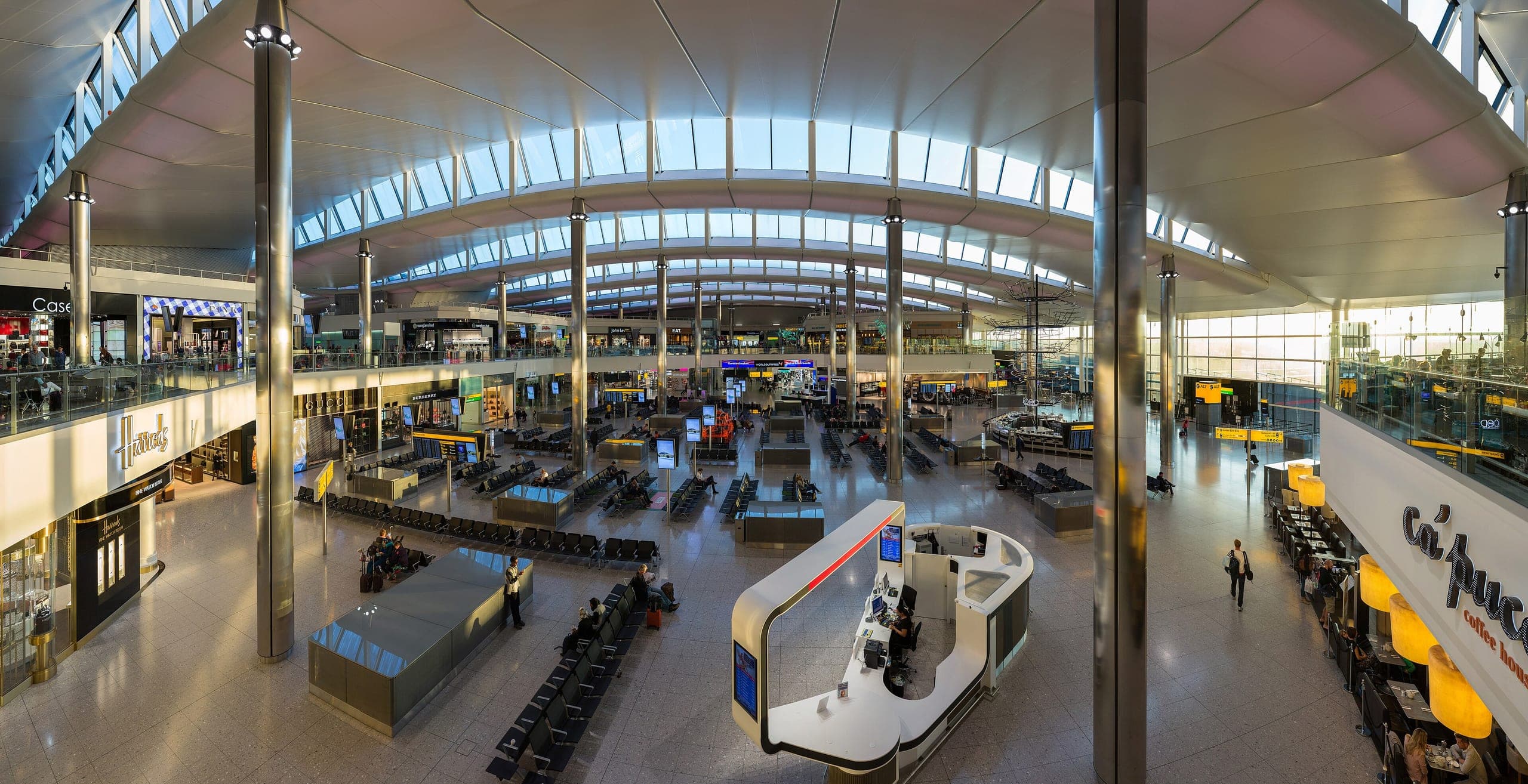
The central departures concourse of Terminal 2, the Queen's Terminal, daylit through its wave-form roof

Terminal 2

Opened 2014 · Originally The Queen's Terminal · Luis Vidal + Architects · 24 gates

Heathrow's newest passenger building, opened in June 2014 on the site of the 1955 Europa Building it replaced, the second terminal to carry the number 2 on the same patch of ground. Home to most of the Star Alliance carriers, its wave-form roof lights the departures concourse almost entirely by day.

Terminal 3

Opened 1961 · Originally Oceanic Terminal · 28 gates

Opened in November 1961 as the Oceanic Terminal, built for the long-haul piston and early jet fleets that could not be handled in the central area's original buildings. Repeatedly extended since, it remains the airport's principal terminal for non-aligned and oneworld long-haul carriers.

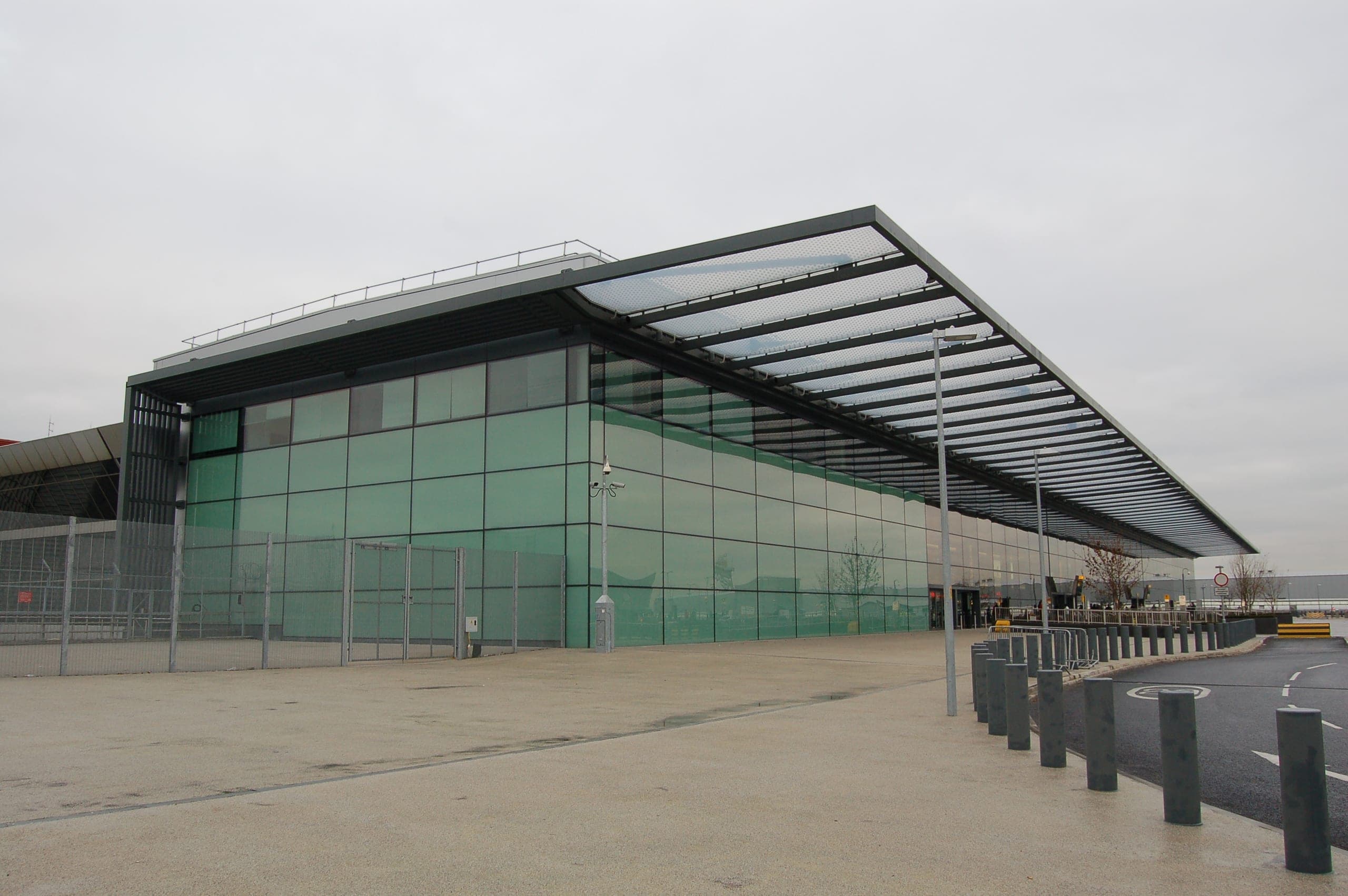
The glazed frontage and cantilevered canopy of Terminal 4, on the south side of the airfield

Terminal 4

Opened 1986 · 22 gates

Opened in April 1986 on the south side of the airfield, away from the central terminal area and reached by its own spur road and rail station. Built for British Airways' long-haul operation, it passed to SkyTeam and other carriers after they moved to Terminal 5.

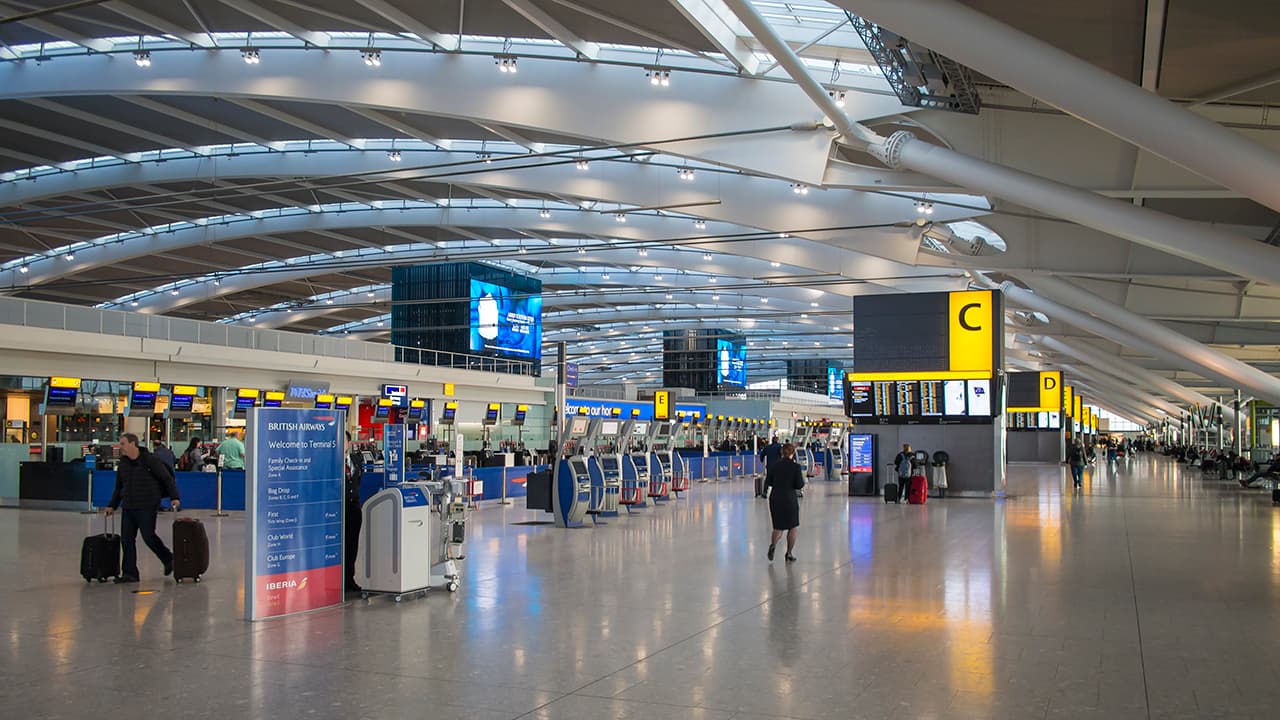
The check-in concourse of Terminal 5 under its single-span waveform roof

Terminal 5

Opened 2008 · Richard Rogers Partnership · Design capacity 30 m passengers a year

The £4.2 billion terminal at the western end of the airfield, opened by Queen Elizabeth II on 14 March 2008 and to passengers on 27 March. Its single-span waveform roof covers a building 1,300 ft long and 130 ft tall, the largest free-standing structure in the United Kingdom, with two satellites reached by an underground transit. It is British Airways' home.

Closed

Terminal 1

1968–2015

Opened in November 1968 for domestic and European services and closed on 30 June 2015, its traffic absorbed by the new Terminal 2 next door. Its demolition released the land on which Terminal 2 is still expanding.

Getting there

Piccadilly line
50 min to the city · since 1977
London Underground reached the airport in December 1977, making Heathrow one of the first major airports in the world with a direct metro connection to its city centre.
Heathrow Express
15 min to the city · since 1998
A dedicated non-stop service to London Paddington, opened in June 1998 and running on its own spur from the Great Western main line.
Elizabeth line
35 min to the city · since 2022
Cross-London stopping services reached the airport terminals in 2022, connecting Heathrow to the West End, the City and Canary Wharf without a change.
Road
The airport sits inside the angle of the M4 and M25, entered through a tunnel under the northern runway to the central terminal area and by separate spurs to Terminals 4 and 5.

Timeline

  1. 1929

    Fairey Aviation buys the Great West Aerodrome

    Fairey begins acquiring farmland beside the hamlet of Heath Row, at roughly £10 an acre, for a private assembly and test field. It is a grass strip in market-garden country, and it is the direct ancestor of the airport.

  2. 1944

    The Air Ministry requisitions the site

    The land is taken under wartime powers for a long-range transport base, RAF Heathrow. Harold Balfour, then Under-Secretary of State for Air, later wrote that he had deliberately misled the committee about the military need in order to secure the site for post-war civil aviation.

  3. January 1, 1946

    London Airport opens

    The site passes to the Ministry of Civil Aviation. A British South American Airways Avro Lancastrian, Star Light, leaves for Buenos Aires. Passengers wait in army tents on duckboards along the Bath Road; the airport opens fully to civil traffic on 31 May.

  4. May 2, 1952

    The first scheduled jet passenger service

    BOAC's de Havilland Comet 1 G-ALYP leaves London for Johannesburg with thirty-six passengers, the first fare-paying jet airliner service in the world.

  5. 1955

    The central area becomes a building

    Queen Elizabeth II opens the Europa Building, the airport's first permanent passenger terminal, together with the Queens Building and a new 127 ft control tower. The tents are finally gone.

  6. November 1961

    The Oceanic Terminal

    A dedicated long-haul building opens on the north side of the central area for the transatlantic fleets. It is Terminal 3 today.

  7. September 1966

    British Airports Authority, and the name Heathrow

    The new state authority takes over London Airport, Gatwick, Stansted and Prestwick, and renames the first of them Heathrow so that the four can be told apart.

  8. January 22, 1970

    The first 747 in service

    Pan American's Boeing 747-121 N736PA arrives from New York with 335 passengers on the type's inaugural commercial flight, after a substitution and a delay of several hours. Heathrow lengthens runways and rebuilds stands around the aircraft.

  9. January 21, 1976

    Concorde enters service

    British Airways flight BA300 leaves Heathrow for Bahrain at the same moment an Air France Concorde leaves Paris for Rio: the first scheduled supersonic passenger services. New York follows in November 1977.

  10. December 1977

    The Underground arrives

    The Piccadilly line extension opens to Heathrow Central, giving the airport a direct metro link to the middle of London two decades before most of its rivals.

  11. April 1986

    Terminal 4

    The airport spills out of its central island for the first time, opening a terminal on the far side of the southern runway.

  12. October 24, 2003

    The last Concorde arrivals

    Three British Airways Concordes land at Heathrow within minutes of each other on the final day of supersonic passenger service, watched by crowds along the perimeter road.

  13. March 27, 2008

    Terminal 5 opens, and stops

    The largest free-standing building in the country opens to passengers and immediately fails: staff cannot reach their posts, the baggage system backs up, more than 500 flights are cancelled and some 42,000 bags travel without their owners over ten days.

  14. June 2014

    The Queen's Terminal

    Terminal 2 reopens as a wholly new building on the site of the 1955 Europa. Terminal 1 closes the following June and is demolished to let it grow.

  15. December 16, 2020

    The Supreme Court clears the third runway

    Ten months after the Court of Appeal ruled the government's airports policy unlawful for failing to account for its climate commitments, the Supreme Court overturns that judgment and allows a planning application to proceed.

  16. March 20, 2025

    A substation fire closes the airport

    Fire at the North Hyde substation in Hayes cuts the airport's power. Heathrow closes for roughly sixteen hours, cancelling or disrupting more than a thousand flights and stranding about 200,000 passengers, the largest single interruption in its history.

  17. November 25, 2025

    The government picks Heathrow's scheme

    Ministers select the airport's own north-west runway proposal over a rival third-party scheme as the basis for review, setting a timetable aimed at planning permission by 2029.
Aircraft in this story

Types whose story is bound up with this airport.