History
The First Powered Flight
December 17, 1903, 10:35 AM
Kill Devil Hills, near Kitty HawkNorth Carolina, United States
59seconds
Longest flight
852ft
Distance covered
4
Flights that day
The event
- Date
- 17 December 1903
- First flight
- 10:35 a.m.
- Place
- Kill Devil Hills, N.C.
- First pilot
- Orville Wright
- Wind
- 17–23 kt, from the north
- Witnesses
- 5, plus the brothers
- Take-off
- 60 ft wooden rail, level sand
The four flights
- First, Orville
- 120 ft · 12 s
- Second, Wilbur
- ≈ 175 ft · ≈ 12 s
- Third, Orville
- ≈ 200 ft · 15 s
- Fourth, Wilbur
- 852 ft · 59 s
- Ground speed, 1st flight
- ≈ 6 kt
The machine
- Name
- Wright Flyer
- Configuration
- Canard biplane, twin pushers
- Wingspan
- 40.32 ft
- Length
- 21.1 ft
- Wing area
- 510 ft²
- Empty weight
- 604 lb
- Weight with pilot
- ≈ 745 lb
- Engine
- Wright 4-cylinder, ≈ 12 hp
- Propellers
- 2 × 8.5 ft, counter-rotating
- Structure
- Spruce, ash, muslin
- Where it is now
- National Air and Space Museum
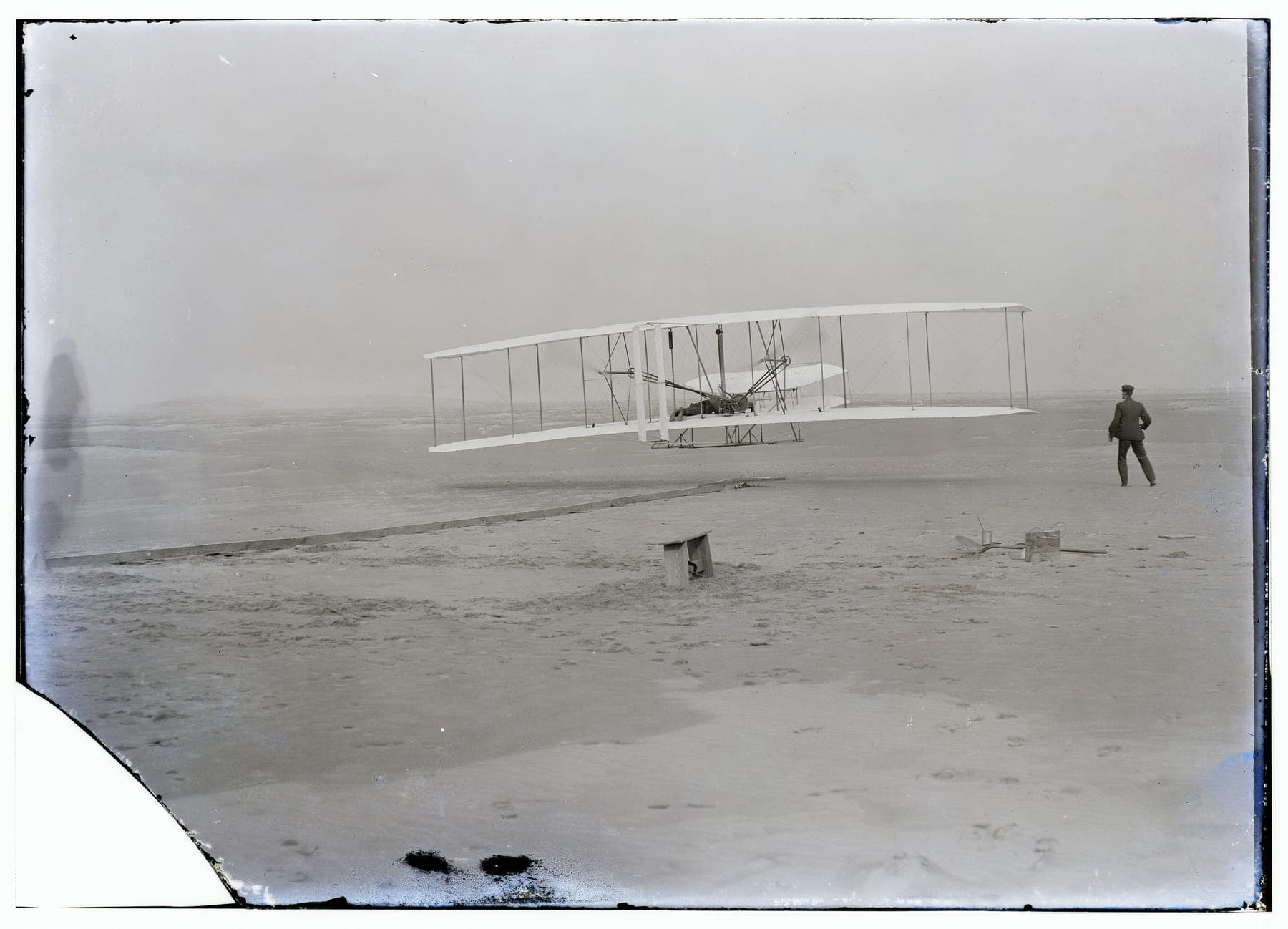
On a cold Thursday morning at Kill Devil Hills, North Carolina, Orville Wright flew a machine of his own design 120 feet in twelve seconds, the first sustained, controlled, powered flight of a heavier-than-air craft carrying a human being. Three more flights followed before noon, the longest 852 feet in 59 seconds, and within five years the aeroplane was a practical machine.
At half past ten on the morning of Thursday 17 December 1903, on a sand flat between Kill Devil Hills and the Atlantic, a machine of wood, muslin and bicycle chain lifted off a wooden rail with a man lying prone across its lower wing. It stayed up for twelve seconds and came down 120 ft away, a little further than the wingspan of the airliner that would cross the same coast a century later. Three more flights followed before noon. The last covered 852 ft in 59 seconds.
What happened that morning was not that a man left the ground: Clément Ader had done that in 1890, and others had made hops of a sort. It was that a powered machine rose from level ground under its own power, flew forward without losing height or speed, was steered by its pilot, and landed no lower than it had started; and then did it three more times, with two different pilots, in the space of ninety minutes. Repeatability is the part that is easy to overlook and impossible to fake.
The Wrights arrived there by a route that looks, in hindsight, less like invention than like engineering. They had decided at the outset that lift and power were solved problems and that control was not; they had spent four seasons proving it on gliders; and when the published aerodynamic tables failed them, they built a wind tunnel and replaced the tables. The aeroplane was the last step, not the first.
Background
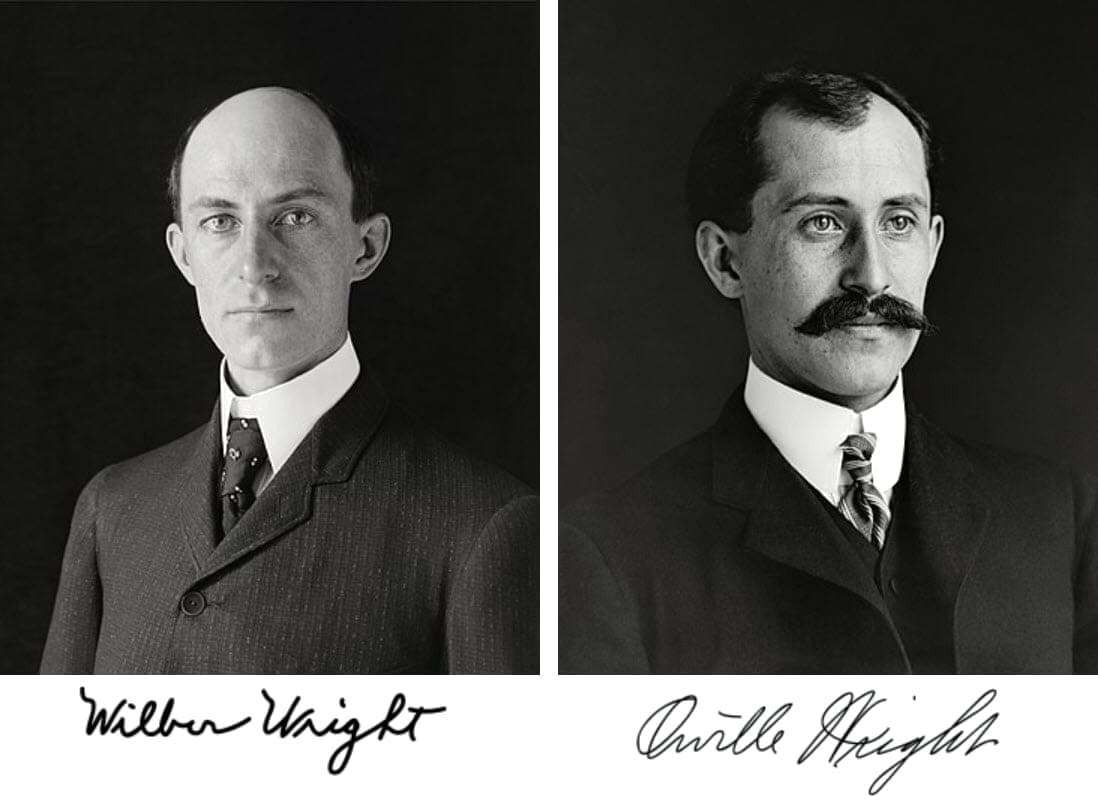
Wilbur and Orville Wright ran a bicycle shop at 1127 West Third Street in Dayton, Ohio. Neither had been to university; both had left school without a diploma. The shop mattered more than the biographies usually allow: a bicycle is an unstable machine that a rider learns to balance, and the brothers reasoned from it that a flying machine would be the same, something to be flown rather than something to be made stable and then merely steered. Almost every contemporary thought the opposite.
The programme began with a letter. In May 1899 Wilbur wrote to the Smithsonian Institution asking for everything it had published on human flight, explaining that he was "an enthusiast, but not a crank". The reply (pamphlets, a reading list, Octave Chanute's Progress in Flying Machines) gave them the state of the art in a fortnight's reading, and told them what was missing from it.

Otto Lilienthal's death in 1896 had made the missing piece specific. The German had flown some two thousand glides and controlled them by swinging his legs; when a gust exceeded what his body could correct, he fell. The brothers concluded that a pilot needed a control that acted on the wings themselves, not on the machine's centre of gravity.
The answer came to Wilbur in the shop, twisting an empty cardboard inner-tube box between his hands. If a biplane's wings could be warped helically (one tip raised, the other lowered) the machine would roll, and roll deliberately. A five-foot kite built in July 1899 and flown on four lines from the ground behaved exactly as the theory said it would. Everything that followed for four years was an attempt to put a man inside that idea.
Development
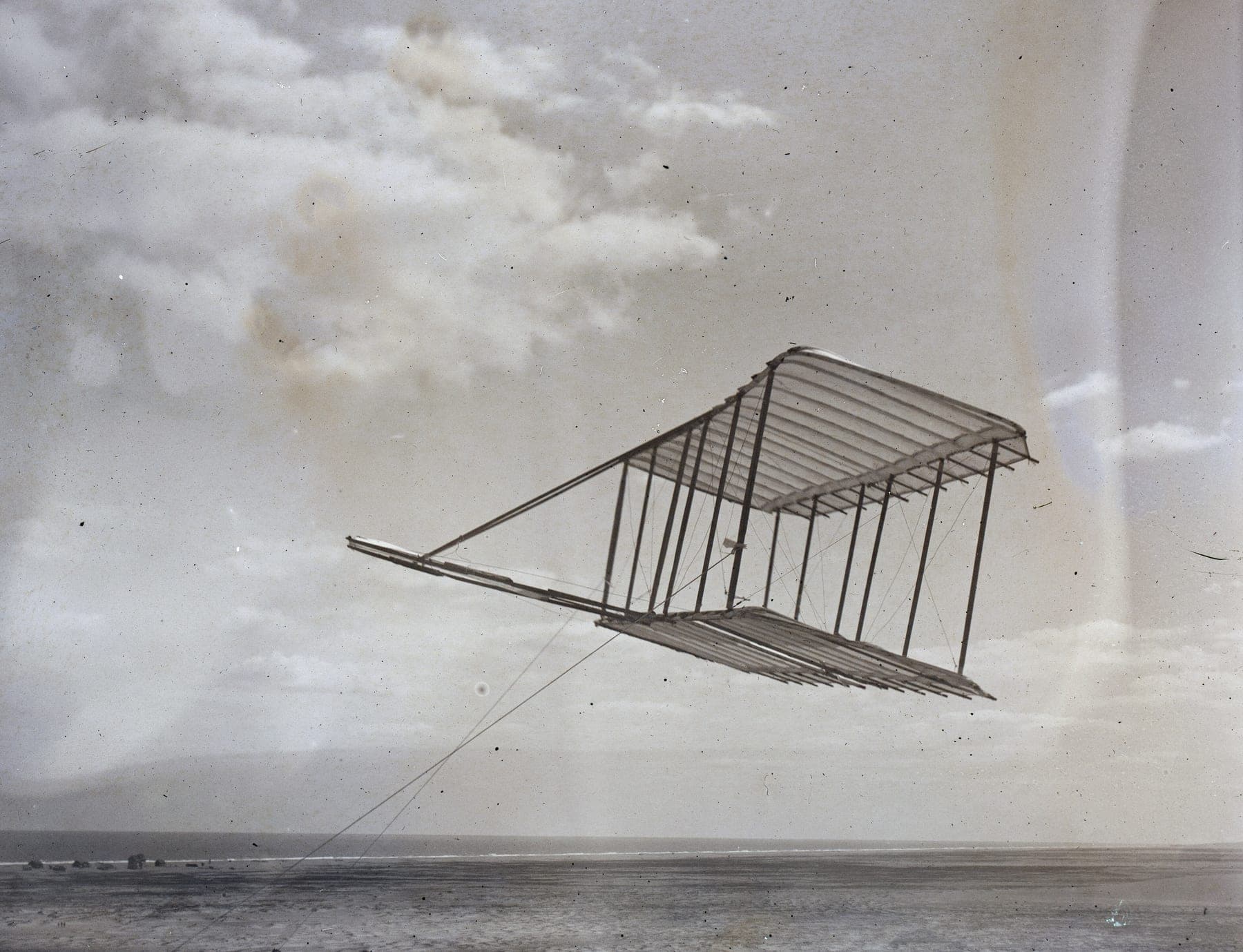
They needed wind, sand and solitude. The United States Weather Bureau's records pointed to the Outer Banks of North Carolina, and in September 1900 they set up camp at Kitty Hawk with a glider of 17.5 ft span. Most of that season it flew as a kite on ropes. The important discovery was postural: lying prone on the lower wing halved the drag of an upright pilot and, contrary to every expectation of the day, proved survivable in a crash.
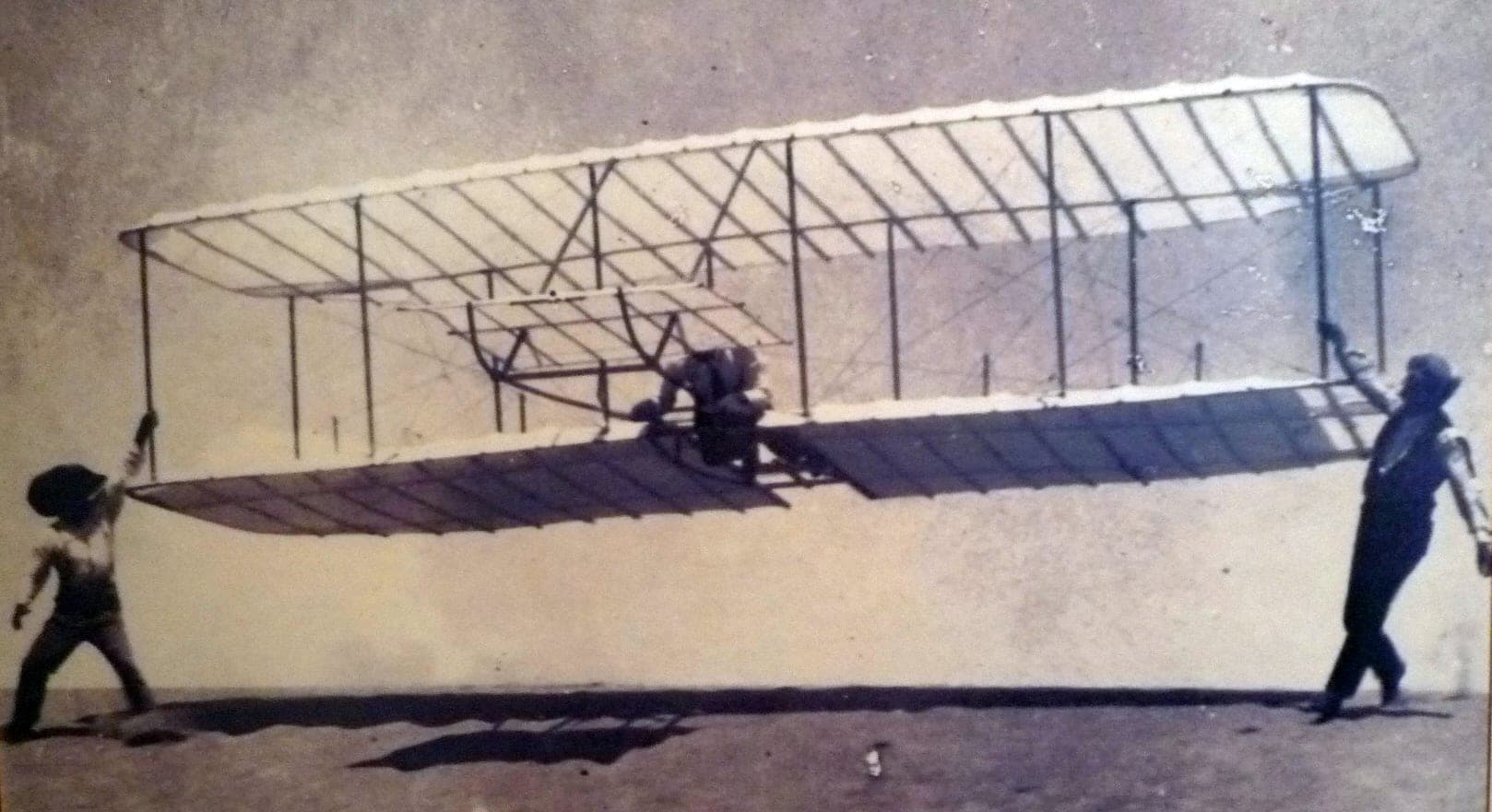
The 1901 season nearly ended the project. The larger glider produced barely a third of the lift its designers had calculated, and worse, warping the wings occasionally swung the machine the wrong way: what would later be called adverse yaw. On the train home Wilbur said that man would not fly for a thousand years. Both brothers had realised something more useful than despair: the published figures were wrong. Lilienthal's coefficients, and John Smeaton's air-pressure constant of 1759, had been taken on trust by everyone in the field, themselves included.
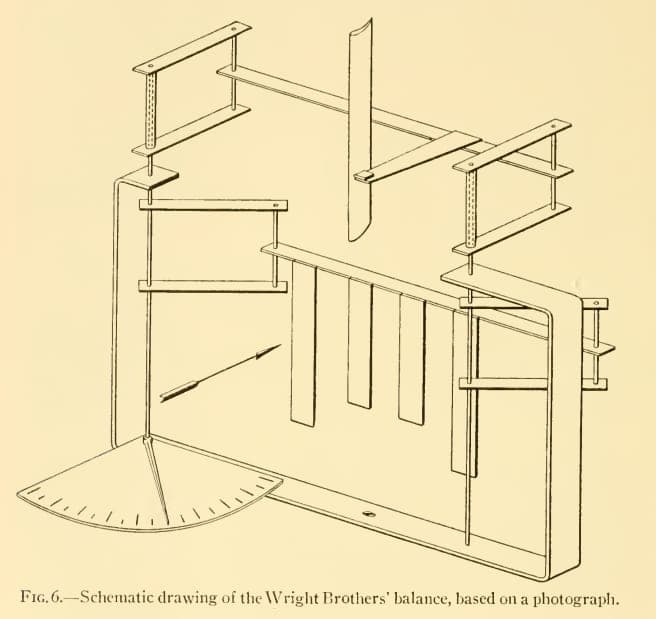
So they rebuilt the foundation. In the autumn of 1901, in the back of the bicycle shop, they made a wind tunnel, a wooden box about six feet long with a fan at one end, and two exquisitely simple balances from bicycle spokes and hacksaw blades, which measured lift and drag as ratios and so cancelled out most sources of error. In roughly two months they tested some two hundred model wing shapes, several dozen of them systematically. The result was the first body of reliable aerodynamic data in existence, and it belonged to two shopkeepers in Ohio.
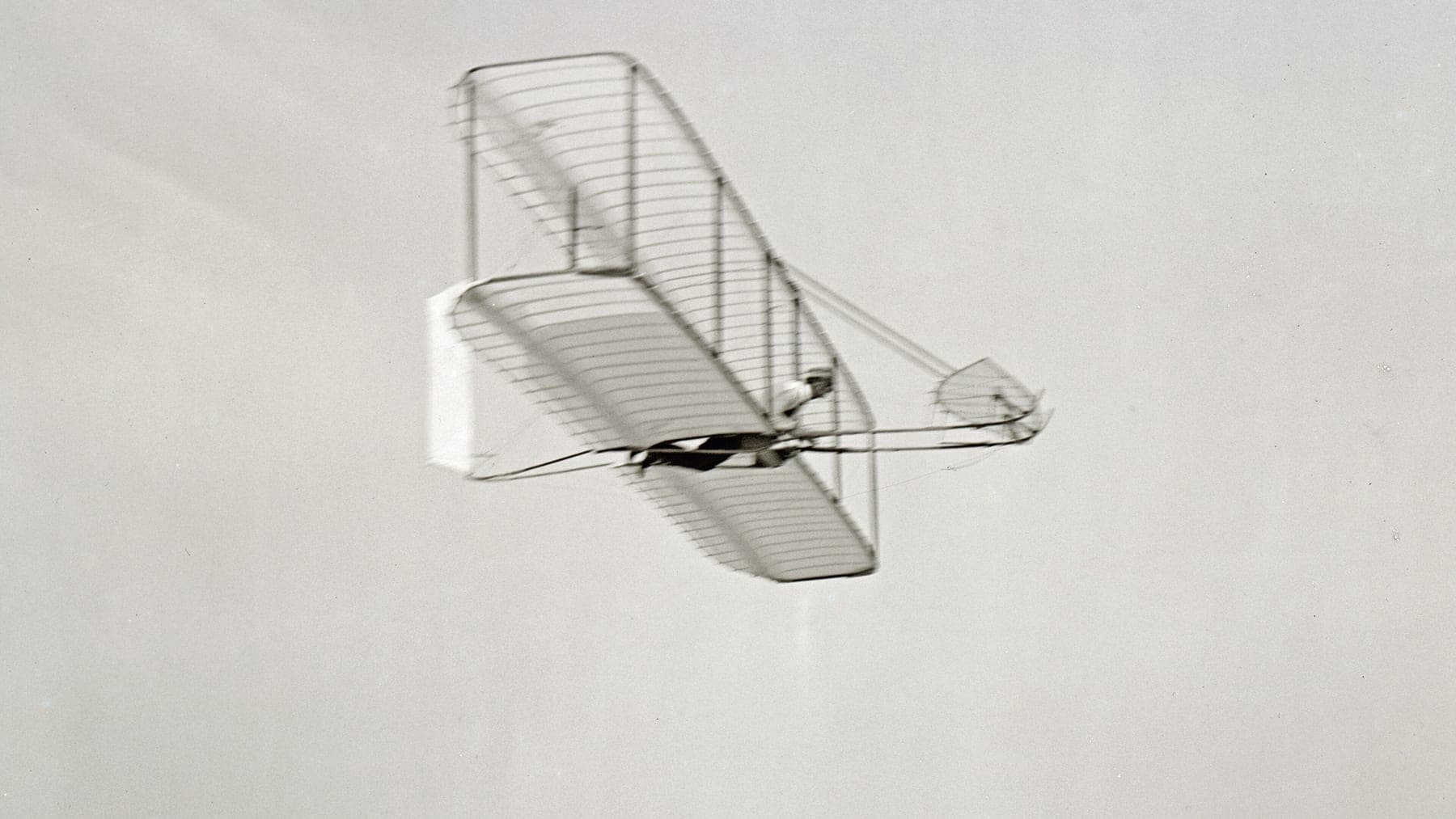
The 1902 glider was built to those numbers, and it flew. One problem remained: in a warped turn the machine could still slew and spin in. Orville, sleepless one night in October after too much coffee, proposed making the fixed rear fin movable; Wilbur added that it should be linked to the wing-warping cradle so the pilot commanded both together. That linkage (roll and yaw coordinated, with the forward elevator for pitch) is three-axis control, and it is the invention. The brothers made something over a thousand glides that season, some lasting 26 seconds. They went home able to fly, and needing only an engine and a propeller.
The machine
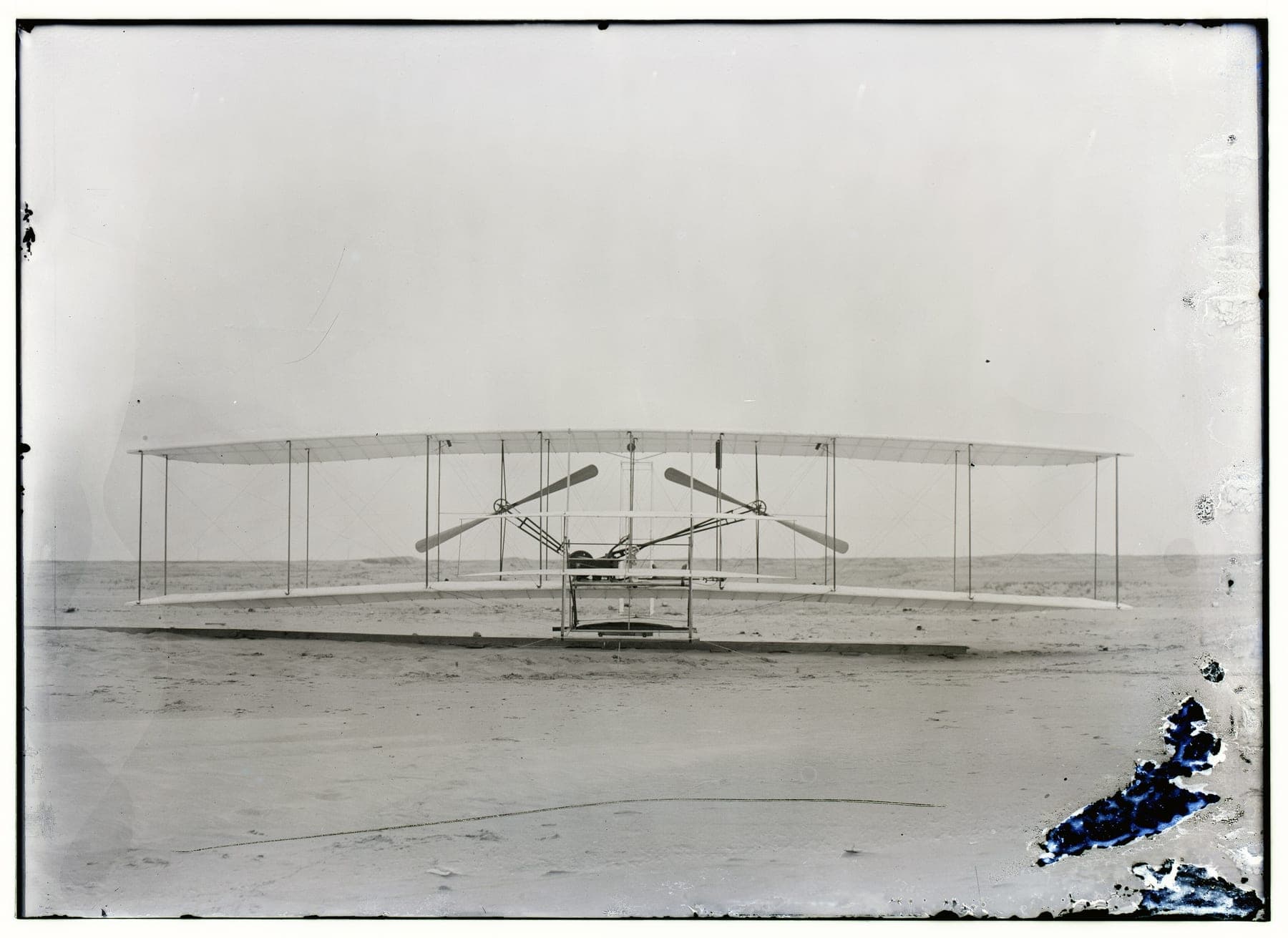
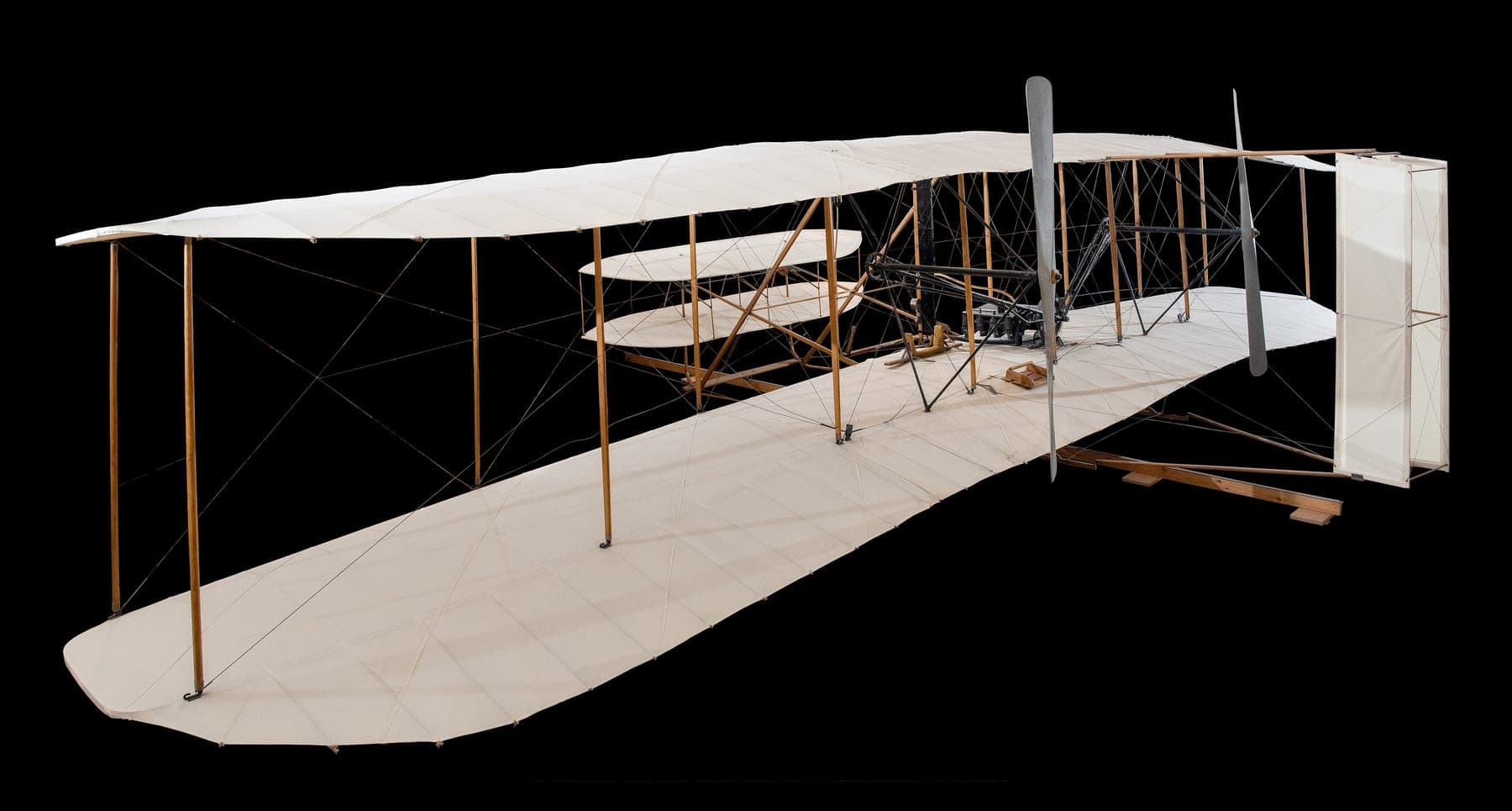
The machine of 1903 was a canard biplane of 40.32 ft span and 605 lb empty, built of spruce and ash and covered in unbleached "Pride of the West" muslin, dress fabric from a Dayton department store, sewn by the brothers. It had no wheels: two skids, and a 60 ft launching rail of two-by-four topped with a strip of steel, on which the machine ran on a small wheeled truck. It had no throttle worth the name, no instruments beyond a stopwatch, an anemometer and a revolution counter, and no seat, the pilot lay in a cradle on the lower wing and moved his hips to warp the wings.
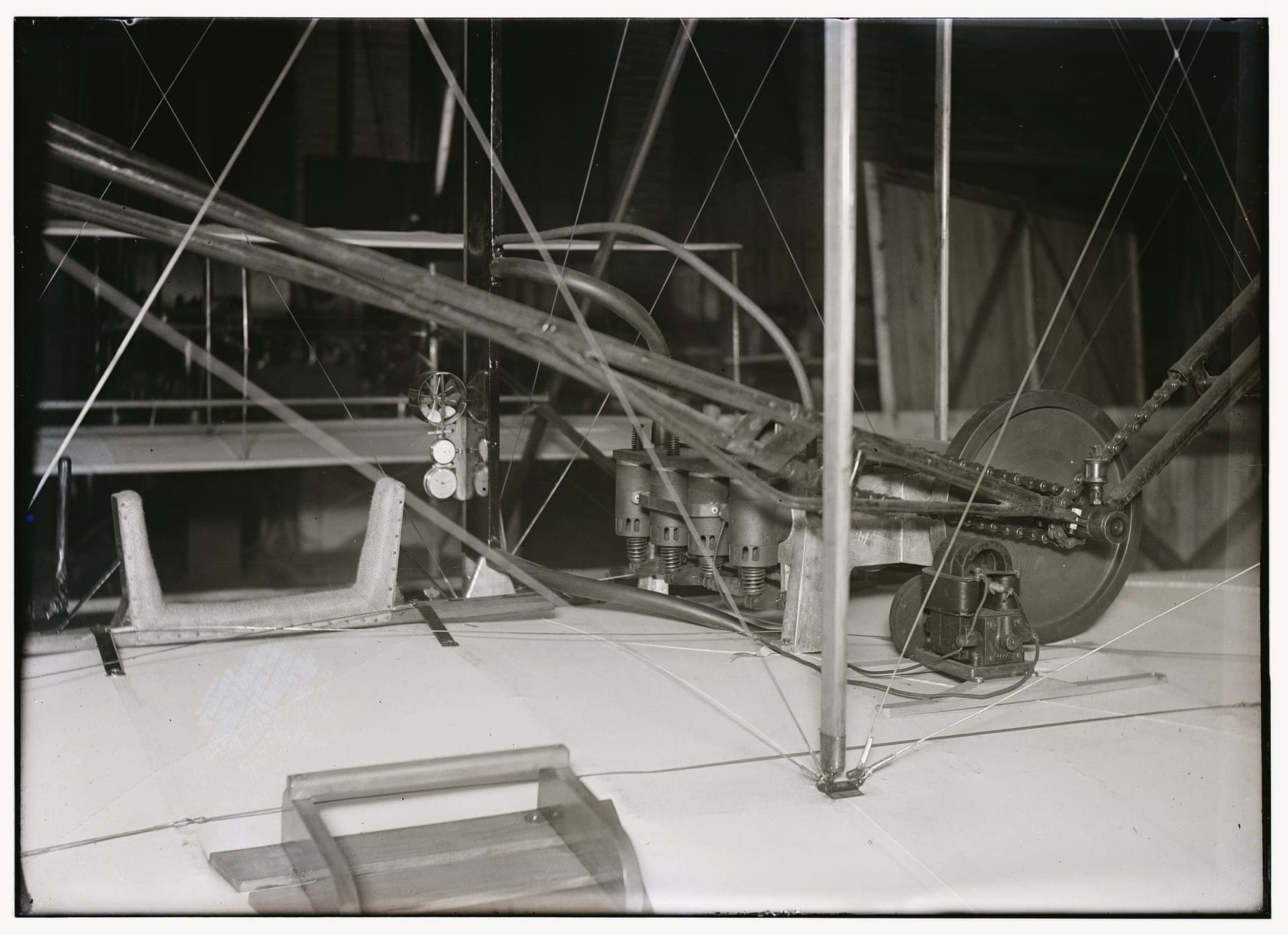
No manufacturer would sell them an engine of eight horsepower weighing under two hundred pounds, so Charlie Taylor, the machinist who kept the bicycle business running while the brothers were away, built one in six weeks from sketches chalked on the shop wall. It was a horizontal four-cylinder of 0.9 US gal with a cast aluminium crankcase, an exotic material in 1903, and it delivered around twelve horsepower, comfortably more than the specification. It had no carburettor, no fuel pump and no spark plugs; fuel dripped into a heated manifold and the charge was fired by opening and closing contact points inside the cylinder.
The propellers were the intellectual surprise. Marine practice offered nothing usable, so the brothers reasoned that a propeller is simply a wing travelling in a helix, and applied their own wind-tunnel data to it. The two 8.5 ft blades, carved from laminated spruce and turning in opposite directions to cancel torque, were calculated to be 66 per cent efficient. Tests on accurate replicas a century later measured better than 75 per cent, a figure modern designers respect. Chains ran the drive from the single engine to both shafts, one crossed to reverse its rotation; the chains came from a bicycle supplier, in tubes to keep them from whipping.
The event
The first attempt was made on Monday 14 December. Wilbur won the toss, launched from the slope of the big hill, pulled up too sharply and stalled into the sand after 105 ft and three and a half seconds. The brothers did not count it; the machine had not sustained itself. Repairs took two days.
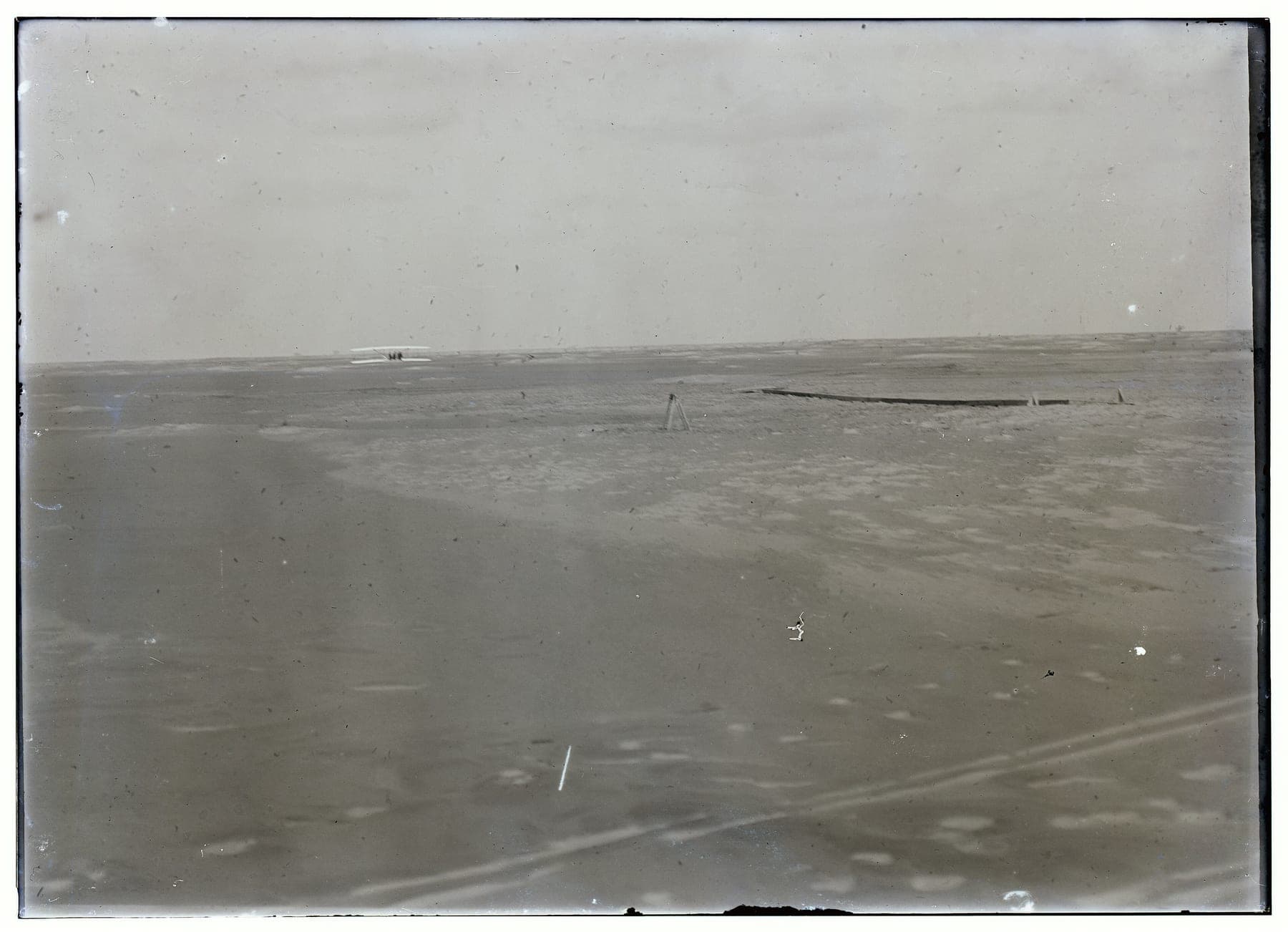
Thursday the 17th was freezing, with puddles of ice on the sand and a north wind of 17–23 kt, stronger than they wanted, and they discussed waiting. They decided the wind was tolerable and, at ten o'clock, hung out the signal that brought volunteers from the Kill Devil Hills Life-Saving Station a mile away. Five men came: the surfmen John T. Daniels, Adam Etheridge and Will Dough; W. C. Brinkley, a lumber buyer from Manteo; and Johnny Moore, a teenage boy from Nags Head. This time the rail was laid on level ground, so that nobody could say the machine had been helped downhill.
At 10:35 Orville released the restraining wire. The Flyer ran about forty feet along the rail with Wilbur steadying the wingtip, lifted into the wind and flew a lurching, undulating path (the forward elevator was far too sensitive, and every correction bred the next) before touching down 120 ft from the end of the rail. Twelve seconds. The ground speed was about seven miles an hour; the airspeed near thirty-four. A man could keep pace on foot beside it, and it was nonetheless flying.
They took turns. Wilbur flew about 175 ft, Orville about 200 ft, each a little steadier than the last. Then, at about noon, Wilbur flew the fourth: 852 ft in 59 seconds, holding the machine level for over half a minute before a pitching oscillation drove a skid into the sand and cracked the elevator supports. Half a mile through the air, on a machine that had never flown before that morning.
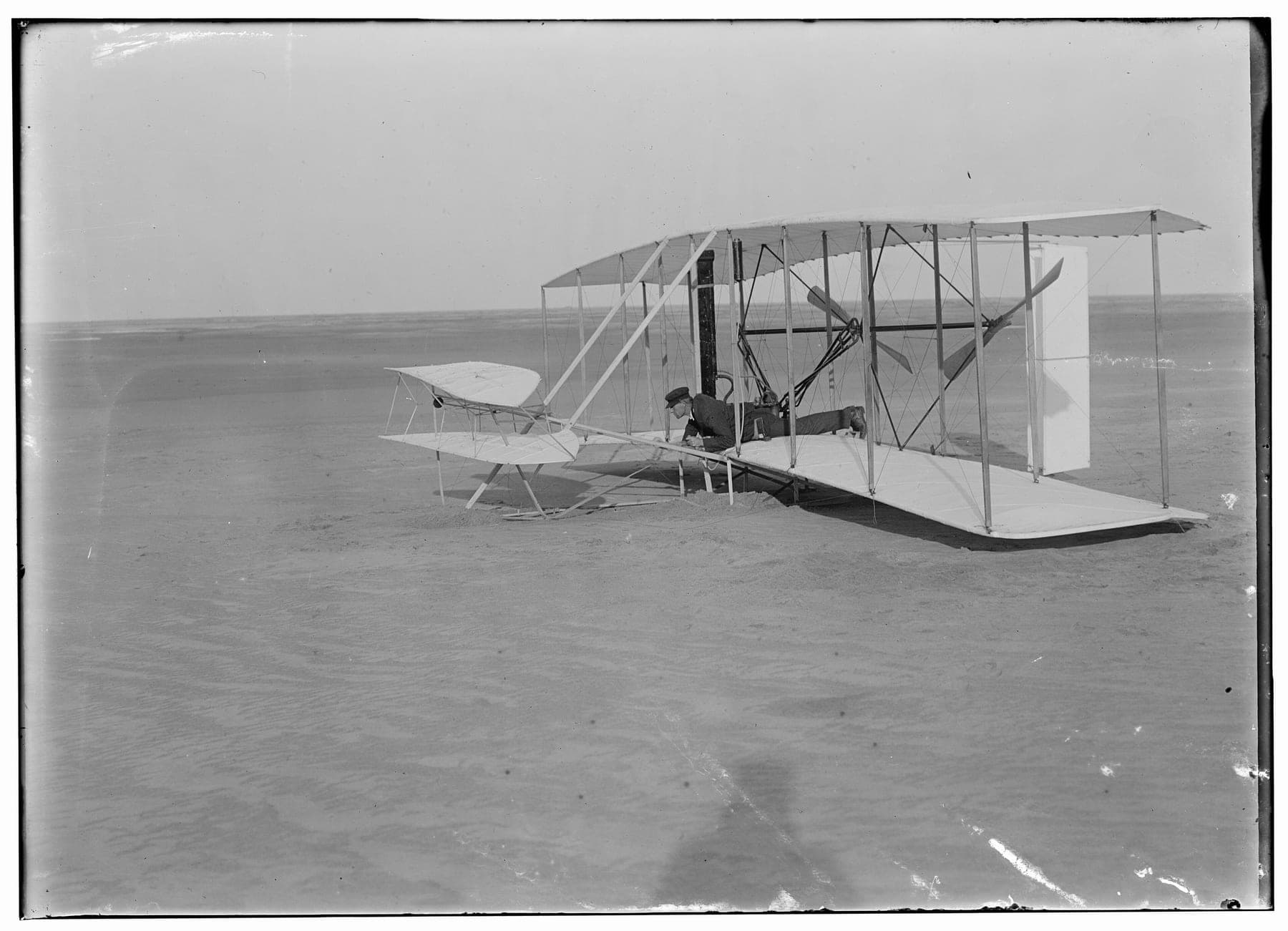
They carried it back to camp and stood talking beside it. A gust caught the Flyer, rolled it over and over across the sand, and wrecked it. John Daniels, who had grabbed at a strut and been carried inside the tumbling wreck, emerged bruised, the first person injured in an aeroplane accident, as he liked to say afterwards. The machine never flew again.
Aftermath
Almost nothing happened. The Dayton Journal declined the story on the grounds that a fifty-nine-second flight was too short to be of interest. A garbled account appeared in the Virginian-Pilot of Norfolk and was reprinted in a handful of papers, most of it invented. Scientific American did not believe it for three years. The brothers, who wanted a patent before they wanted publicity, were content to be ignored.
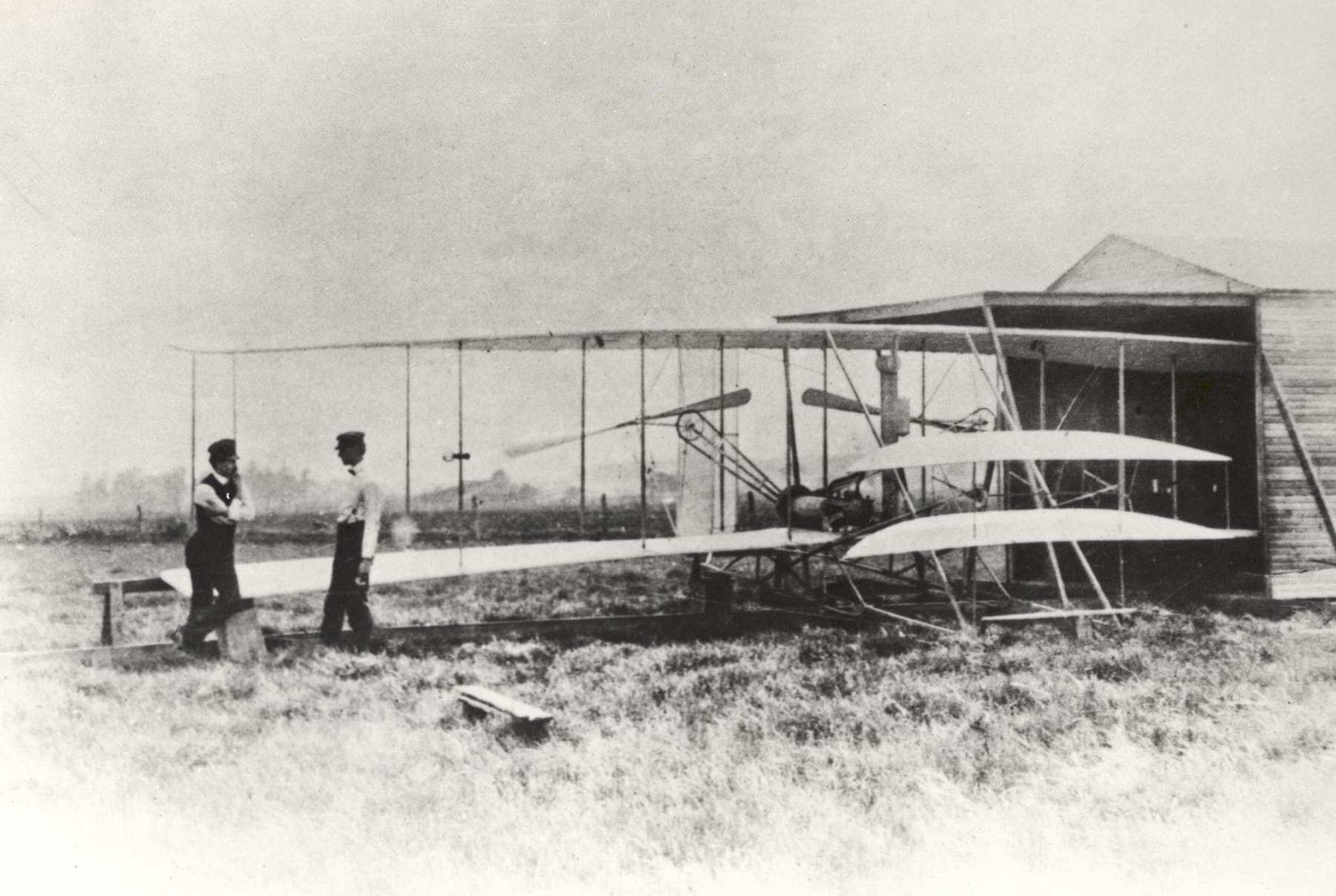
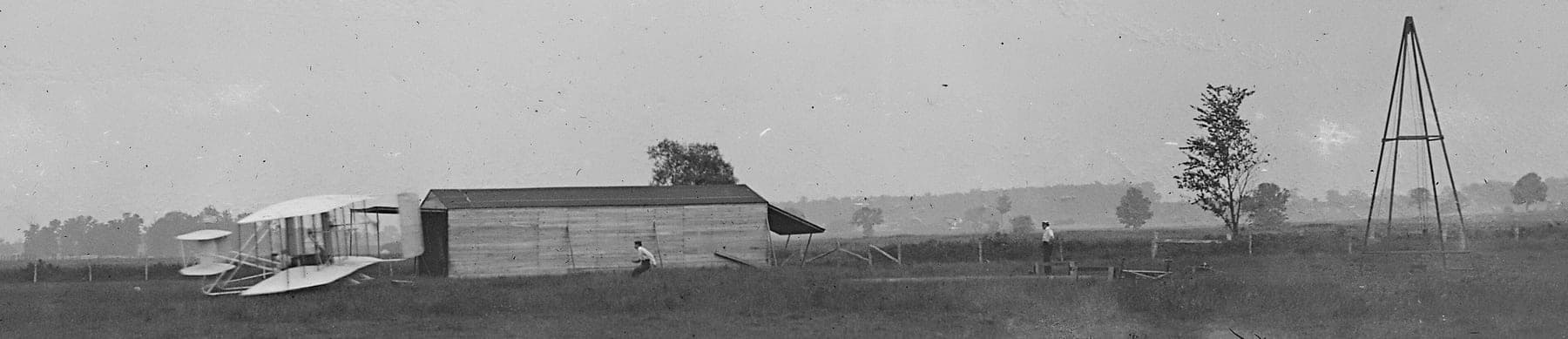
They moved their flying to Huffman Prairie, a cow pasture eight miles from Dayton, where the wind was poor and the field was small but the streetcar ran past the gate. There, with a weight-and-derrick catapult substituting for the missing sea breeze, they turned an aeroplane that could fly straight into one that could be flown. On 20 September 1904 Wilbur completed the first full circle ever flown by a powered aircraft. In 1905 the Flyer III, the first practical aeroplane in the world, stayed up for 38 minutes and covered 21 nm, landing only when the fuel ran out.
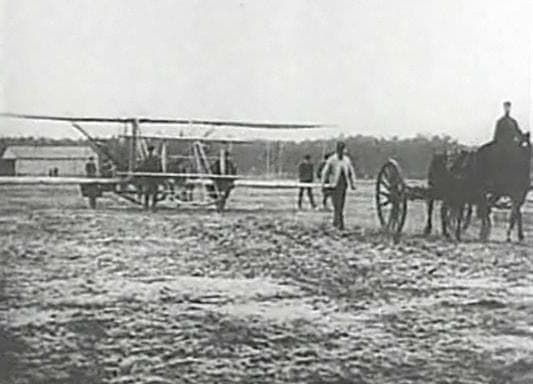
Then they stopped flying entirely, for two and a half years, while they negotiated with governments who would not buy a machine they were not allowed to see. The silence cost them dearly in credit: in Europe the word bluffeurs was used in print. It ended on 8 August 1908 at the Hunaudières racecourse near Le Mans, where Wilbur, in front of a sceptical French crowd, made a flight of one minute forty-five seconds that included two banked circles. The scepticism collapsed in that minute. "We are as children compared with the Wrights," said Louis Blériot, who would cross the Channel eleven months later.
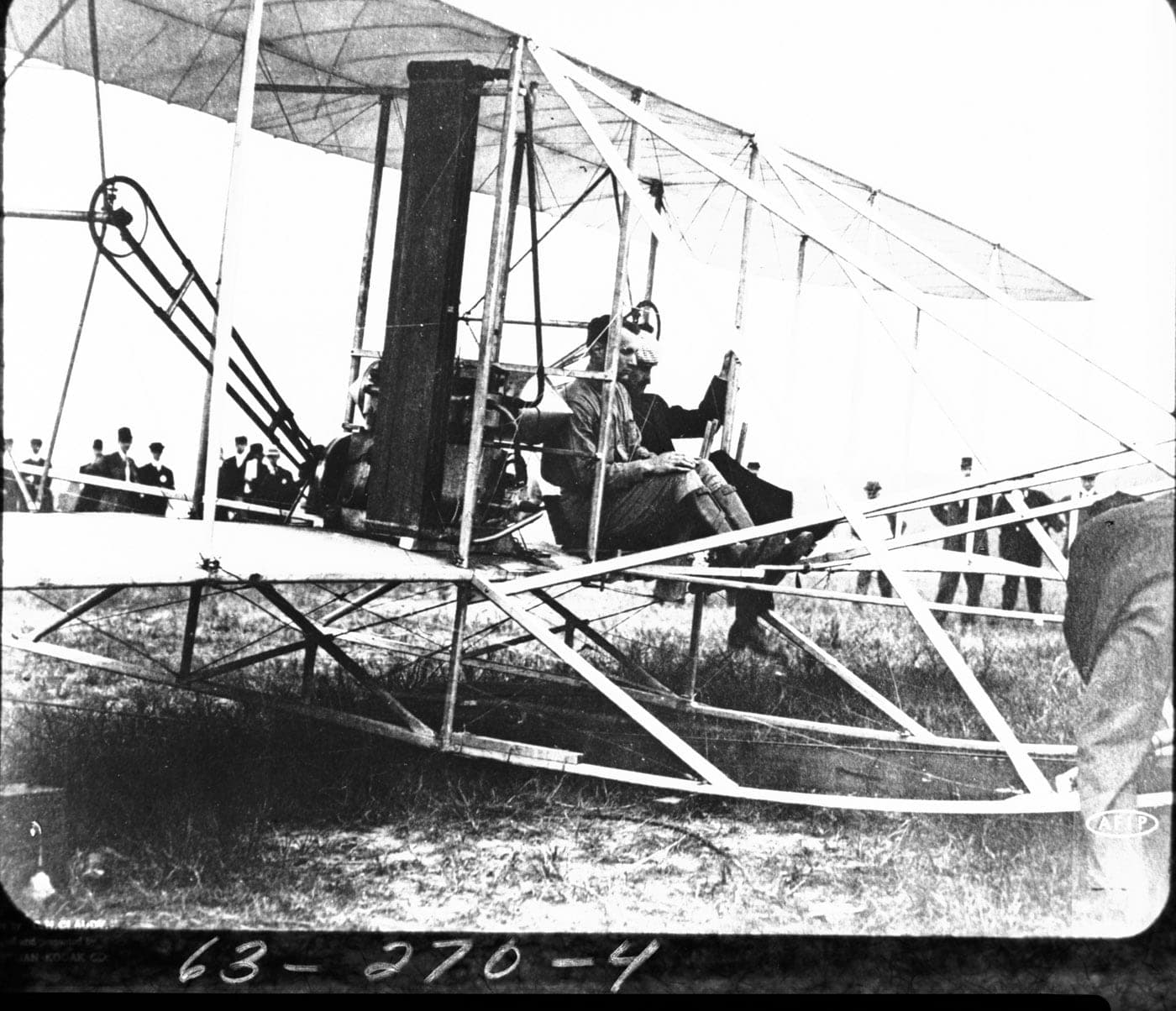
The same season took its price. On 17 September 1908, demonstrating the machine to the US Army at Fort Myer, Orville crashed when a propeller split; his passenger, Lieutenant Thomas Selfridge, became aviation's first fatality. Orville flew again, but never without pain. Wilbur died of typhoid in 1912, at forty-five, worn down by the patent litigation his invention had made inevitable.
The evidence
The claim for 17 December 1903 rests on an unusually thick record for an event witnessed by seven people on an empty beach.
There is the photograph. Orville had set up the brothers' Gundlach Korona V on its tripod, framed on the end of the rail, and asked Daniels, who had never used a camera, to squeeze the bulb if anything happened. He did, at the instant the skids left the rail. The 5×7 glass plate was developed in Dayton weeks later and shows the machine a foot above the sand, Orville prone at the controls, Wilbur running at the wingtip with his hand still open. It is one of the most examined photographs ever taken, and it has never been credibly challenged.
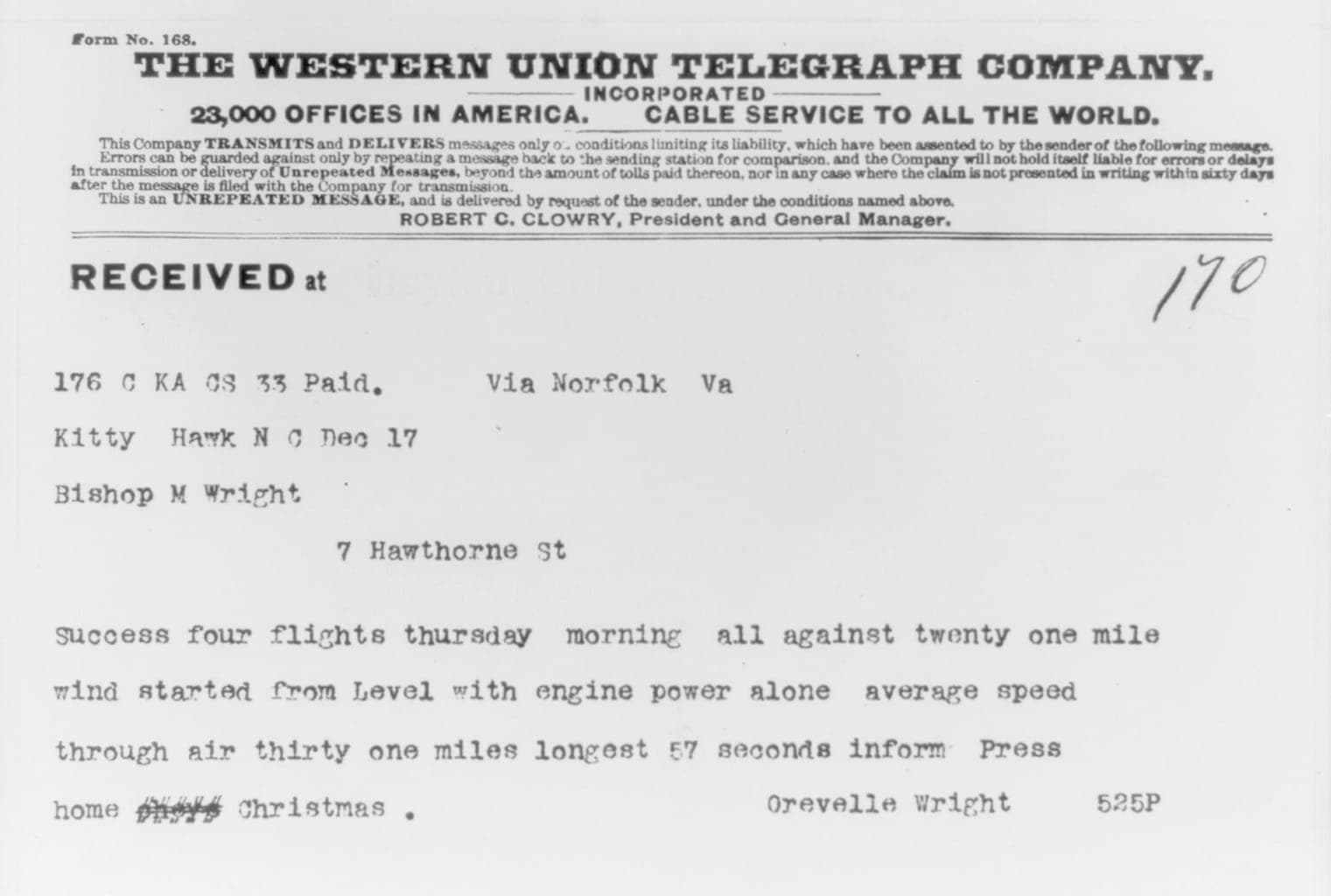
There are the diaries. Both brothers kept dated notebooks; Orville's entry for the day records the times, the durations and the wind. There is the telegram, sent that afternoon from the Kitty Hawk weather station, mistranscribing 59 seconds as 57 and misspelling Orville's name. There are the five witnesses, all named, all locally traceable, three of them government employees who wrote up the day in the station's own log.
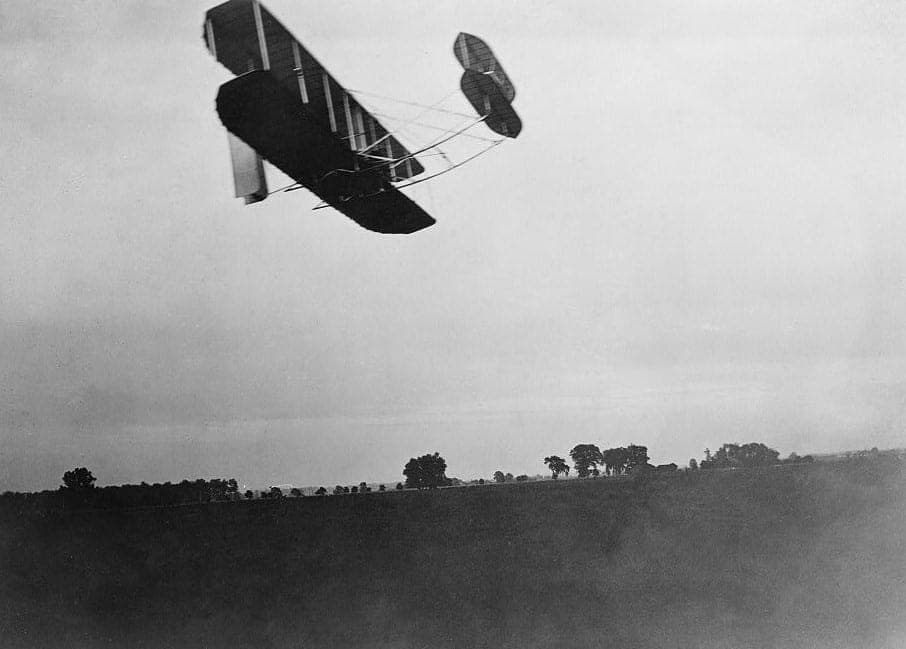
And there is the strongest evidence of all, which is not documentary. A hoax or a fluke does not repeat. Within two years the same brothers, with the same principles and a much-improved machine, were flying circles over an Ohio cow pasture for half an hour at a time and landing where they intended. Nobody else in the world could do that in 1905.
Controversy
The longest quarrel over the first flight was fought not with a rival inventor but with a museum.
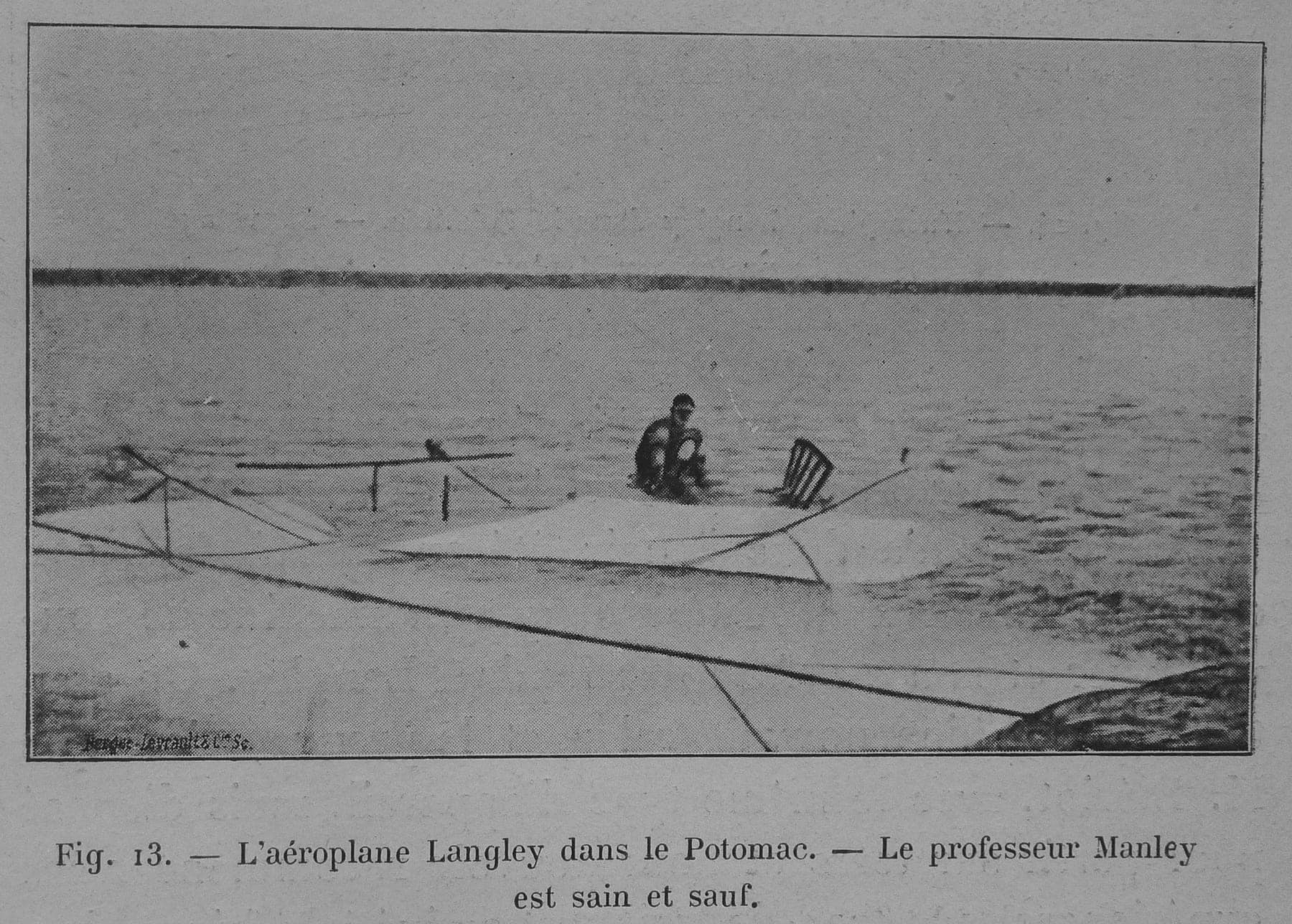
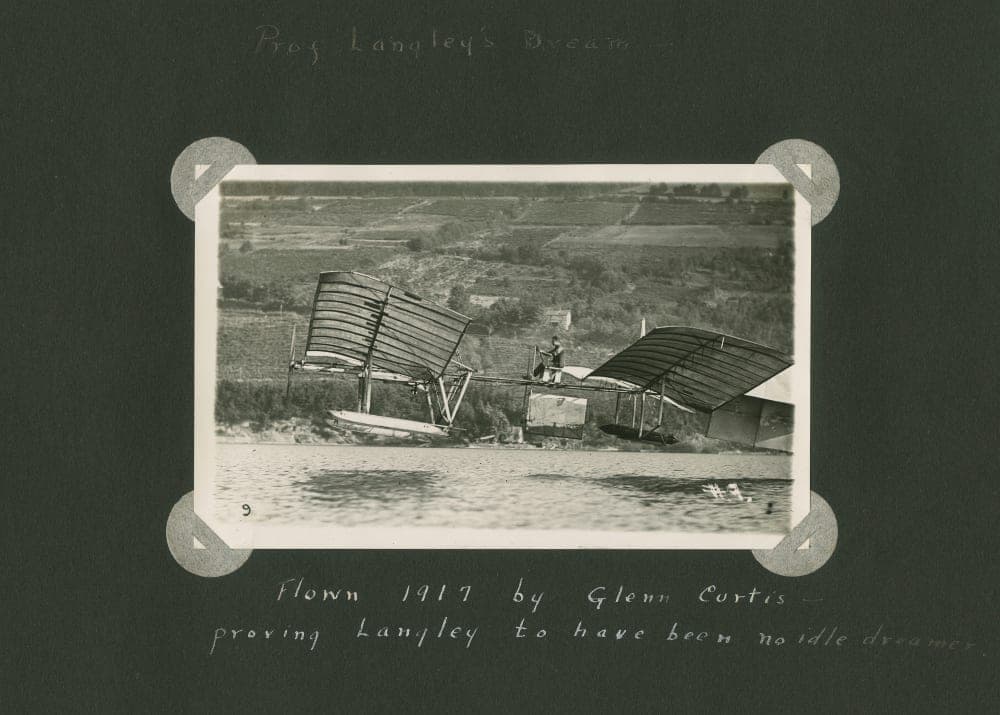
Samuel Langley, Secretary of the Smithsonian Institution, had spent $50,000 of public money, most of it a War Department grant, on a manned Aerodrome that was catapulted into the Potomac twice in 1903, on 7 October and on 8 December, nine days before Kitty Hawk. Both times it collapsed on launch. In 1914 the Smithsonian lent the wreck to Glenn Curtiss, then defending himself against the Wright patent, who rebuilt it with a different wing camber, a stronger structure, new propellers and eventually a different engine, and made brief hops off Keuka Lake. The Institution then exhibited the machine with a label describing it as the first aeroplane "capable of" manned powered flight, and repeated the claim in its annual reports for years without disclosing the extent of the rebuilding.
Orville Wright's response was to refuse the Smithsonian the Flyer. In 1928 he sent it to the Science Museum in London, where it stayed for twenty years, through a war, in a bomb-proof store. Public opinion, and eventually the Institution itself, came round: in October 1942 the Smithsonian published a full account of the 1914 modifications and withdrew its claims. Orville agreed to bring the Flyer home, but died in January 1948, before it arrived.
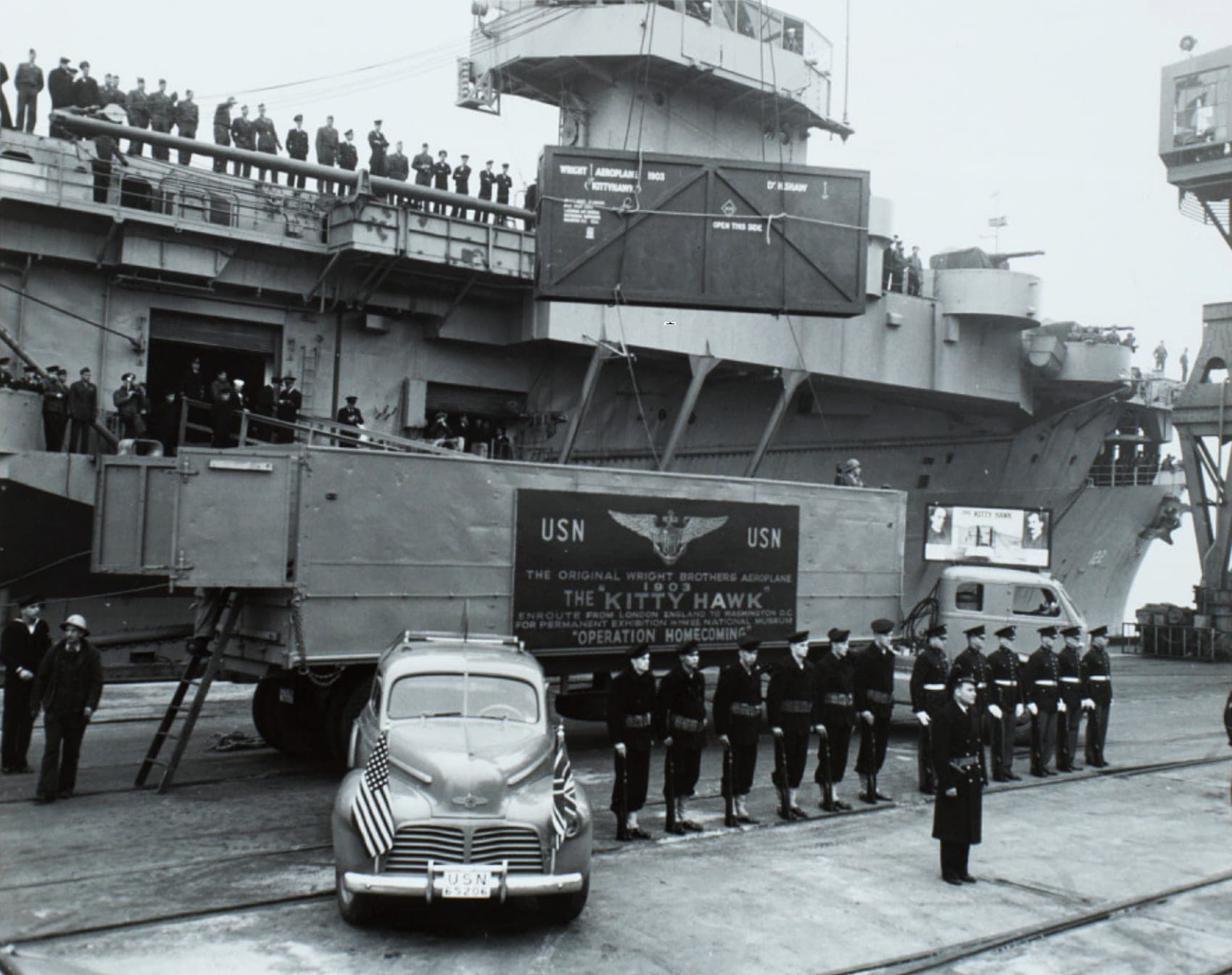
It was installed at the Smithsonian on 17 December 1948, the forty-fifth anniversary, under a deed of gift whose conditions include an undertaking that the Institution will not state that any aircraft earlier than the 1903 Flyer was capable of carrying a man in powered, controlled flight. The clause is often described as a gag on scholarship. It is more precisely a scar: the price a museum agreed to pay for having spent a quarter of a century marking its own answer as correct.
Recognition
"First" is a claim about definitions before it is a claim about dates, and the definition matters more than the arguing usually admits. The generally applied test asks for a machine that is heavier than air, carries a person, is powered, takes off from level ground under its own power, sustains itself without losing speed or height, is controlled in flight by its pilot, and lands at a point no lower than its start: and does so in a way that can be repeated and documented.
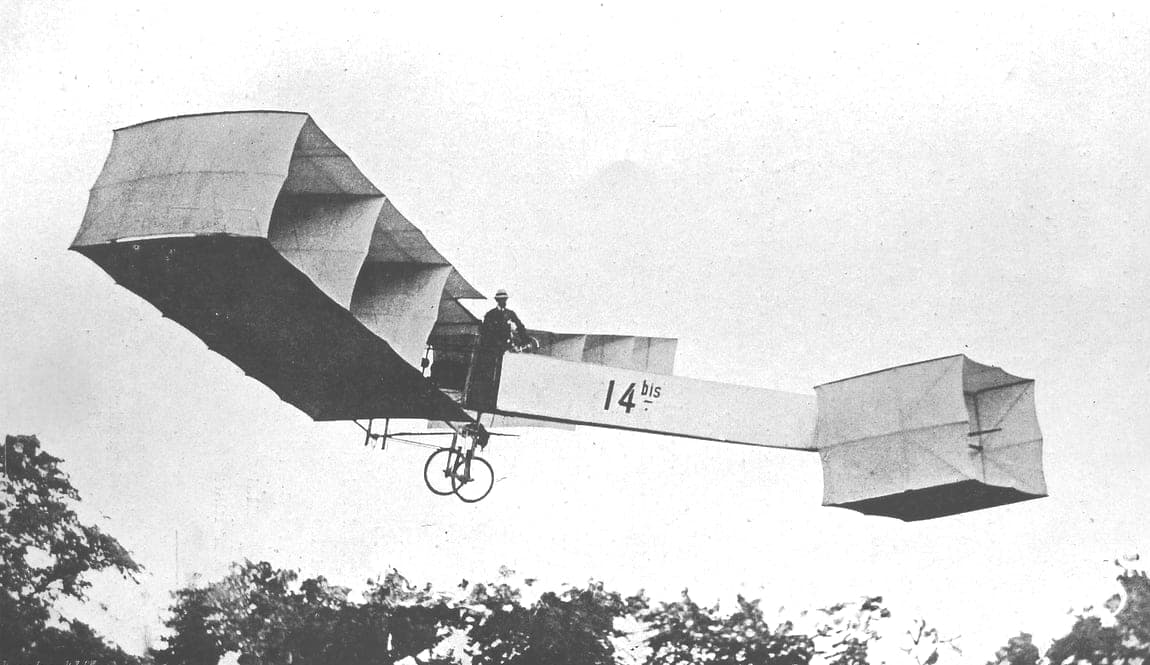
Strike any one of those conditions and the answer changes. Drop "controlled" and Ader's Éole takes the honour in 1890. Drop "from level ground under its own power" and the argument for Santos-Dumont's 14-bis, which used neither rail nor headwind, becomes strong: as Brazil maintains it is. Drop "documented" and half a dozen claimants arrive at once.
The entries below set out the principal competing claims with the evidence for each, rather than a verdict. Two things are worth holding on to while reading them. The first is that a hop and a flight are genuinely different events, and the distinction was drawn by the pioneers themselves, not invented later by partisans: the Wrights refused to count their own 14 December attempt. The second is that being first is a smaller achievement than being repeatable, and the Wrights' real claim is the second one.
Legacy
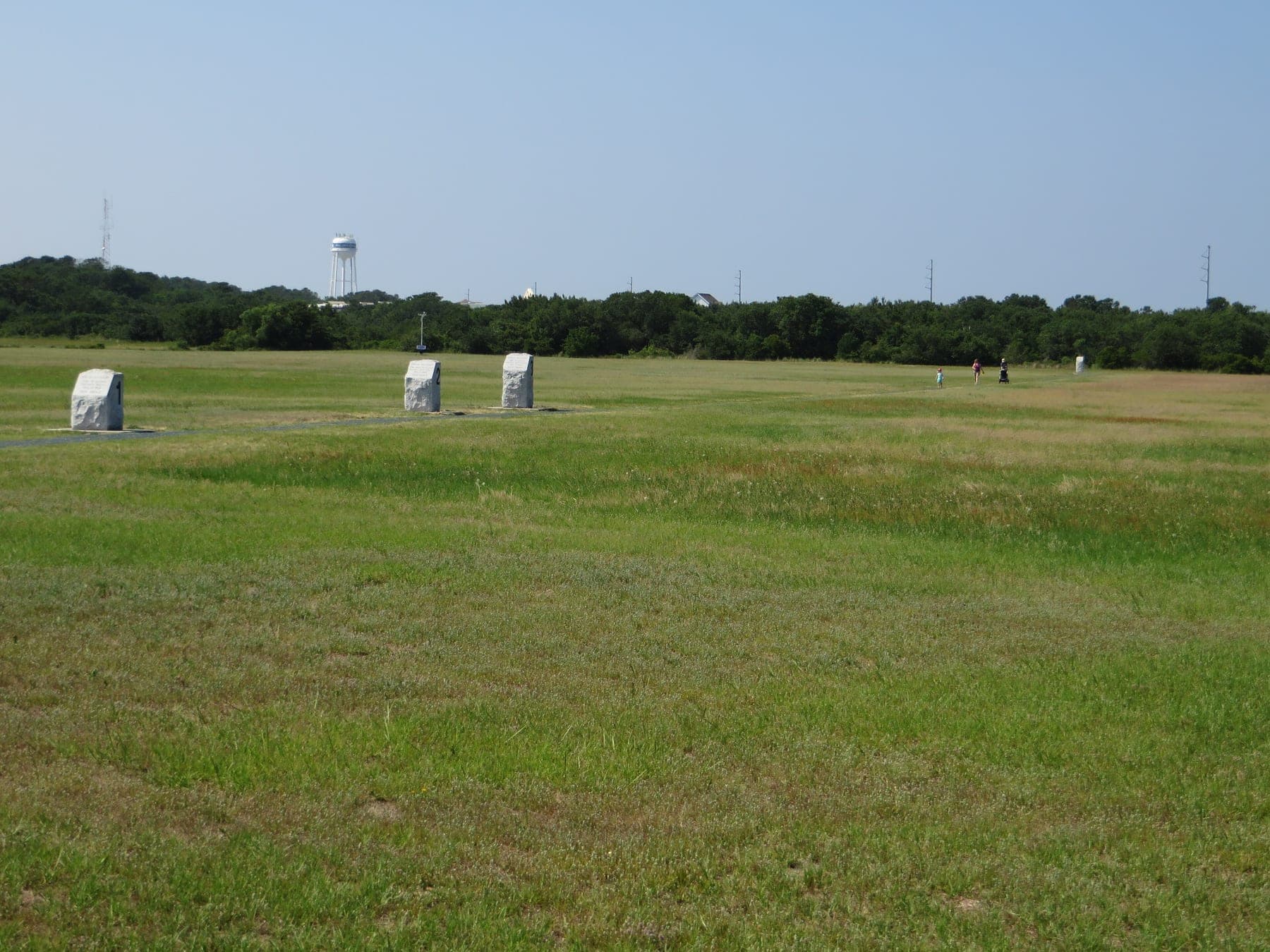
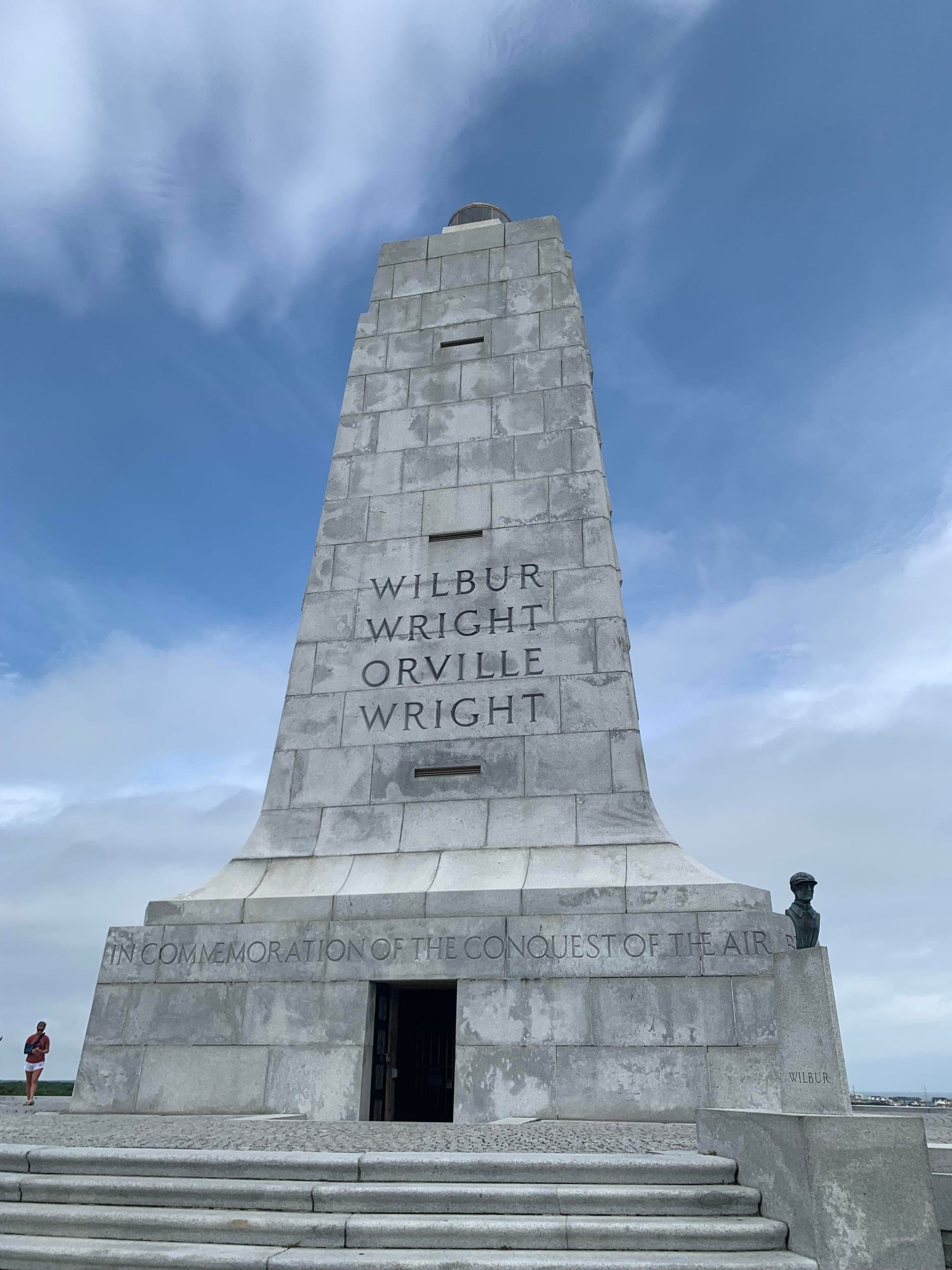
The site is now the Wright Brothers National Memorial. Four numbered markers stand on the sand at the distances the machine reached that morning, and the walk from the first to the fourth takes about three minutes: which is the most eloquent exhibit there. A granite pylon on Kill Devil Hill, which was a shifting dune in 1903 and had to be stabilised with grass before anything could be built on it, carries the words "conceived by genius, achieved by dauntless resolution and unconquerable faith".
The Flyer itself hangs in the Wright Brothers gallery of the National Air and Space Museum, its 1985 recovering the fourth in its life. North Carolina's licence plates say First in Flight; Ohio's say Birthplace of Aviation; both states are stating a fact and neither is stating the whole one.
The most exact measure of what the sixty-six years after Kitty Hawk contained is a small parcel Neil Armstrong carried to the Moon in 1969: a piece of muslin from the Flyer's left wing and a splinter of wood from its left propeller. In 2021 another swatch of the same wing, the size of a postage stamp, was taped to a cable beneath NASA's Ingenuity helicopter and flown in the atmosphere of Mars. The fabric was bought over a counter in Dayton for a few cents a yard.
The road to Kitty Hawk
Four seasons of gliders, one winter of laboratory work and a self-built engine separate a bicycle shop in Dayton from a sand flat in North Carolina.
August 1896Rhinow, Germany
Otto Lilienthal is killed gliding
The German pioneer had made some two thousand glides and controlled them by swinging his body. His death turned the brothers' schoolboy interest into a question: what is the right way to control a flying machine?
July 27, 1899Dayton, Ohio
The warping kite
Wilbur twisted an empty inner-tube box in his hands and saw how a biplane's wings could be helically warped. The five-foot kite built to test it banked exactly as predicted from lines held on the ground: the control idea existed before the aircraft did.
October 1900Kitty Hawk, North Carolina
First glider at Kitty Hawk
The site was chosen from Weather Bureau records for its steady wind, its soft sand and its privacy. The glider flew mostly as a kite; Wilbur made about a dozen free glides and the brothers learned to lie prone rather than hang upright.
- Wingspan
- 17 ft
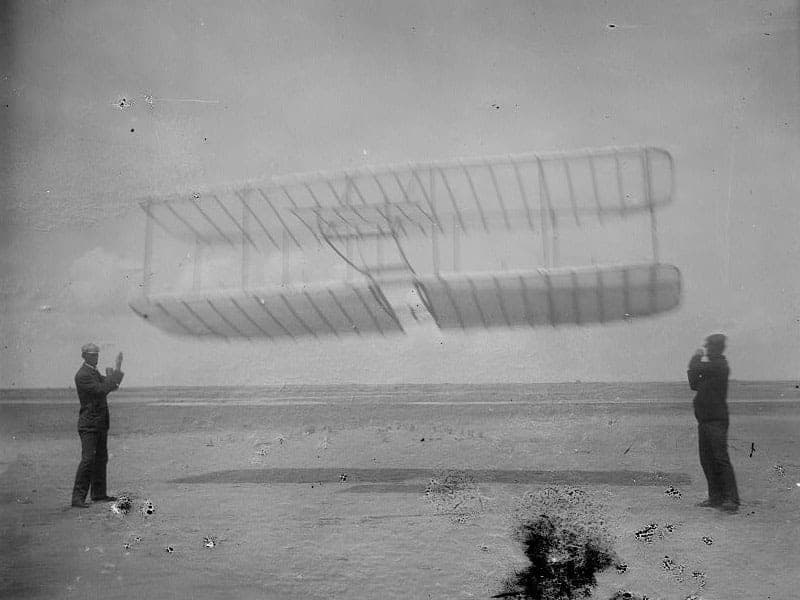
The 1901 Wright glider on the sand at Kitty Hawk, Wilbur at the left and Orville at the right.1901 · Library of Congress · Public domain August 1901Kill Devil Hills
The discouraging season
A bigger glider gave barely a third of its calculated lift, and warping the wings sometimes turned the machine the wrong way. Riding home on the train Wilbur told his brother that man would not fly in a thousand years. The published aerodynamic tables they had trusted were wrong.
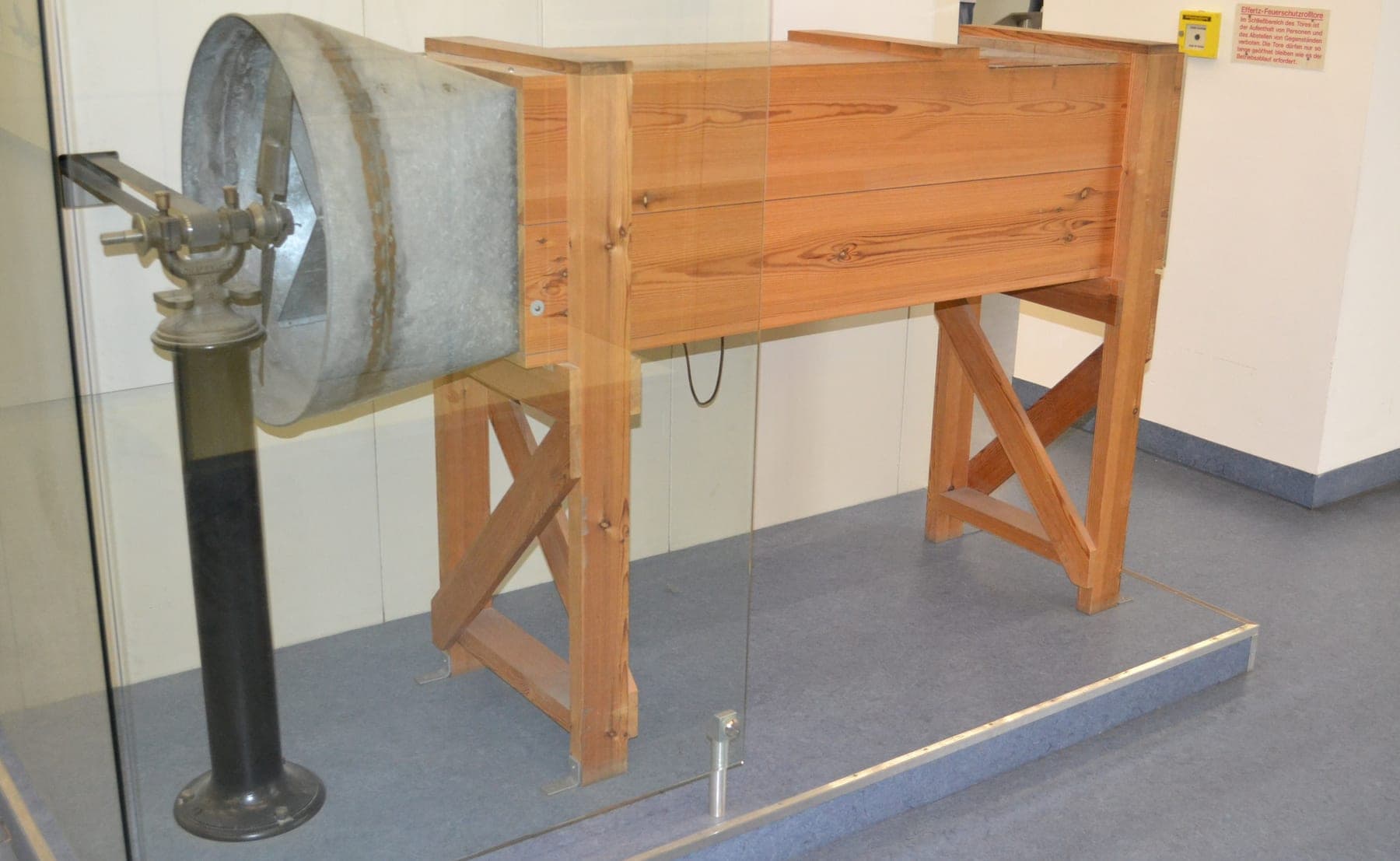
A reconstruction of the Wright brothers' wooden wind tunnel, a long open-ended box with a fan at one end.MLWatts, Deutsches Museum, Munich · CC BY-SA 3.0 October 1901 – December 1901Dayton, Ohio
The wind tunnel
Rather than abandon the problem, they rebuilt its foundations. A six-foot wooden tunnel and two balances made of bicycle spokes and hacksaw blades let them measure lift and drag on some two hundred model wing shapes over one autumn: the first reliable aerodynamic data any aircraft designer had.
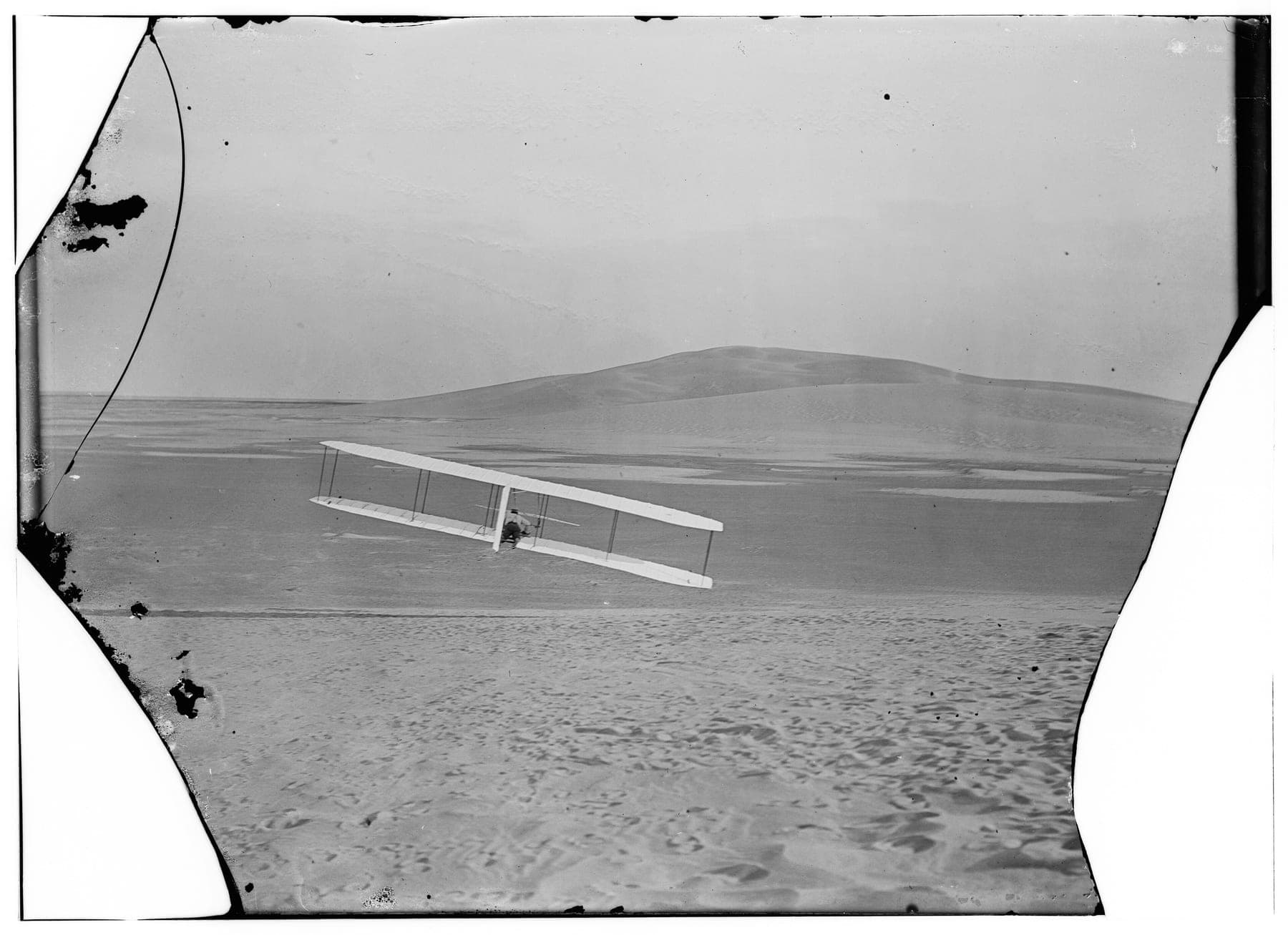
The 1902 glider in a right turn, seen from behind, its right wingtip close to the ground.October 1902 · Wilbur or Orville Wright / Library of Congress · Public domain October 8, 1902Kill Devil Hills
Three-axis control
The 1902 glider flew on the new figures and flew well. The last problem, a warped wing dragging the machine into a spin, was cured by making the fixed rear fin movable and linking it to the warping cradle, so that roll and yaw were commanded together. Over a thousand glides followed. From this point the brothers could fly; what they lacked was an engine.
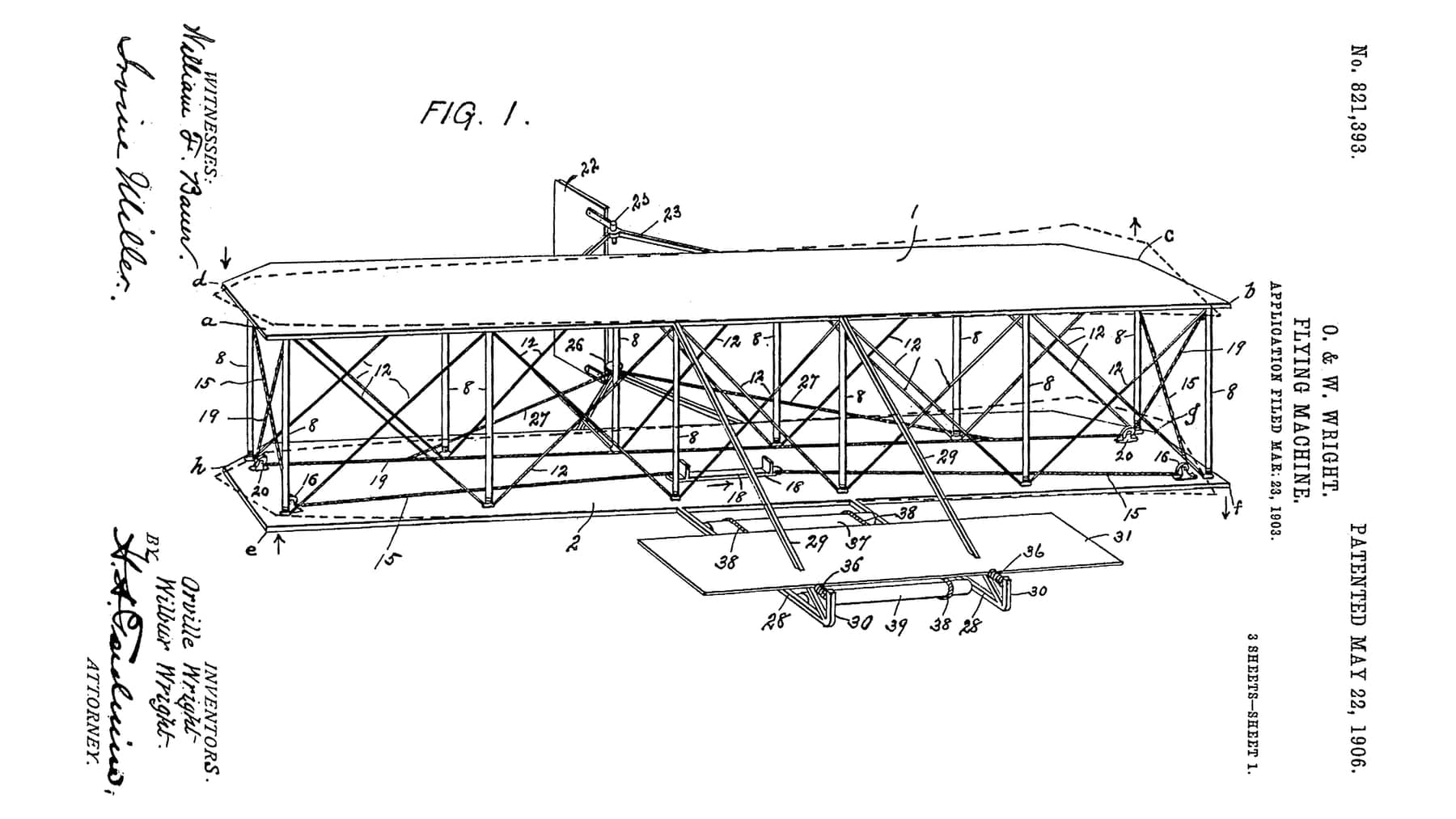
Figure 1 of United States patent 821,393: the machine drawn as a system of control, with the wings warped in opposite directions.1906 · Orville and Wilbur Wright / United States Patent Office · Public domain March 23, 1903Washington, D.C.
The patent application
Filed nine months before the aeroplane flew, and covering not a machine but a system of control. Granted in 1906 as US 821,393, it became the instrument of a decade of litigation.
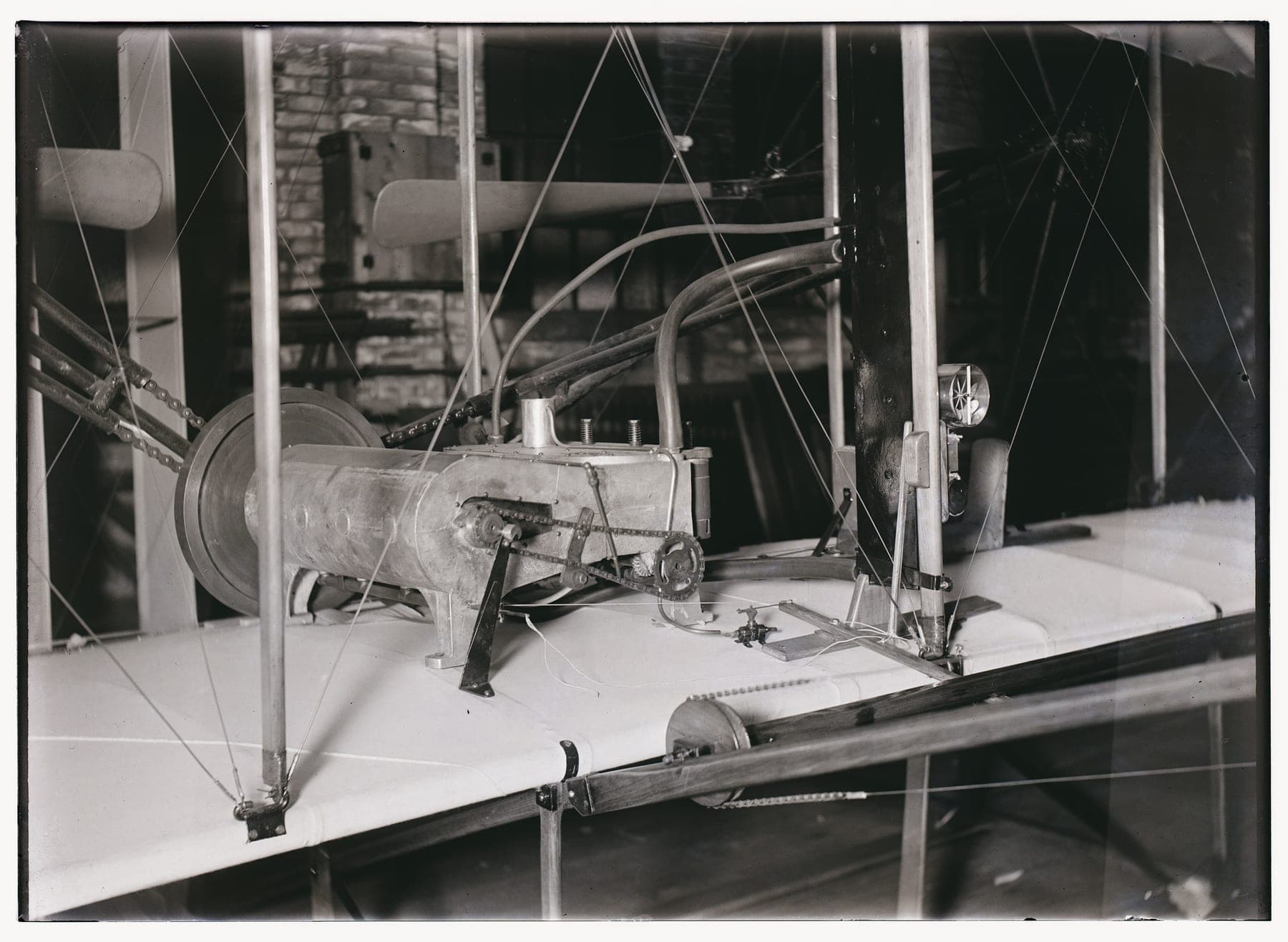
The central section of the 1903 Flyer photographed in the shop, showing the four-cylinder engine, the chain drives and the pilot's cradle.1 January 1928 · Attributed to Orville Wright / Library of Congress · Public domain February 1903Dayton, Ohio
An engine nobody would sell them
No manufacturer would supply eight horsepower under two hundred pounds, so Charlie Taylor built one in six weeks. It gave about twelve horsepower: more than asked for, and the margin that made the difference in December.
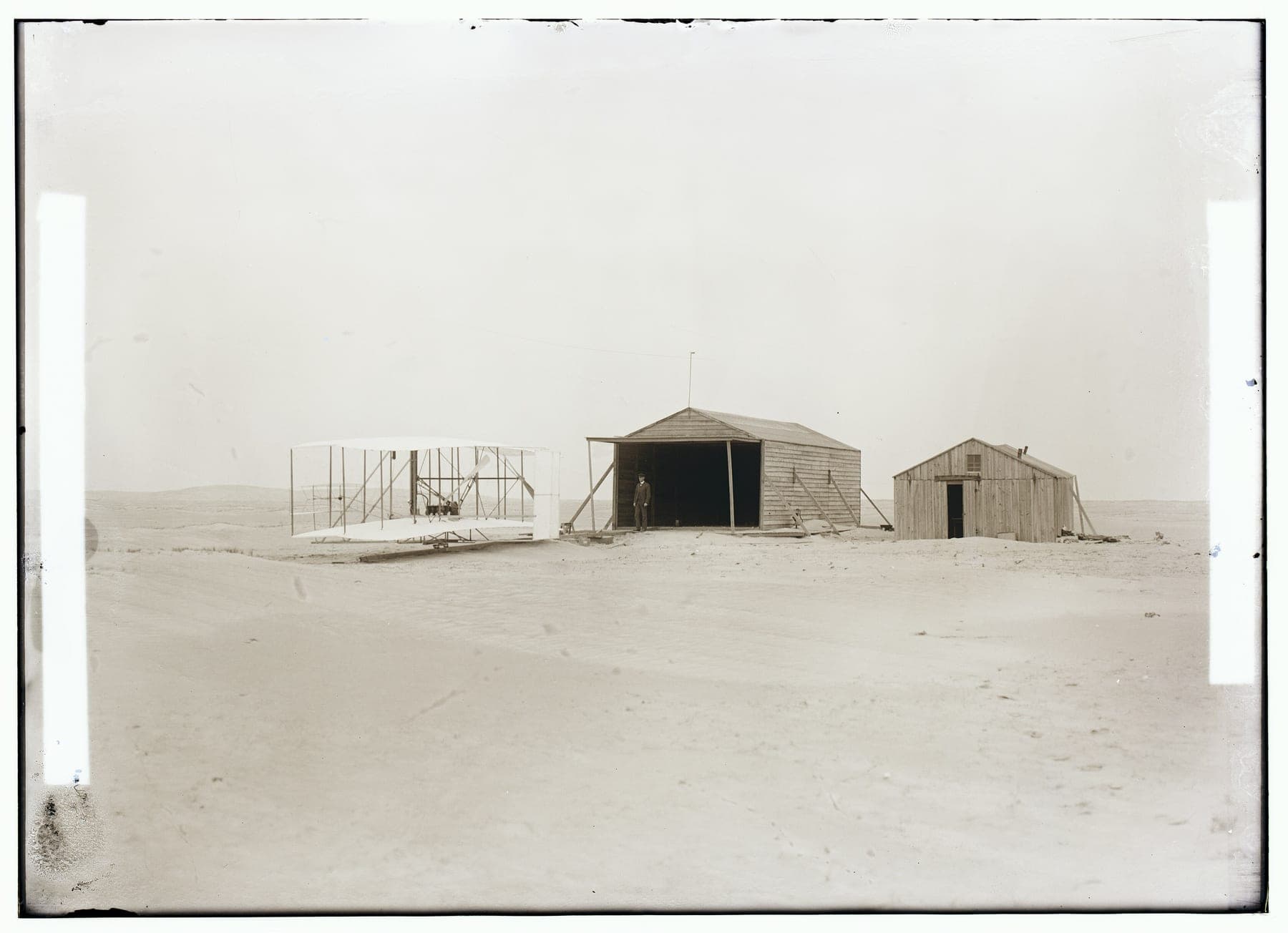
The 1903 Flyer outside the camp buildings at Kill Devil Hills: a large shed housing the machine and a smaller hut used as workshop and living quarters.1903 · Wilbur or Orville Wright / Library of Congress · Public domain September 25, 1903Kill Devil Hills
Camp at Kill Devil Hills
Eleven weeks of assembly, broken propeller shafts and storms. Twice a shaft cracked and had to be carried back to Dayton; the second replacement arrived on 11 December.
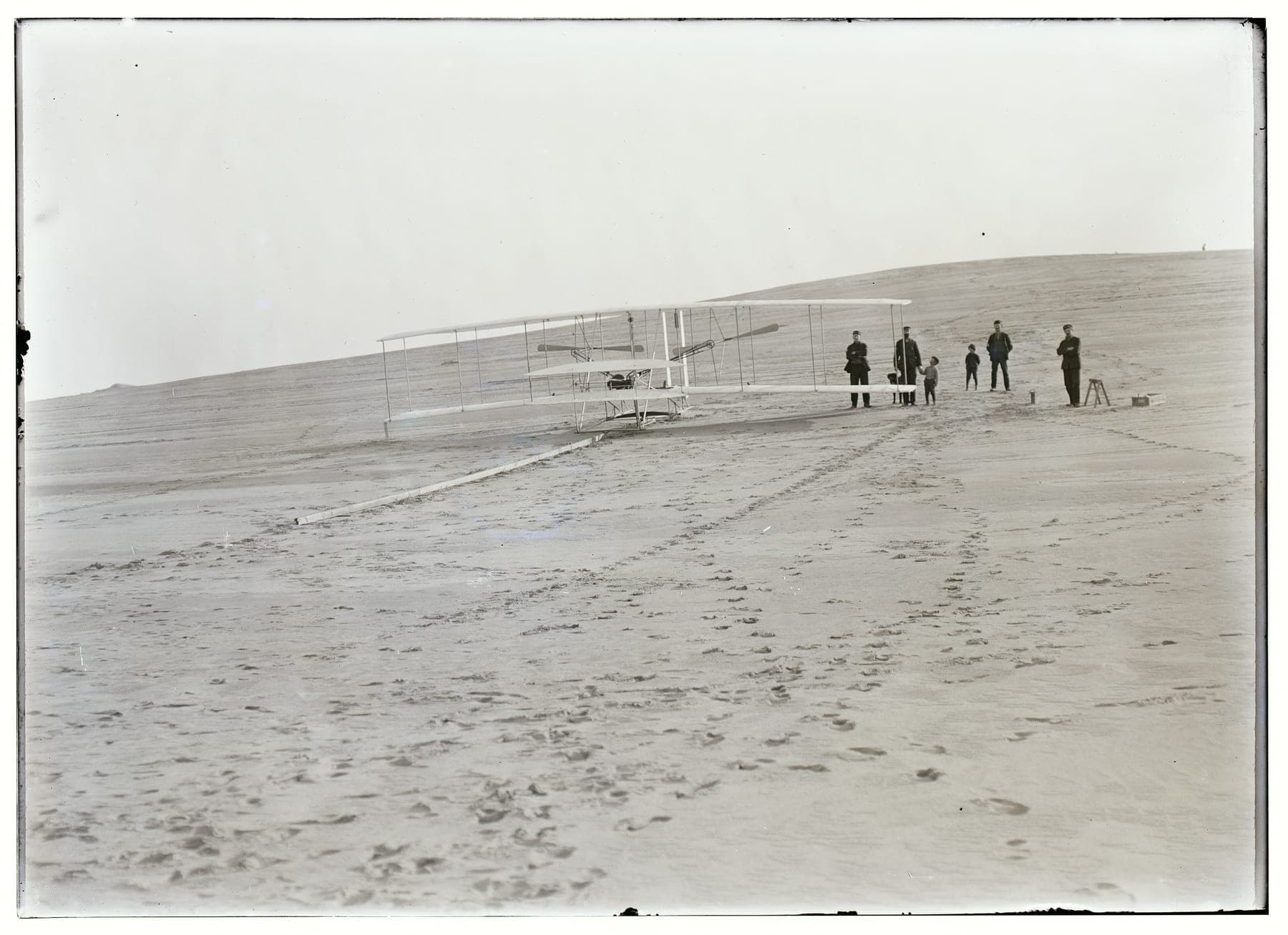
The Flyer on its launching rail at the foot of the big hill on 14 December 1903, with four men from the life-saving station standing by.14 December 1903 · Wilbur or Orville Wright / Library of Congress · Public domain December 14, 1903Kill Devil Hills
The first attempt fails
Wilbur won the coin toss, launched down the slope of the big hill, pulled up too steeply and stalled after 105 ft and three and a half seconds. The brothers counted it as an attempt, not a flight, the machine had not sustained itself, and spent two days on repairs.
- Distance
- 100 ft
- Duration
- 3.5 seconds
The morning of 17 December 1903
Freezing, with puddles of ice on the sand and a north wind too strong for comfort. The brothers hung out the signal for the life-saving station at ten o'clock and laid the rail on level ground.
10:35 AM
First flight, Orville
The machine ran forty feet down the rail with Wilbur steadying the wingtip, lifted, and flew a bucking, undulating course into the wind before settling on the sand. Twelve seconds, and the first time in history a powered machine carrying a man rose from level ground under its own power, flew forward without losing speed and landed no lower than it started.
- Distance
- 120 ft
- Duration
- 12 seconds
11:20 AM
Second flight, Wilbur
Barely longer than the first, and just as difficult: the forward elevator was too responsive and every correction produced another. The brothers took turns, learning the machine between flights.
- Distance
- about 175 ft
- Duration
- about 12 seconds
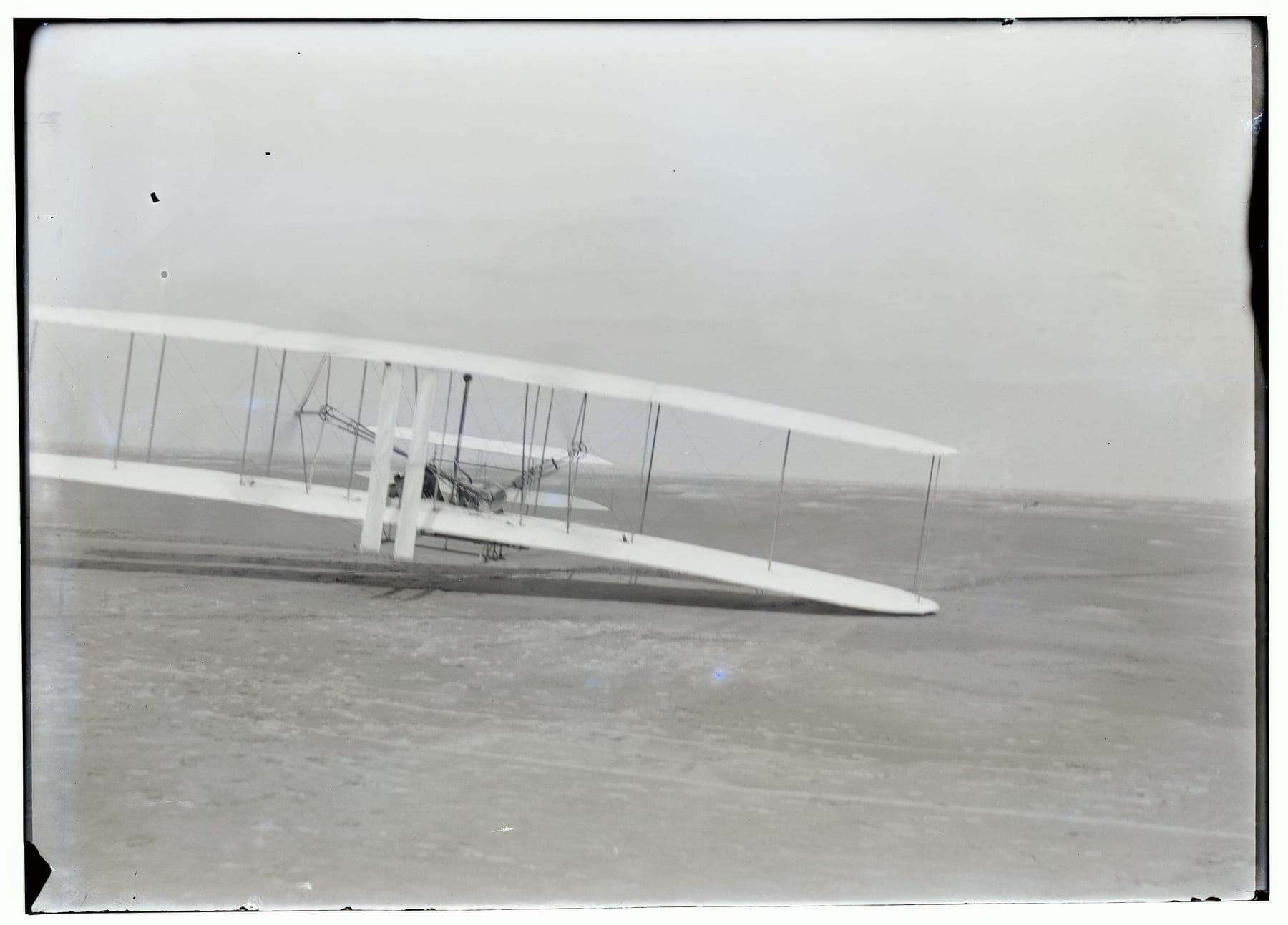
Orville Wright flying the third flight of 17 December 1903, the machine low over the sand.17 December 1903 · Attributed to Wilbur Wright / Library of Congress · Public domain 11:40 AM
Third flight, Orville
Longer and steadier, and ended by a sudden slew to the right that Orville corrected before touching down. The pattern of the morning was that each flight taught the next one something.
- Distance
- about 200 ft
- Duration
- 15 seconds
12:00 PM
Fourth flight, Wilbur
The flight that settles the argument. Wilbur held the machine level for over half a minute, covering 852 ft against the wind, roughly half a mile through the air, before a pitching motion put a skid into the sand and cracked the elevator supports. Nobody could call this a hop.
- Distance
- 852 ft
- Duration
- 59 seconds
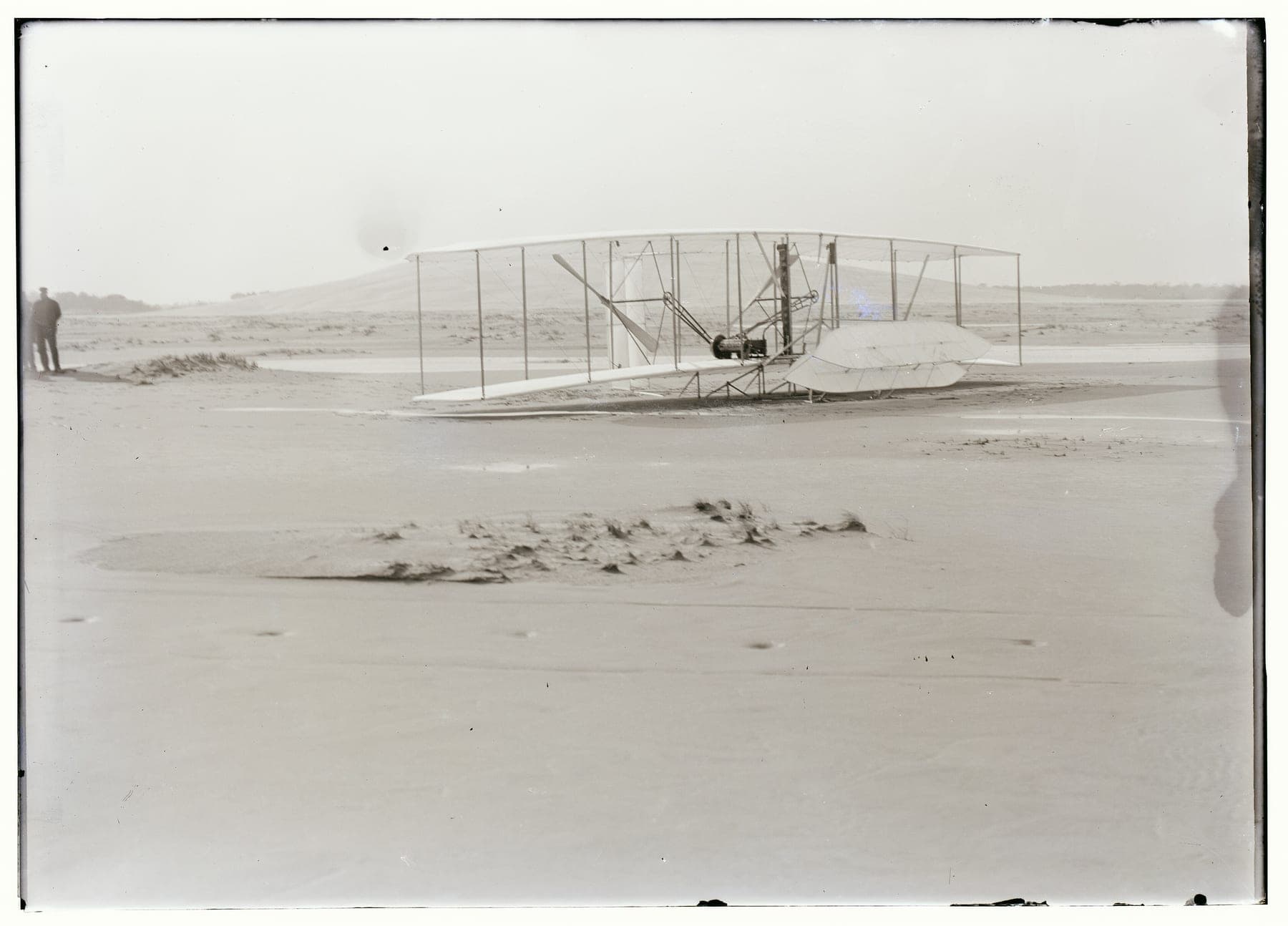
The Flyer on the sand after the gust rolled it over, the elevator frame broken and the wings crumpled.17 December 1903 · Wilbur or Orville Wright / Library of Congress · Public domain 12:30 PM
A gust ends the machine's career
While the men stood talking beside it, the wind caught the Flyer and rolled it over the sand. John Daniels, tangled in the wires, went with it and became the first person injured in an aeroplane accident. The machine never flew again.
5:25 PMKitty Hawk weather station
The telegram to Dayton
"Success four flights thursday morning all against twenty one mile wind started from level with engine power alone average speed through air thirty one miles longest 57 seconds inform press home Christmas." The operator mistranscribed the duration and misspelled Orville's name; the message reached their father, and the Dayton Journal declined to print the story.
Who was there
- Wilbur Wright1867 to 1912
- Elder brother; pilot of the second and fourth flightsThe theorist of the pair. His 1899 letter to the Smithsonian asking for everything published on flight began the whole programme.
- Orville Wright1871 to 1948
- Younger brother; pilot of the first and third flightsWon the toss for the first attempt on 14 December and lost it; Wilbur's failure that day gave Orville the turn that made him first.
- Charlie Taylor1868 to 1956
- Machinist; built the Flyer's engineWorked from sketches on the shop wall rather than drawings, with a lathe and a drill press.
- John T. Daniels
- Witness; took the photograph of the first flightA surfman of the Kill Devil Hills Life-Saving Station who had never operated a camera before. He squeezed the bulb at the moment the machine left the rail.
- Adam Etheridge
- Witness; life-saving station crew
- Will Dough
- Witness; life-saving station crew
- W. C. Brinkley
- Witness; lumber buyer from Manteo
- Johnny Moore
- Witness; a teenage boy from Nags Head
- Octave Chanute1832 to 1910
- Correspondent and mentorThe engineer whose Progress in Flying Machines gave the brothers their reading list, and whose letters carried their results to Europe.
Competing claims
Wilbur and Orville Wright
Accepted17 December 1903Kill Devil Hills, North Carolina
The claim
The first sustained, controlled, powered flight of a heavier-than-air machine carrying a pilot, from level ground and under its own power.
The evidence
A photograph taken at the moment of take-off, five named witnesses, the brothers' own dated diaries and notebooks, a telegram sent the same afternoon, and, decisively, a repeatable machine: within two years the same design was flying circles for half an hour at a time.
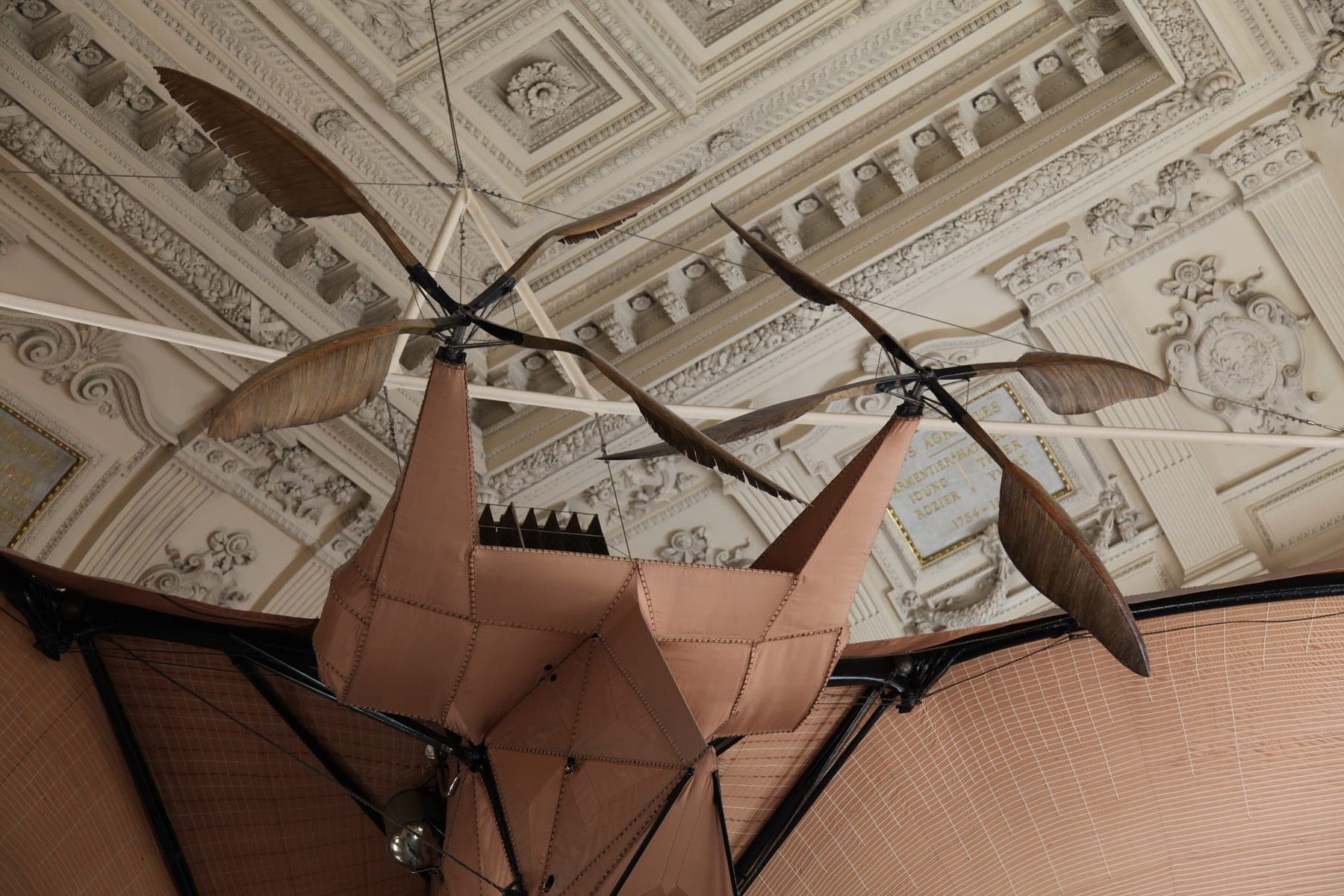
Clément Ader's bat-winged Avion III preserved at the Musée des arts et métiers in Paris.Rama, Musée des arts et métiers · CC BY-SA 3.0 FR Clément Ader
Partly accepted9 October 1890 / 14 October 1897Armainvilliers and Satory, France
The claim
That the steam-powered Éole left the ground for some fifty metres in 1890, and that the twin-engined Avion III flew 980 ft at Satory in 1897.
The evidence
The 1890 hop is generally accepted as a genuine powered lift-off, the first anywhere, but it was uncontrolled and unsustained, and Ader could not see out of the machine. The 1897 claim was made in 1906; the French Army's own report on the trial, published in 1910, recorded that the machine never left the ground. Avion III itself survives in the Musée des arts et métiers.
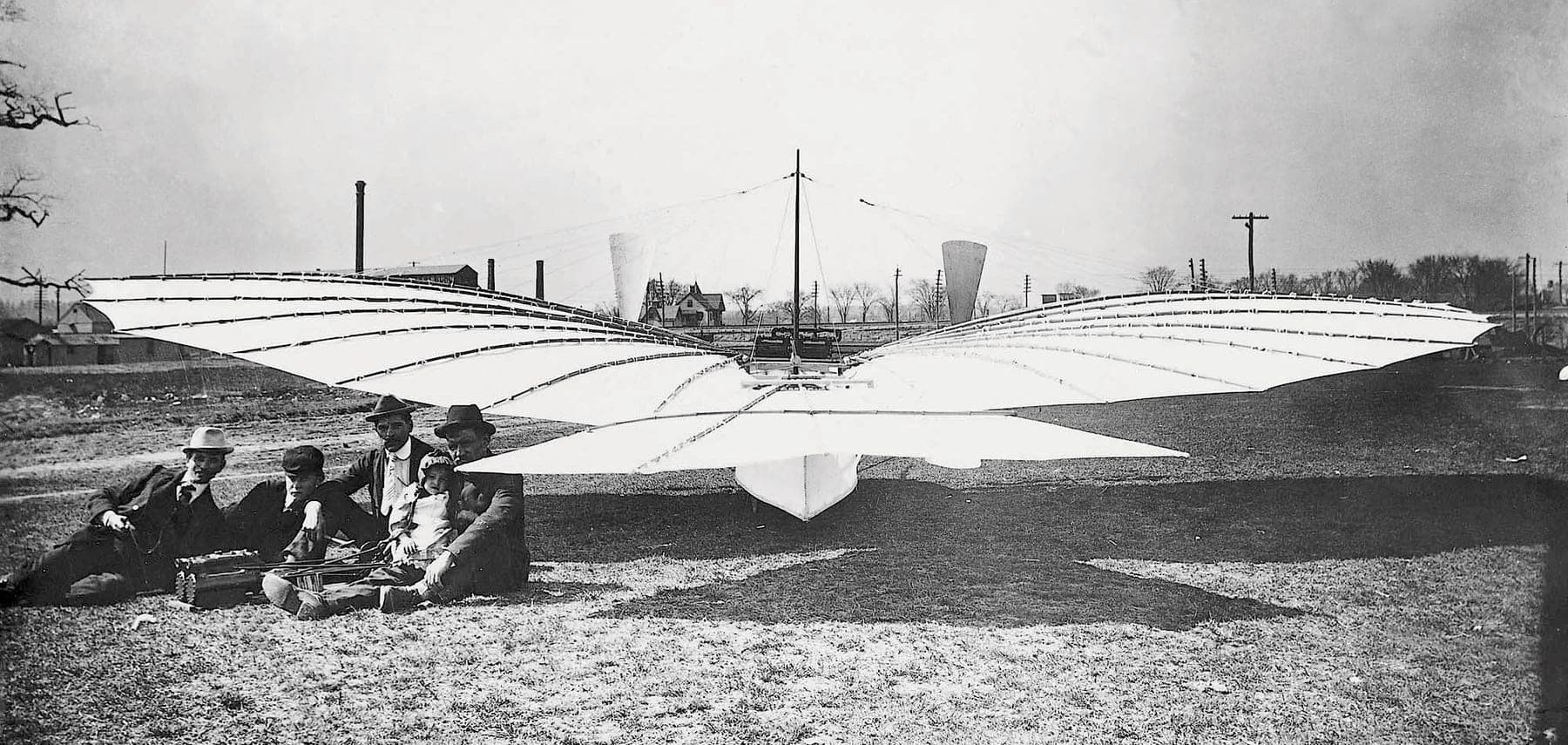
Gustave Whitehead beside his 1901 monoplane No. 21, photographed on the ground near his Bridgeport workshop.1901 · Valerian Gribayedoff · Public domain Gustave Whitehead
Disputed14 August 1901Bridgeport, Connecticut
The claim
That his monoplane No. 21 flew about half a mile near Fairfield, two years before Kitty Hawk, and was steered in flight.
The evidence
A single newspaper account in the Bridgeport Sunday Herald, later affidavits collected decades after the fact, and photographs of the machine on the ground, but none in the air, and no consistent technical or documentary record. Jane's All the World's Aircraft endorsed the claim in 2013 and Connecticut passed a statute recognising it; aviation historians examining the same material have not been persuaded.
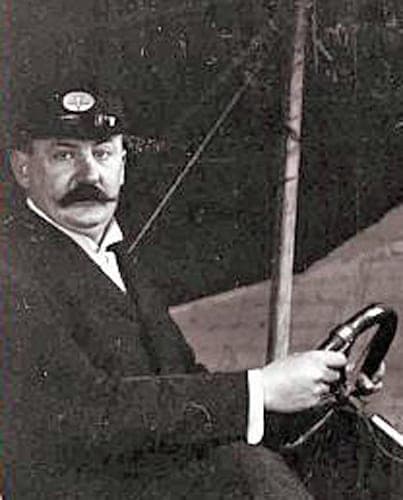
Karl Jatho at the wheel of his biplane at Hanover, a few years after the powered hops he made in 1903.1907 or 1908 · Unknown author · Public domain Karl Jatho
Partly accepted18 August 1903Hanover, Germany
The claim
That his petrol-engined machine hopped 59 ft in August 1903 and up to 200 ft by November, four weeks before Kitty Hawk.
The evidence
The hops themselves are generally credited. What is not is control: the sources do not show a machine that could be steered or held in the air, and Jatho abandoned the design.
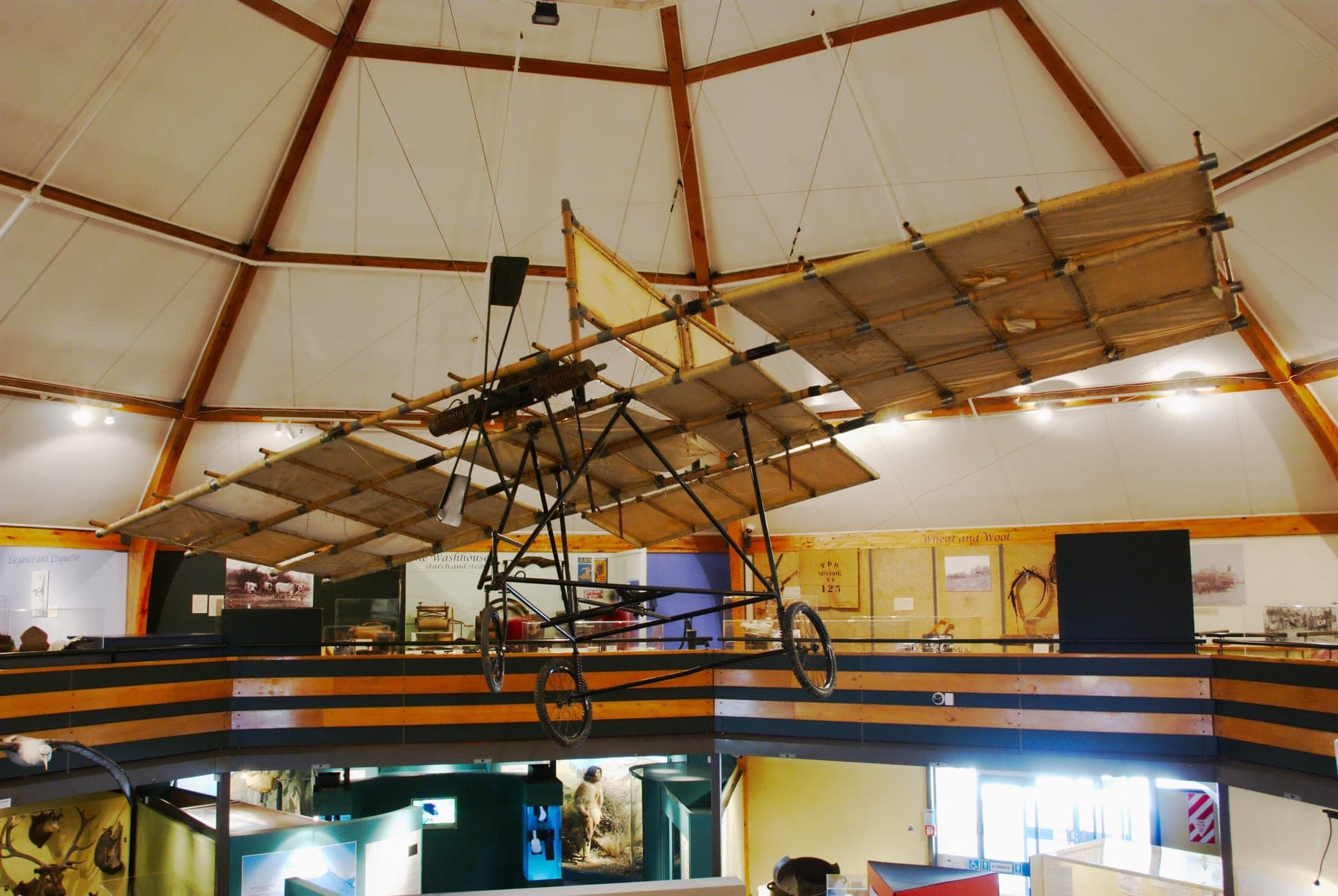
A replica of Richard Pearse's monoplane at the South Canterbury Museum in Timaru, built from surviving parts and local descriptions.Karora / South Canterbury Museum · Public domain Richard Pearse
Rejected31 March 1903 (traditional date)Waitohi, New Zealand
The claim
That a farmer in South Canterbury flew a monoplane of his own construction some months before the Wrights.
The evidence
Local recollection gathered long afterwards, and no contemporaneous record. Pearse never made the claim himself and described his own attempts as failures; his biographer concludes that no responsible researcher has argued for controlled flight.
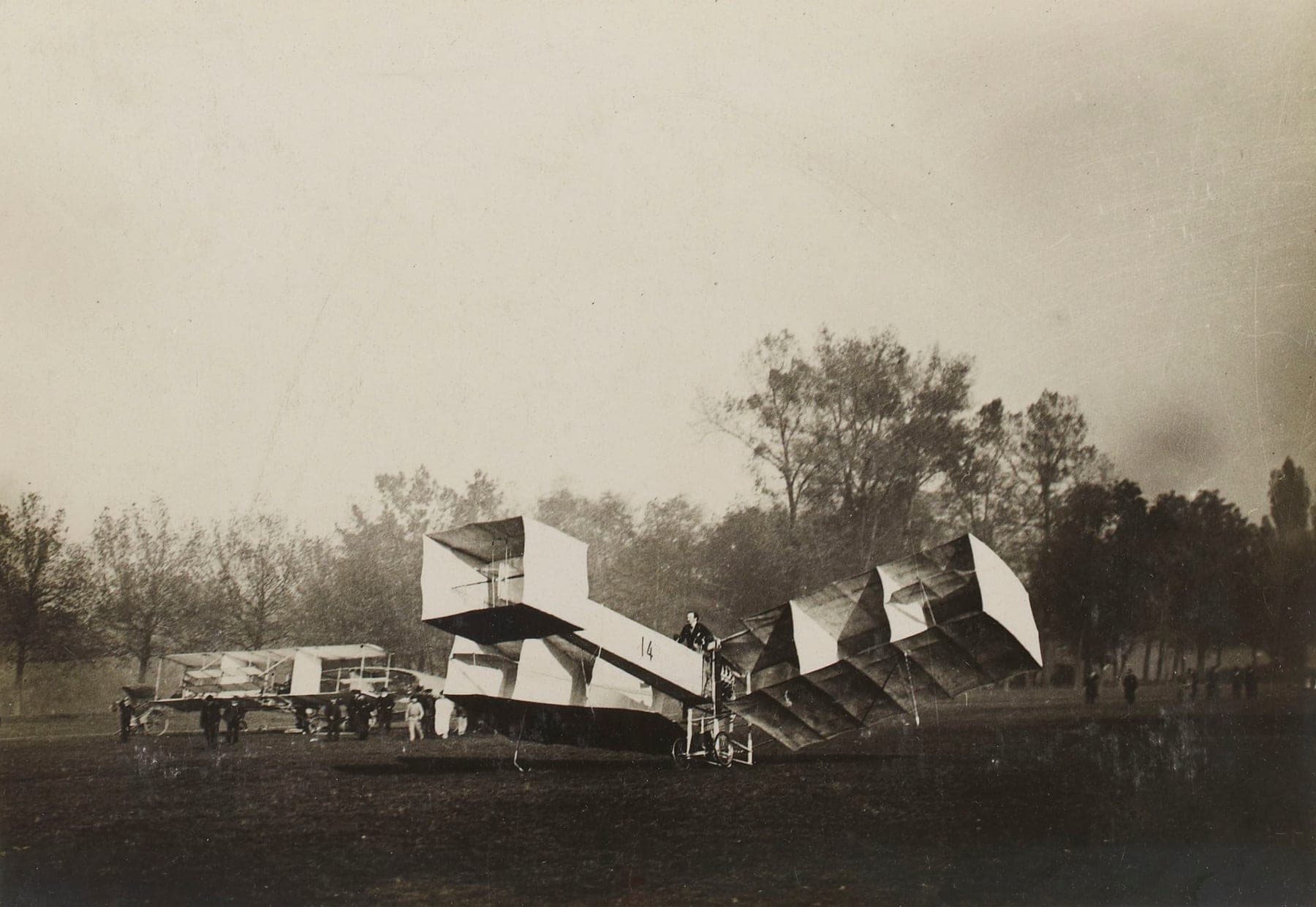
Alberto Santos-Dumont's 14-bis at Bagatelle, its box-kite cellular wings and forward control cell clearly visible.1906 · Jules Beau / Bibliothèque nationale de France · Public domain Alberto Santos-Dumont
Partly accepted23 October and 12 November 1906Bagatelle, Paris, France
The claim
That the 14-bis made the first public, officially observed and certified aeroplane flight, unaided by rail, catapult or headwind: and that this, not Kitty Hawk, is the proper starting point.
The evidence
All of it documented and none of it in doubt: 200 ft on 23 October, 720 ft in 21.5 seconds on 12 November, before the Aéro-Club de France. The distinction is real, the Wrights flew in near-privacy and used a rail, but the flights came three years later, and the 14-bis had no effective lateral control. Brazil marks the date as the birth of aviation.
Related entries
- The First Flight — Wright Brothers National Memorial, National Park Service
- 1903 Wright Flyer (collection object A19610048000), Smithsonian National Air and Space Museum
- First Flight — Collection Highlights, Wilbur and Orville Wright Papers, Library of Congress
- Wood and Fabric, 1903 Wright Flyer, Apollo 11, Smithsonian National Air and Space Museum
- Mars Helicopter Ingenuity Holds a Piece of Wright Brothers History, Smithsonian Magazine
- Wright Flyer, Wikipedia
- Wright brothers, Wikipedia
- Claims to the first powered flight, Wikipedia
- Langley Aerodrome, Wikipedia
Checked September 3, 2026