History
Blériot's Channel Crossing
July 25, 1909, 4:41 AM
Les Baraques, near CalaisFrance
Northfall Meadow, DoverEngland, United Kingdom
32 to 37minutes
In the air
≈ 21nm
Distance
25hp
Engine
The flight
- Take-off
- 25 July 1909, 4:41 a.m.
- Landing
- ≈ 5:12 a.m., Dover
- Time in the air
- 32 to 37 min
- Distance
- ≈ 21 nm
- Speed and height
- ≈ 39 kt · ≈ 250 ft
- Navigation
- No compass
- Escort
- Destroyer Escopette
The machine
- Aircraft
- Blériot XI
- Designed by
- Blériot, with Raymond Saulnier
- First flight
- January 1909
- Wingspan
- ≈ 26 ft
- Wing area
- 150 ft²
- Engine
- Anzani 3-cylinder, 25 hp
- Propeller
- Chauvière, two blades
- Lateral control
- Wing warping
- Where it is now
- Arts et Métiers, Paris
The prize
- Offered by
- Daily Mail
- First offered
- October 1908, £500
- Renewed
- 1909, £1,000
- Terms
- Channel, by daylight
- Entrants
- Blériot, Latham, de Lambert, Seymour
At dawn on 25 July 1909 Louis Blériot took off from the beach at Les Baraques near Calais in his own Type XI monoplane, crossed the English Channel without a compass in a little over half an hour, and crash-landed on a meadow beside Dover Castle, the first crossing of the Channel by aeroplane, and the Daily Mail's £1,000 prize. Orders for more than a hundred Blériot XIs followed within weeks, and Britain read the flight at once as the end of its security as an island.
On Sunday 25 July 1909, a little after half past four in the morning, Louis Blériot took off from a field behind the beach at Les Baraques, between Calais and Sangatte, in a small monoplane of his own design. He carried no compass. A little over half an hour later he came down hard on a sloping meadow beside Dover Castle, breaking the undercarriage and a blade of the propeller and walking away unhurt. He had made the first crossing of the English Channel by aeroplane, and won the £1,000 prize the Daily Mail had offered for it.
By any measure of performance the flight was modest. Blériot had already stayed aloft for longer, and the thirty-eight kilometres of water were fewer than he had covered between Étampes and Orléans twelve days earlier. What made it an event was the water itself. The Channel had been crossed by balloon since 1785, but never by a machine that flew under its own control, and the strip of sea it spanned had defined Britain's place in Europe for centuries. A Frenchman with a burned foot and a 25-horsepower engine had now crossed it before breakfast.
The consequences came in two currencies. For Blériot, a headlamp manufacturer who had spent a fortune on a decade of failed and half-successful aeroplanes, the crossing turned his workshop into a business: more than a hundred orders for copies of the Type XI arrived within weeks, and the design became one of the dominant aeroplanes of the years before the First World War. For Britain, the flight was read at once as a strategic event. Newspapers, politicians and writers declared that the country was, in one phrase or another, no longer an island: an old anxiety, first raised by steamships, that now had a date and a photograph.
Background
Louis Blériot was born in Cambrai in 1872, trained as an engineer at the École Centrale in Paris, and made his money with the first practical acetylene headlamp for motor cars. From the turn of the century he spent it on flight. His early machines: ornithopters with flapping wings, a floatplane glider built by Gabriel Voisin that nearly drowned him, a series of canard and tandem-wing designs, mostly broke. In November 1906, at Bagatelle, he saw his Blériot IV damaged in a taxiing accident on the same day Alberto Santos-Dumont flew 720 ft to win the Aéro-Club de France's prize. The partnership with Voisin ended, and Blériot set up on his own.

What he pursued from then on was the monoplane, a configuration most designers of the time distrusted. The Blériot VII of 1907 and the VIII of 1908 established the arrangement that would last: the engine and propeller at the front, the tail surfaces at the back, the layout of almost every aeroplane since. The VII, which first flew in November 1907, is recognised as the first successful monoplane, and on 31 October 1908 the Type VIII made a 15 nm round trip across country from Toury to Artenay. He was also the first to combine a hand-operated control stick with foot-operated rudder pedals, the layout pilots still use.
By 1909 the experiments had cost him, on one reckoning, at least 780,000 francs, at a time when one of his skilled mechanics earned 250 francs a month. Three new designs appeared at the first Paris aeronautical salon in December 1908. Two of them never flew. The third, the Type XI, first flew at Issy-les-Moulineaux in January 1909.
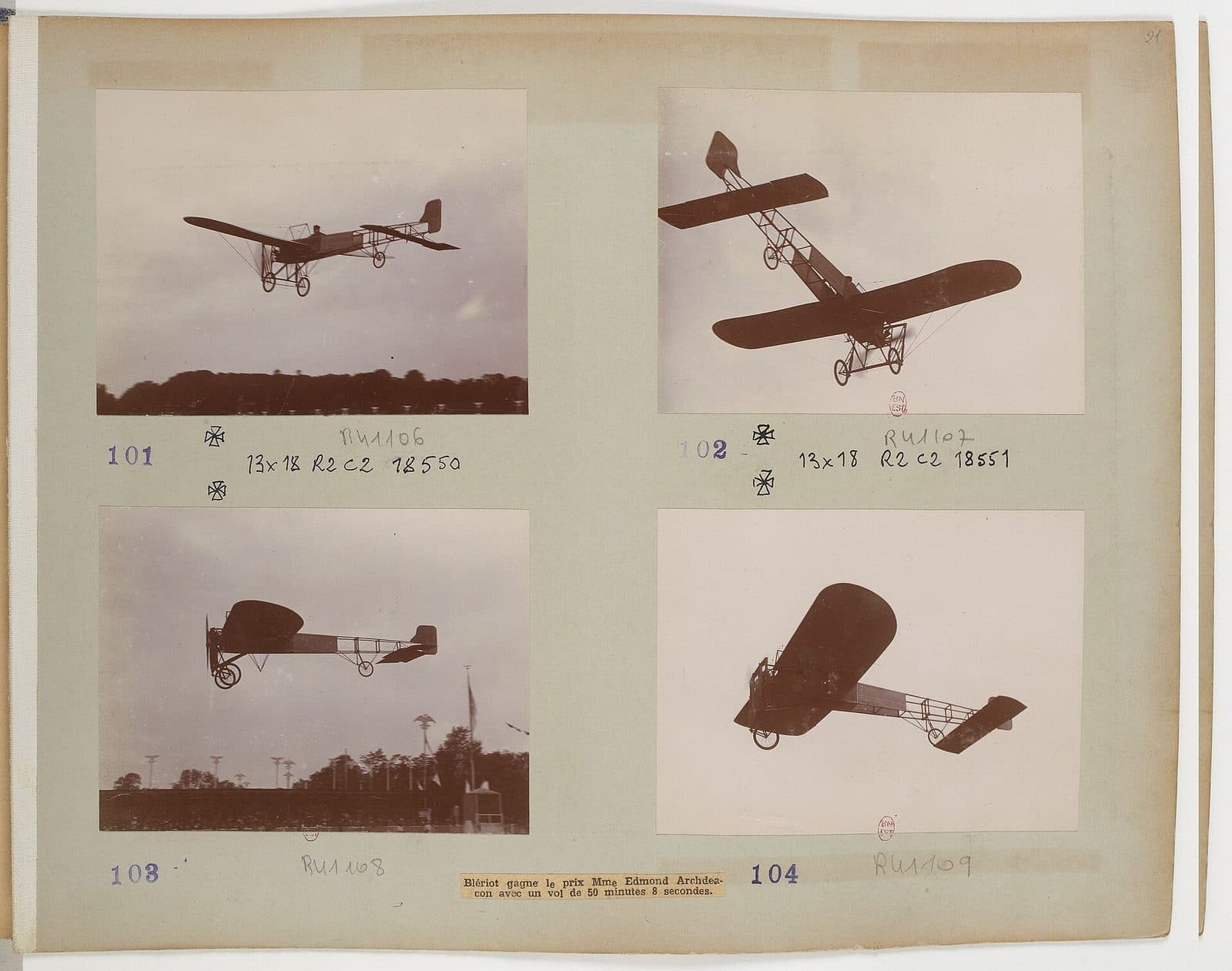
Through the early summer Blériot flew it with growing confidence, and with growing cost to himself. On 26 June he stayed up for more than 36 minutes. On 2 July, at a meeting at Douai, the asbestos lagging worked loose from the exhaust; one of his shoes burned through, and he carried on until the engine stopped, with third-degree burns that took more than two months to heal. On 4 July he flew for 50 minutes at Port-Aviation near Paris, and on 13 July he flew about 22 nm across country from Étampes to Orléans, winning the Aéro-Club de France's first Prix du Voyage. Between those flights, on 19 June, he had written to the Daily Mail to enter for its Channel prize.
The machine
The Type XI was a development of the Type VIII, drawn largely by the engineer Raymond Saulnier. It was a tractor monoplane with a box-girder fuselage of ash, braced with wire and only partly covered with fabric. The main difference from its predecessor was lateral control: instead of hinged surfaces at the wingtips, the XI twisted its thin, cambered wings by wires, wing warping, the method the Wright brothers had used. The wires ran to a small pyramid of struts above the fuselage and another below it. At the tail, a small all-moving rudder sat behind a tailplane whose outer sections served as elevators.
The undercarriage was one of its best features, and the part that took the punishment at Dover. The wheels were carried on castering trailing arms that slid up and down steel tubes, sprung by rubber cords, so that they could absorb a rough field and swivel when the aircraft touched down with any drift.
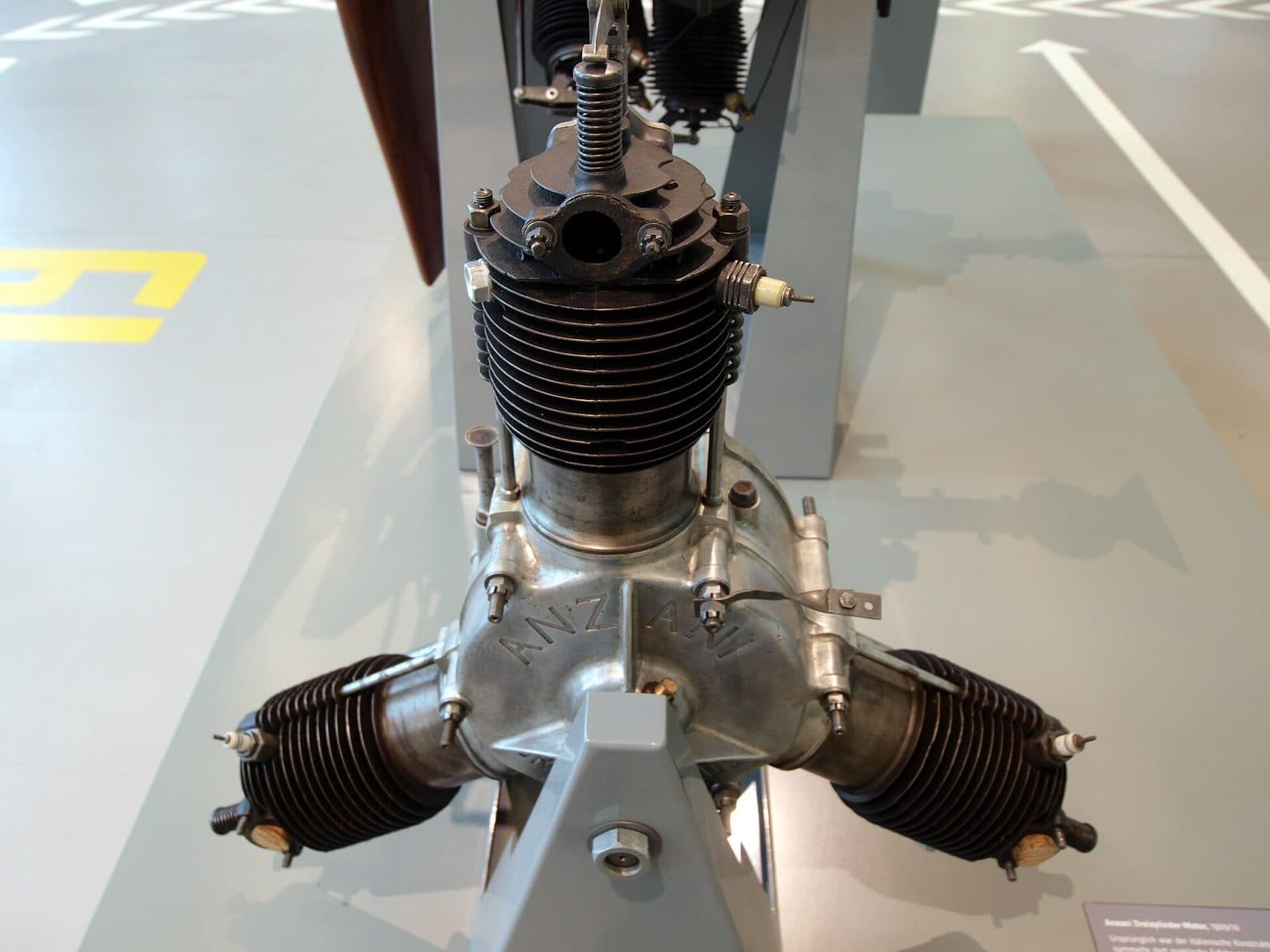
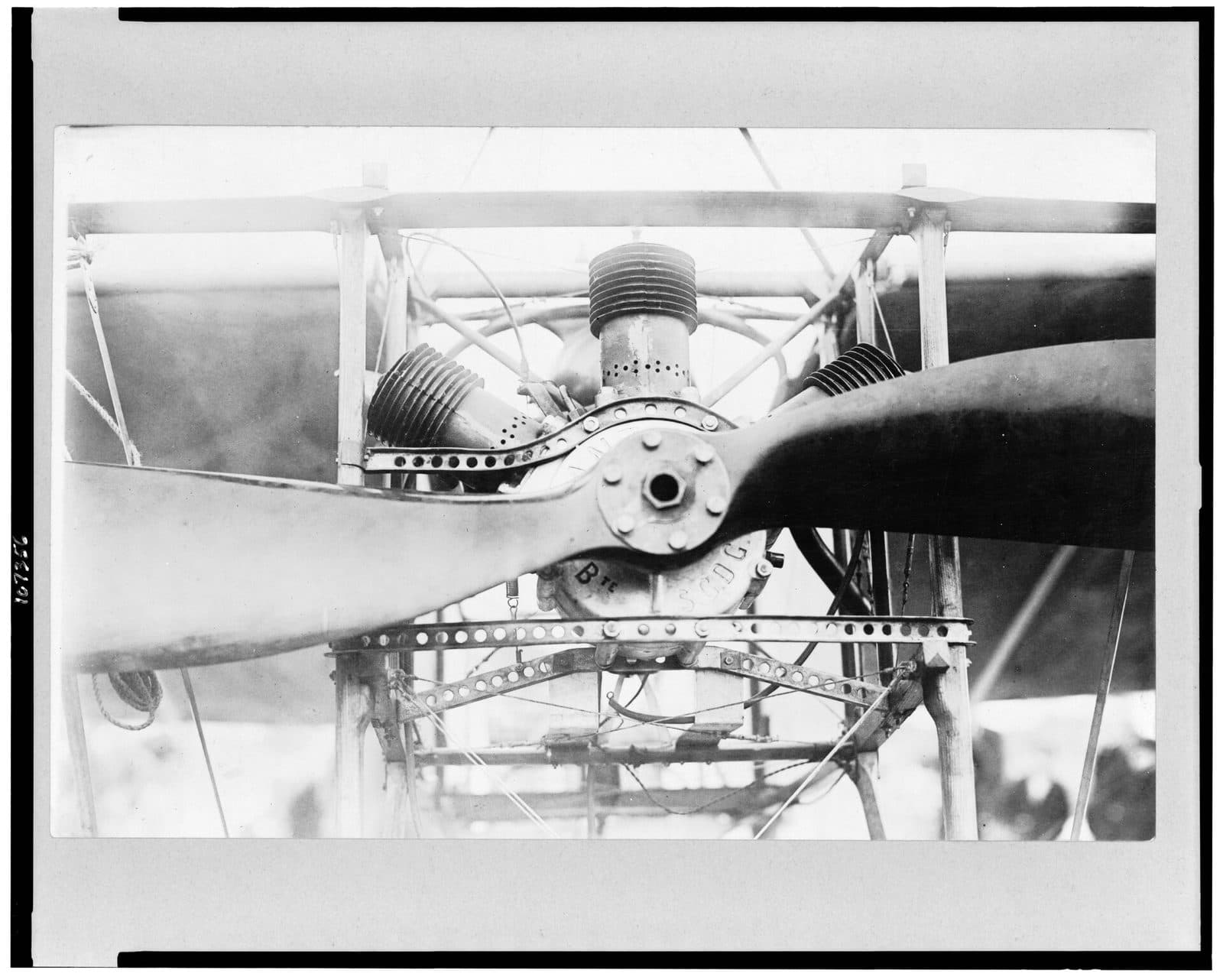
The engine was the problem. At the Paris salon the XI carried a seven-cylinder REP engine, and although the aeroplane handled well, the engine would not run for long. At the suggestion of his mechanic Ferdinand Collin, Blériot went to Alessandro Anzani, an Italian motorcycle racer who built his own engines and had just moved into aviation. On 27 May 1909 a three-cylinder Anzani was fitted: an air-cooled engine of about 25 horsepower with its cylinders splayed upward in a fan, a layout sometimes called a semi-radial. It was not powerful, but it was reliable enough.
With it came a new propeller. Lucien Chauvière's Intégrale, a two-bladed scimitar shape carved from laminated walnut, replaced the four-bladed paddle Blériot had been using. It was the first European propeller to rival the efficiency of the Wrights', and the combination of Anzani and Chauvière is credited with making the Type XI a practical aeroplane. Before the Channel attempt the wing area was increased from 130 ft² to 150 ft² and the small fin above the fuselage was removed. A flotation bag was fitted in case he came down in the sea.
The aircraft that crossed the Channel was, by the Musée des Arts et Métiers' own description, fragile, even rudimentary. It had no instruments to speak of. The span was about 26 ft. Its cruising speed was around 32 kt, and on the day it probably reached a little more.
Preparation
Between 1906 and 1930 the Daily Mail, at the instigation of its proprietor Alfred Harmsworth, Lord Northcliffe, offered a long series of prizes for achievements in the air. The Channel prize was announced in October 1908: £500 for a crossing in a heavier-than-air machine made before the end of that year. Nobody tried. For 1909 the offer was renewed and doubled to £1,000. Many regarded it as cheap publicity for a prize no one could win; the Paris newspaper Le Matin said as much. Northcliffe, who had come to know Wilbur Wright during the Wright demonstrations in France in 1908, had hoped Wilbur would take it. Wilbur was tempted, but Orville, recovering from his crash at Fort Myer, cabled him not to try until he could come to help, and the brothers judged £1,000 too little for the risk.
Four men entered. The favourite, in both Britain and France, was Hubert Latham, a 26-year-old Frenchman of English descent, educated partly at Oxford, who had become the chief pilot of the Antoinette company. His Antoinette IV was an elegant, long-bodied monoplane with a V8 engine designed by Léon Levavasseur, and by the end of May 1909 Latham had flown it for more than an hour at a stretch. The second was Comte Charles de Lambert, a Russian aristocrat of French descent and the first man Wilbur Wright had taught to fly in France, who owned two French-built Wright biplanes. The third, Arthur Seymour, an Englishman said to own a Voisin, never went further than sending in his entry. Blériot was the fourth.
Latham notified the Daily Mail on 9 July and set up camp at Sangatte, west of Calais, in the half-derelict buildings left from an 1881 attempt to dig a Channel tunnel. Within four days de Lambert had established his own base at Wissant, further west along the coast. The contest became a spectacle: some 10,000 visitors were reported at Calais and as many at Dover, and the Marconi Company set up a wireless link between Cap Blanc-Nez and the roof of the Lord Warden Hotel in Dover so that news could cross faster than the aeroplanes.
The wind blew for a week. Latham finally went on 19 July, taking off from Cap Blanc-Nez near Sangatte with the destroyer Harpon following below. Some eight miles out the engine failed, and he put the Antoinette down on the sea: the first time an aeroplane had landed on water. The fuselage floated; he is said to have lit a cigarette and waited for the boat. A stray piece of wire was later found inside the engine. He returned to Calais to learn that Blériot had arrived to compete.
Blériot reached Calais on Wednesday 21 July with two mechanics and his friend Alfred Leblanc, who handled the organisation, and set up at a farm near the beach at Les Baraques, between Calais and Sangatte. Next day a replacement aircraft for Latham arrived from the Antoinette works. On Friday and Saturday the wind was too strong for anyone to fly, but on Saturday evening it began to drop, and both camps went to bed hoping for the morning.
The event
Alfred Leblanc went to bed around midnight and slept badly. At two in the morning he looked out, judged the weather ideal and woke Blériot, who for once was pessimistic and had to be talked into eating breakfast. His mood lifted. By half past three his wife Alice was aboard the French destroyer Escopette, which was to steam towards Dover as his escort and, if needed, his rescue. In Latham's camp at Sangatte, nobody noticed the change in the weather; Levavasseur and his team slept through, a lapse Latham's supporters never forgave.
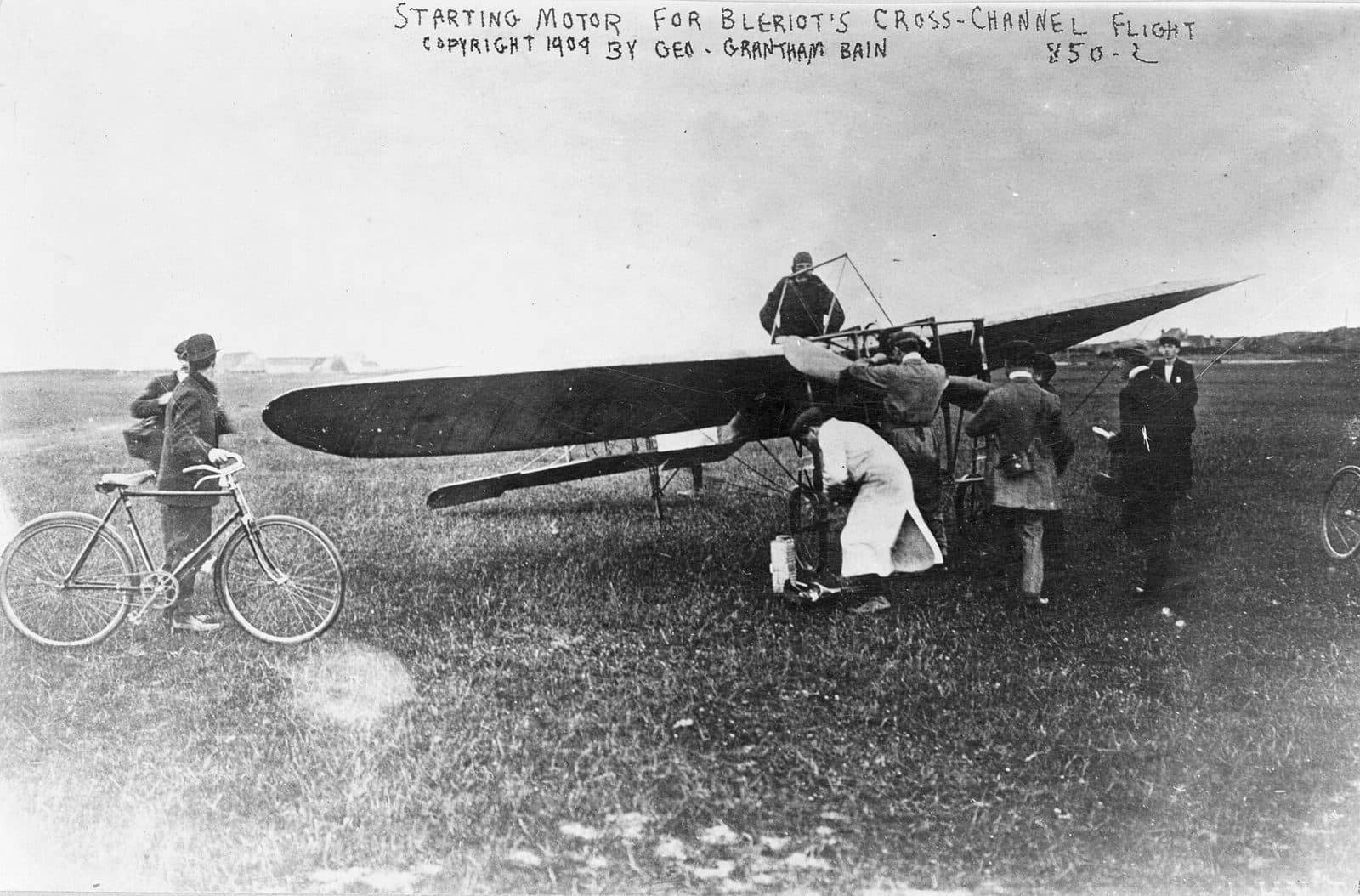
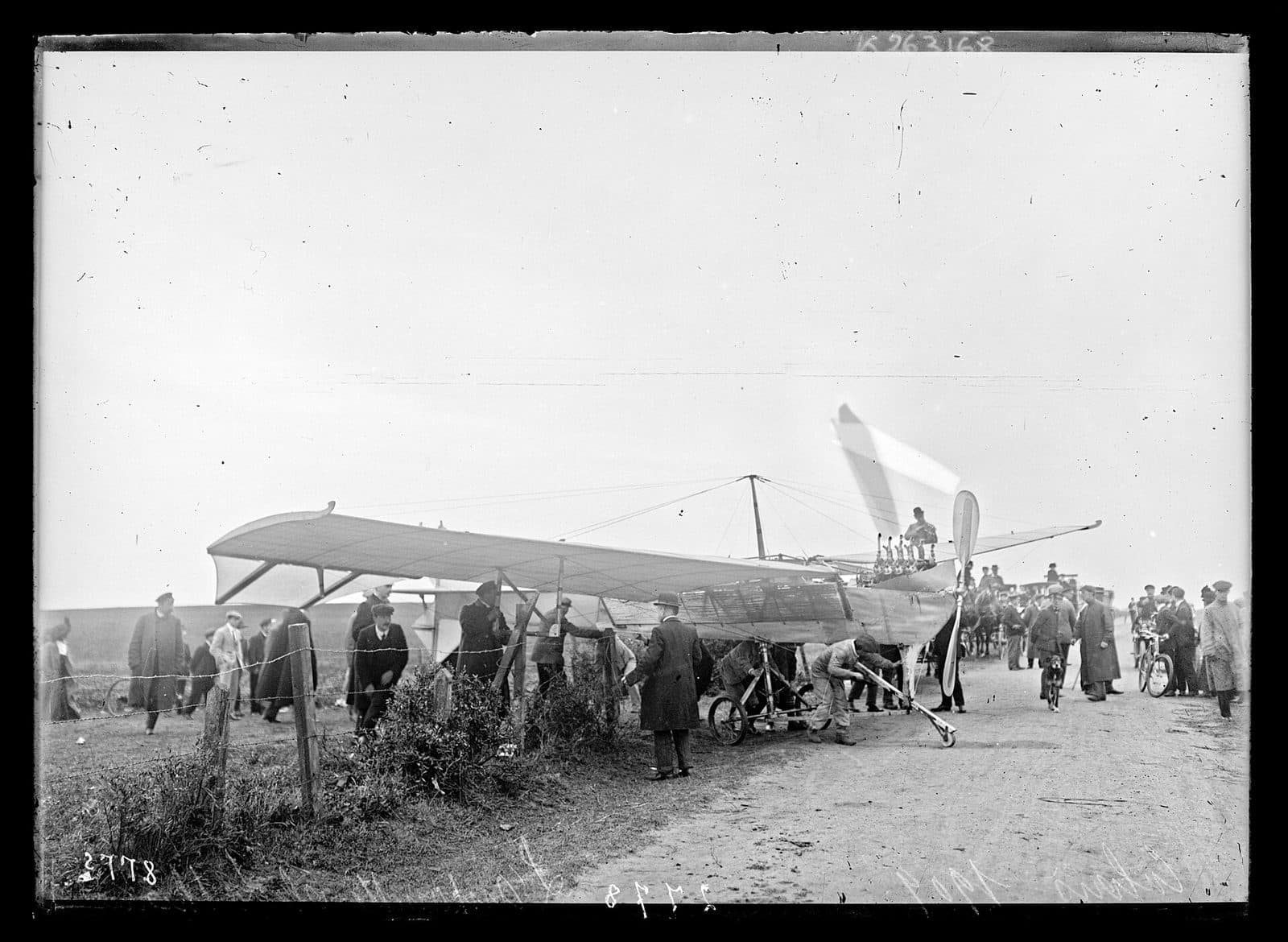
At 4:15, watched by a crowd that had come out in the dark, Blériot made a short trial flight around the field. The rules required the crossing to be made between sunrise and sunset, so he waited for the signal that the sun was up, and at 4:41 he took off and turned out over the sea. He flew at about 39 kt and at a height of about 250 ft. Having no compass, he took his course from the Escopette, heading for Dover below him: and within minutes he had overtaken her.
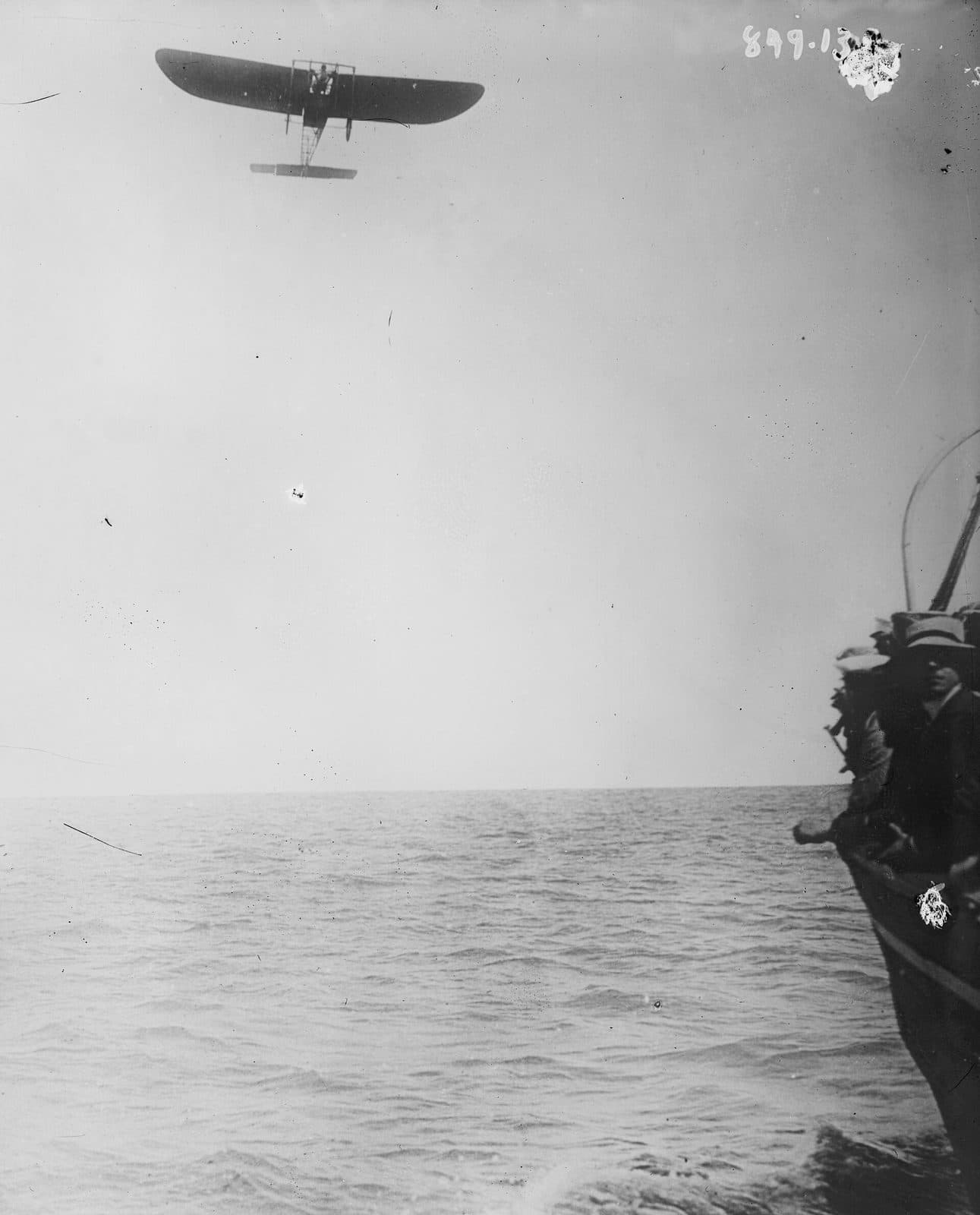
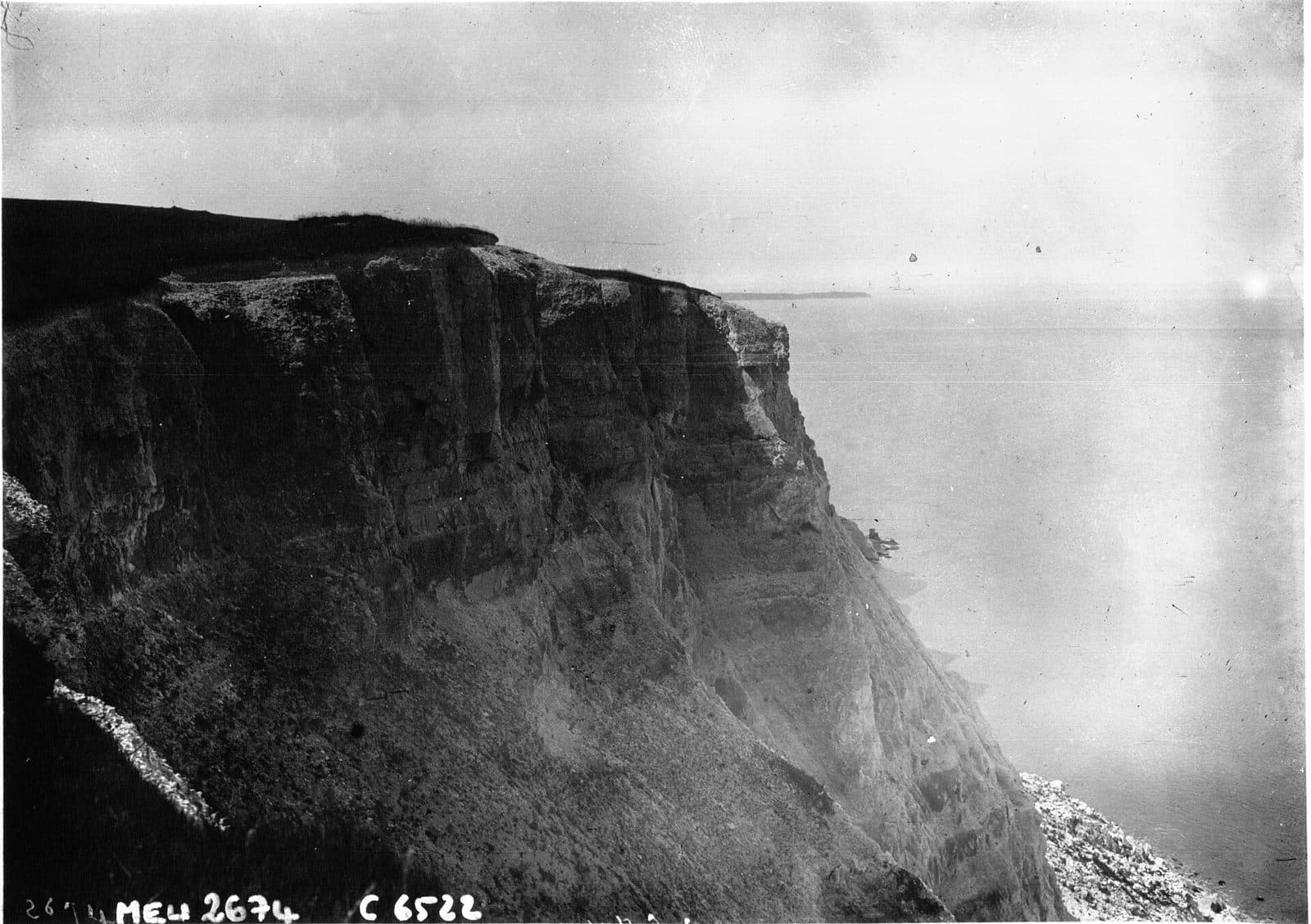
Then the visibility closed in. "For more than ten minutes," he said afterwards, "I was alone, isolated, lost in the midst of the immense sea, and I did not see anything on the horizon or a single ship." He held his heading and kept going. When a grey line of coast appeared, it was on his left: the wind, freshening, had carried him east of his line, and he first crossed the English coast near St Margaret's Bay, north-east of Dover. He turned and followed the shore south-westward about a mile out to sea, looking for his landing place.
Blériot, unlike Latham, had never visited Dover to choose a field. The choice had been made for him by Charles Fontaine, the correspondent of Le Matin, on the advice of Frederick Duckham, the engineer in charge of the harbour works: Northfall Meadow, a patch of gently sloping grass on the clifftop close to Dover Castle. Fontaine stood in it waving a large French tricolour. Blériot saw the flag, crossed the cliff edge and circled twice to lose height, in gusty wind.
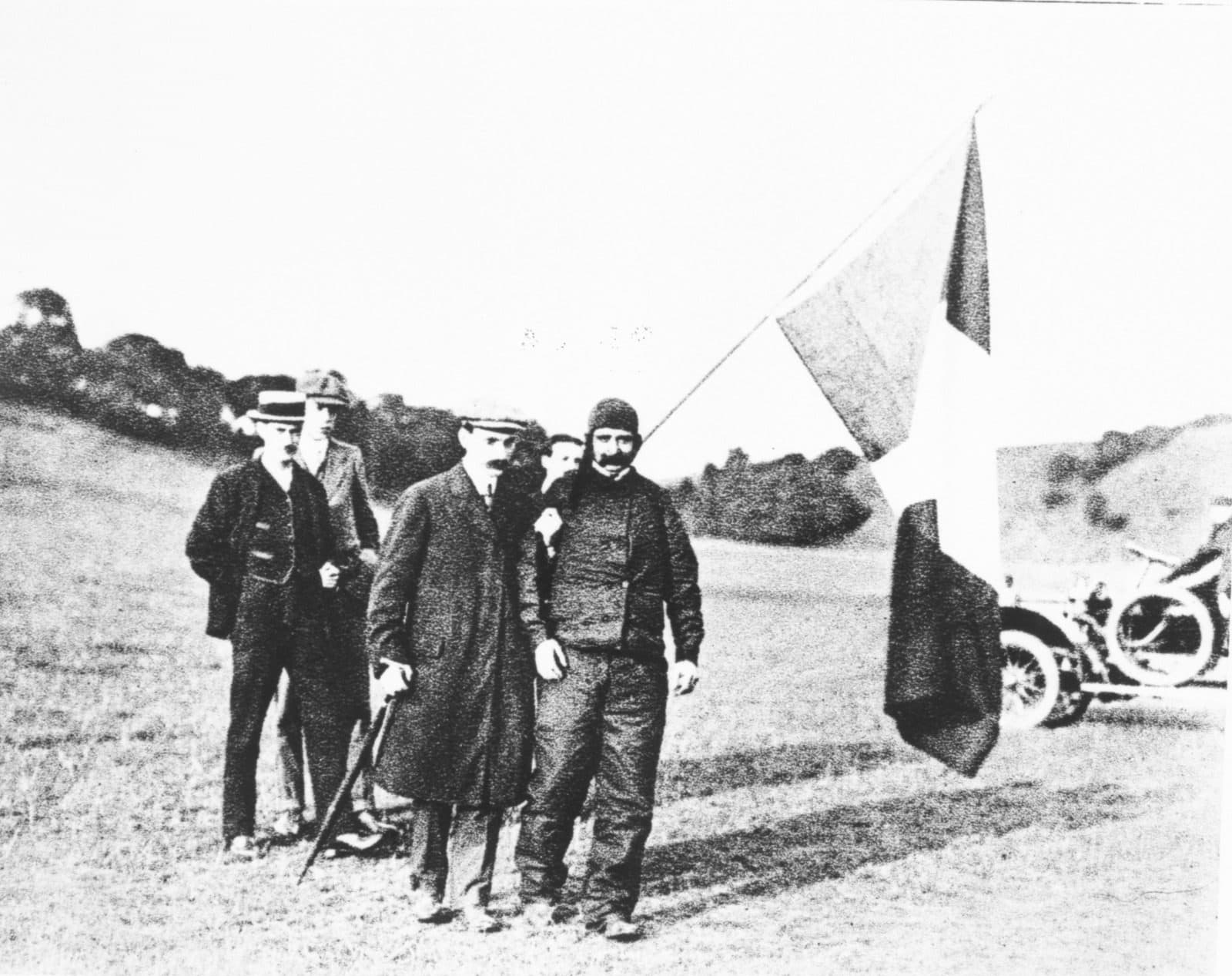
At about twenty metres he cut the engine, and the Type XI dropped onto the meadow in a heavy "pancake" landing. The undercarriage buckled and one blade of the propeller shattered. Blériot climbed out unhurt. It was a little after 5:10 in the morning. The flight had lasted something over half an hour, exactly how much over, the sources still do not agree.
Aftermath
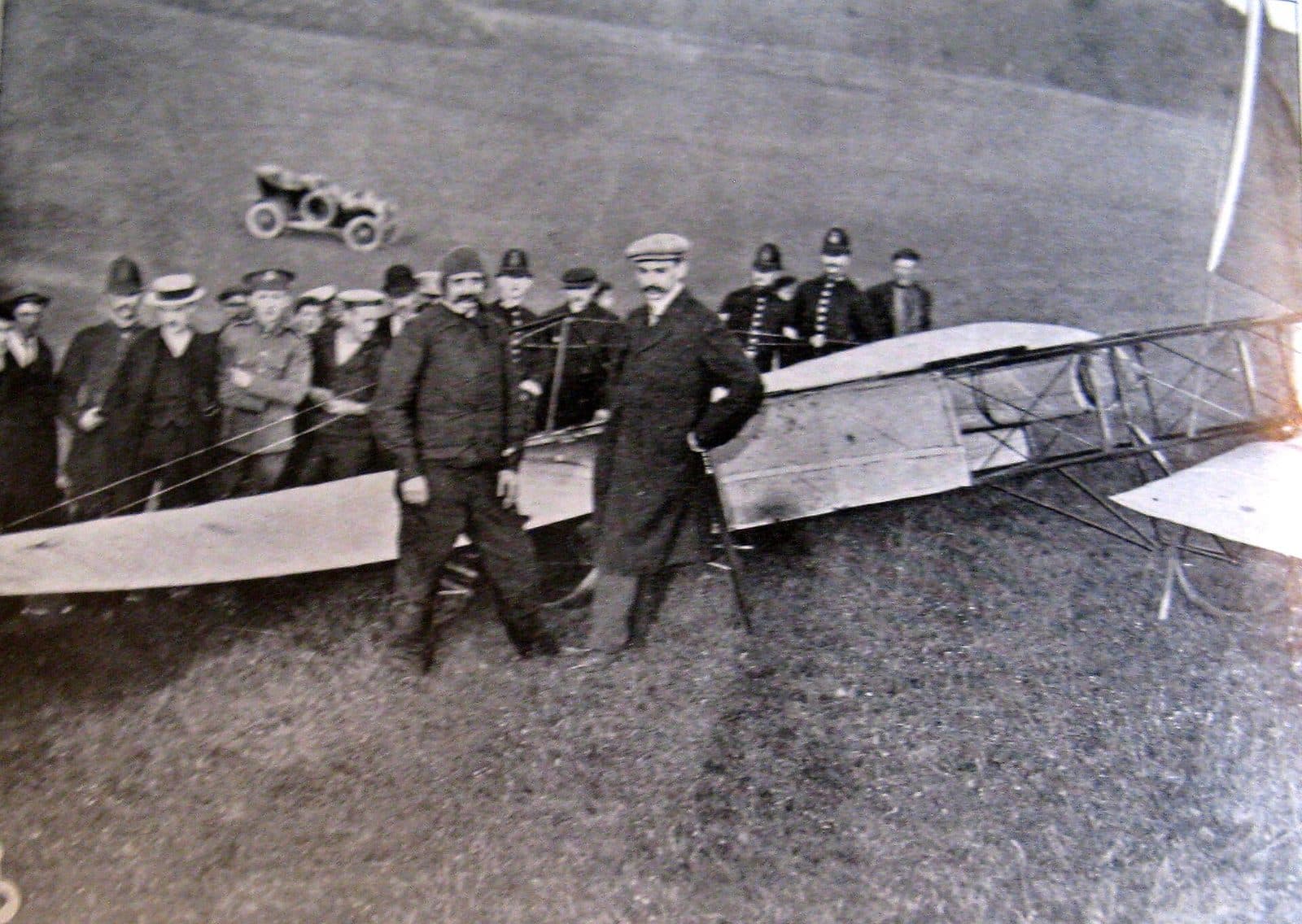
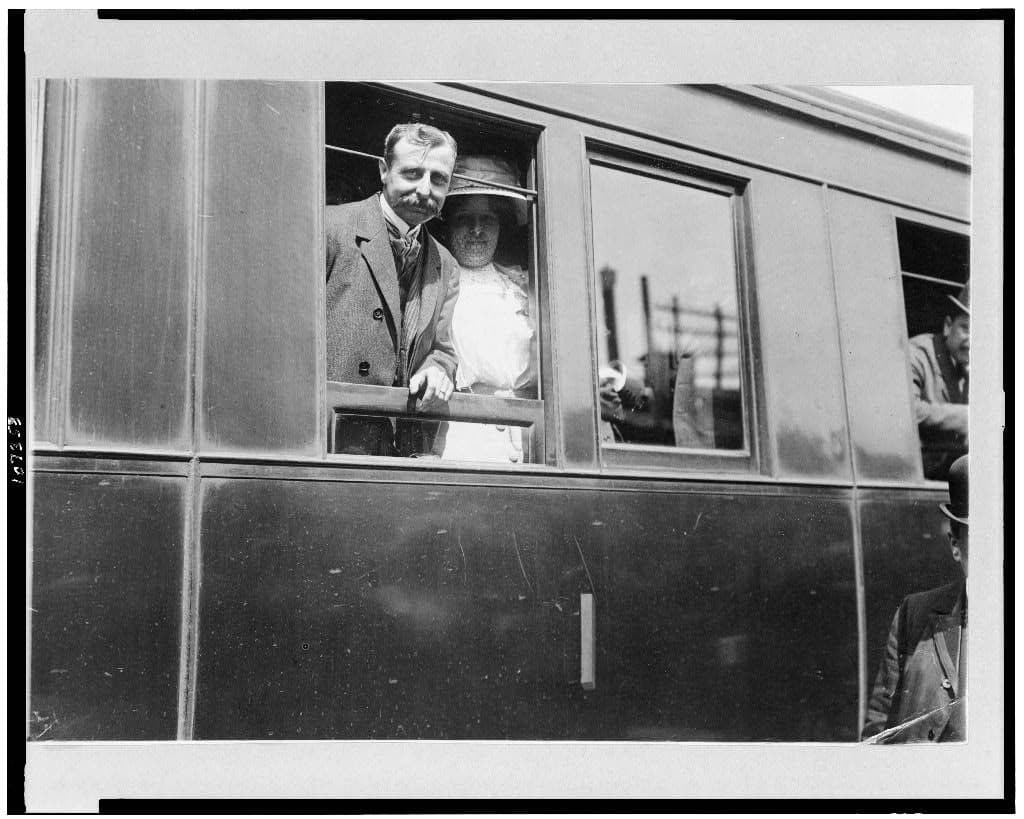
News of the departure had gone across by wireless, but Dover expected him on the beach west of the town. The Daily Mail's correspondent, realising where he had come down, drove up at speed and took Blériot to the harbour, where he was reunited with Alice, landed from the Escopette. Surrounded by a cheering crowd and photographers, the couple were taken to the Lord Warden Hotel at the foot of the Admiralty Pier. According to Dover Museum, the customs officer, having no category for an aeroplane, entered the machine in his records as a yacht and its pilot as her master.
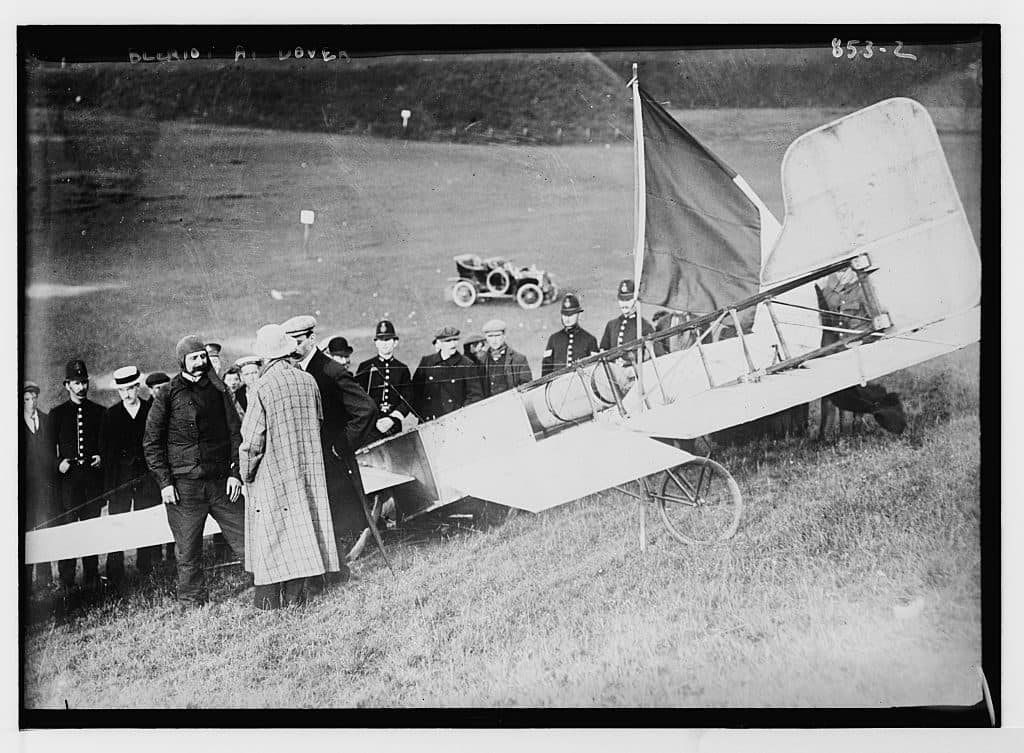
Photographs taken on the meadow show the broken monoplane guarded by police beside a French tricolour, with visitors crowding round. Blériot had become a celebrity between breakfast and lunch. In London, thousands cheered him at Victoria Station in the company of Lord Northcliffe. Back in France, a crowd put by the RAF Museum at 100,000 greeted him in Paris.
Latham, meanwhile, had not given up. On 27 July, two days after Blériot's crossing, he took off again in the replacement Antoinette. This time he came within sight of Dover, within minutes of the English coast, before the engine failed once more. He could not control the descent as well as on 19 July; the aircraft was badly damaged when it struck the water and he cut his face. The cause was never settled: perhaps fuel clogging the injection system, perhaps, as Gabriel Voisin argued, the Antoinette V8's habit of losing power after a quarter of an hour. The company, having lost two aircraft, declined to fund a third attempt with the great Reims meeting weeks away. De Lambert, who had damaged his Wright biplanes practising at Wissant, never made one.
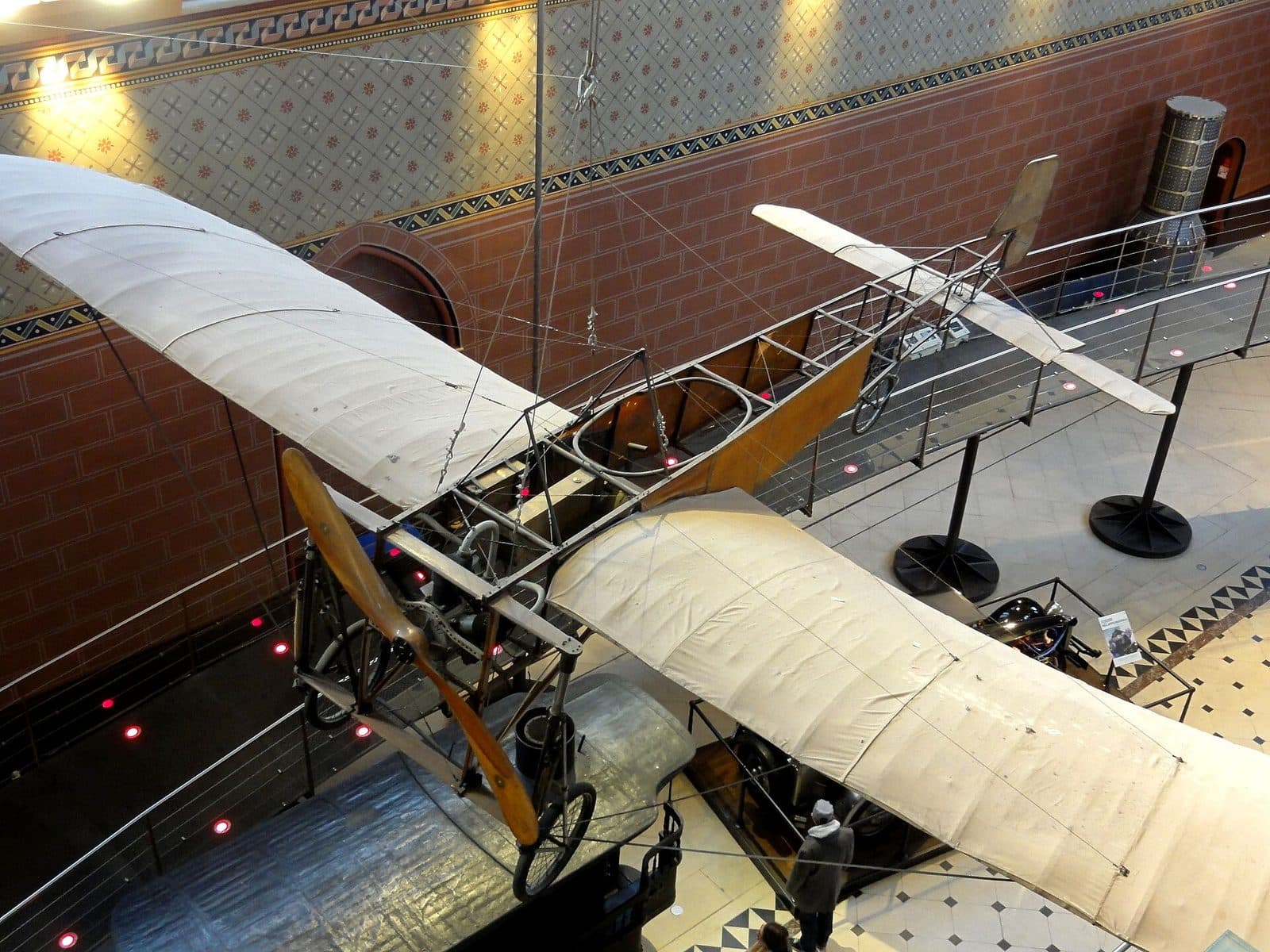
The aeroplane itself never flew again. It was hurriedly repaired and exhibited at Selfridges department store in London, then outside the offices of Le Matin in Paris. On 13 October 1909 it entered the collection of the Conservatoire national des arts et métiers, where it still hangs in the former church of Saint-Martin-des-Champs.
Controversy
Nobody disputes that Blériot crossed the Channel on 25 July 1909, or that he was the first to do it by aeroplane. The details are another matter, and several of the most repeated ones rest on less than they seem.
The first is the time. The figure most often printed is 36 minutes 30 seconds. Dover Museum says 37 minutes, with a take-off at 4:35. The Musée des Arts et Métiers, which holds the aircraft, gives a take-off at 4:41 and a landing at 5:13, 32 minutes, and the RAF Museum says 4:41 to 5:12, "just over 30 minutes". No official timekeeper stood at both ends; the times were taken by different observers, on different watches, on two sides of the sea. This entry gives the range rather than choose among them.
The distance varies too. Arts et Métiers speaks of 38 kilometres between England and the continent; the RAF Museum gives 24 miles, about 39 kilometres. Both describe the width of the strait rather than the path actually flown, which bent east with the wind before turning back along the coast, and was therefore somewhat longer.
The most famous words attached to the flight are the least secure. "England is no longer an island" is widely attributed to Lord Northcliffe on hearing the news. The historian Brett Holman, tracing the phrase, found it already a stock expression in 1846, when steamships raised the same fear, and could find no primary source for Northcliffe saying it; the earliest attribution he traced came decades later. What is documented is the chorus of 27 July 1909: in the Daily Mail, H. G. Wells wrote that "in spite of our fleet, this is no longer, from the military point of view, an inaccessible island", and the same issue reprinted a Daily Express piece headed "No Longer an Island". Latham's supporters, finally, blamed his team for sleeping through the calm; whether an Antoinette that failed twice in eight days would have got across that morning is unknowable.
Recognition
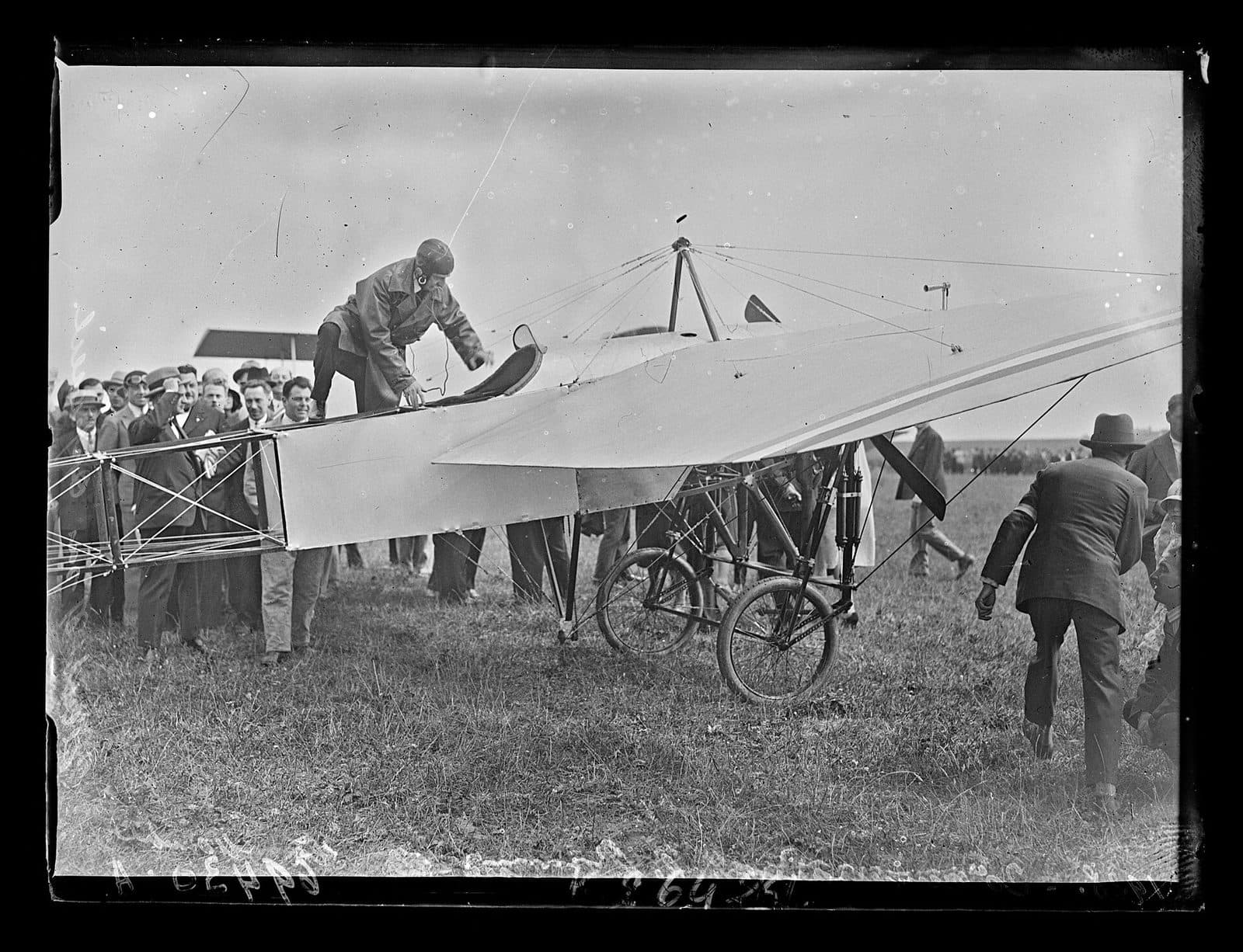
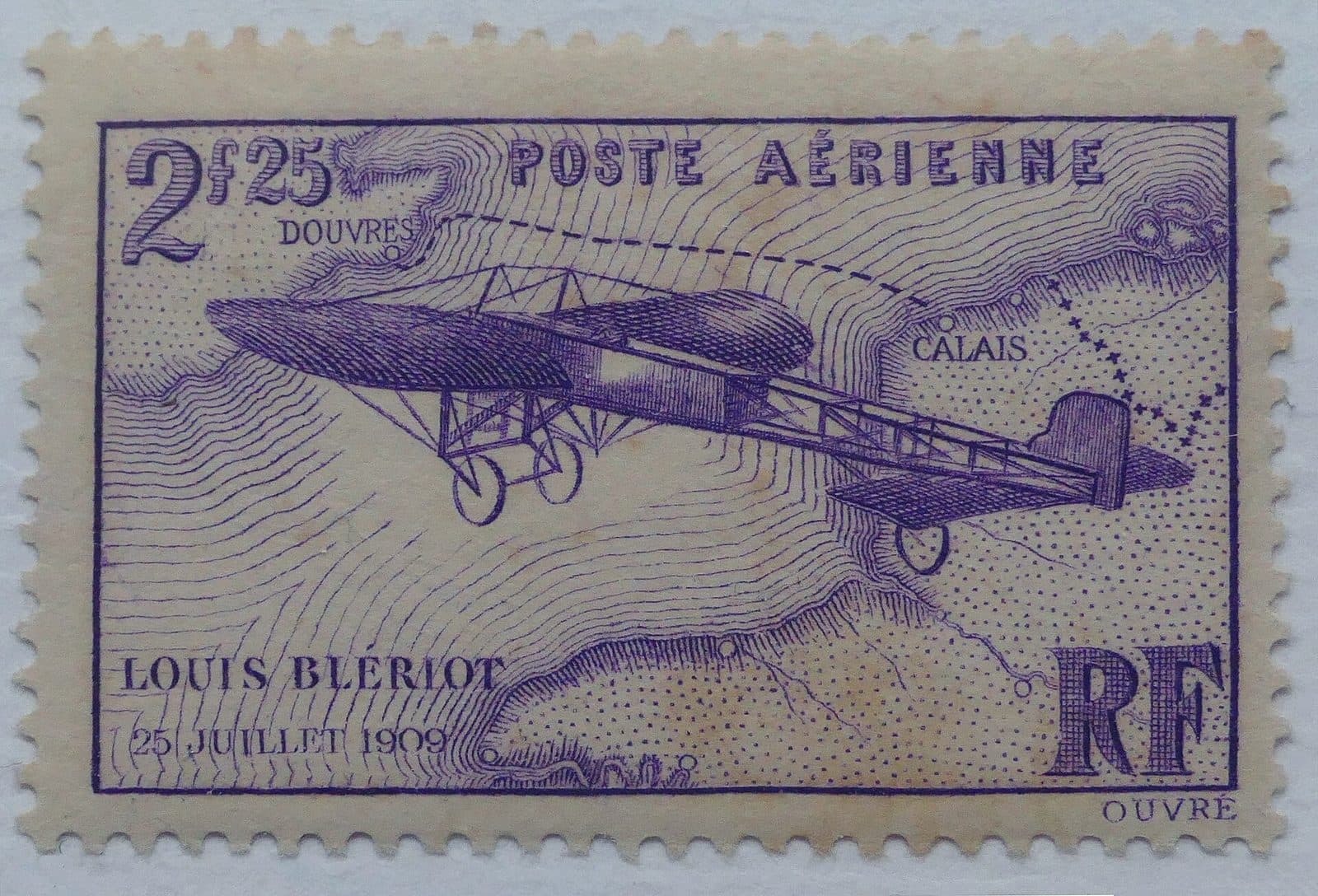
Blériot's fame outlived the aeroplane that made it. France marked the crossing on its round anniversaries: in July 1929 Blériot returned to Calais for the twentieth, photographed in the cockpit of a monoplane, and in November 1934 the French post issued a 2 franc 25 airmail stamp for the twenty-fifth, engraved by Achille Ouvré with the Type XI over a map of the strait between Calais and Dover.
He was honoured as a founder of the industry as much as a pilot. In 1930 he instituted the Blériot Trophy for the first crew to sustain 1,100 kt for half an hour, a target so far ahead of its time that his widow Alice presented it only in 1961, to the crew of a US Air Force B-58. In 1936 the Fédération Aéronautique Internationale created the Louis Blériot Medal, still awarded for speed, altitude and distance records in light aircraft. After his death he received a funeral with full military honours at Les Invalides.
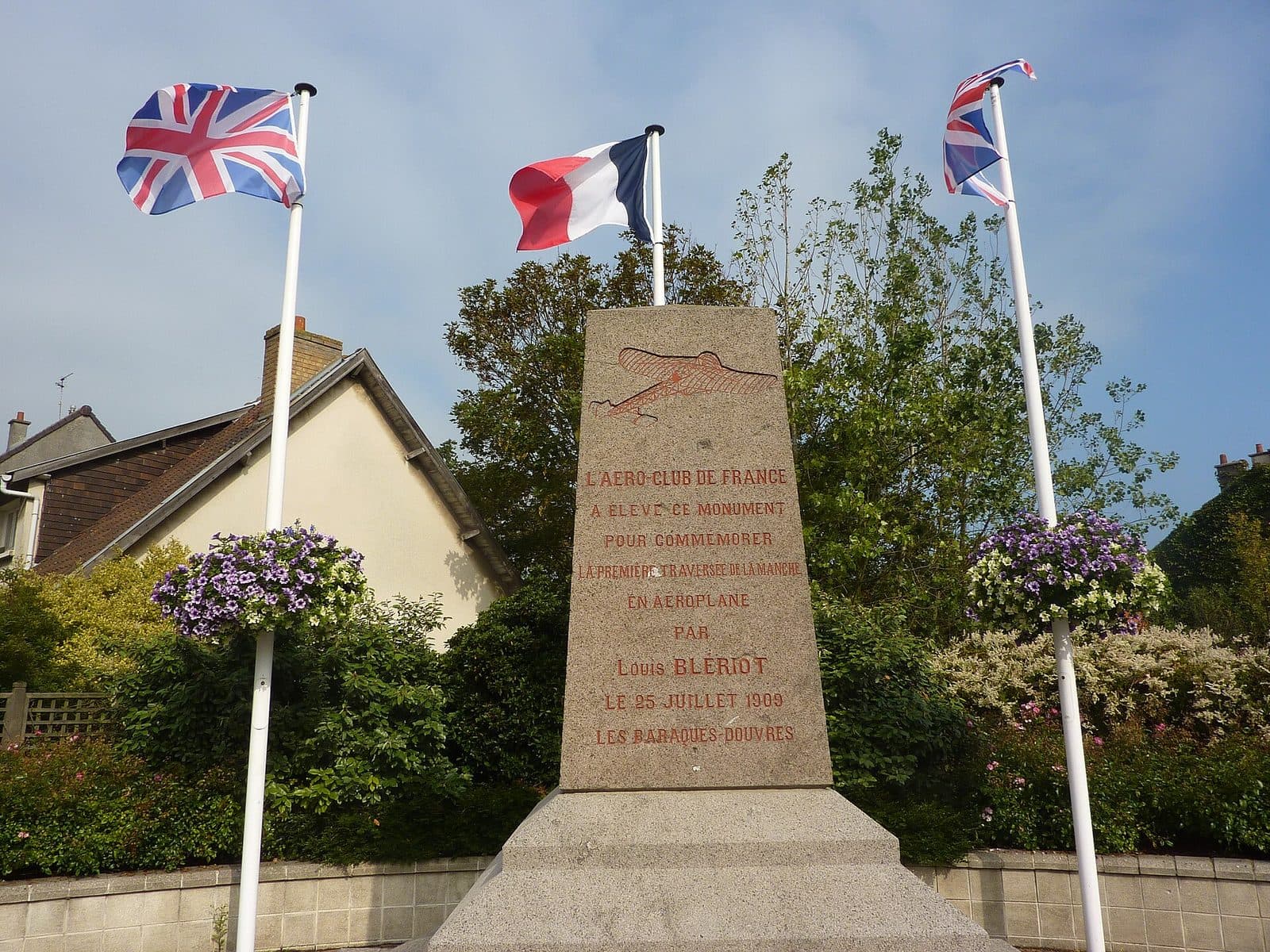
The centenary in 2009 brought the flight back to both shores. The Musée des Arts et Métiers mounted an exhibition around the original aircraft, and on 25 July 2009 Edmond Salis flew a replica Blériot from Blériot-Plage to Kent.
Legacy
For Blériot the crossing was the return on a decade of losses. Orders for copies of the Type XI came at once: 103 by the end of September 1909, according to one account, more than a hundred by the end of the year, each selling for 10,000 francs. In August he flew at the Grande Semaine d'Aviation at Reims, where Glenn Curtiss narrowly beat him for the first Gordon Bennett Trophy but Blériot set a world speed record for the fastest lap. After a crash at Istanbul in December 1909 that broke several ribs, he gave up competition flying and left it to others, Alfred Leblanc among them.
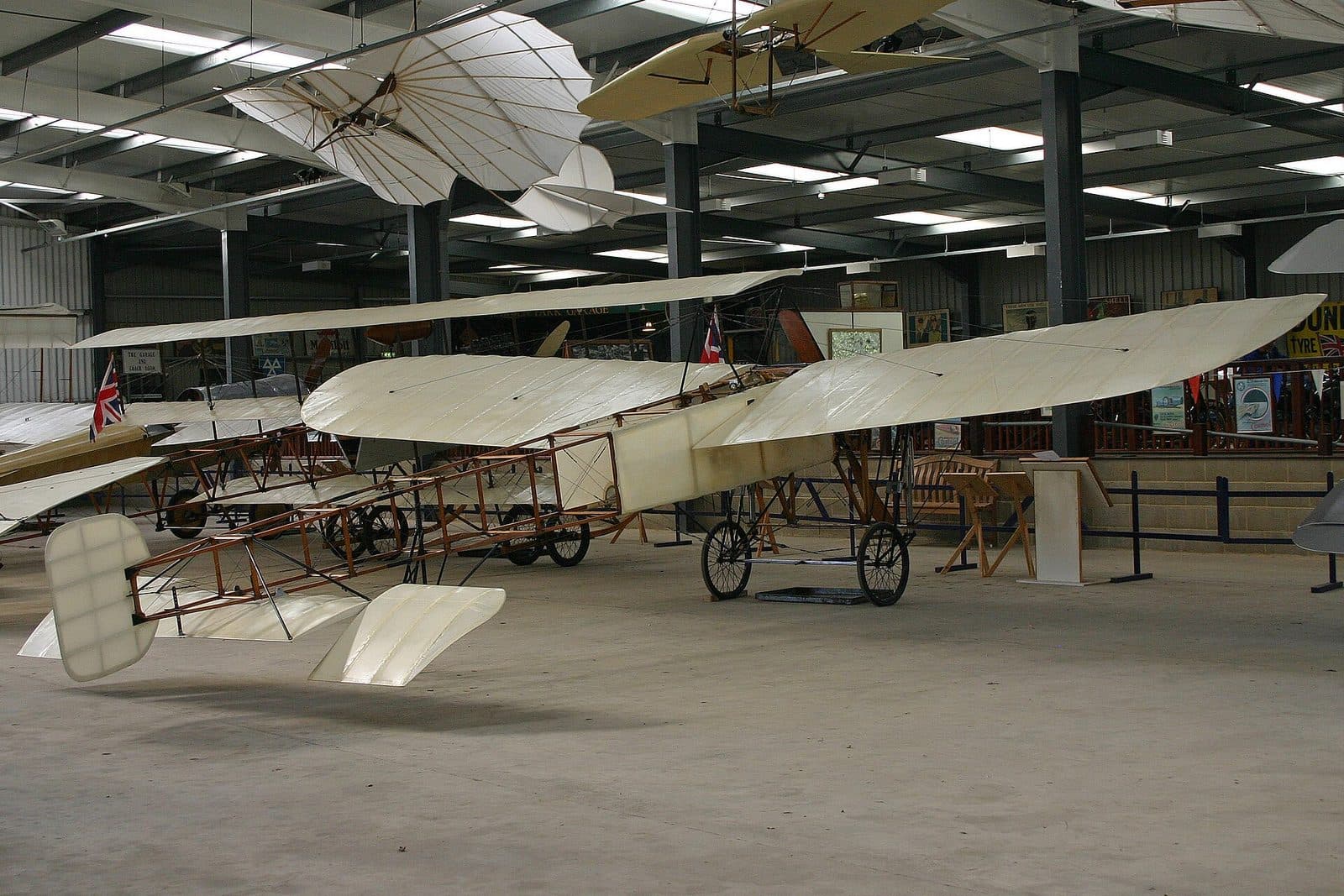
The firm grew into one of the great manufacturers of pre-war aviation. Between 1909 and 1914 Blériot built about 900 aircraft, most of them variants of the Type XI, with Gnome rotary engines and one or two seats, sold as trainers, sporting machines, racers and military scouts. Blériot schools opened in France and in England, at Brooklands and Hendon. Type XIs won the Circuit de l'Est in 1910 and the Circuit of Europe in 1911; Claude Grahame-White won the 1910 Gordon Bennett race in one, and Harriet Quimby became the first woman to fly the Channel in one in 1912. Two early survivors still fly: the Shuttleworth Collection's G-AANG in England, the world's oldest airworthy aeroplane, and a Type XI at Old Rhinebeck in New York.
For Britain the flight was a shock of another kind. The country's security had rested for centuries on the Royal Navy and the width of the sea, and a Frenchman had now crossed that sea in the time it took to eat breakfast, over the heads of the fleet. The fear was not new: steamships had prompted the same phrase in the 1840s, and Britain had had its first air panic in 1908: but Blériot gave it a date and a photograph. Wells's warning in the Daily Mail was echoed across the press, and others later drew the lesson that Britain must seek another form of defence besides ships.
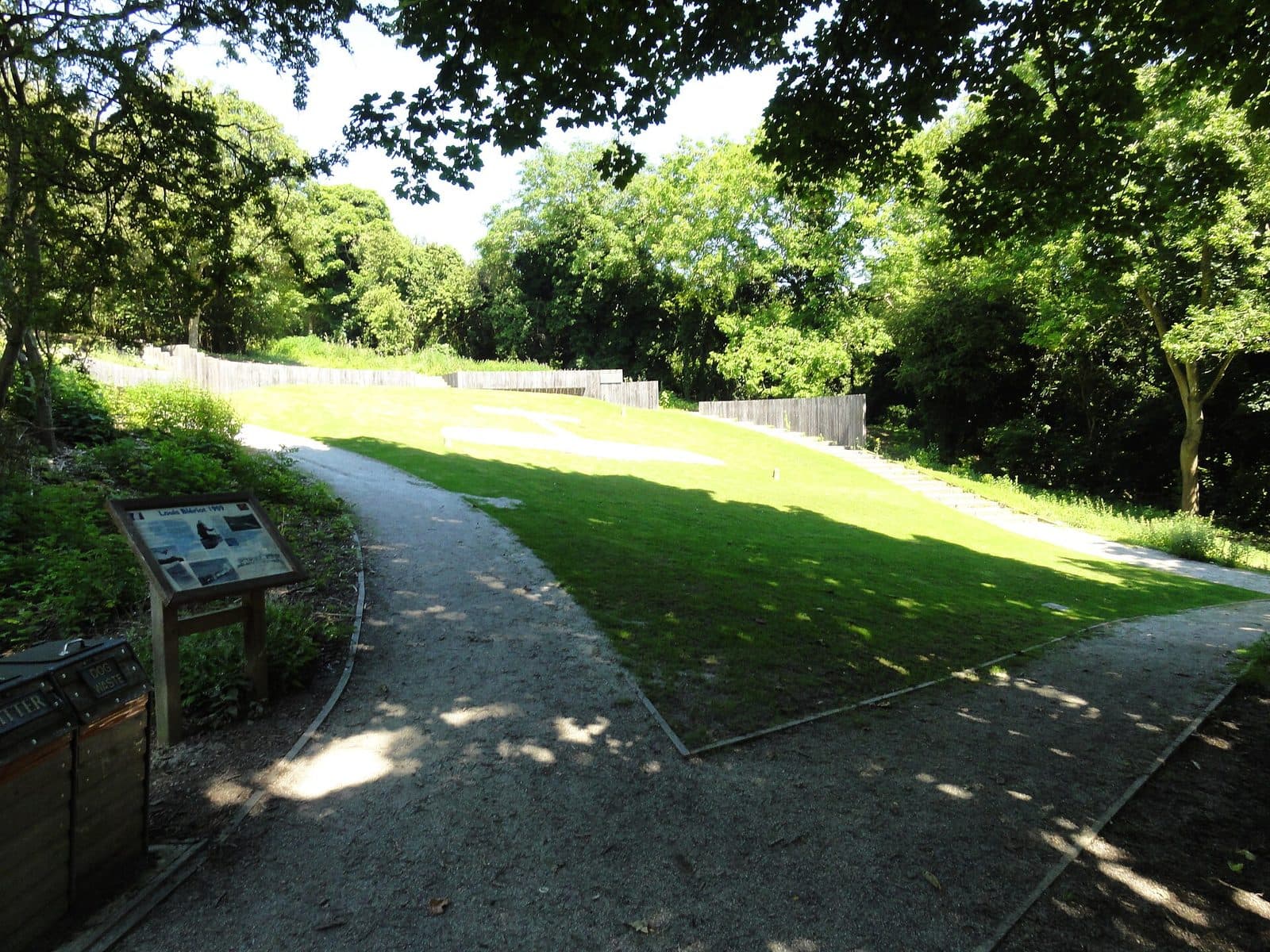
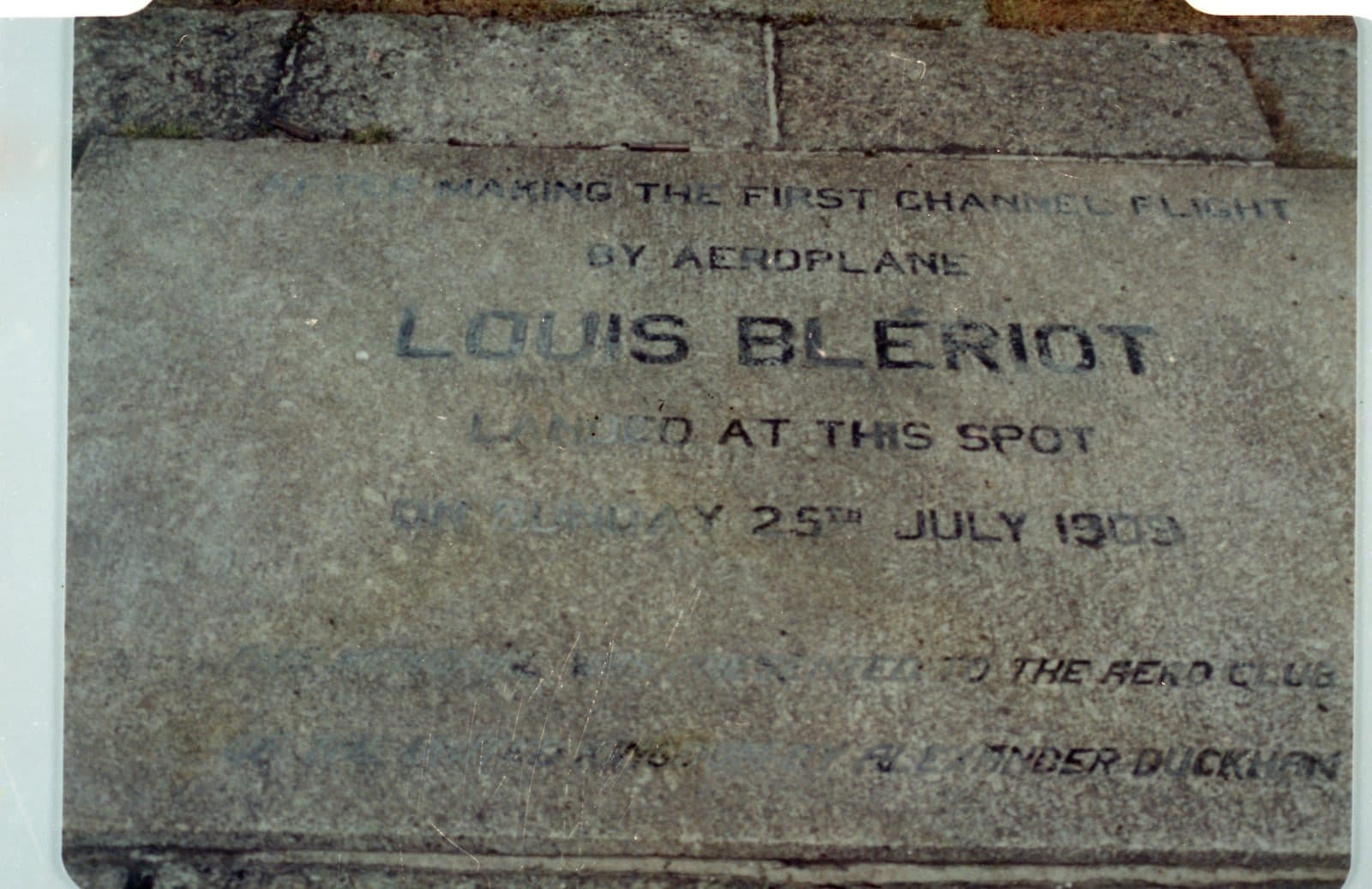
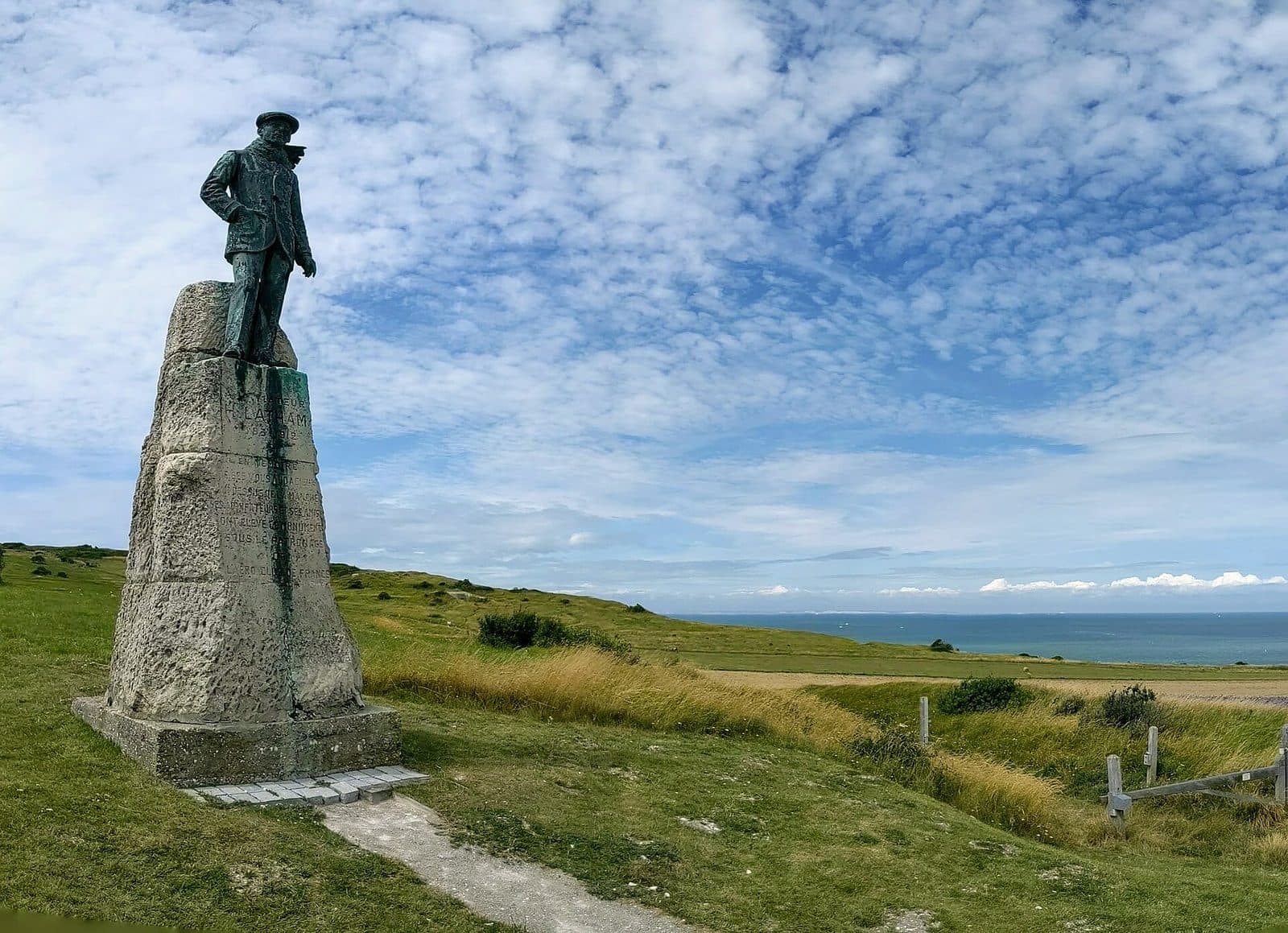
The places of the flight are marked on both shores. On the meadow behind Dover Castle, the outline of the monoplane was laid out in granite setts in the turf, paid for by Alexander Duckham, who had witnessed the landing, and presented to the Aero Club. At Les Baraques a monument was inaugurated in 1911, and in 1936 the hamlet took the aviator's name, as Blériot-Plage. A statue of Hubert Latham stands on the clifftop near Sangatte, looking at the sea that beat him twice. Blériot died in Paris on 1 August 1936, a week after the anniversary of his flight.
The race for the Daily Mail prize
Nine months from the first offer to the winning flight, and three weeks of wind on the Pas-de-Calais coast.
October 1908
The Daily Mail offers £500
For a Channel crossing by a heavier-than-air machine before the end of 1908. Nobody attempts it.
1909
The prize is renewed and doubled to £1,000
May 27, 1909
The Type XI gets its Anzani engine
Together with Chauvière's walnut propeller, it turns an unreliable machine into a practical one.
June 19, 1909
Blériot tells the Daily Mail he will compete
Hubert Latham's Antoinette monoplane on the ground at Sangatte, its long fuselage surrounded by onlookers.July 1909 · Agence Meurisse / Bibliothèque nationale de France · Public domain July 9, 1909Sangatte
Latham formally enters, from his camp at Sangatte
July 1909Wissant
De Lambert sets up at Wissant with two Wright biplanes
July 13, 1909
Blériot flies from Étampes to Orléans
About 22 nm across country, winning the Aéro-Club de France's first Prix du Voyage.
July 19, 1909
Latham's first attempt ends in the sea
Engine failure some eight miles out: the first landing of an aeroplane on the sea. Rescued by the destroyer Harpon.
July 21, 1909Les Baraques
Blériot arrives at Calais
With Leblanc and two mechanics, he sets up at a farm near the beach at Les Baraques.
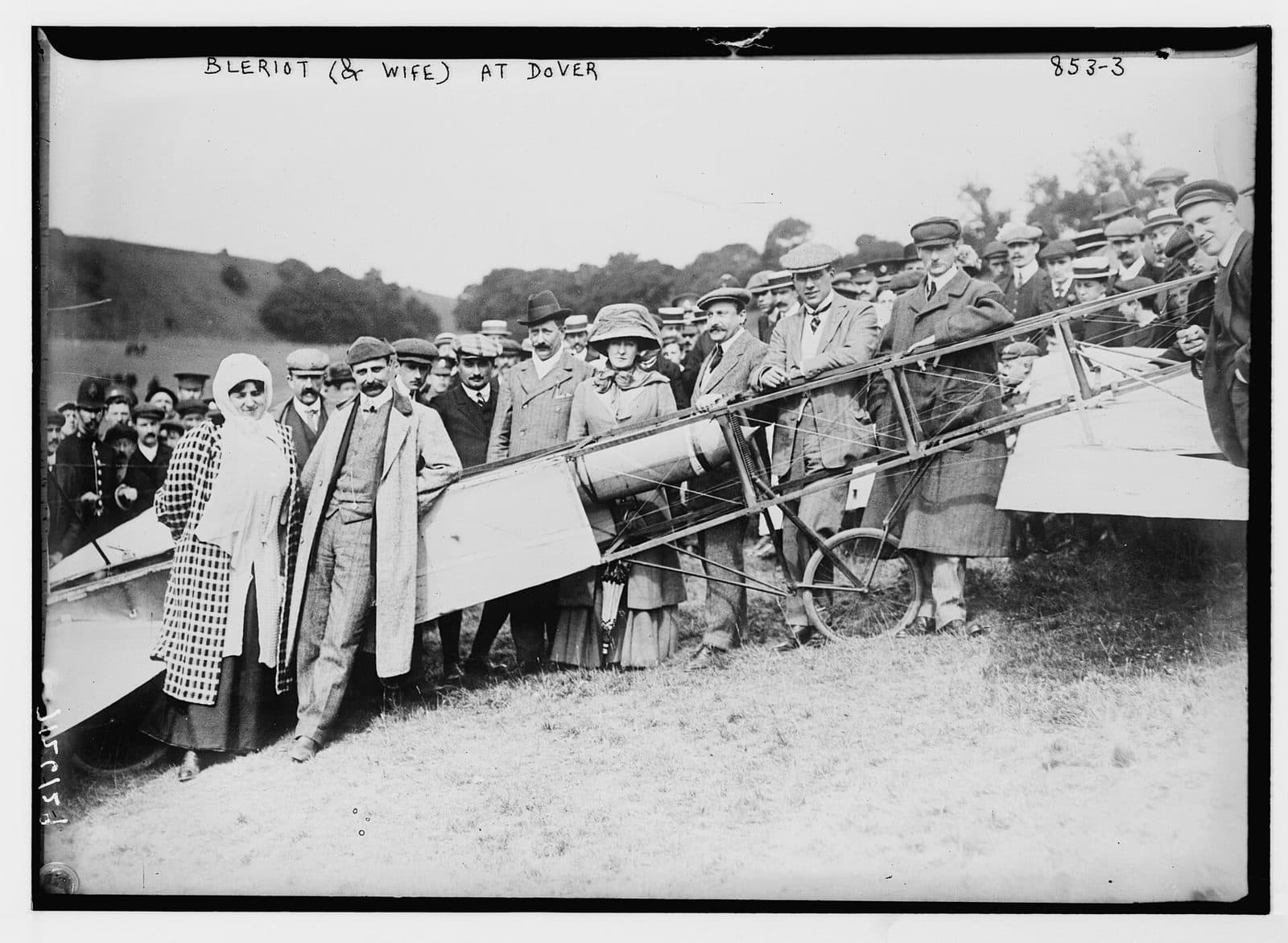
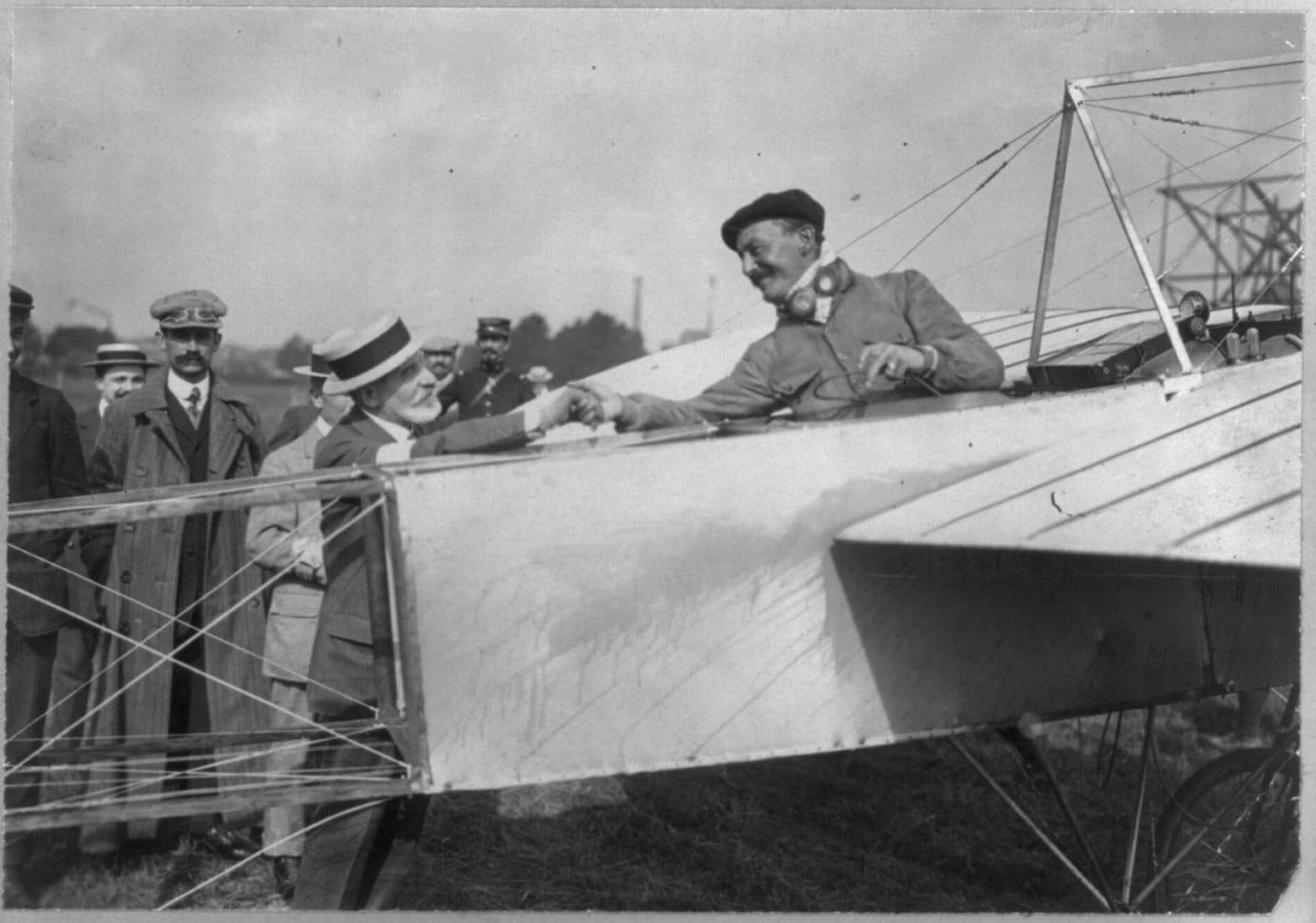
Louis and Alice Blériot with a crowd posing in front of the aeroplane on the field at Dover.1909 · Bain News Service / Library of Congress · Public domain July 25, 1909Calais to Dover
Blériot crosses and wins
July 27, 1909
Latham ditches again, within sight of Dover
Injured in the face; Antoinette declines to fund a third try.
October 13, 1909Paris
The aircraft enters the Arts et Métiers collection
Sunday morning, 25 July 1909
Local times as the sources record them. They differ by several minutes at each end, and the take-off at 4:41 is the one most agree on.
2:00 AM
Leblanc judges the weather right and wakes Blériot
3:30 AM
Alice Blériot boards the escort destroyer Escopette
The Blériot XI on the grass at Les Baraques, men bent over its engine and a cyclist watching, as the motor is started for the cross-Channel flight.25 July 1909 · George Grantham Bain Collection / Library of Congress · Public domain 4:15 AM
Short trial flight over the field
4:41 AM
Take-off at sunrise from Les Baraques
Dover Museum gives 4:35. He heads out over the sea at about 39 kt and 250 ft, following the Escopette.
A tiny monoplane high over open water, the rail of a ship at the edge of the frame, catalogued as Blériot in mid-Channel.25 July 1909 · Bain News Service / Library of Congress · Public domain July 25, 1909
Mid-Channel, out of sight of land
Having overtaken the destroyer, he flies for more than ten minutes with nothing in sight; the wind carries him east.
July 25, 1909
The English coast, near St Margaret's Bay
He turns south-west along the cliffs towards Dover, looking for Fontaine's flag.
Blériot standing among policemen and spectators beside his damaged monoplane on the meadow at Dover.25 July 1909 · Worlds Grafic Press, published in Illustreret Tidende · Public domain c. 5:12 AMDover
Heavy landing on Northfall Meadow
Engine cut at about 66 ft; undercarriage and a propeller blade broken. The RAF Museum gives 5:12, the Musée des Arts et Métiers 5:13.
- In the air
- 32 to 37 min
- Across the strait
- ≈ 21 nm
Who was there
- Louis Blériot1872 to 1936
- Pilot and designerEngineer from the École Centrale who made his fortune in car headlamps and spent it on aeroplanes. Thirty-seven at the time of the crossing.
- Alice Blériot
- His wife; watched from the escorting destroyerBorn Alice Védères. Decades later she presented the Blériot Trophy, in 1961.
- Alfred Leblanc1869 to 1921
- Friend and organiser of the attemptBalloonist who ran the logistics at Calais, woke Blériot at two in the morning and later became one of the firm's chief pilots and instructors.
- Hubert Latham1883 to 1912
- Rival; ditched twiceAntoinette's chief pilot and the favourite on both sides of the Channel. His engine failure on 19 July made the first landing of an aeroplane on the sea.
- Charles de Lambert1865 to 1944
- Rival, camped at WissantWilbur Wright's first pupil in France. Brought two Wright biplanes to the coast and damaged them in practice.
- Léon Levavasseur1863 to 1922
- Latham's designer and engine builder
- Alessandro Anzani1877 to 1956
- Builder of the engineItalian motorcycle racer turned engine maker.
- Lucien Chauvière1876 to 1966
- Maker of the propeller
- Raymond Saulnier
- Engineer who largely drew the Type XI
- Ferdinand Collin
- Blériot's mechanicSuggested the approach to Anzani when the REP engine kept failing.
- Charles Fontaine
- Le Matin correspondent who chose the landing ground and waved him in
- Alexander Duckham
- Witness of the landing; paid for the memorial
- Lord Northcliffe1865 to 1922
- Proprietor of the Daily Mail, which offered the prize
Competing claims
The monoplane tipped on the slope of Northfall Meadow with a French tricolour planted beside it, police and visitors around.1909 · Bain News Service / Library of Congress · Public domain Louis Blériot
Accepted25 July 1909Calais to Dover
The claim
The first crossing of the English Channel by aeroplane.
The evidence
Observed departure at Les Baraques, the escorting destroyer, photographs of the aircraft on Northfall Meadow the same morning, and the Daily Mail's award of its prize. The aircraft itself has been in the Musée des Arts et Métiers since October 1909.
The usual figure: 36 minutes 30 seconds
Disputed25 July 1909
The claim
The crossing took exactly 36 minutes 30 seconds.
The evidence
Widely printed, but the institutions closest to the event disagree: Dover Museum gives 37 minutes from 4:35, the Musée des Arts et Métiers 4:41 to 5:13 (32 minutes), the RAF Museum 4:41 to 5:12. That the flight lasted a little over half an hour is secure; the precise figure is not.
Lord Northcliffe (attributed)
Partly acceptedJuly 1909
The claim
On hearing of the flight, Northcliffe declared that England was no longer an island.
The evidence
The phrase was a stock expression from the 1840s, and no primary source has been found for Northcliffe saying it; the attribution appears only much later. Contemporary versions are documented: H. G. Wells in the Daily Mail of 27 July 1909, and a Daily Express piece titled "No Longer an Island" reprinted in the same issue.
The statue of Hubert Latham on a stone plinth on the clifftop grassland near Sangatte, the Channel behind.8 August 2019 · Mechtraveller · CC BY-SA 4.0 Hubert Latham's supporters
Rejected19 to 27 July 1909Sangatte
The claim
Latham, not Blériot, should have been first across: his team slept through the calm of 25 July, and his engine, not his flying, failed him.
The evidence
True that Levavasseur's team missed the break in the weather and that by the time the Antoinette was ready the wind had risen. But the Antoinette's engine failed on both attempts, on 19 and 27 July, and it never reached England.
Related entries
- Aéroplane Blériot XI, Musée des Arts et Métiers
- L'avion de l'exploit. 1909, Louis Blériot traverse la Manche, Musée des Arts et Métiers
- Louis Blériot Landing in Dover, Dover Museum
- Louis Blériot and the first Channel crossing, RAF Museum
- No longer an island? — I, Airminded (Brett Holman)
- No longer an island? — IV, Airminded (Brett Holman)
- Louis Blériot, Wikipedia
- Blériot XI, Wikipedia
- Hubert Latham, Wikipedia
- Charles de Lambert, Wikipedia
Checked September 12, 2026