Airline
KLM
KL · KLM · KLMNetherlandsAir France-KLM
Koninklijke Luchtvaart Maatschappij N.V.
Identity
- IATA
- KL
- ICAO
- KLM
- Callsign
- KLM
- Founded
- October 7, 1919
- First service
- May 17, 1920
Company
- Legal name
- Koninklijke Luchtvaart Maatschappij N.V.
- Headquarters
- Amstelveen, Netherlands
- Country
- Netherlands
- Parent
- Air France-KLM
- Status
- Operating
Network
- Alliance
- SkyTeam
Hubs and bases
Amsterdam Airport SchipholAMS
Hub
KLM is the oldest airline in the world still flying under the name it was given, and it has been flying under it for more than a century. The Dutch have a word for how unusual that is in an industry where carriers are founded, merged, renamed and liquidated with some regularity: they do not, but the fact speaks for itself. Companies older than KLM have existed; airlines older than KLM have existed; an airline that has carried the same name continuously since 1919 is a category with one member.
The full name is Koninklijke Luchtvaart Maatschappij, Royal Dutch Airlines, and the first word was granted before the company existed. It flies from Amsterdam Airport Schiphol, belongs to the SkyTeam alliance, and since 2004 has been one of the two airlines inside the Air France-KLM group, a structure in which the holding company owns both carriers while each keeps its name, its nationality and its hub.
The shape of KLM's business is the same one Singapore and the Gulf carriers would later make famous, arrived at several decades earlier and for the same reason. The Netherlands is a small country. There was never enough domestic traffic to fill aeroplanes, so the airline built a hub and sold connections through it: a passenger from Manchester to Nairobi who changes at Schiphol is the business, and always has been.
What distinguishes KLM from the airlines that copied the model is how long it has been doing it, and what it was connecting to. For the first two decades the hub existed largely to reach one place, and that place was on the other side of the world.
Formation
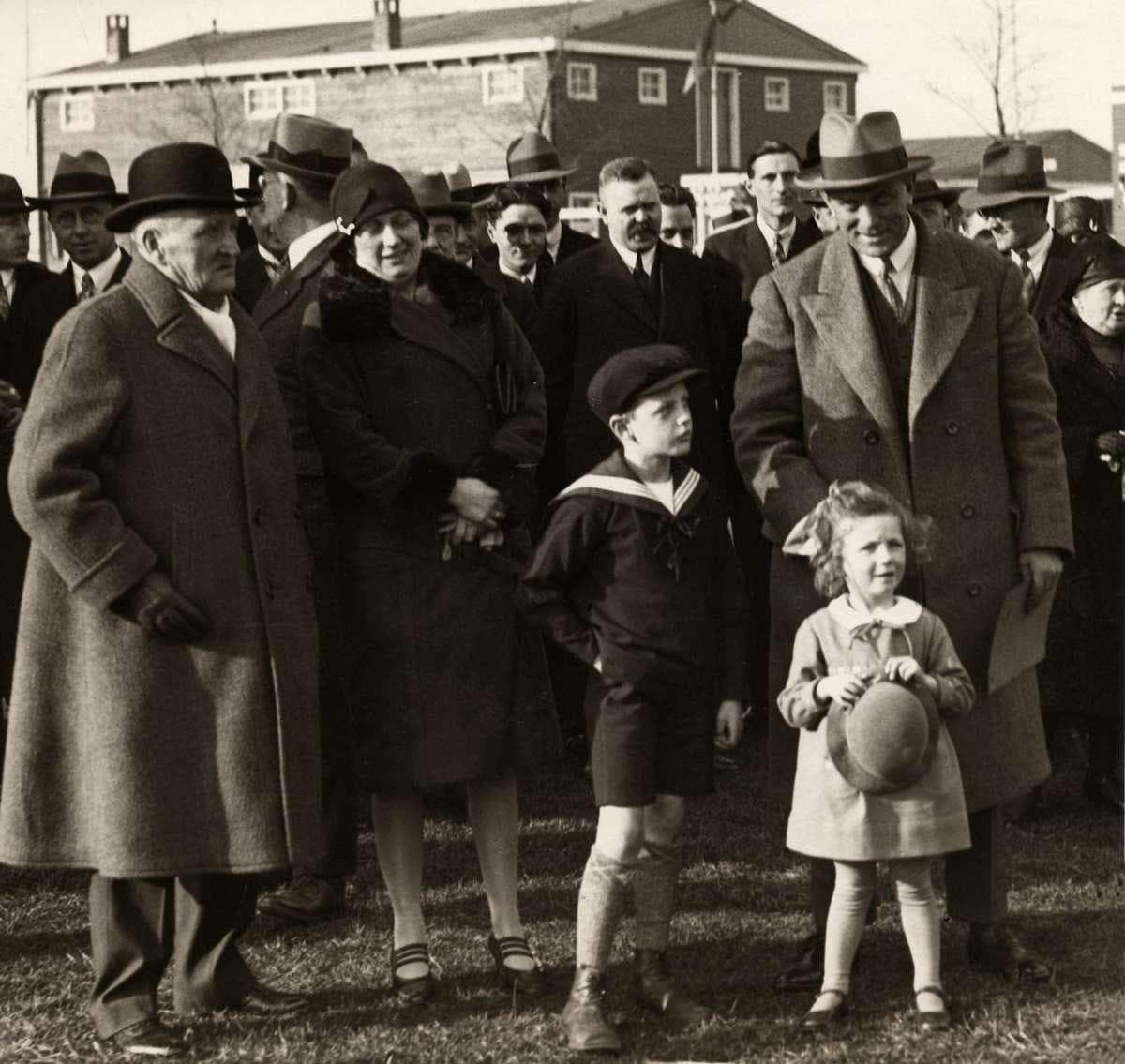
On 7 October 1919 Queen Wilhelmina granted the royal predicate, Koninklijke, to a company that had not yet been founded. The airline took its name that day: Koninklijke Luchtvaart Maatschappij voor Nederland en Koloniën, the Royal Dutch Airlines for the Netherlands and Colonies, a title that states the whole strategic intent in its final three words.
The man behind it was Albert Plesman, a Dutch army aviator who had organised an aviation exhibition in Amsterdam the previous year and used the attention it generated to assemble backing from Dutch business. He became the company's first administrator and director, and ran it for more than thirty years. Airlines founded by enthusiasts tend not to survive their founders' enthusiasm; KLM is among the exceptions, and Plesman's long tenure is part of why.
The first service left on 17 May 1920, and it is worth noticing which way it went. The aeroplane flew from London, Croydon, to Amsterdam, carrying two British journalists and a bundle of newspapers. It was an Airco DH.16, registered G-EALU, and it was not KLM's: the aircraft and its pilot, Jerry Shaw, were leased from a British operator because the new airline did not yet have aeroplanes of its own.
An airline whose first flight used someone else's aircraft, flown by someone else's pilot, from someone else's country, is not an obviously promising start. What it demonstrates is the thing Plesman seems to have understood from the beginning: that the route and the connection mattered more than owning the machinery, and that an airline is a network before it is a fleet.
The Empire route
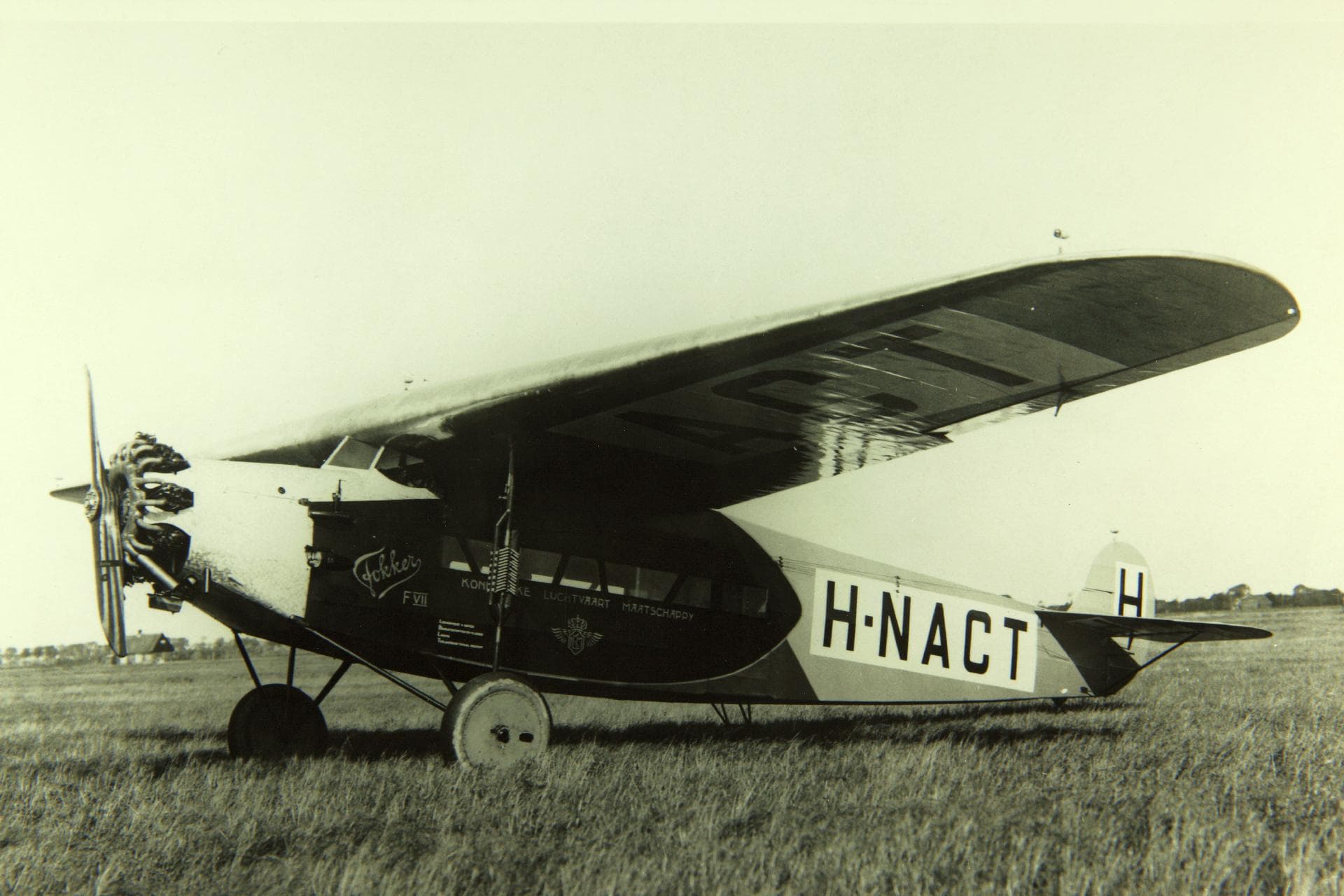
The three words at the end of the company's name, en Koloniën, pointed 11,000 kilometres east, to the Dutch East Indies. Getting there by sea took weeks. An airline that could do it in days would be doing something no amount of domestic traffic could match in importance, and KLM set out to do it almost immediately.
An experimental flight left Amsterdam for Batavia, now Jakarta, in October 1924, flown in a Fokker F.VII. It took 16 days. Regular scheduled services began in 1926, and the route became the longest regularly scheduled air service in the world, holding that distinction for more than a decade until war ended it in 1939.
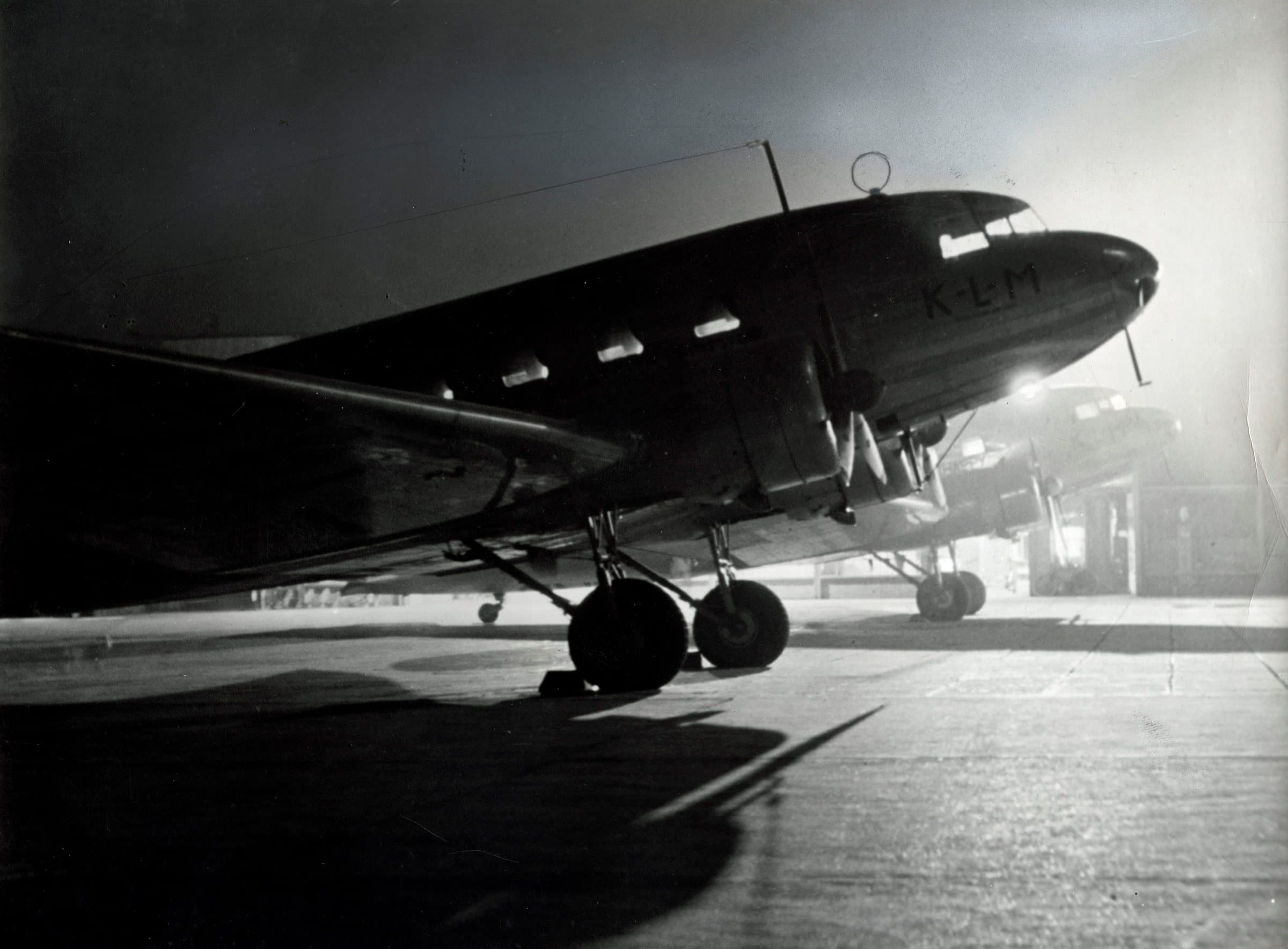
It is worth being clear about what this route was. It was a colonial artery, flown by a company named for the colonies it served, in an era when the Netherlands governed the archipelago it connected to. The aeroplane made the empire administrable in a way the steamship could not, and KLM's early identity is inseparable from that fact. An encyclopedia can admire the achievement, which was genuine and technically formidable, while recording plainly what the achievement was for.
Operationally it was extraordinary. A journey of that length in 1920s aircraft meant a chain of staging posts across Europe, the Middle East, India and Southeast Asia, every one of which needed fuel, maintenance, weather information and someone to meet the aeroplane. KLM built that chain, and the experience of running it is what turned a small European operator into an airline capable of thinking in intercontinental terms decades before most of its competitors needed to.
Growth and expansion
The war took almost everything. The Netherlands was occupied in May 1940, the Indies route was gone, and KLM's European network ceased. What survived did so outside Europe: a remnant of the airline continued flying in the Caribbean, and some aircraft and crews operated under British direction. The company that reassembled itself in 1945 had lost its fleet, its network and the colonial purpose written into its name.
The rebuilding was fast and pointed firmly west. Amsterdam to New York resumed, and KLM set about the North Atlantic with an intensity that reflected where the traffic and the dollars now were. The Indies route was restored but the empire it had served did not survive the decade: Indonesia became independent in 1949, and the three words at the end of the airline's full name became a historical curiosity rather than a description.
The most distinctive thing KLM did in these years was go north. Flying the polar route, over the Arctic rather than around it, cut thousands of kilometres from journeys between Europe and the Pacific, and KLM became a pioneer of it, eventually reaching Tokyo that way. It required navigation techniques that did not work near the magnetic pole, aircraft with the range to cross a region with nowhere to divert, and a willingness to operate where a diversion meant ice.
It was the same instinct that had sent a Fokker to Batavia in 1924. KLM's history is unusually consistent in this respect: faced with a long way round, the airline has repeatedly looked for a way through, and has generally been willing to be first.
The jet age
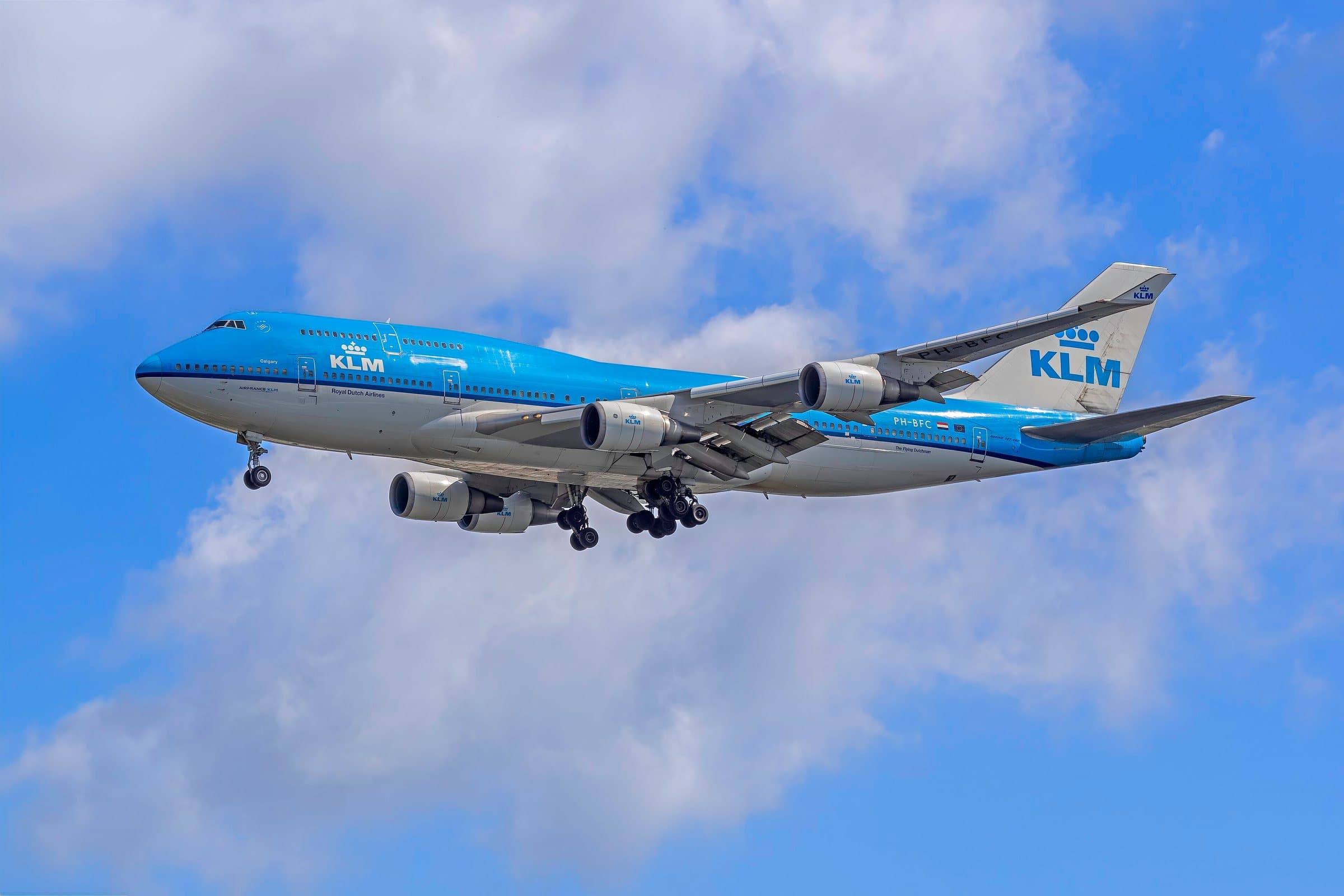
KLM came to jet and turbine equipment early. The Vickers Viscount 800, a turboprop, entered European service in 1957, and the Lockheed L-188 Electra followed. The Douglas DC-8 arrived by March 1960, putting pure jets on the long-haul routes and compressing the Atlantic in the way the piston aircraft never could.
The wide-body era brought the Boeing 747, which suited KLM's hub economics precisely: a large aircraft filling itself from a continent of connecting passengers funnelled through one airport. The McDonnell Douglas MD-11 followed, and KLM was among the last significant passenger operators of the type, keeping it in service long after most carriers had moved on.
That last detail is characteristic and worth drawing out, because it cuts against the pattern of a carrier like Singapore Airlines. KLM has generally not run a young fleet for its own sake. It has run aircraft that suit the network, kept them a long time, and accepted the maintenance cost that comes with age in exchange for capital that stays in the business. Neither approach is right in the abstract; they are answers to different questions. Singapore sells an experience and needs the aircraft to be new. KLM sells a connection, and a connection works the same in a fifteen-year-old aeroplane.
Today the mainline fleet is a mixture rather than a monoculture, with around ten passenger types in service, which is a consequence of the same philosophy: aircraft are chosen to fit particular jobs in the network rather than to simplify the fleet list.
Consolidation and merger
Air France and KLM agreed to merge in September 2003, and the combination completed the following year. What they built was not a conventional merger, and the structure is the interesting part.
Rather than one airline absorbing the other, a single listed holding company, Air France-KLM, was created to own both. Each airline kept its own name, its own national identity, its own hub and its own operating certificate. Schiphol did not become a spoke of Paris, and Amsterdam did not lose its flag carrier. That arrangement was novel in 2004, when cross-border airline mergers in Europe generally meant the smaller partner disappearing, and it has largely held.
The reason it had to be built that way is partly regulatory and partly political. Air traffic rights are granted between states to airlines those states substantially own or control, so an airline that stops being Dutch can lose the rights that make its network possible. Keeping KLM Dutch was not sentiment; it was a condition of the business continuing to exist. The sentiment existed too, and in the Netherlands it has never entirely gone away.
The group that resulted is one of the largest airline groups in the world, with Air France, KLM and the low-cost operator Transavia between them flying a combined fleet in the high hundreds. Within it, KLM remains the smaller of the two network carriers, and the relationship between Paris and Amsterdam has been intermittently difficult in ways that periodically reach the Dutch and French governments.
Network and hubs
Everything KLM does happens at Schiphol. The airport sits below sea level on reclaimed land, it has been developed in concert with the airline for decades, and its design reflects what the airline needs: a single large terminal complex in which a connecting passenger can move between almost any two flights without leaving the building.
The network reaches 164 destinations, split between a dense European operation and a long-haul network reaching the Americas, Africa, the Middle East and Asia. The European routes are not an end in themselves. They are the feed: a flight from Birmingham or Bologna to Amsterdam exists in large part to fill the aircraft going to Nairobi or Shanghai, and the airline's economics depend on the two halves fitting together.
This is why the regional operation matters more than its aircraft size suggests. KLM Cityhopper flies the short routes that keep the long ones viable, and in a hub system the thin regional sector that looks unprofitable on its own may be the reason a wide-body leaves full.
The arrangement has a vulnerability that has become more visible over time. A hub concentrated at a single airport in a small, densely populated country is constrained by that country's tolerance for aircraft noise and emissions, and Schiphol's capacity has been the subject of sustained Dutch political argument. An airline whose entire model depends on one airport is exposed to decisions about that airport in a way a carrier with several hubs is not.
Fleet
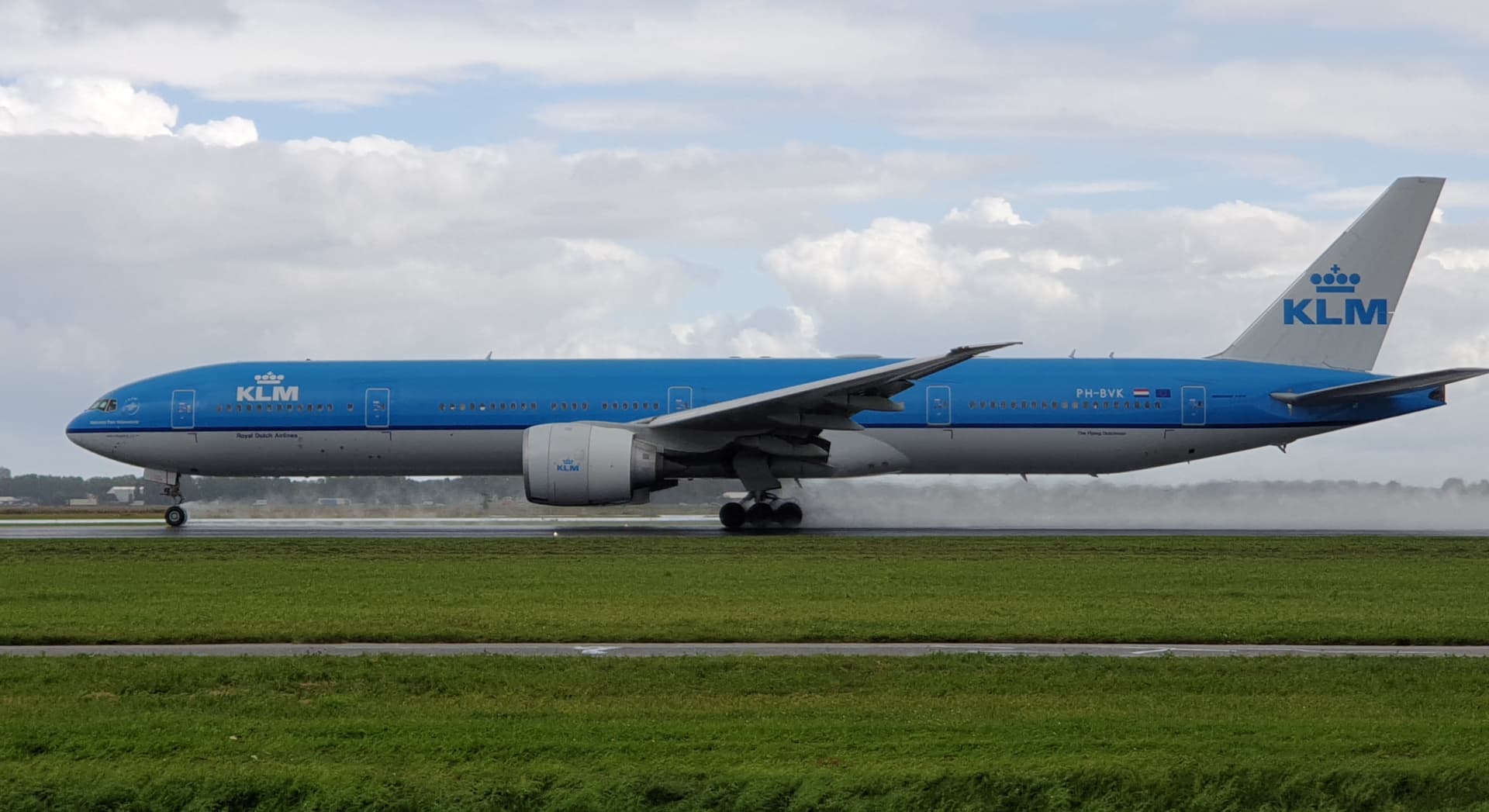
KLM's mainline fleet numbers around 111 aircraft operating roughly ten passenger types, a figure that should be read as a position in time rather than a permanent fact, since fleets change continuously.
Ten types for a hundred-odd aircraft is a lot of variety, and it is the opposite of the concentration a carrier like Singapore Airlines pursues. The reason is the hub. A network that feeds long-haul departures from across Europe needs aircraft sized for routes carrying forty passengers and routes carrying three hundred, and the saving from standardising on fewer types has to be weighed against the cost of flying the wrong size of aeroplane on a thin route. KLM has consistently chosen to match the aircraft to the job.
Within the Air France-KLM group the fleets are managed together to a degree, and the group's combined operation runs to several hundred aircraft across Air France, KLM and Transavia. The group buys in larger quantities than either airline could alone, which is one of the real economic benefits of the 2004 structure and among the clearer arguments that the merger did what it was meant to.
The fleet's historical pattern is worth restating: KLM tends to acquire aircraft and keep them. It was among the last major operators of the MD-11 in passenger service, and its aircraft have generally stayed in the fleet long enough to be thoroughly depreciated. That is a legitimate strategy with an identifiable cost, which is that passengers notice cabin age before they notice balance sheets.
Livery and identity
KLM's visual identity is one of the most stable in the industry, and the reason is the first word of its name. The royal predicate granted by Queen Wilhelmina in 1919 is not decoration: it is a standing permission, held continuously for more than a century, and an airline does not lightly redesign around something a monarch gave it.
The result is a brand that has changed by increments where most carriers have changed by revolution. The blue is the constant, applied with a consistency that makes a KLM aircraft identifiable at a distance and across generations of livery, and the crown remains in the mark.
The deeper identity is harder to put on an aeroplane and more interesting. KLM has spent a century being the national airline of a country that is not big enough to need one, and which has nonetheless decided repeatedly that it wants one. That tension runs through the airline's whole existence: it was founded to reach colonies the Netherlands no longer has, merged with a French company while insisting on remaining Dutch, and operates a hub whose expansion the Dutch public has not straightforwardly supported.
Being the oldest airline still flying under its own name is the fact most often quoted about KLM, and it is a genuine distinction. But it describes continuity of name rather than continuity of purpose. The company that flew to Batavia for a colonial administration and the company that connects Manchester to Nairobi through Schiphol share a name, a crown and a colour. What they do, and who they do it for, has changed entirely.
Safety record
On 27 March 1977 a KLM Boeing 747, registration PH-BUF, operating flight 4805, collided on the runway at Los Rodeos airport on Tenerife with a Pan American Boeing 747, N736, operating flight 1736. All 248 people aboard the KLM aircraft and 335 of those aboard the Pan Am aircraft were killed: 583 deaths, and it remains the deadliest accident in the history of aviation.
Neither aircraft should have been at Tenerife. A bomb had exploded at Las Palmas that afternoon and the airport was closed on warnings of a second, so flights were diverted to Los Rodeos, a smaller airport which filled with aircraft it was not built to hold. Fog came down. The taxiways were blocked by parked aeroplanes, so departing aircraft had to taxi along the runway itself and turn at the end.
The Spanish Secretary of Civil Aviation published its report in October 1978. Its conclusion is unusually direct, and worth quoting as it was written. The fundamental cause was that the KLM captain:
Took off without clearance; did not obey the "stand by for take-off" from the tower; did not interrupt take-off when Pan Am reported that they were still on the runway; and, in reply to the flight engineer's query as to whether the Pan Am airplane had already left the runway, replied emphatically in the affirmative.
The report then asks the question that gives the accident its lasting importance: how a captain of that technical capacity and experience, whose state of mind during the stopover had seemed perfectly normal, could commit a basic error despite repeated warnings. It answers with a series of contributing factors, beginning with accumulating tension as problems mounted.
That question, how a competent and experienced crew can go wrong together, is the one the industry took away from Tenerife. The accident is the single most important reason that cockpit culture changed: that a first officer or flight engineer who doubts the captain is now trained and expected to say so, and that the captain is trained to hear it. Crew resource management as a discipline grew out of this runway, in fog, in 1977.
Legacy
KLM's claim on aviation history rests on two things that have nothing to do with each other.
The first is simple endurance. An airline that has operated under the same name since 1919 has outlasted the colonial empire it was founded to serve, a world war that destroyed its network, the end of the piston era, the arrival of the jet, deregulation, the collapse of most of its contemporaries, and a cross-border merger that elsewhere would have meant the end of the junior partner. Longevity is not in itself an achievement, but a century of continuous operation in this industry is a demonstration that something about the model works.
The second is the hub. KLM showed, decades before anyone built an airline on the principle deliberately, that a small country can support a large international carrier if the airline sells connections rather than seats to and from its own population. Every subsequent carrier built on that logic, in the Gulf and in Southeast Asia, is working a model KLM arrived at out of necessity in the 1920s because the Netherlands was too small and the Indies too far.
The airline enters its second century with the structural question it has always had, now sharper. Its single hub sits in a country debating how much aviation it wants. Its parent group contains a larger French airline with its own hub and its own government watching. And the connecting traffic it depends on is precisely what Gulf and Turkish carriers have spent twenty years taking.
What KLM has that they do not is a hundred years of evidence that it can survive losing the thing it was built for. It did that in 1949, when the colonies went, and it is still flying.
Genealogy
KLM's line: founded in 1919 and still flying under its original name, it has belonged since 2004 to the Air France-KLM holding company, alongside Air France.
Scroll to see the full diagram
Timeline
September 1919
Queen Wilhelmina grants the "Royal" title to the airline yet to be founded
October 7, 1919
KLM is founded
May 17, 1920
The first KLM flight
October 1, 1924
The first experimental intercontinental flight, to the Dutch East Indies
September 1929
Scheduled Amsterdam to Batavia services begin
1934
The DC-2 "Uiver" places second in the MacRobertson Air Race
May 21, 1946
First continental European airline with scheduled flights to New York
1977
The Tenerife disaster
July 1989
KLM buys 20 per cent of Northwest Airlines
2004
Merger with Air France under the Air France-KLM holding company
In the catalogue
Aircraft central to this airline's story, as the encyclopedia records them.
Related airlines

- Secretary of Aviation Report on Tenerife Crash: KLM B-747 PH-BUF and Pan Am B-747 N736, 27 March 1977 (report dated October 1978; ICAO Circular 153-AN/56), Secretary of Civil Aviation, Spain
- The History Behind the World’s Oldest Airline, AirlineGeeks
- 6 Major Milestones That Have Defined The Life & Times Of KLM, Simple Flying
- KLM, Wikipedia
Checked October 6, 2026