History
The First Jet Airliner Service
May 2, 1952, 3:12 PM – May 3, 1952
LondonUnited Kingdom
JohannesburgSouth Africa
36
Passengers
23 h 38 min
Time from London
5
Intermediate stops
The service
- Date
- 2 May 1952
- Departure
- 15:12 GMT, London Airport
- Arrival
- 3.38 p.m., Palmietfontein
- Elapsed
- 23 h 38 min
- Flying time
- About 18 h 40 min
- Stops
- Five, Rome to Livingstone
- Fare
- £175 single, £315 return
The aircraft
- Registration
- G-ALYP
- Known as
- Yoke Peter
- Type
- de Havilland Comet 1
- Operator
- BOAC
- Delivered
- April 1952
- First civil jet C of A
- G-ALYS, 22 January 1952
The first year
- Revenue hours
- 9,443
- Passengers carried
- Over 28,000
- Load factor
- 89%
- Routes added
- Colombo, Singapore, Tokyo
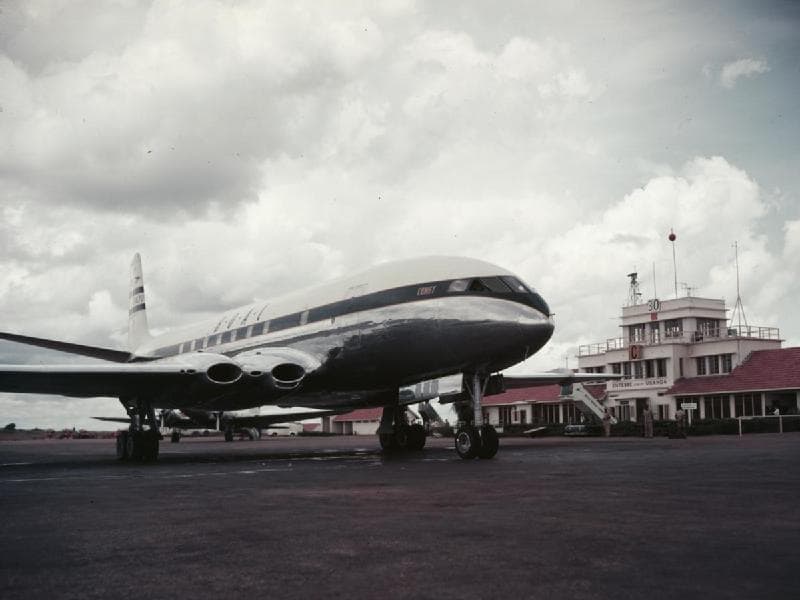
On 2 May 1952 the BOAC de Havilland Comet 1 G-ALYP left London Airport for Johannesburg with fare-paying passengers aboard, the world's first scheduled jet airliner passenger service. It arrived to a crowd of thousands, having cut more than five hours off the fastest piston time, and for a little over a year BOAC held a commercial lead no other airline could touch.
At 15:12 GMT on Friday 2 May 1952, a de Havilland Comet 1 registered G-ALYP lifted off from London Airport and turned south for Rome. Aboard were thirty-six passengers who had bought tickets, a crew under Captain A. M. Majendie, and thirty bags of mail. Nothing about the departure was technically novel: the Comet had been flying for nearly three years, and BOAC had been running the route with freight for four months, but the combination was. This was the first time anywhere that a jet-powered aircraft had flown a scheduled passenger service for money.
The destination was Johannesburg, 5,843 nm away down the old Empire trunk route, with five intermediate stops at Rome, Beirut, Khartoum, Entebbe and Livingstone. The Comet made it in 23 hours 38 minutes, of which about 18 hours 40 minutes was spent in the air. The Handley Page Hermes that had been flying the same route averaged 28 hours 55 minutes. The saving was not marginal; it was most of a working day.
What happened at the other end mattered as much as what happened in the air. Between five and ten thousand people went out to Palmietfontein aerodrome to watch the landing, jamming the 12 nm road from Johannesburg bumper to bumper at about 8.7 kt, and most of them saw nothing more than the aircraft circling overhead. Airport staff were overwhelmed. The captain who brought the aeroplane in, R. C. Alabaster, had spent the last stage deliberately wasting time so as not to arrive before the reception was ready.
The claim attached to the day has to be stated carefully, because it is often stretched. This was the first scheduled passenger service by a *jet* airliner. It was not the first by a turbine-powered one: a Vickers Viscount had flown fare-paying passengers from Northolt to Le Bourget on 29 July 1950 behind four turboprops. And the lead the Comet won lasted a little over a year before the aircraft that flew this service was lost off Elba, and the Comet 1 was withdrawn. None of that undoes 2 May 1952. It was the day the jet stopped being a demonstration and became a ticket you could buy.
Background
BOAC was not an ordinary customer. Created in 1939 by merging Imperial Airways with the original British Airways, it was a public corporation charged with flying between Britain and the non-European world: the flag carrier, in the era when that phrase carried obligations as well as prestige. Its network was the imperial trunk route system: long, multi-stop, and flown by piston aircraft that took a day and a half to reach southern Africa.
The Comet reached BOAC through the Brabazon Committee, the Cabinet body formed in March 1943 to decide what airliners Britain should build after the war. Its Type IV specification (a pressurised, fast, jet-powered aircraft) went to de Havilland, and BOAC found the idea attractive enough to keep revising how many it wanted. In 1946 to 47 the airline wanted eight and its associate British South American Airways wanted six; when the two merged the projected order became fourteen; when the DH.106's specification finally settled as a thirty-six-seater, the firm order was for ten.
That pattern of revision says something honest about the aircraft. Nobody knew what a jet airliner would be worth, because none had existed. The order was a national bet placed by a state airline on a national manufacturer, using money the country did not really have, in a decade when buying American aeroplanes meant spending dollars the Treasury was hoarding.
The man who had to make the bet pay was Sir Miles Thomas, who succeeded Sir Harold Hartley as chairman of BOAC in July 1949. He flew in the unpressurised prototype that November. The aircraft was limited to 25,000 ft and everyone aboard wore oxygen masks, which is not a promising introduction to a new airliner, and Thomas came away convinced anyway: he found it exhilarating and judged that it would give the corporation a commercial advantage nobody could match.
Johannesburg was a deliberate choice for the first route, and the reasoning is visible in the timetable. The Comet 1's range was short, so it could not attack the North Atlantic, where BOAC's most profitable and most competitive traffic lay. The southern African trunk route was long enough for the speed advantage to compound across five stages, was flown against piston competition rather than American jets, and ended in a Commonwealth capital where a British aeroplane arriving in record time would be read as exactly what BOAC wanted it read as.
Development

The aeroplane itself arrived in stages, and only the last of them belongs to this story; the design and the engineering are the subject of the Comet's own entry. What matters here is the sequence by which an experimental aircraft became something an airline could sell seats on.
The first prototype, G-ALVG, flew from Hatfield on 27 July 1949 with John Cunningham at the controls, a flight of thirty-one minutes, on Sir Geoffrey de Havilland's sixty-seventh birthday. A second prototype, G-ALZK, was completed in July 1950. That second machine is the one that touches BOAC directly: it was re-registered from its Class B marks and delivered in April 1951 to the airline's Comet Unit, where it flew some 500 hours of crew training and route proving before any production aircraft was handed over.
Certification came next, and it was a first in its own right. The first certificate of airworthiness ever issued to a civil jet transport was granted to Comet 1 G-ALYS on 22 January 1952. From that date BOAC was legally free to carry fare-paying passengers in a jet; that it waited another three months says more about the airline's caution than about the aircraft.
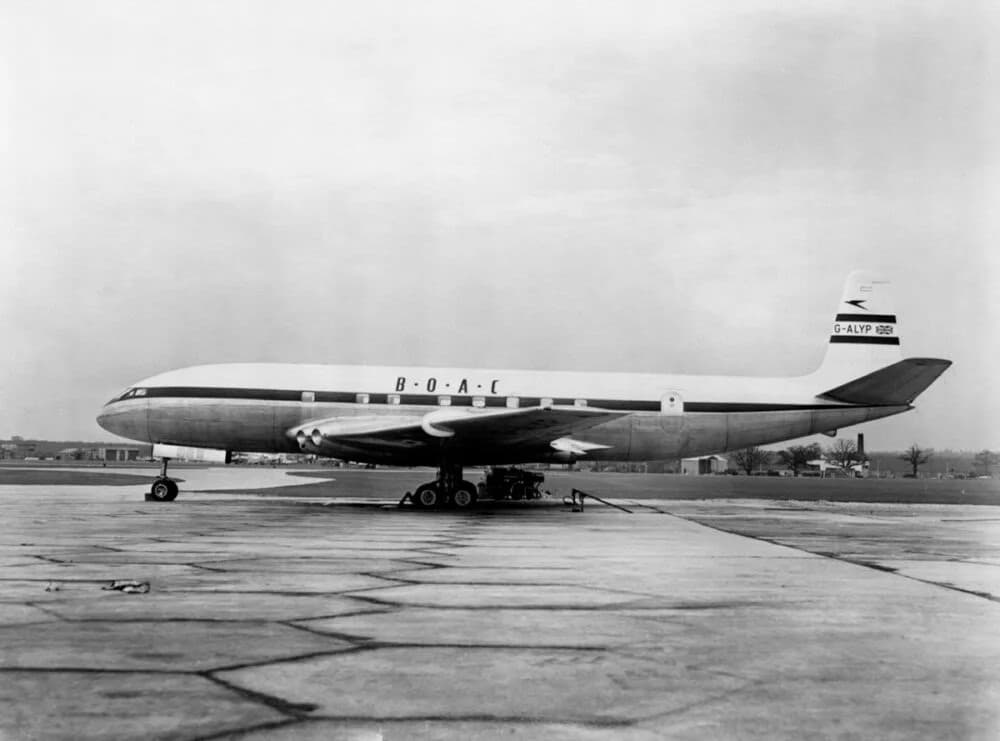
G-ALYP was delivered in April 1952, weeks before it opened the service, and the rest of the fleet followed at intervals through the summer, ending with G-ALYZ in September. The aeroplane that made the first jet airliner service was therefore almost brand new on the day: a production aircraft with a handful of hours on it, flying a route its crews had rehearsed for a year on a prototype.
What the timetable conceals is how long the commitment had run behind it. BOAC had backed the DH.106 years before there was an aeroplane to inspect, and the Comet Unit it built around the second prototype was an airline department created to operate a type that did not yet exist in production form. By the time G-ALYP was handed over in April 1952 the airline had a trained crew pool, a worked-out set of procedures and a year of route experience: all of it accumulated on an aircraft no fare-paying passenger had ever boarded. The first jet service was not a leap, then, but the last short step of a long and deliberately slow approach, which is the part the anniversary coverage usually leaves out in favour of the departure photograph.
The machine
Three properties of the machine decided what the service felt like, and all three follow from one decision: to cruise high. The Comet held about 40,000 ft, which put it above most of the weather rather than inside it, so the continuous jostling that defined piston-airliner travel largely disappeared. Its four turbojets were buried in the wing roots and produced none of the low-frequency drumming that propellers transmit through an airframe. And it flew fast enough that the time saved compounded over a long route rather than being eaten by the stops.
The same design also set the service's limits. The Comet 1's range is why Johannesburg took five intermediate landings instead of one or two; the aeroplane was fast but it could not reach far, and the Empire routes suited it precisely because they were already a sequence of hops. The de Havilland Ghost was not a frugal engine either, which made fuel planning the hardest part of operating the aircraft and, as BOAC's own crews pointed out during a pay dispute, arguably a more demanding job than flying a piston aircraft across the Atlantic.
A third consequence was navigational. A jet covers ground faster than the dead-reckoning practice of the day was built for, and BOAC's Comet Development Unit had to invent around the gap. Captain Majendie produced a method of converting indicated Mach number and outside air temperature into true airspeed, because there was no ready way to work it out. He also insisted on a navigation standard for the type: the aircraft had to arrive within a defined box around 100 miles out from its destination, from which radio aids could take over. The answer was distance measuring equipment and a reliable medium-frequency beacon: and the Unit's requirement is the reason DME appeared at the airfields along the route at all.
The cabin those decisions produced was small by later standards and generous by its own. The Comet 1 seated thirty-six to forty-four passengers four abreast, and held a cabin altitude of about 8,000 ft while the aircraft cruised at 40,000 ft, roughly the pressure airliners hold today. It cruised at about 413 kt over a range of about 1,520 nm, and that second figure is the arithmetic behind the five stops: fast enough to halve the journey, short-legged enough to need the ground at every stage of the old Empire route. Passengers experienced the first number and the airline planned around the second, which is a fair summary of the whole aeroplane.
Preparation
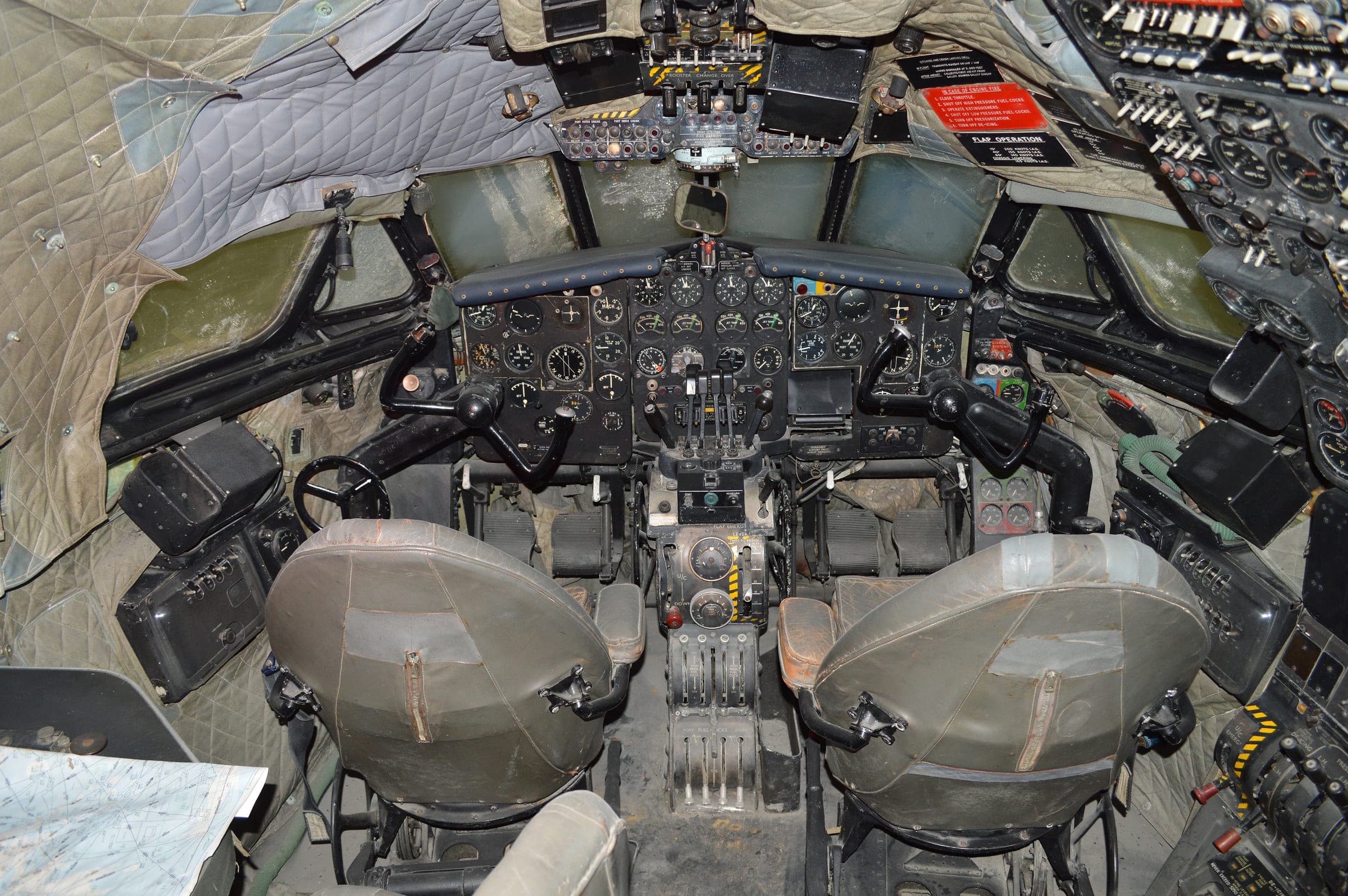
BOAC set up a Comet Unit at Hurn in September 1950 under Captain M. R. J. Alderson, nineteen months before the service opened. When the second prototype arrived there in April 1951 it became the airline's flying classroom and its route-proving aircraft at once, and the 500 hours it flew were split between teaching crews to operate a jet and finding out how a jet fitted into an air traffic system built for something slower. Training courses were initially centred on Hatfield, with proving flights run out from there; the airline later established its own Comet Development Unit at Heathrow.
The crews were not a hand-picked elite, whatever the newspapers implied. Selection was in many cases a matter of chance and timing. Ken Emmott, one of the original members of the training course, was a BOAC first officer flying Hythe, Plymouth, Sandringham and Solent flying boats out of Southampton Water; the corporation was phasing the flying boats out, and the Comet came along at the right moment for him and for two flying-boat captains. Another ten pilots came from British South American Airways, spare after the merger.
Learning to fly the thing was genuinely hard. Initially about thirty per cent of candidates failed or were rejected: a rate that says less about the pilots than about the instruction, since everyone involved was new to jet training and was writing the training manuals as the course went along. Once the techniques were revised the failure rate fell sharply.
Nor were jet crews universally admired inside BOAC. The corporation already had an elite of its own: the Stratocruiser crews who flew the North Atlantic, nicknamed the Atlantic Barons. When the Comet crews asked for and won a pay increase for operating jets, the Barons resisted it, on the argument that the Atlantic was the most demanding flying there was. The counter-argument, as Emmott put it, was that the Atlantic needed careful weather analysis but always offered somewhere to divert: whereas the Comet's fuel margins had to be calculated to a standard nobody had needed before.
The final rehearsal was the most convincing part. Before any passenger was carried, BOAC ran a series of freight flights to Johannesburg over the actual route, each one worked to the operating procedures that had been drawn up for the service. Comets had been filmed on route-proving flights across Africa through 1951 and 1952. By 2 May 1952 the airline had flown the route repeatedly, with the aeroplane, on the schedule, without anyone in the seats.
The event
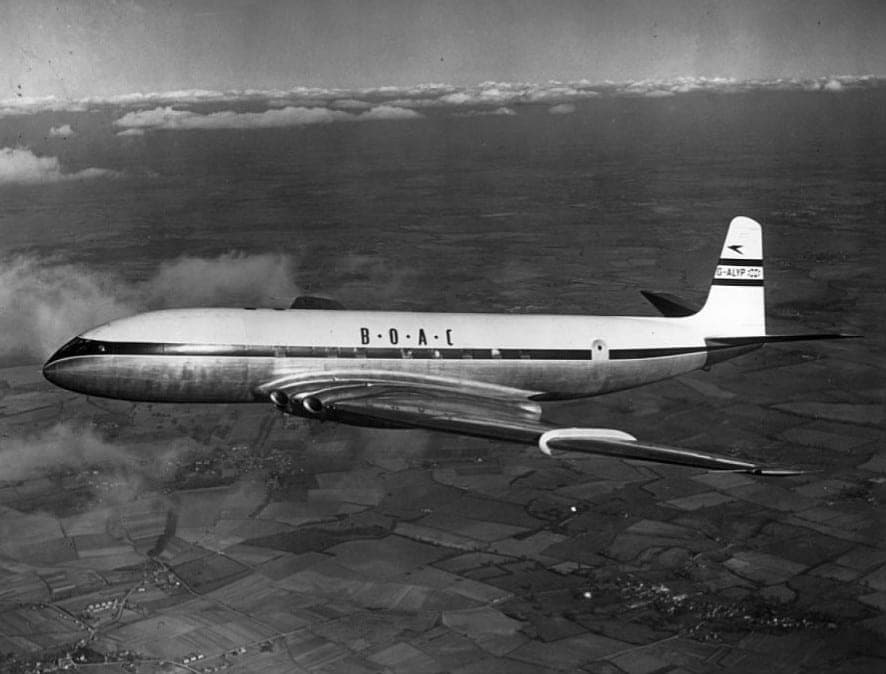
Captain A. M. Majendie, flight captain of the Comet fleet, lifted G-ALYP off London Airport's runway at 15:12 on 2 May 1952. The aircraft was carrying thirty-six passengers and, by most accounts, a crew of seven; the mail went in the hold. The first man to have booked a seat had done so sixteen months earlier, in January 1951: Albert Henshaw, father of Alex Henshaw, who had set a London to Cape flying record in 1939.
The flight was run in relays. Majendie commanded out of London; Captain J. T. A. Marsden took over at Beirut, with Ken Emmott in the left-hand seat beside him for the leg down to Khartoum; Captain R. C. Alabaster, DSO, DFC, took command at Khartoum and kept it to the end. The passenger list was a cross-section of the route's usual clientele and rather more: the chairman of Barclays Bank, a consulting chemist from the Anglo American Corporation, a Cape Town businessman, South Africa's Director of Civil Aviation, a London policewoman. One passenger, Averil Coleridge-Taylor, spent the flight composing a Comet prelude meant to give an impression of it, the first music written aboard a jetliner.
Between Rome and Beirut the aircraft was reported to have reached 456 kt, which was read at the time as a record and as a figure beating the Comet's own trial performances. Averaged over the whole journey, with five stops subtracted, the speed came out at about 210 kt; averaged over the flying time alone it was almost 430 kt. The gap between those two numbers is the whole argument about the Comet 1's range.
By Livingstone the aeroplane was half an hour ahead of schedule, and this became a problem of protocol rather than of airmanship. Sir Miles Thomas came aboard there for the final stage. The crew deliberately left Livingstone late, and then, as Alabaster explained afterwards, made wide sweeping turns between Livingstone and the Rand to use up time so as not to arrive before the reception party. "We realized we were getting a tremendous reception when we flew over Palmietfontein," he said. "The airport was black with people, and cars stretched along the road for at least a mile."
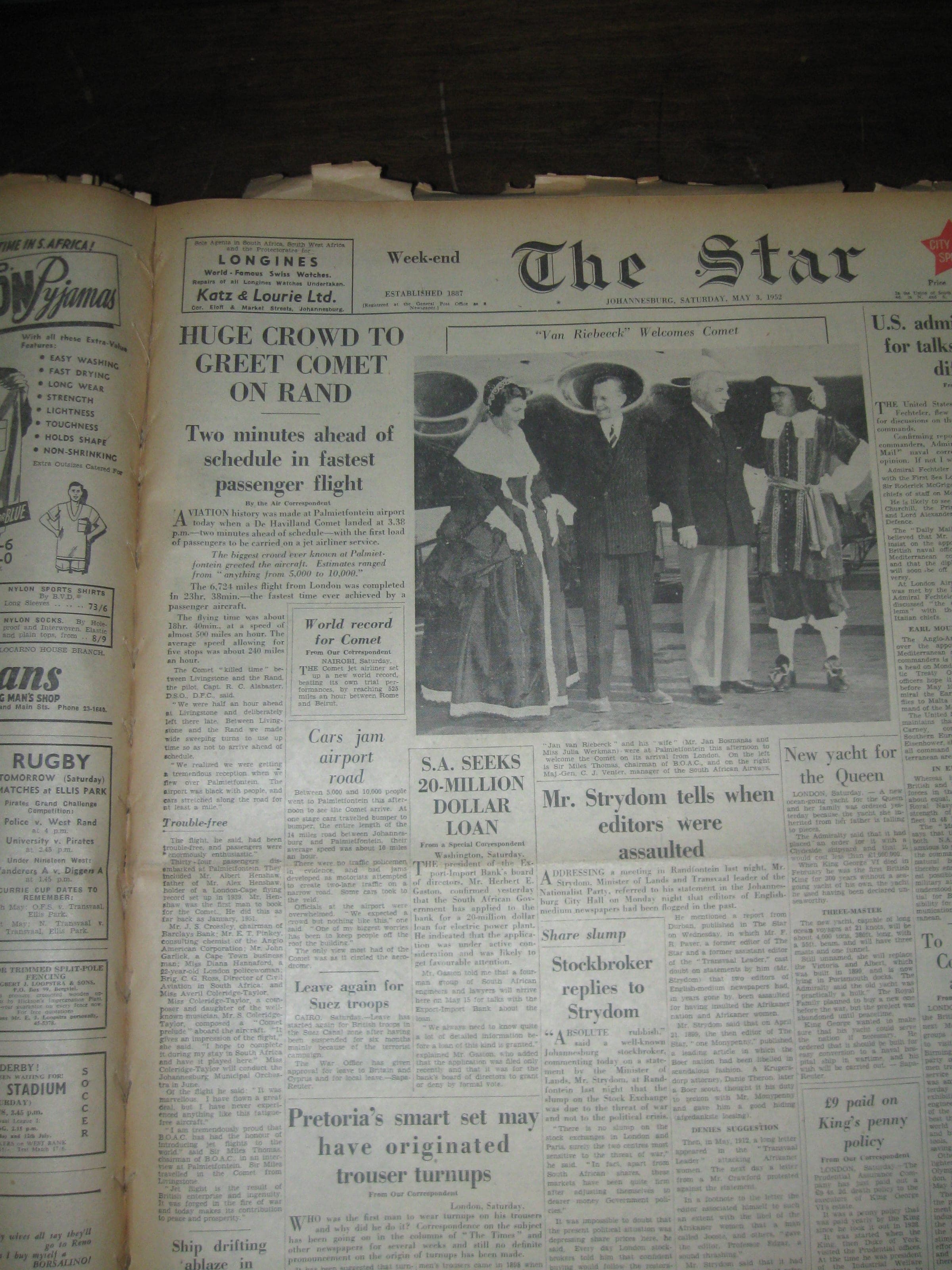
G-ALYP landed at Palmietfontein at 3.38 in the afternoon on 3 May, two minutes ahead of schedule, and thirty-four passengers disembarked into the largest crowd the aerodrome had ever held. Airport officials admitted they had expected a crowd but nothing like this; one said his biggest worry had been keeping people off the roof of the building. A man in a Jan van Riebeeck costume was on the apron to welcome the aircraft, standing beside Sir Miles Thomas and the manager of South African Airways. Alabaster told reporters the flight had been trouble-free and that the passengers were enormously enthusiastic; one of them said he had flown a great deal but had never experienced anything like this fatigue-free aircraft. Thomas, interviewed on the field, called jet flight the result of British enterprise and ingenuity, forged in the fire of war and now making its contribution to peace and prosperity.
Aftermath
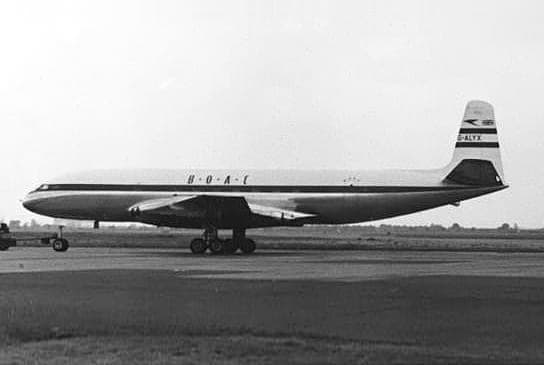
The route network expanded within months. Colombo opened in August 1952 at 21½ hours, Singapore in October at 25 hours, Tokyo in April 1953 at 33 hours. Across the network the Comet cut journey times by more than sixty per cent on average, and the public responded in the only way that matters to an airline: load factors rose to eighty-nine per cent. Over their first year BOAC's Comets accumulated 9,443 revenue hours. The number of passengers they carried in that year is given as over 28,000 by BOAC-derived accounts and as over 30,000 by the manufacturer's heritage record, which is a reasonable measure of how loosely such figures were kept.
The aircraft was also used politically, and used well. In June 1952 BOAC laid on a flight for Members of Parliament. In May 1953, after a request from the Palace, Sir Geoffrey and Lady de Havilland demonstrated the Comet to Queen Elizabeth the Queen Mother and Princess Margaret on a four-hour round trip over Europe: a journey only the Comet could have made in an afternoon. When the aircraft's troubles came, the goodwill those flights had built was not incidental.
The troubles began early and were, at first, comprehensible. On 26 October 1952 G-ALYZ failed to get airborne from Rome's Ciampino airport and was written off; two passengers were slightly hurt. On 3 March 1953 a Canadian Pacific Comet 1A failed to lift off at Karachi and burned, killing all eleven aboard. Both were understood as take-off accidents and answered by a modification to the wing leading edge, and the fix worked.
Then, on 2 May 1953, a year to the day after the inaugural service, BOAC Flight 783, G-ALYV, broke up in a severe thundersquall six minutes after leaving Calcutta, killing all forty-three on board. The Indian inquiry found structural failure through overstress in the storm. Nothing in that finding pointed at the pressure cabin, and nothing in the evidence available at the time suggested it should have.
The end came in 1954, and it took the aeroplane that had started everything. On 10 January, twenty minutes out of Rome, G-ALYP, the Comet that had opened the service twenty months earlier, broke up and fell into the sea off Elba with thirty-five aboard. The fleet was grounded, modified against every cause anyone could imagine, and returned to service on 23 March. Sixteen days later, on 8 April, a South African Airways Comet, G-ALYY, was lost off Naples. The Comet 1's certificate of airworthiness was withdrawn, and it never carried a fare-paying passenger again.
The evidence
For an event so often retold, the primary record of 2 May 1952 is thinner than it looks, and the best single document is a newspaper. The Star of Johannesburg carried the arrival on its front page the following afternoon under the headline "Huge crowd to greet Comet on Rand", with a by-the-hour account from its air correspondent, direct quotation from Captain Alabaster, a list of who got off the aeroplane, and a separate report on the traffic jam. Almost every colourful detail that survives about the day (the crowd estimate, the time-wasting turns, the man in Jan van Riebeeck costume) comes from that page.
The operational record sits in institutional hands. The Royal Air Force Museum holds photographs, log books and airline memorabilia from the Comet's career, together with archive film of Comets on their route-proving flights across Africa in 1951 and 1952. Accounts of BOAC's own preparation (the Comet Unit, the training failure rate, Majendie's navigation standard) come down largely through first-hand testimony from crew members such as Ken Emmott rather than through published corporate records.
Where the sources disagree, they disagree on small things, consistently. The passenger count is given as thirty-six by most accounts and as thirty-three by one detailed operational history; The Star, counting heads on the apron, says thirty-four disembarked, a figure that is compatible with either if anyone left or joined along the way. The crew is six in one account and seven in others. The margin on arrival is two minutes in The Star, three minutes at Livingstone in a BOAC-derived account, and fourteen minutes in another; the elapsed time is 23 hours 38 minutes in the contemporary report against a schedule variously given as 23 hours 40 minutes. The route length is 6,724 miles in the newspaper and "approximately 7,000" elsewhere.
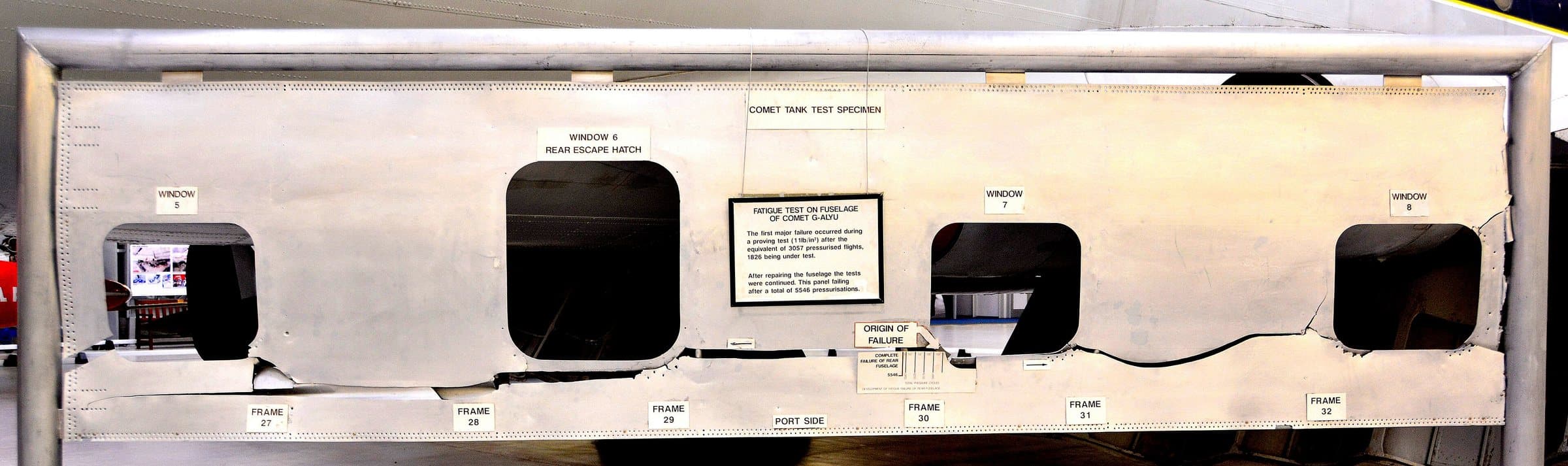
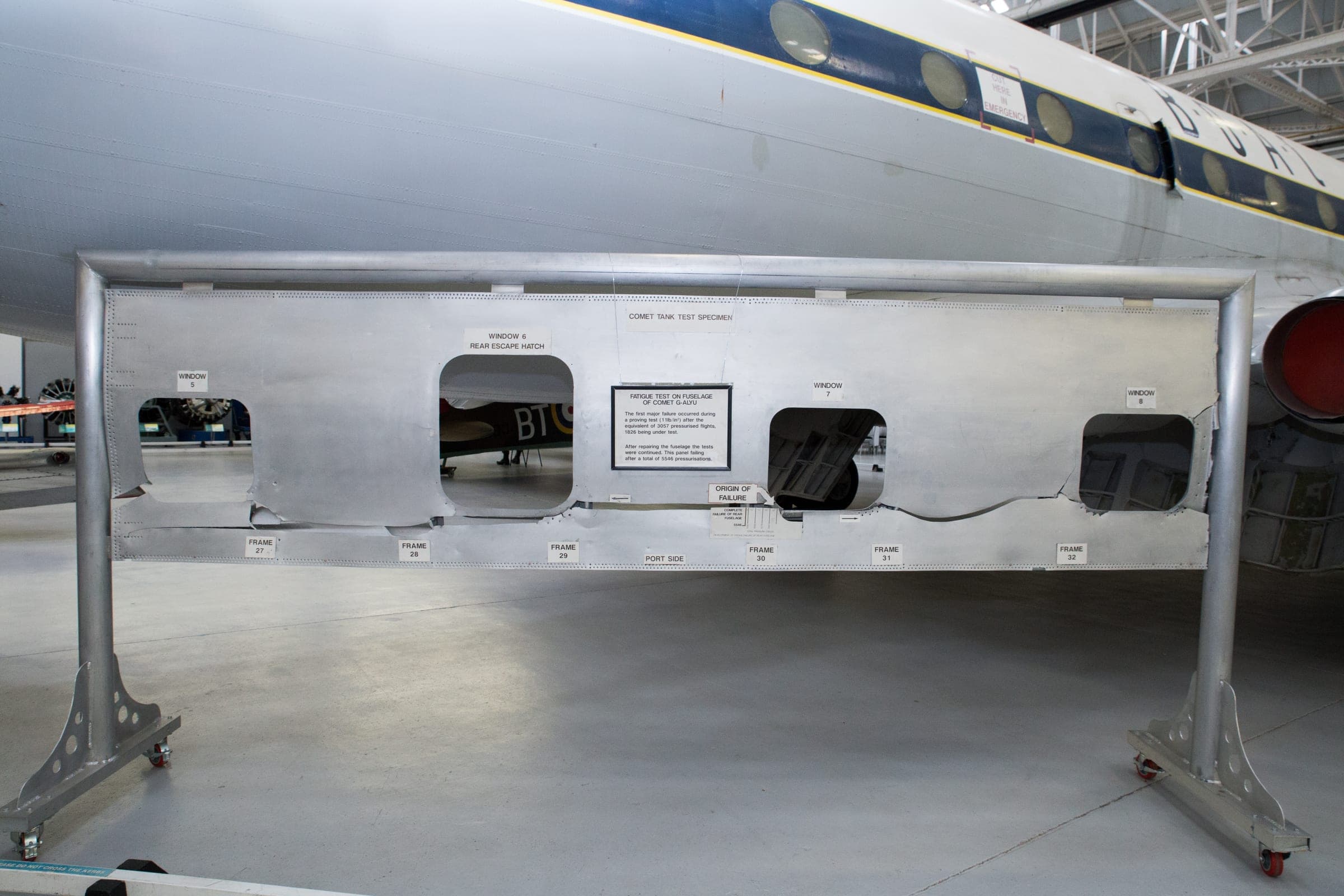
The later physical evidence is of a different order and is held at Cosford, where a section of Comet G-ALYU's fuselage survives from the Farnborough water-tank test, the airframe deliberately cycled to destruction after the 1954 losses, with its frames, its apertures and the origin of the failure labelled on the metal. It is the clearest surviving object from the inquiry that ended the Comet 1, and it belongs to the aftermath of this service rather than to the day itself.
Controversy
The superlative attached to this flight is correct but narrow, and it is routinely widened past what the record supports. The Comet opened the first scheduled passenger service by a jet airliner. It did not open the first by a turbine-powered airliner: on 29 July 1950, a Vickers Viscount flew a scheduled service from London Northolt to Paris Le Bourget with fare-paying passengers aboard, behind four Rolls-Royce Dart turboprops. That is the first scheduled flight by any turbine-powered aircraft, and it happened twenty-one months before the Comet's. Neither claim diminishes the other; they are different claims, and conflating them costs the Viscount a genuine first.
A second question is whether 2 May 1952 was a scheduled service at all, or the first of a series of proving flights that happened to have passengers on it. The distinction is real. BOAC had been flying the route to a timetable, to written operating procedures, for four months, carrying freight instead of people. What changed on 2 May was that the seats were sold. That is the correct line to draw, a service is scheduled when the public can buy a place on it, but it does mean the aeroplane was flying an itinerary it had already rehearsed rather than opening one.
The third argument is economic and was audible at the time. The Ghost was a thirsty engine, the Comet 1 was a thirty-six-seater, and the route needed five intermediate stops. Sceptics held that a jet could not carry enough fuel to be operated safely and profitably, particularly if it were ever forced to hold. The inaugural flight was cited as an answer to them, and the eighty-nine per cent load factors of the first year were a better one; but the Comet 1's economics were never properly tested, because the aircraft was withdrawn before a full commercial picture existed.
The last difficulty is hindsight. G-ALYP opened the jet age and then broke up off Elba twenty months later, and it is tempting to narrate 2 May 1952 as a day already shadowed. It was not. No fatigue problem was suspected in 1952, no regulation of the day required full-scale fatigue testing of a pressure cabin, and de Havilland's own structural testing had gone beyond what the rules demanded. The people on the apron at Palmietfontein were not celebrating something doomed; they were celebrating something that worked, and it did work, for a while, exactly as advertised.
The people
Captain A. M. Majendie is the figure the day is named after, and his contribution was larger than the four hours he spent commanding the first stage. As flight captain of the Comet fleet he ran the development work that made the route operable: the conversion of indicated Mach number and temperature into true airspeed, and the navigation standard that forced distance measuring equipment onto the airfields along the way. He signed the certificate each of the thirty-six passengers was given, which is why his signature turns up in collections of memorabilia far more often than his engineering does.
J. T. A. Marsden and R. C. Alabaster flew the other two-thirds of the journey and are much less remembered, which is a fair illustration of how first-flight credit distributes itself. Alabaster, a DSO and DFC from the war, made the landing, gave the interview that produced most of the surviving quotation, and had the awkward job of arriving on time in an aeroplane that was half an hour too fast.
Ken Emmott sat in the left-hand seat beside Marsden from Beirut to Khartoum and, decades later, supplied the account that makes the preparation legible: the flying-boat background, the chance nature of crew selection, the thirty per cent failure rate, the Atlantic Barons and their objection to jet pay. Almost everything known about what it was like to be a BOAC jet pilot in 1952 rather than a BOAC jet passenger comes from crew testimony of that kind.
Two passengers are worth naming for what they say about the occasion. Albert Henshaw had booked in January 1951, sixteen months before there was an aeroplane to board, which is a reasonable measure of how much anticipation the Comet had generated; he was the father of the record-breaking pilot Alex Henshaw, and the press made a good deal of the connection. Averil Coleridge-Taylor, daughter of the composer Samuel Coleridge-Taylor, wrote a Comet prelude during the flight to convey what it felt like, intending to finish it in South Africa and have it played there. Neither of them was aboard to prove anything. They had simply bought seats, which was the entire point of the day.
Recognition
The recognition given at the time was modest and personal. Every passenger received a certificate signed by Captain Majendie confirming that they had flown on the first jet airliner service: an object that has outlived most of the official commemoration, since it is the thing that turns up in archives and collections. The press did the rest: The Star's front page, and a separate wire report from Nairobi presenting the Rome to Beirut leg as a world record for a passenger aircraft.
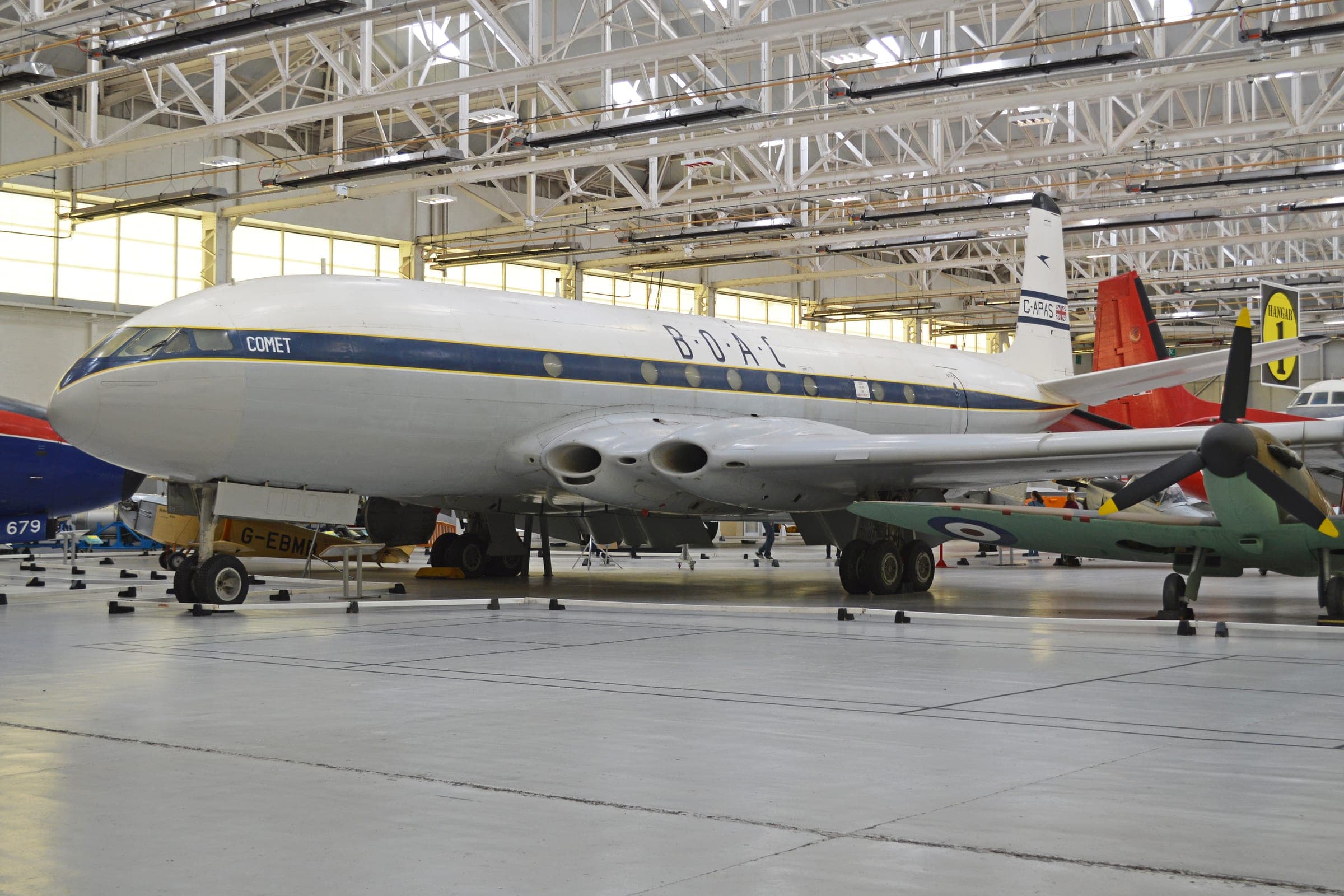
Institutional recognition came much later, and mostly through museums. The Royal Air Force Museum has treated the service as a landmark in its own right rather than as a footnote to the accidents: for the sixtieth anniversary, RAF Museum Cosford unveiled a commissioned exhibition on 2 May 2012, built around photographs, log books, airline memorabilia and previously unseen archive film of the route-proving flights over Africa.
The unveiling was itself a piece of recognition of the people involved. It was performed by George Aird, then eighty-four, a de Havilland test pilot who had flown the museum's own Comet extensively in the 1960s and had taken it on its last flight, to RAF Shawbury in 1968, for storage. A Comet 4 air stewardess, Judy Lerrigo, attended with her uniform and original flight plans to describe what working in a Comet cabin had actually been like.
The exhibition stood beside the museum's Comet 1XB G-APAS, which the museum describes as the only complete Comet 1 remaining anywhere in the world. It is not the aircraft that flew the service, that one is on the seabed and in pieces at Farnborough, but it is the closest thing to it that exists, and it is displayed in BOAC colours.
There is a shape to all this worth naming. The Comet is remembered for how it failed, and the failure was genuinely the more consequential event: it changed how every pressurised aircraft since has been tested. But the two stories are routinely collapsed into one, in which the aeroplane is a cautionary tale and 2 May 1952 is merely its prologue. The recognition that has actually lasted mostly resists that reading. The passengers' certificates, the Cosford exhibition, G-APAS preserved in BOAC colours: each treats the service as something that happened on its own terms, to people who were there, before anyone knew what was coming. That is a reasonable corrective. For something close to a year, this was simply the fastest and most comfortable way to cross the world that had ever existed, and the people who did it were not living in the prologue to anything.
Legacy
The most durable thing the service produced was an expectation. Before 2 May 1952 the case for jet airliners was an argument between engineers; after it, it was a thing several thousand people had queued on a Johannesburg road to see, and 28,000 more had bought tickets for within a year. Eighty-nine per cent load factors and journey times cut by more than sixty per cent settled a commercial question that no amount of prototype flying could have settled. Every manufacturer that built a jet airliner afterwards was building for a market BOAC had demonstrated existed.
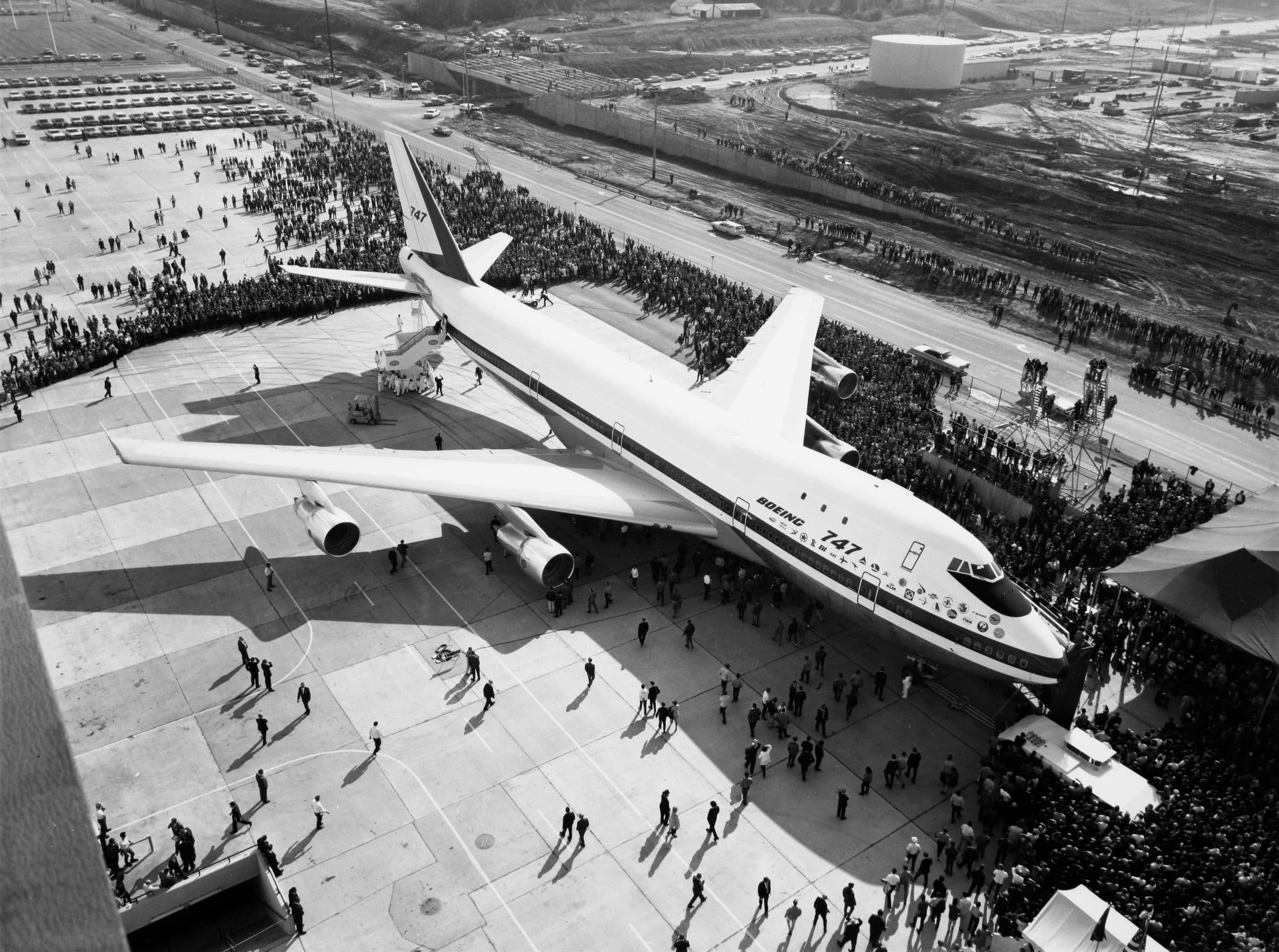
The lead itself did not last, and the reason is arithmetic rather than tragedy. The withdrawal of the Comet 1's certificate in April 1954 and the entry into service of the redesigned Comet 4 in October 1958 are separated by four and a half years, and the aircraft the Comet 4 met at the end of that gap were larger, longer-ranged and designed after the lesson had been learned. BOAC still got one more first out of it: on 4 October 1958 the Comet 4 opened the first transatlantic jet service, three weeks ahead of Pan American's Boeing 707, on the route the Comet 1 had never been able to reach.
The technical legacy belongs to the inquiry rather than to the service, and it is worth stating accurately because it is so often told wrong. The Elba break-up originated at an aperture on the crown of the fuselage, where the automatic direction finding aerials sat, and the water-tank failure at Farnborough began at a corner of the forward escape hatch. Neither began at a passenger window. What the investigation changed was certification: from 1 July 1956 the British requirements demanded a repeated-loading fatigue test on a complete pressure cabin that had not previously been used for strength testing, and the philosophy of aircraft structures moved towards designs that tolerate cracks rather than designs assumed not to develop them.
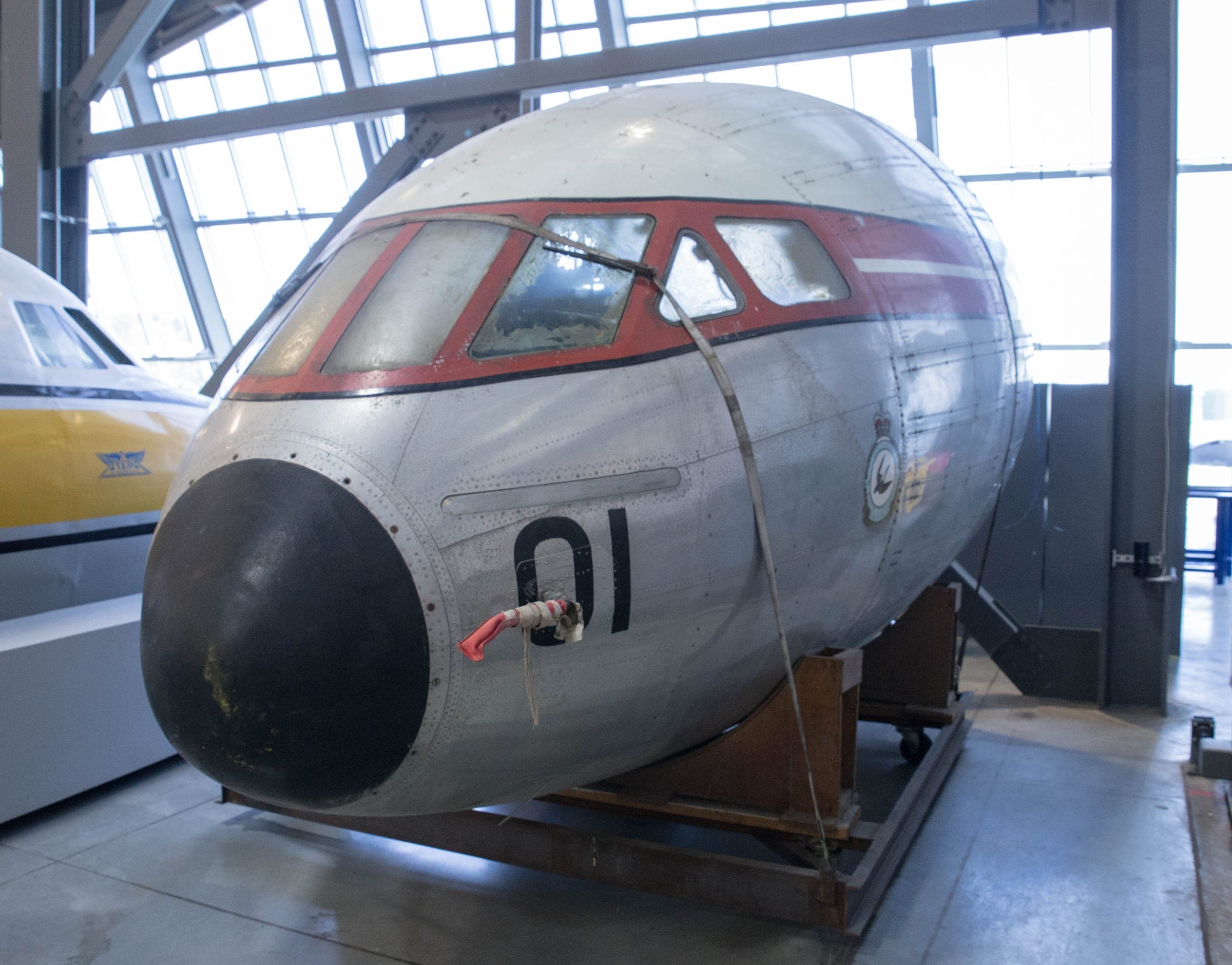
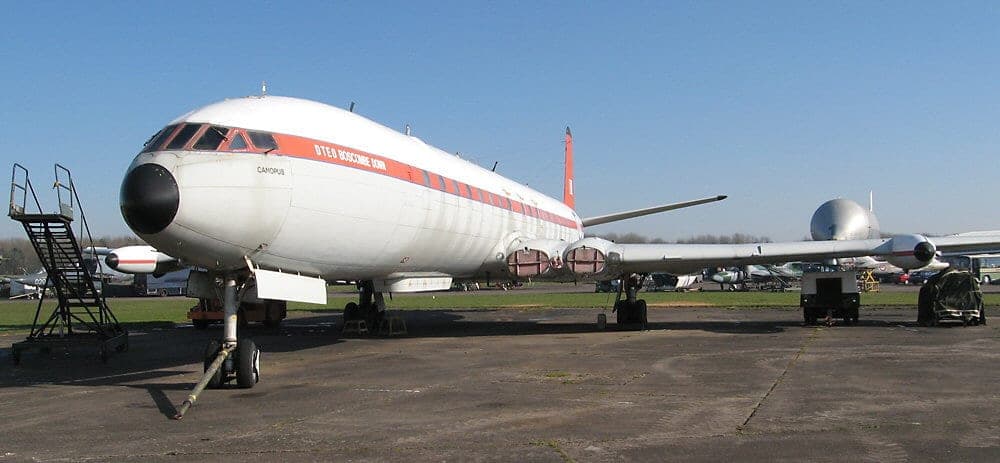
The physical survivors are scattered and none of them flies. G-APAS sits at Cosford in BOAC colours; the de Havilland Aircraft Museum holds a Comet 1A fuselage built for Air France and later used for pressure-testing research at Farnborough; the Cosford fuselage section from G-ALYU records the test that solved the case; a Comet 1A nose survives in Royal Canadian Air Force markings, from the batch that made Canada the first air force anywhere to fly jet transports. The last Comet to fly at all, Comet 4C XS235 *Canopus*, was retired from trials work in 1997.
What is left of 2 May 1952 is therefore not an aeroplane. It is the ordinary fact that a long journey can be short and smooth, which every airline passenger since has taken for granted, and which thirty-six people paid £175 each to discover on a Friday afternoon in 1952.
Who was there
- A. M. Majendie
- Flight captain, BOAC Comet fleetCommanded the opening stage out of London and signed the certificate each passenger was given; he also devised the Comet's method of converting indicated Mach number and temperature into true airspeed.
- J. T. A. Marsden
- Captain, Beirut stageTook command at Beirut for the leg down to Khartoum.
- R. C. Alabaster
- Captain, final stagesTook command at Khartoum and brought the aircraft into Johannesburg, where he told reporters the flight had been trouble-free and described deliberately losing time to avoid arriving early.
- Ken Emmott
- First officer, BOAC Comet flightA former flying-boat pilot, one of the original BOAC Comet training course; he flew in the left-hand seat beside Captain Marsden on the Beirut to Khartoum stage.
- Sir Miles Thomas
- Chairman of BOACChairman from July 1949; he had flown the unpressurised prototype in November 1949 and came aboard at Livingstone for the last stage into Johannesburg.
- Albert Henshaw
- The first passenger to bookReserved his seat in January 1951, sixteen months before the service opened. He was the father of Alex Henshaw, who had set a London to Cape record in 1939.
- Averil Coleridge-Taylor
- Passenger and composerDaughter of the composer Samuel Coleridge-Taylor; she wrote a "Comet prelude" during the flight to give an impression of it, and was to conduct the Johannesburg Municipal Orchestra that June.
- John Cunningham
- De Havilland chief test pilotA night-fighter pilot of the Second World War; he flew the Comet prototype's maiden flight from Hatfield on 27 July 1949.
Airports
Related entries

- De Havilland DH.106 Comet 1 and 2, BAE Systems Heritage
- Comet Enters Service — Comet: The World's First Jet Airliner, Royal Air Force Museum
- Comet pilot unveils anniversary exhibition (press release, 27 April 2012), Royal Air Force Museum Cosford
- de Havilland DH106 Comet 1A, de Havilland Aircraft Museum
- Queen of the Jet Age, Royal Aeronautical Society
- Vickers Viscount (1952), The British Airliner Collection, Duxford
- "Huge crowd to greet Comet on Rand", The Star (Johannesburg), 3 May 1952 (scan), Wikimedia Commons
- Comet's Tale, Smithsonian Magazine
- 2 May 1952, This Day in Aviation
- BOAC and the Comet Mk.1s, Cometra
Checked October 5, 2026