Aéroports de Paris SA, trading as Paris Aéroport, part of Groupe ADP
Owner
Aéroports de Paris SA, a company listed on Euronext Paris in which the French state holds just over half the capital.
Ownership as of 2025
20161 / 6
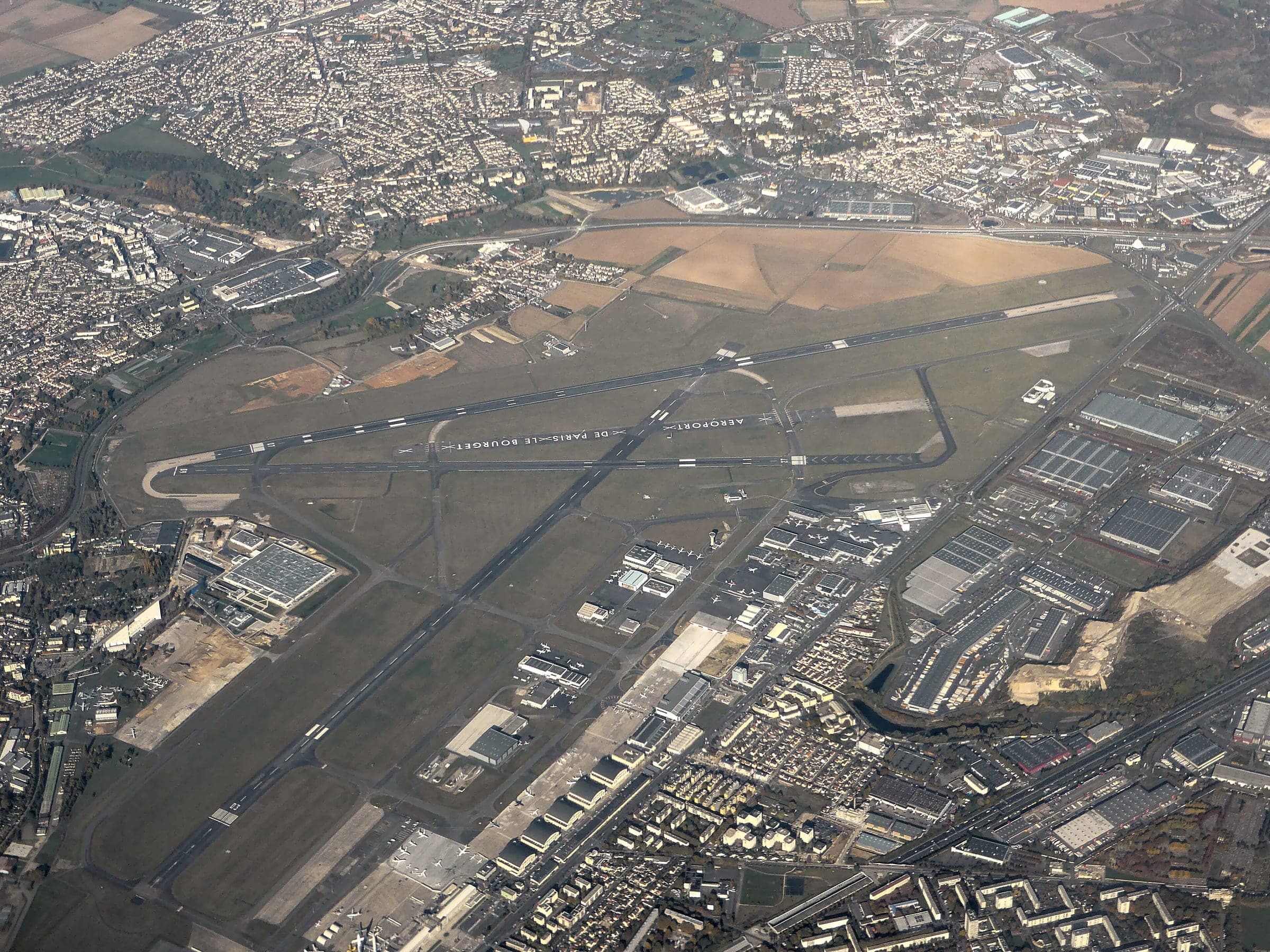
Le Bourget lies eleven kilometres north-north-east of the centre of Paris, on 553 hectares of flat ground between the Autoroute du Nord and the suburbs of Seine-Saint-Denis. It is the oldest of the three Paris airports and the smallest by far. Almost nobody catches a scheduled flight here any more. Business jets use it instead, and nowhere in Europe handles more of them: in 2022, the year travel came back after the pandemic, the airport logged 63,780 movements, and Groupe ADP expected about 57,000 in 2025.
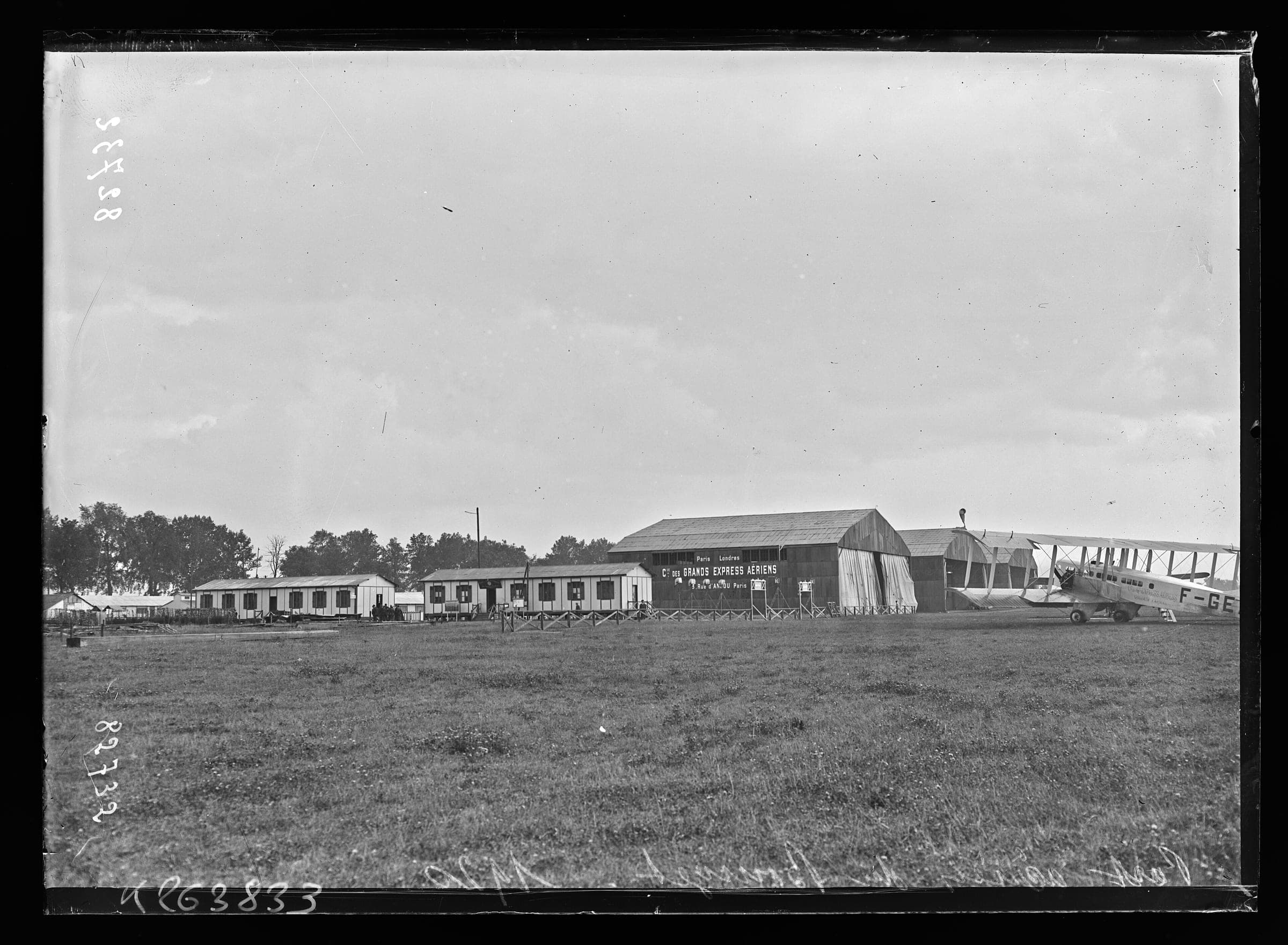
The 'Port aérien du Bourget' in August 1920: a grass field with a row of low wooden sheds and hangars along its edge (1920)
It is also a place where aviation history happened. For nearly two decades Le Bourget was the only airport Paris had. The first regular air services between Paris and London flew from its grass in 1919. Charles Lindbergh landed here in the dark on 21 May 1927 in front of a crowd that broke through the fences, and Dieudonné Costes and Maurice Bellonte were cheered home here after flying the Atlantic in the other direction in 1930. In the thirties Air France set up its head office on the field. Its passengers used a new Art Deco terminal by Georges Labro, one of the finest airport buildings of the period. The building still stands.
What keeps Le Bourget in the public eye today is not its jets but two institutions that fill its old spaces. The Musée de l'Air et de l'Espace, founded in 1919 and one of the oldest aviation museums in the world, took over the 1937 terminal and the hangars around it. Every other June, the Paris Air Show turns the airfield into the largest aerospace exhibition on earth. So one airfield serves three purposes. It is a quiet working airport for people who fly private, a museum of the century it helped create, and for one week in two years the place where the aircraft industry sells its next decade.
History
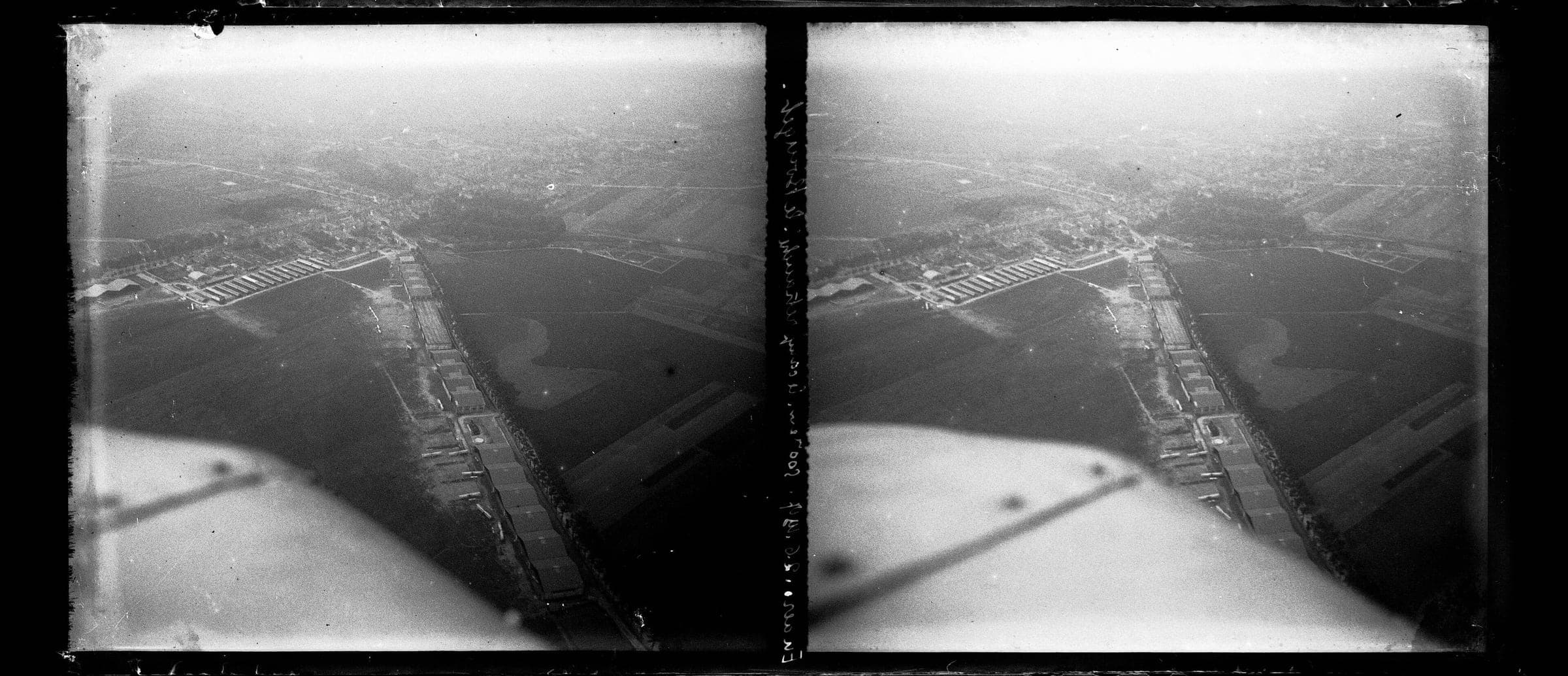
Stereoscopic aerial pair of the Le Bourget military airfield taken from 500 metres on 2 June 1917, the wing of the Caudron G.4 visible in the frame (1917)
Le Bourget began as a military airfield. In the autumn of 1914, with the German armies only just turned back on the Marne, the defences of the Camp retranché de Paris needed landing grounds north of the city, and the fields between Le Bourget, Dugny and Blanc-Mesnil were taken over. For the rest of the war they served as a base for the aircraft protecting Paris. By 1917 observers were photographing the field from the air: a scatter of hangars and sheds on open farmland.
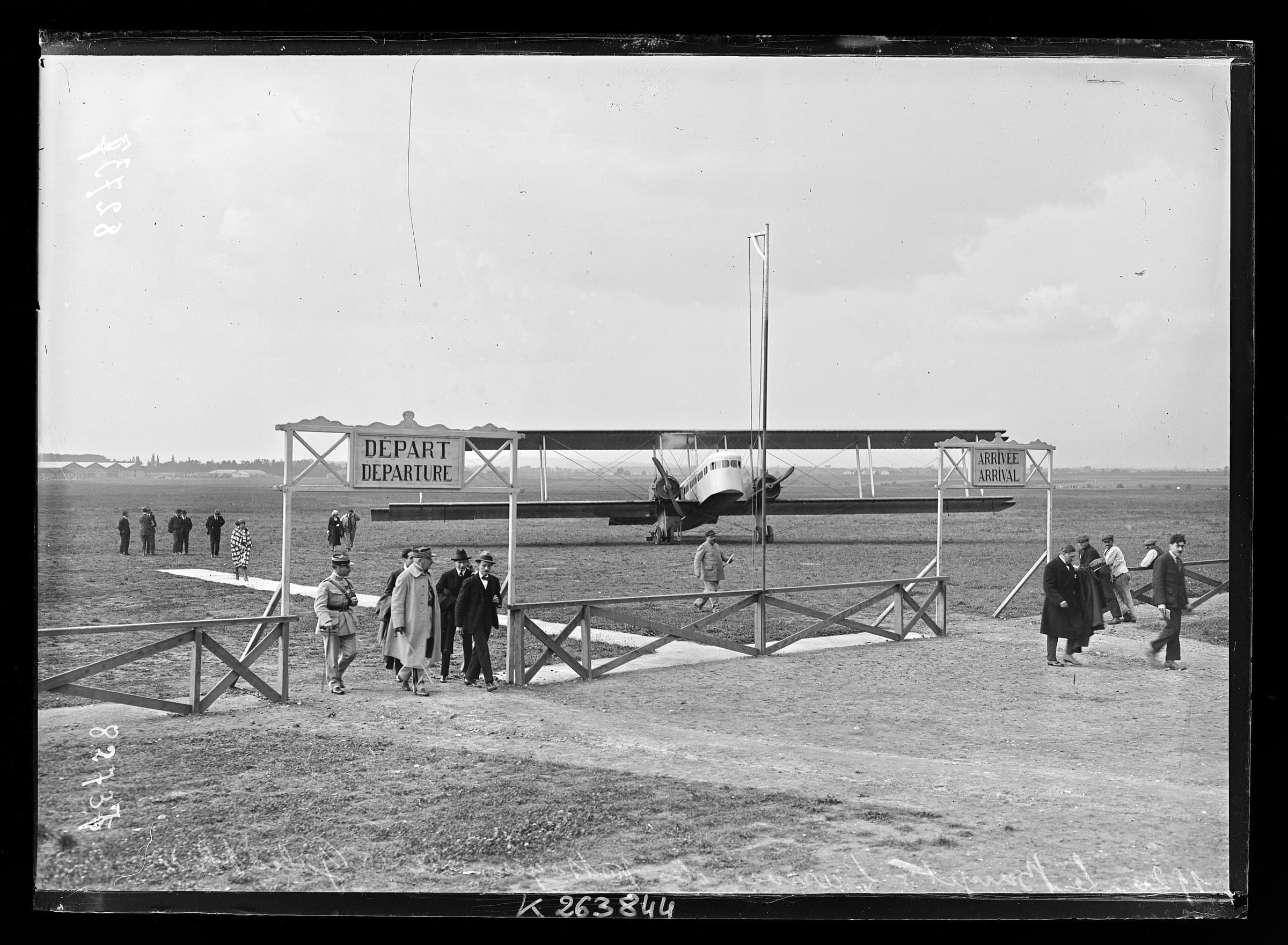
When the war ended, the field was already there. The aircraft were surplus and the pilots needed work, so in 1919 Le Bourget was opened to civil traffic. It became the airport of Paris almost by default. The first regular international passenger services in the world were being tried out in that year, and the Paris to London route was the one that mattered. Farman's Goliath biplanes and their rivals flew it from Le Bourget across the Channel. The press photographers of the early 1920s show a grass field, a wooden gateway marked 'Départ' and luggage carried out by hand.
Passengers walking out to a Farman Goliath airliner past a wooden gateway marked 'Départ' at Le Bourget in 1920 (1920)
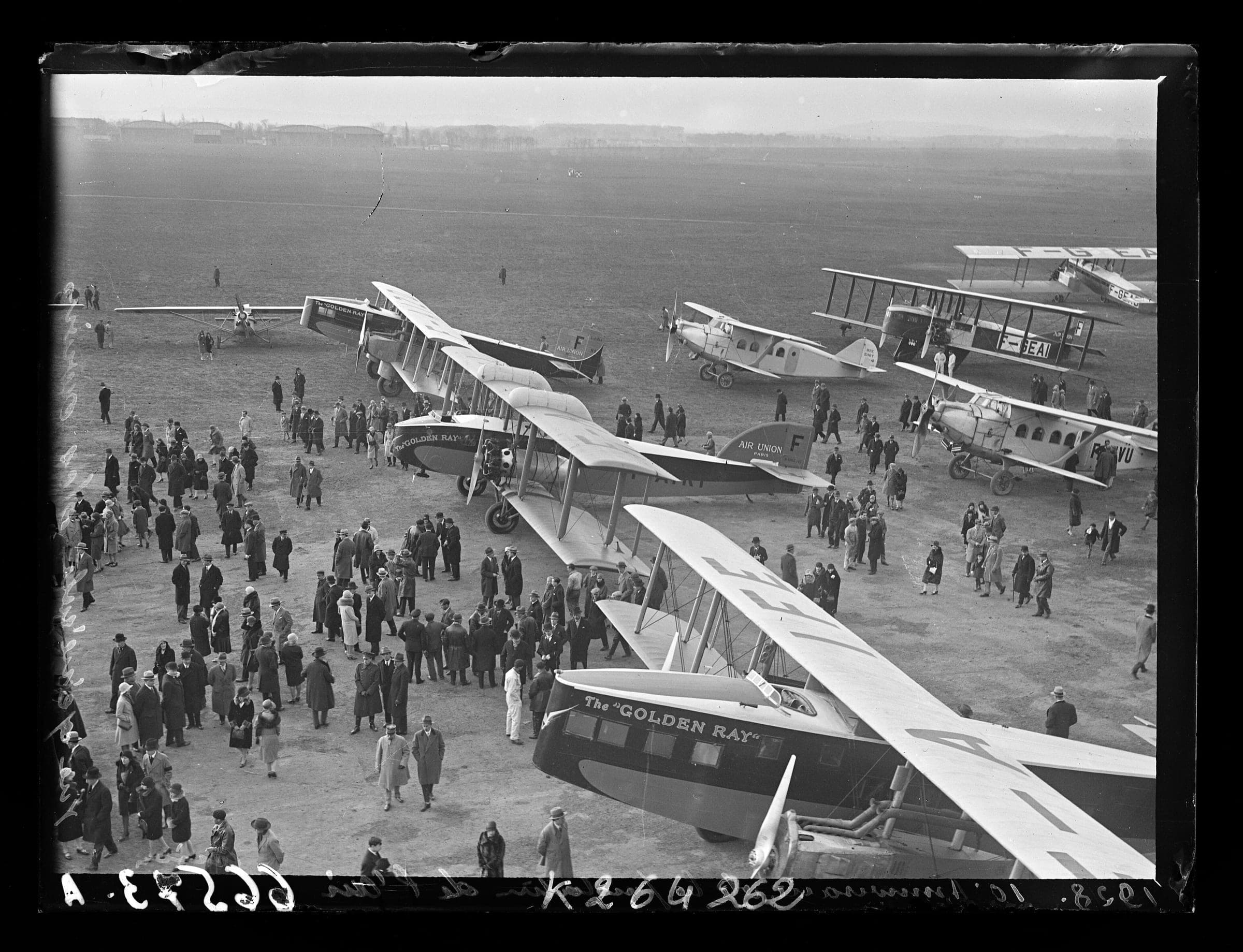
Through the 1920s the small French airlines that flew from the field were joined and merged. Air Union, formed in 1923, took over the London route. The Compagnie internationale de navigation aérienne flew east to Prague, Vienna and beyond. In 1929 Air Union marked ten years of the Paris to London service with a line-up of airliners on the grass. In 1933 these companies were brought together as Air France, which set up its management at Le Bourget. The field was now the centre of French air transport, the arrival point for foreign airlines and the place record flights ended.
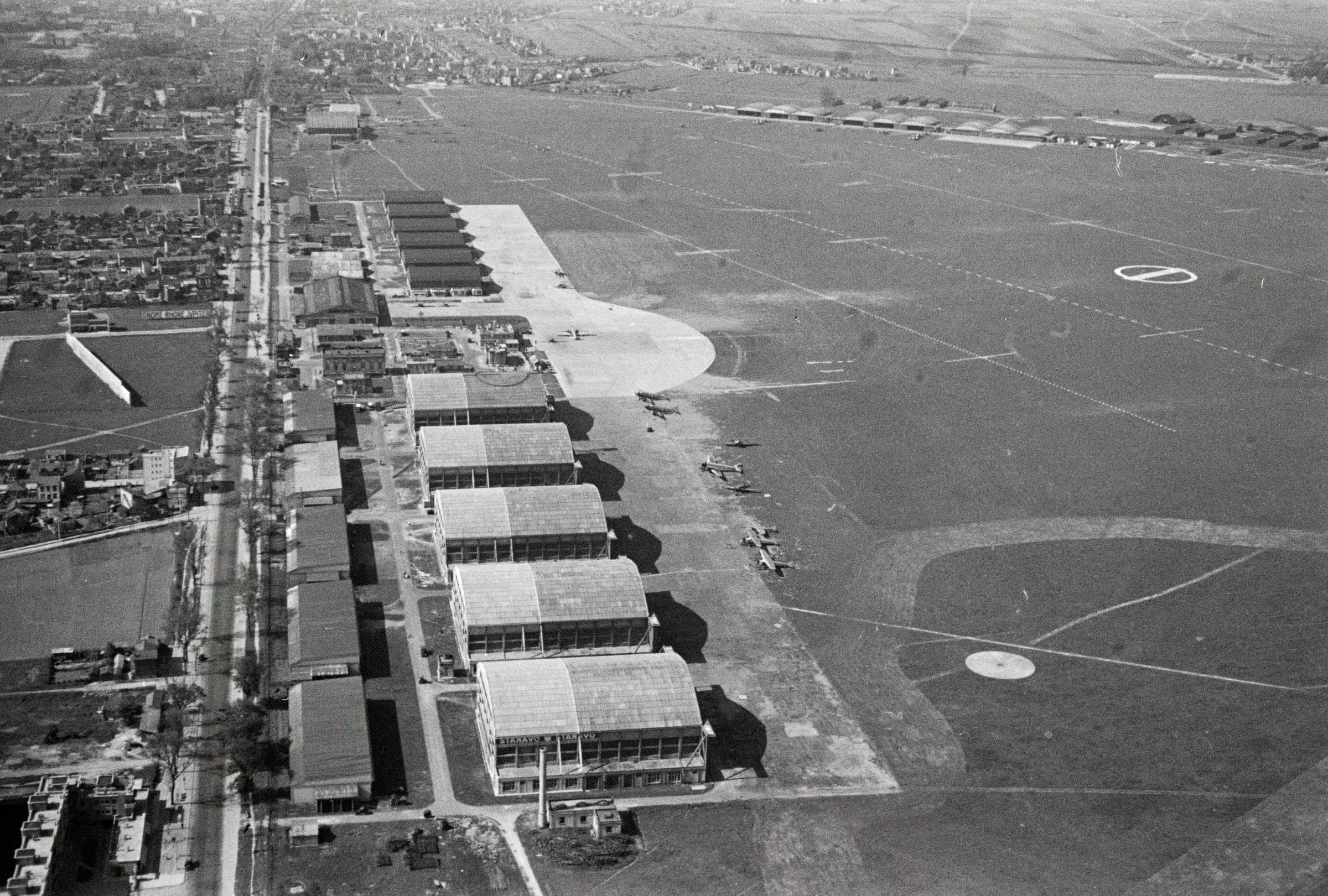
The old buildings could not cope with that role. Aerial photographs from the early 1930s show a long row of arched hangars along the road and hardly anything a passenger would call a terminal. In 1935 the Air Ministry held a competition for a new terminal, won by the architect Georges Labro, and the building was opened on 12 November 1937. By then Paris had a second airfield under construction at Orly, but Le Bourget was still where the city met the air.
Oblique aerial view of Le Bourget in the early 1930s: a long row of arched hangars beside the road, the grass landing ground and its circle marker, before the new terminal was built
The Second World War turned it back into a military base. After the fall of France in June 1940, the German occupiers took the airfield over for the Luftwaffe; Hitler landed there that month for his only visit to Paris. For four years the new terminal and its hangars served a foreign air force. That made the field an Allied target, and by the Liberation in 1944 the airport was a damaged place.
Peace brought traffic back, but the future was elsewhere. Orly had space to grow and Le Bourget, hemmed in by the suburbs, did not. In 1952 Air France moved all its operations to Orly, and in 1953 the Paris Air Show moved in the opposite direction, settling at Le Bourget for good. Other airlines stayed on through the 1960s. In 1976 the airport still handled around two million passengers.
Biplane airliners lined up on the grass at Le Bourget among spectators for the tenth anniversary of the Paris to London air service in 1929 (1929)
The opening of Roissy to Charles de Gaulle in 1974 settled the matter. In March 1977 the international airlines left Le Bourget, and regional services followed at the start of the 1980s. The airport that had been Paris's front door for half a century became a business-aviation field, a museum and a showground, which is what it has remained.
The airfield
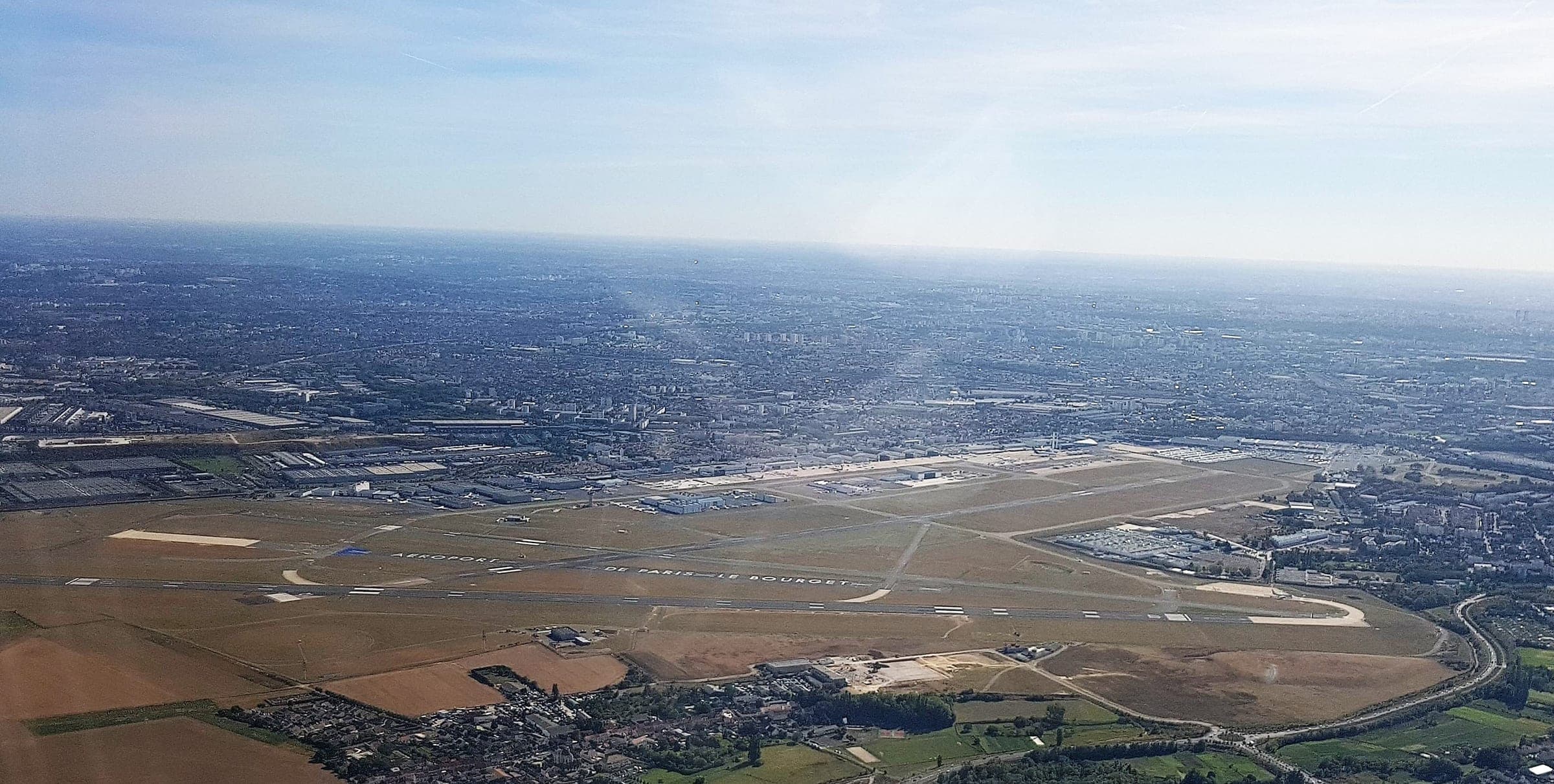
Le Bourget from the air on a clear day: the long runway and the cross runway running through open grass, the aprons and hangars along the edge, the suburbs of northern Paris stretching to the horizon (2018)
The grass field of 1919 is long gone. Le Bourget now has three paved runways laid out across its 553 hectares. The longest, 07/25, is 9,800 ft long; the second, 03/21, crosses it at 8,743 ft; and the third, 09/27, is a shorter 6,053 ft. For a field whose everyday traffic is business jets, that is a generous amount of concrete, and the reason is its past. These runways were built for airliners, and they still have to take the heaviest aircraft in the world when the Air Show comes.
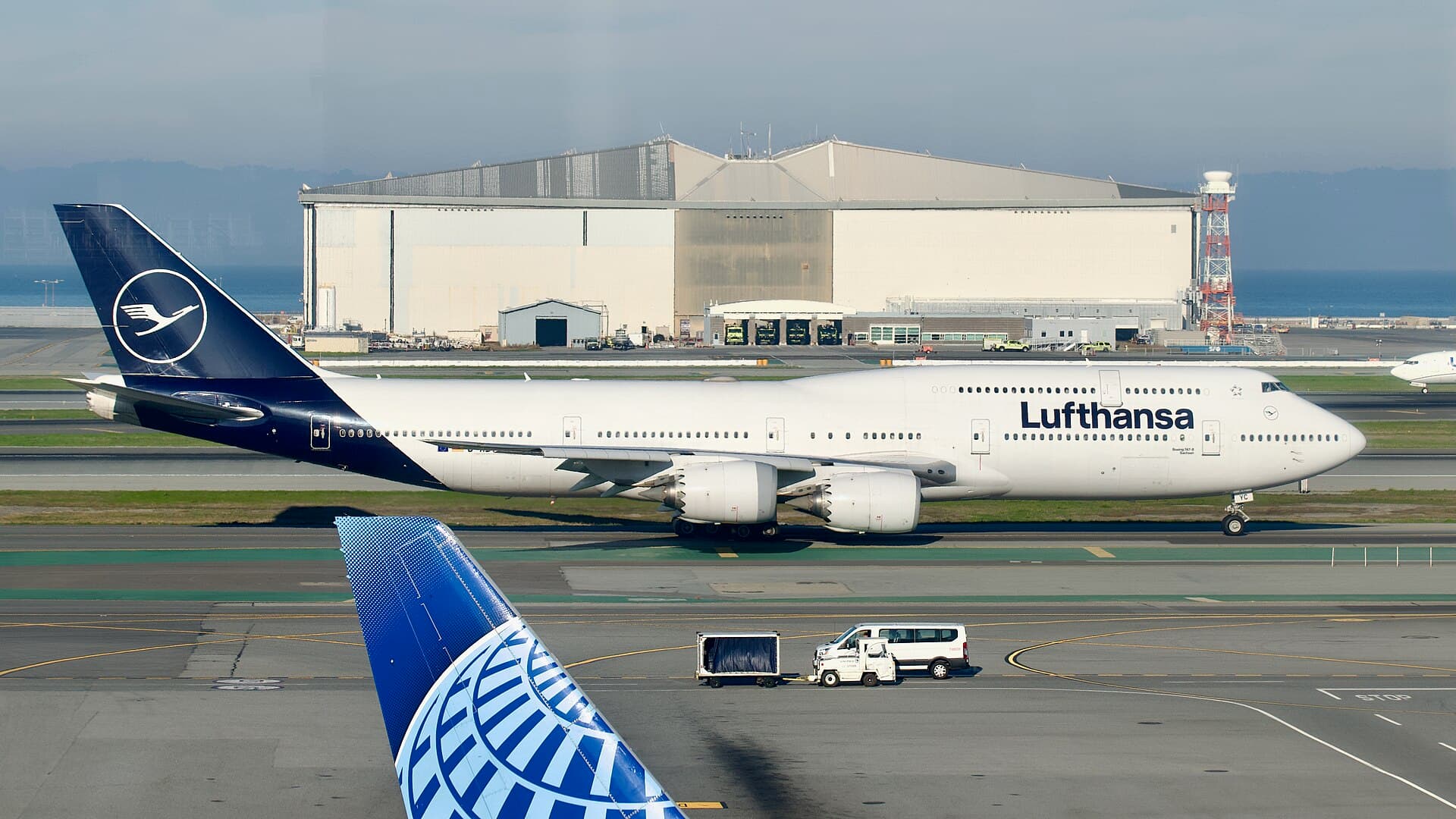
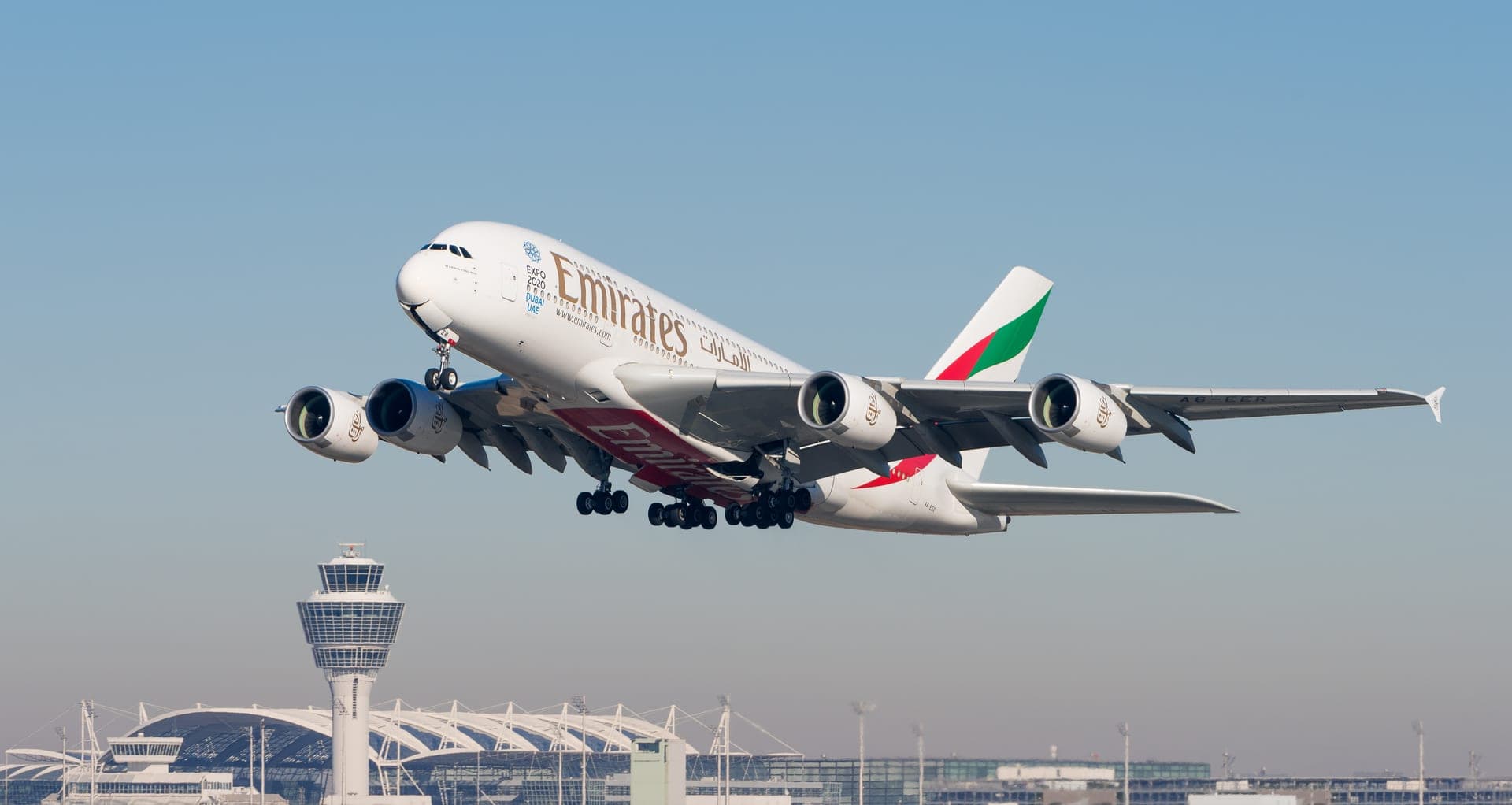
The operator says the airport can accommodate aircraft up to the size of the Airbus A380, and at show time it does. Airliners and military transports fly in from all over the world to be parked on the aprons in front of the exhibition halls, then flown in the daily display. For the other fifty weeks of a two-year cycle the same runways handle aircraft a fraction of that size, from light twin-engined jets to long-range business aircraft able to reach Asia or America non-stop.
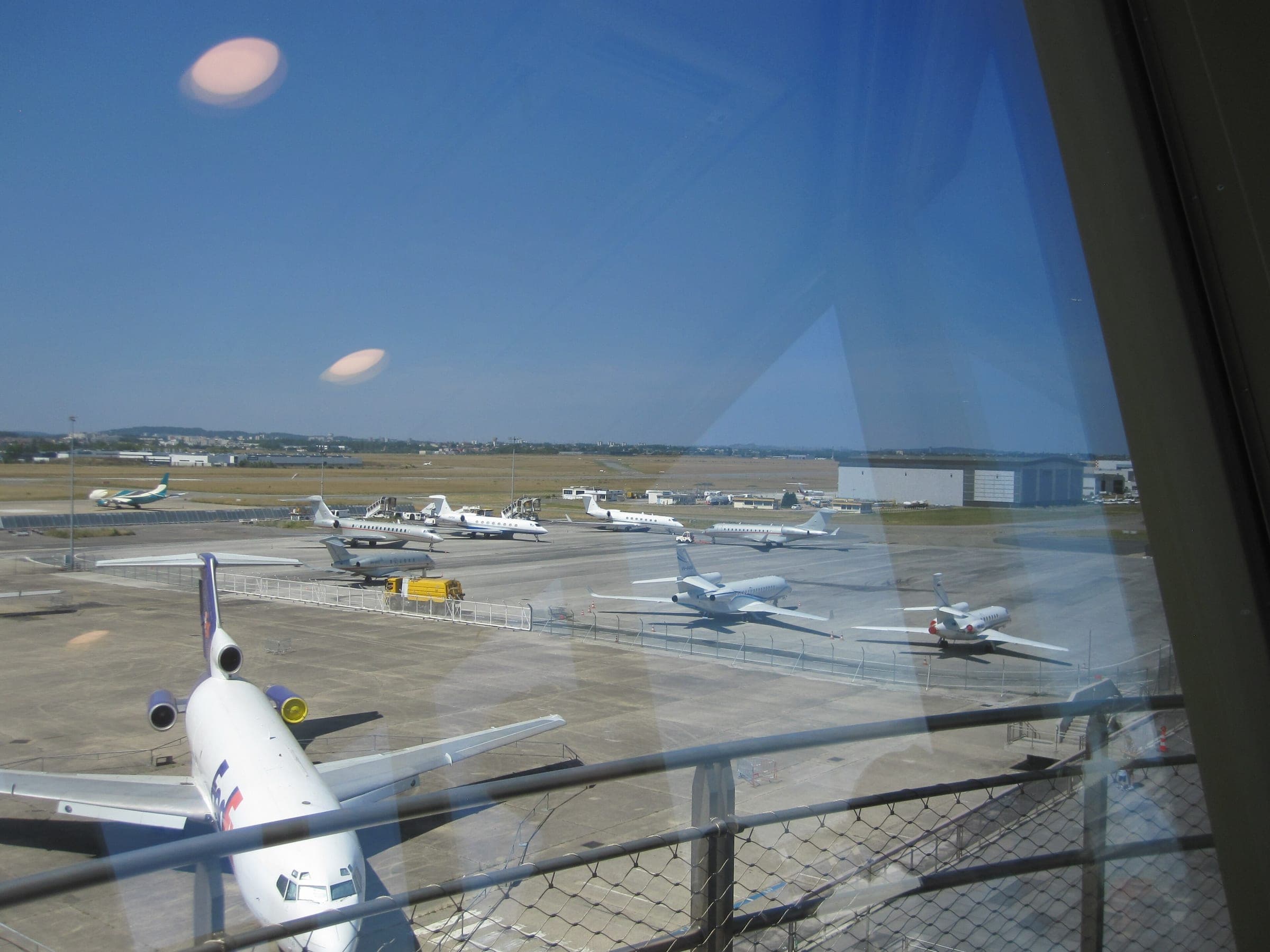
Business jets on the apron seen through the glass of the old control tower, the tail of a museum airliner in the foreground (2022)
The airfield is ringed by town. Dugny, Le Bourget, Le Blanc-Mesnil and Gonesse press in on its sides, and the A1 motorway runs along its western edge. From the air it is a green island with industrial buildings pressed against its borders. Aprons and hangars fill the edges of the site: the business-aviation terminals, the maintenance companies, the Air Show's permanent exhibition centre and the museum's collection of parked aircraft.
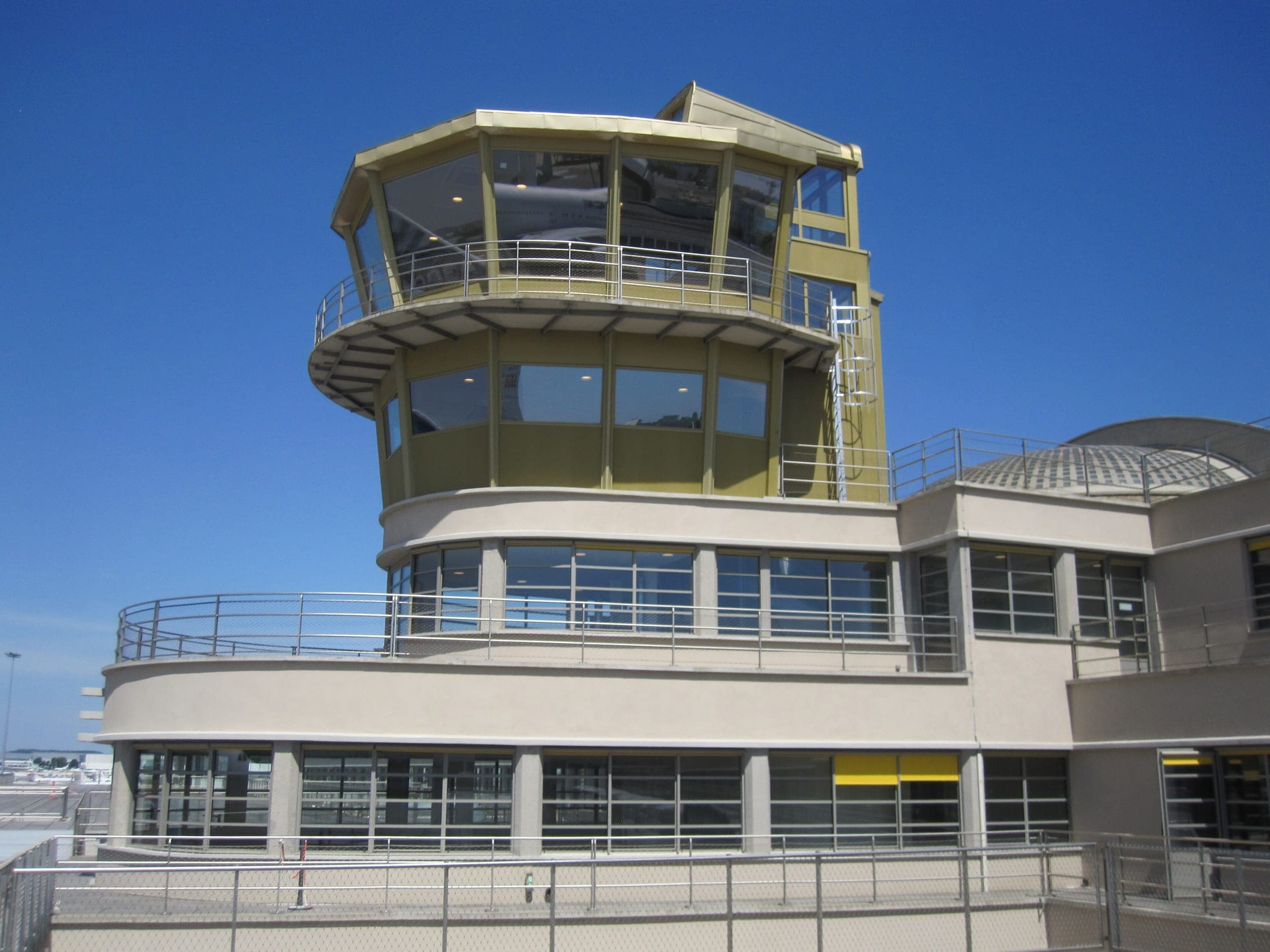
Air traffic control has long since moved out of the tower on the 1937 terminal into a modern tower on the airfield. The old one is now part of the museum. From its windows, visitors look straight down onto the business jets taxiing below, a museum and a working airport sharing one view.
The old control tower rising above the curved terraces of the historic terminal, against a deep blue sky (2022)
Le Bourget's airspace is also crowded. It sits directly between Paris and Roissy to Charles de Gaulle, under the busiest approach paths in France, so its traffic has to be fitted in around the arrivals and departures of its much larger neighbour.
Terminals
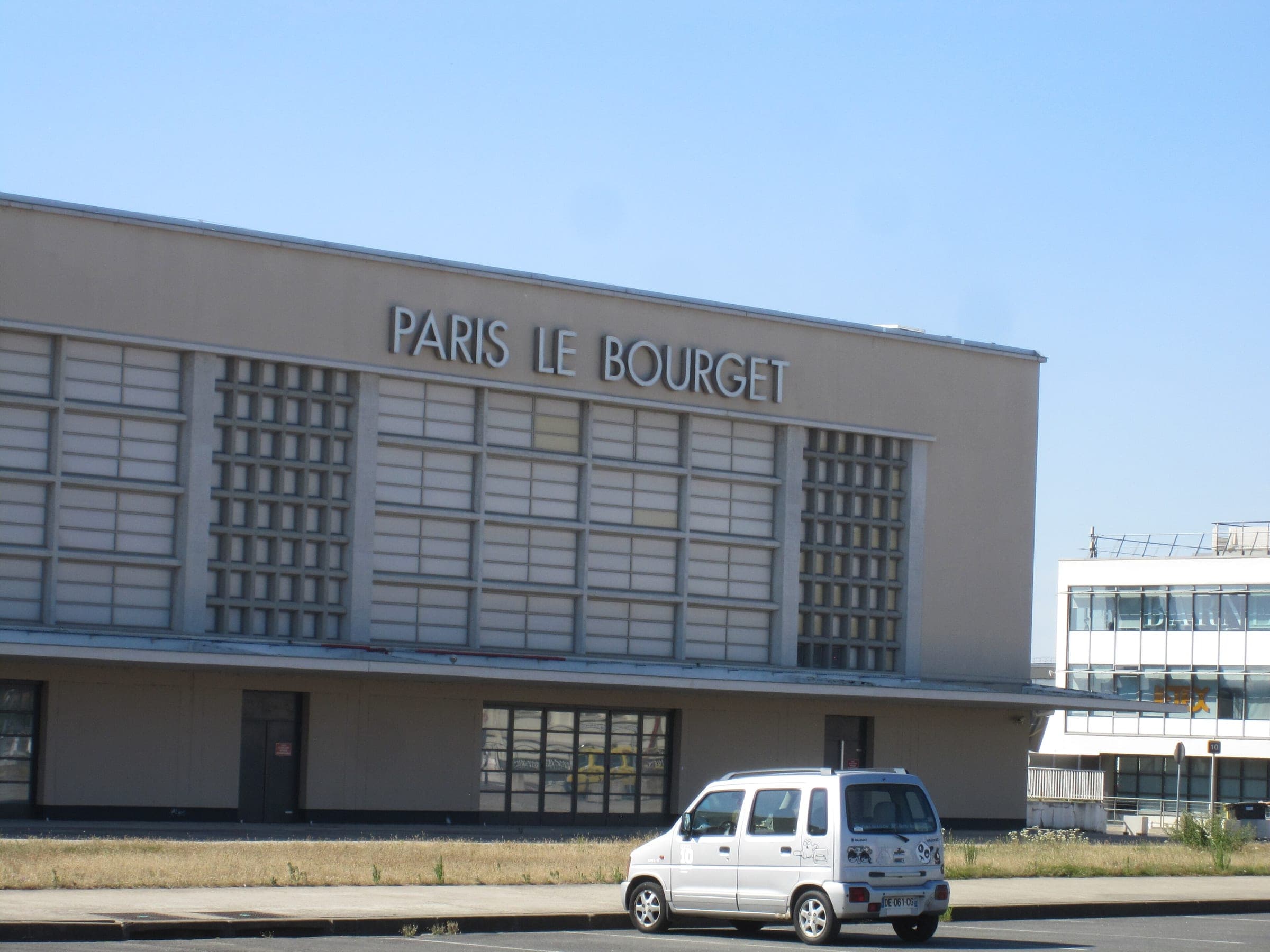
The 1937 terminal by Georges Labro: a pale stone façade with tall vertical glazing and the lettering 'Paris Le Bourget' (2022)
The terminal Georges Labro designed for the 1935 competition is the reason Le Bourget still looks like an airport of the 1930s. It is a long, low building in pale stone, symmetrical and horizontal, with tall bands of glazing on the airfield side and the words 'Paris Le Bourget' across the top. Its central halls rise above the wings on either side, and a control tower stands on the curved terraces where spectators once watched the aircraft come in. It was opened on 12 November 1937, the year of the Paris International Exhibition, when Paris was receiving the world.
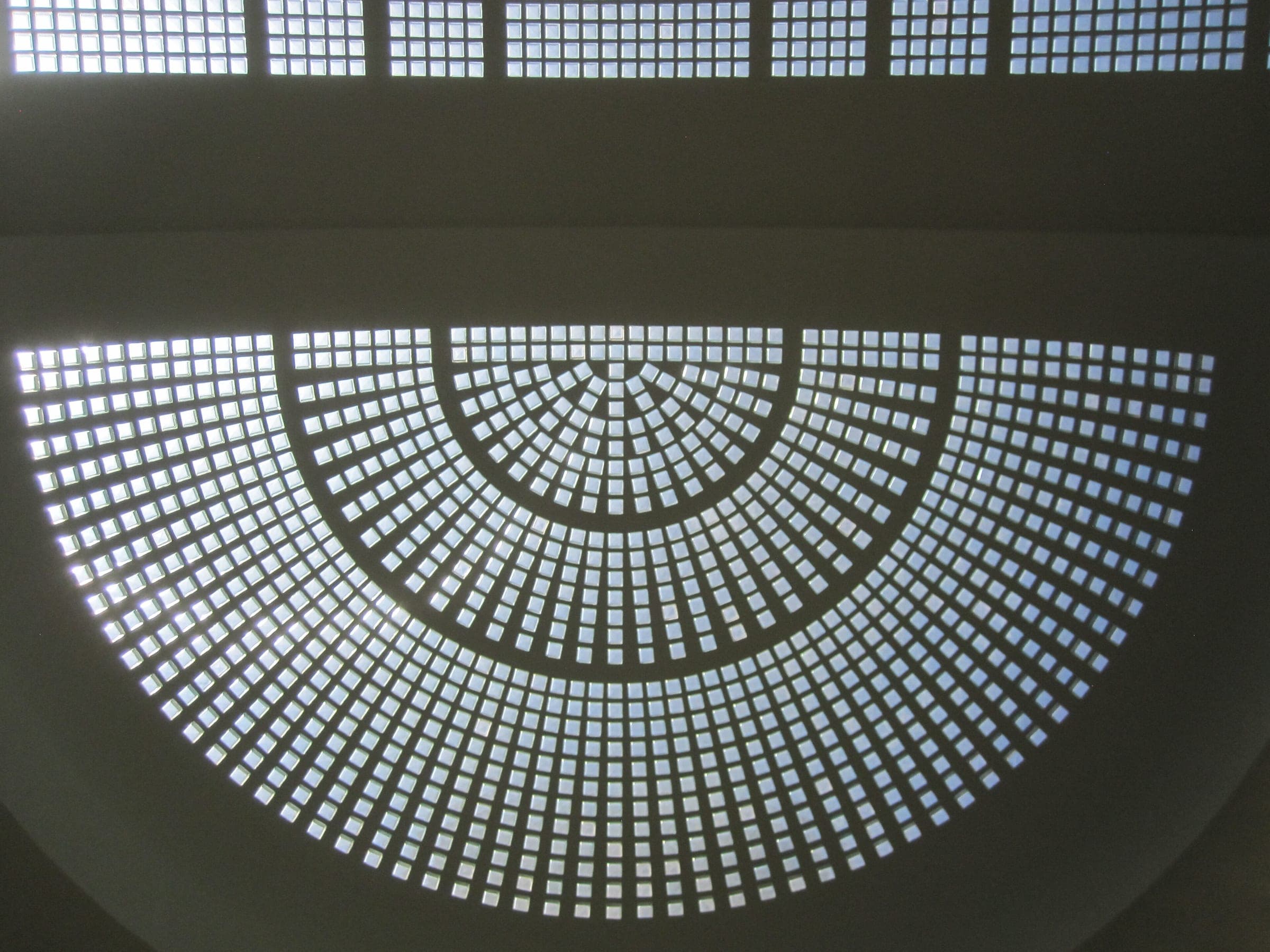
Inside, it was built for a new kind of traveller. Passengers moved through halls lit from above, including a hall of eight columns and a rotunda under a dome of glass blocks. It is a small building by modern standards. In the late 1930s it was a showpiece of modern French architecture, and it survived the Occupation, the Liberation and thirty more years of airline traffic with its character intact.
The glass-block dome of the rotunda inside the 1937 terminal, a half-circle of square lights radiating from the centre (2022)
When the airlines left for Orly and Roissy, the terminal lost its original purpose and found another. The Musée de l'Air et de l'Espace, which had opened its first hall at Le Bourget in 1975, gradually took over the historic building. A long restoration followed. The hall of eight columns was restored and reopened in 2013, and the museum reorganised its entrance and galleries around the old terminal in the years after. Visitors now reach the collection through the same halls and the same doors as the passengers of 1937, and can climb to the old control tower, where an exhibition on air navigation is installed.
Passengers who fly from Le Bourget today never see that building. The airport has no public terminal in the airline sense. Business travellers are handled in eight private terminals run by specialist handling companies, the fixed-base operators, each with its own lounges, customs and security, parked aircraft a few steps from the door. These buildings line the business-aviation aprons. They are modern, discreet and functional, and they are where the airport earns its living.
Operations
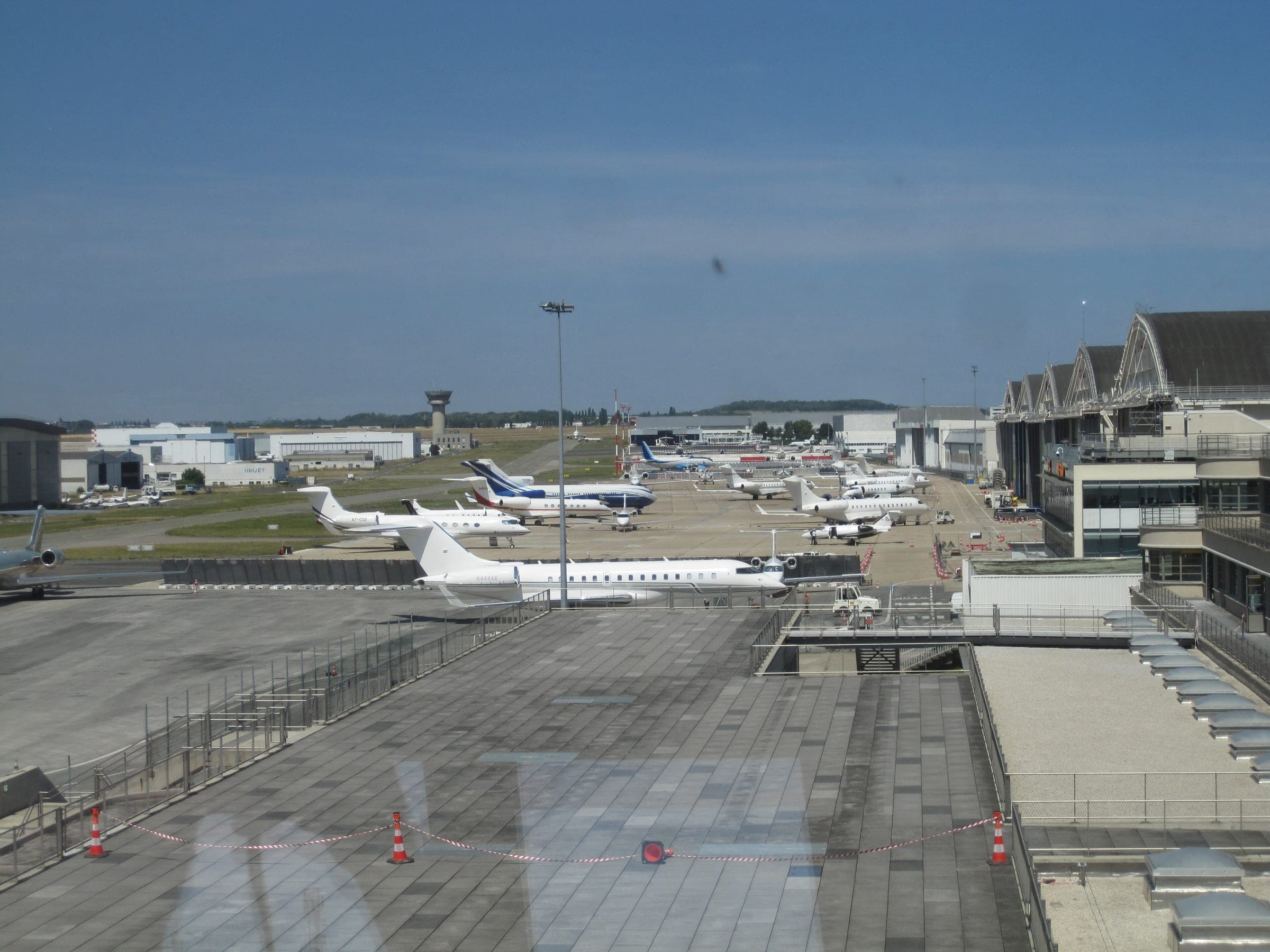
Business jets parked on the apron seen from the terminal's viewing terrace, with the modern control tower and hangars beyond (2022)
Le Bourget is the leading business-aviation airport in Europe, and that is essentially all it does as an airport. There are no airline gates, no departure boards and no baggage halls. What moves through it is a steady stream of private and corporate jets, air-taxi flights, government aircraft and medical flights, carrying executives, officials and patients rather than holidaymakers. Groupe ADP counted 63,780 movements in 2022, a figure inflated by the rebound after the pandemic, and expected about 57,000 in 2025.
The business is shared out among specialist companies. Seven fixed-base operators run the eight business terminals, competing for the same customers on service: fuel, handling, hangar space, crew rest, and the speed with which a passenger can get from a car at the door to a seat on the aircraft. Behind them sits a cluster of nearly a hundred companies working in maintenance, aircraft completion and modification, equipment and airport services. The operator puts direct employment on the site at more than 3,500 jobs, with nearly 10,000 more indirect jobs in related activity.
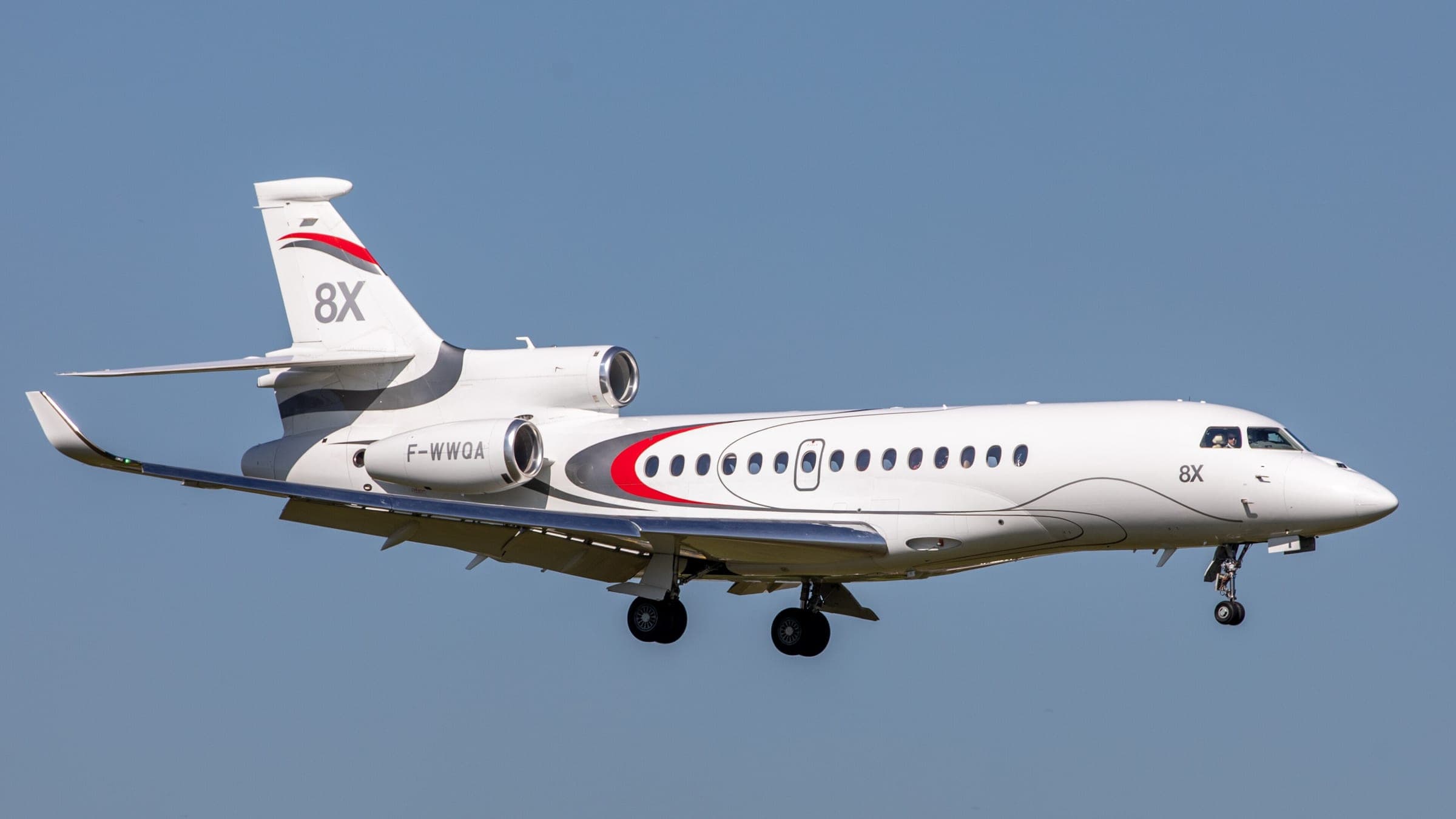
A Dassault Falcon 8X trijet business aircraft flying its display at the 2019 Paris Air Show (2019)
Some of those neighbours are well known. France's air accident investigation bureau, the BEA, has had its headquarters at Le Bourget since 1994, and its laboratories there read flight recorders from accidents far beyond France. Airbus Helicopters moved its Paris-region site to the airport in 2011.
Le Bourget also has a public-service role that its glamour hides. It is the leading airport in Europe for medical and health flights, the organ transports, patient repatriations and emergency transfers that need an airfield close to the centre of Paris and able to operate at short notice. Those flights are the exception to the airport's night restrictions.
Ground access
Le Bourget has always been close to Paris, and that is still its main selling point. The airport sits beside the A1, the Autoroute du Nord, which runs from the Porte de la Chapelle past Saint-Denis and the Stade de France to Roissy. For most of its business passengers the journey starts and ends in a car, and outside rush hour the centre of Paris is a short drive away. That proximity is exactly what a traveller pays for when choosing a private jet over an airline from Charles de Gaulle.
Public transport is less direct. RER line B, the regional express line that also serves Charles de Gaulle, stops at Le Bourget station, some distance south of the airfield, and a local bus covers the rest of the way to the airport and the museum. The T11 Express tram-train, which runs around the northern suburbs, also calls at Le Bourget station, so visitors can reach the area without going through Paris.
That is changing. Line 17 of the Grand Paris Express, the automatic metro being built to link Saint-Denis Pleyel with Charles de Gaulle, will have a station named Le Bourget Aéroport, expected in 2027 or 2028. The station is forecast to carry about 25,000 passengers a day. For the first time since the airlines left, the airport, its business district, the exhibition centre and the museum will be on the metro map.
Noise and environment
An airport that sits in the middle of dense suburbs lives with its neighbours, and Le Bourget's neighbours are close. Houses and flats in Dugny, Le Blanc-Mesnil and Le Bourget itself stand within a few hundred metres of the airfield fence. The traffic is lighter than at Orly or Charles de Gaulle, but business jets fly at all hours and their departures climb out over homes.
The main protection is a curfew on departures. Take-offs are restricted from 22:15 to 06:00, with exceptions for emergency medical and health flights, which are the airport's public-service mission and cannot wait for the morning. Groupe ADP presents its relations with the surrounding towns through a dedicated neighbours' programme, which publishes the airport's figures and restrictions for local residents.
The business-aviation sector is also under pressure over emissions. A private jet carries a handful of people, so its carbon footprint per passenger is far higher than an airliner's, and the argument over whether such flights should be taxed or limited is conducted in France largely with Le Bourget in mind. The airport's answer so far has been to make sustainable aviation fuel available: it has a station dedicated to aviation biofuels, supplying operators who choose to use it.
Notable events
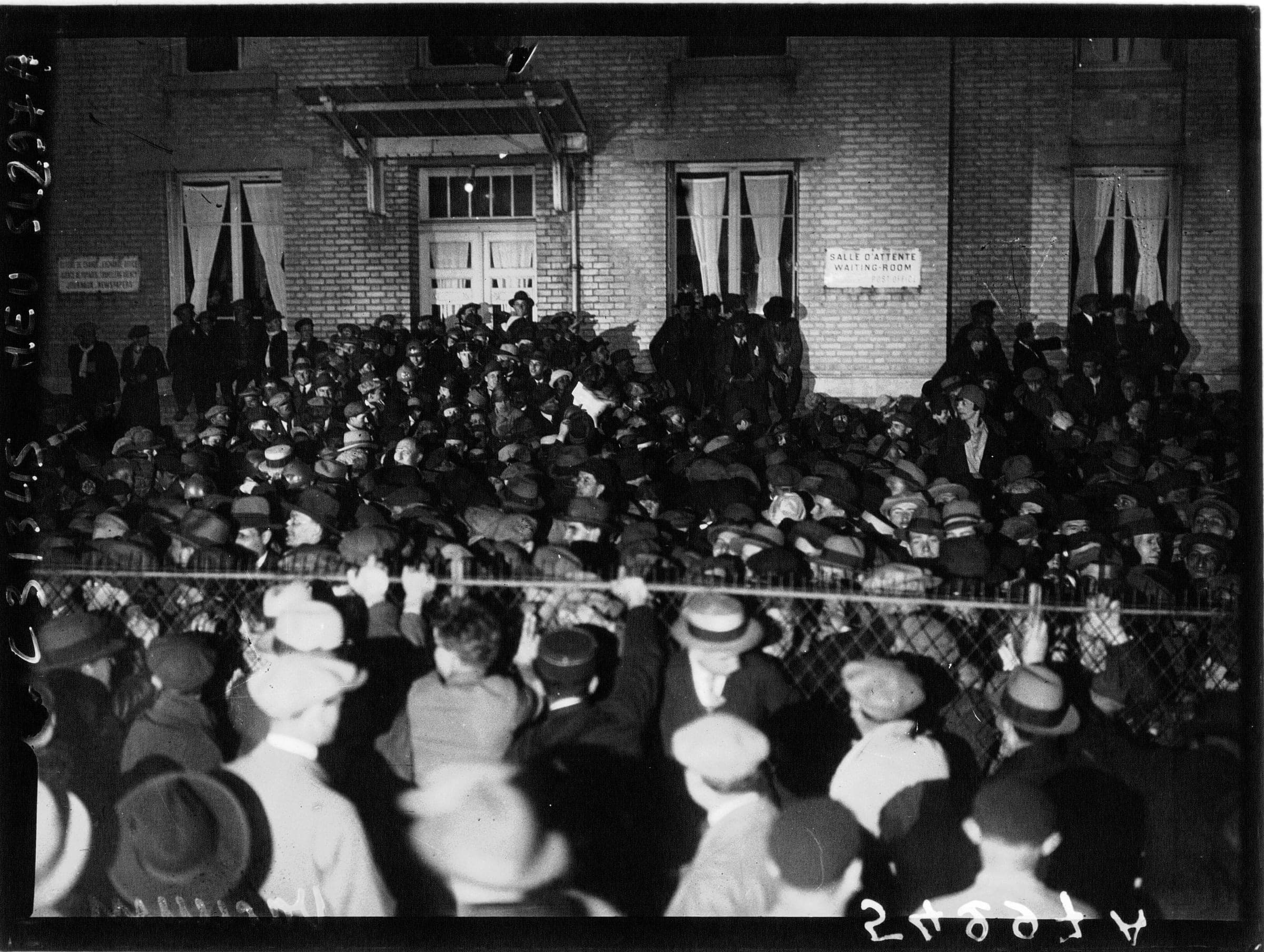
The crowd packed against the barriers in front of the airfield buildings at Le Bourget on 21 May 1927, waiting for the Spirit of St. Louis (1927)
The most famous night in Le Bourget's history began with a disappearance. On 8 May 1927, two French airmen, the war ace Charles Nungesser and the navigator François Coli, took off from Le Bourget in a Levasseur biplane named L'Oiseau Blanc, trying to be the first to fly non-stop from Paris to New York and win the Orteig Prize. They were last seen crossing the French coast. What became of them has never been established; the museum at Le Bourget keeps the landing gear they dropped after take-off to save weight.
Two weeks later the prize went the other way. On the evening of 21 May 1927, Charles Lindbergh, a young American airmail pilot, crossed the coast of France in a single-engined monoplane, the Spirit of St. Louis, and found his way to Le Bourget after some 33 and a half hours alone in the air from New York. Word had spread through Paris, and a crowd estimated at around 200,000 people had come out to the airfield. When he landed, at about half past ten at night, it broke through the barriers and ran onto the field.
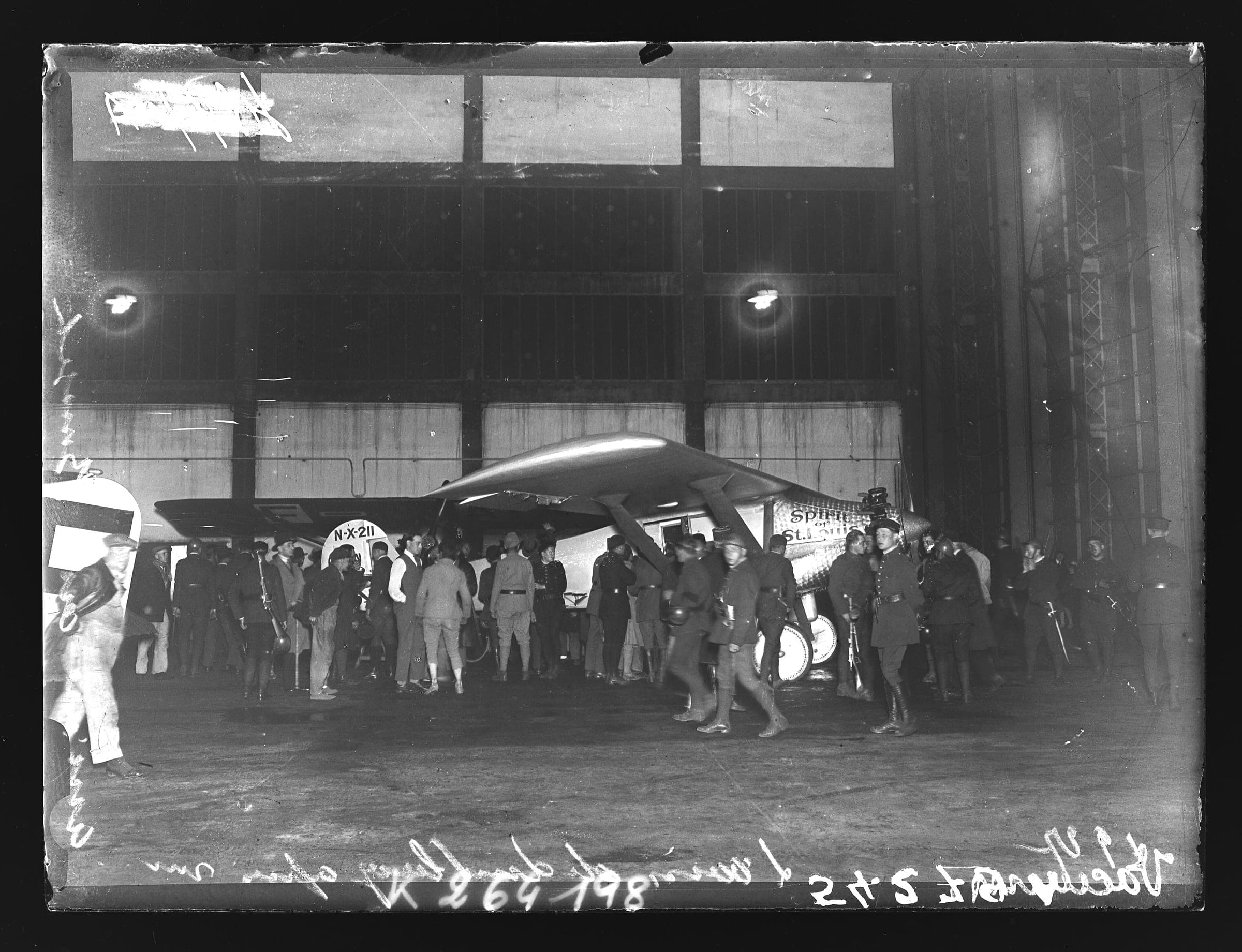
Lindbergh's Spirit of St. Louis inside a hangar at Le Bourget after its arrival, surrounded by onlookers (1927)
The next days turned the airport into a stage. The Spirit of St. Louis was pushed into a hangar under guard and admired by crowds, while Lindbergh was received by the President of the Republic, Gaston Doumergue, and fêted across the city. The flight made him a celebrity overnight on both sides of the Atlantic, and it made Le Bourget, for the rest of the interwar years, the place where long-distance flights were meant to end.
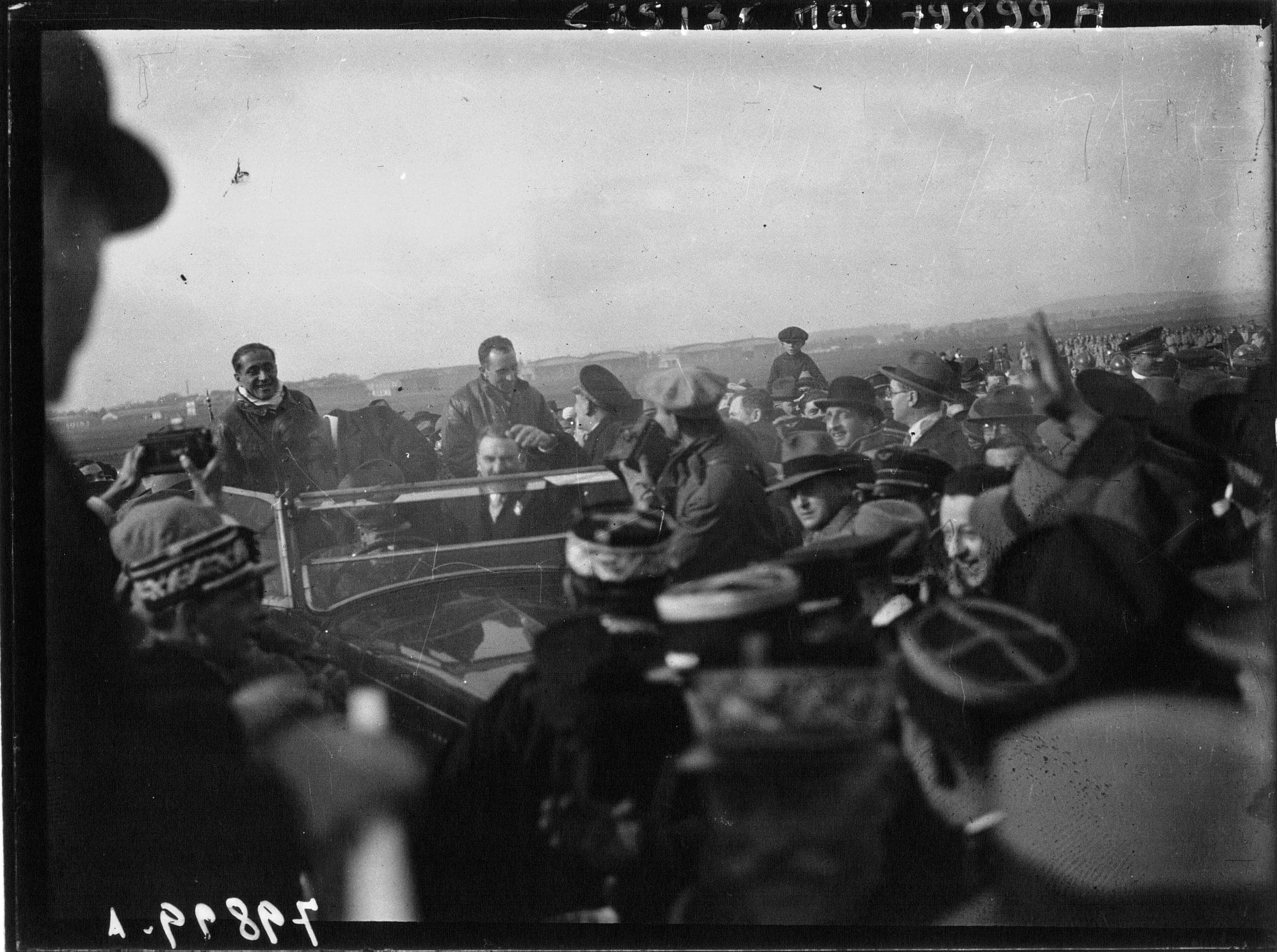
It was the start, too, of long flights heading west. On 1 September 1930, Dieudonné Costes and Maurice Bellonte took off from Le Bourget in a Breguet 19 named Point d'Interrogation and landed in New York the next day, the first non-stop flight from Paris to New York. When they came home in October the airport filled again, this time for a French crew. Their aircraft is now in the Musée de l'Air et de l'Espace, a short walk from where it left.
A dense crowd of officials and spectators at Le Bourget welcoming Dieudonné Costes and Maurice Bellonte in October 1930 (1930)
The airport has seen darker moments. In June 1940 Adolf Hitler landed at Le Bourget for his brief tour of conquered Paris. Two decades later, on 16 June 1961, the Soviet dancer Rudolf Nureyev broke away from his minders at the airport as the Kirov company prepared to leave for London, and asked for asylum in France.
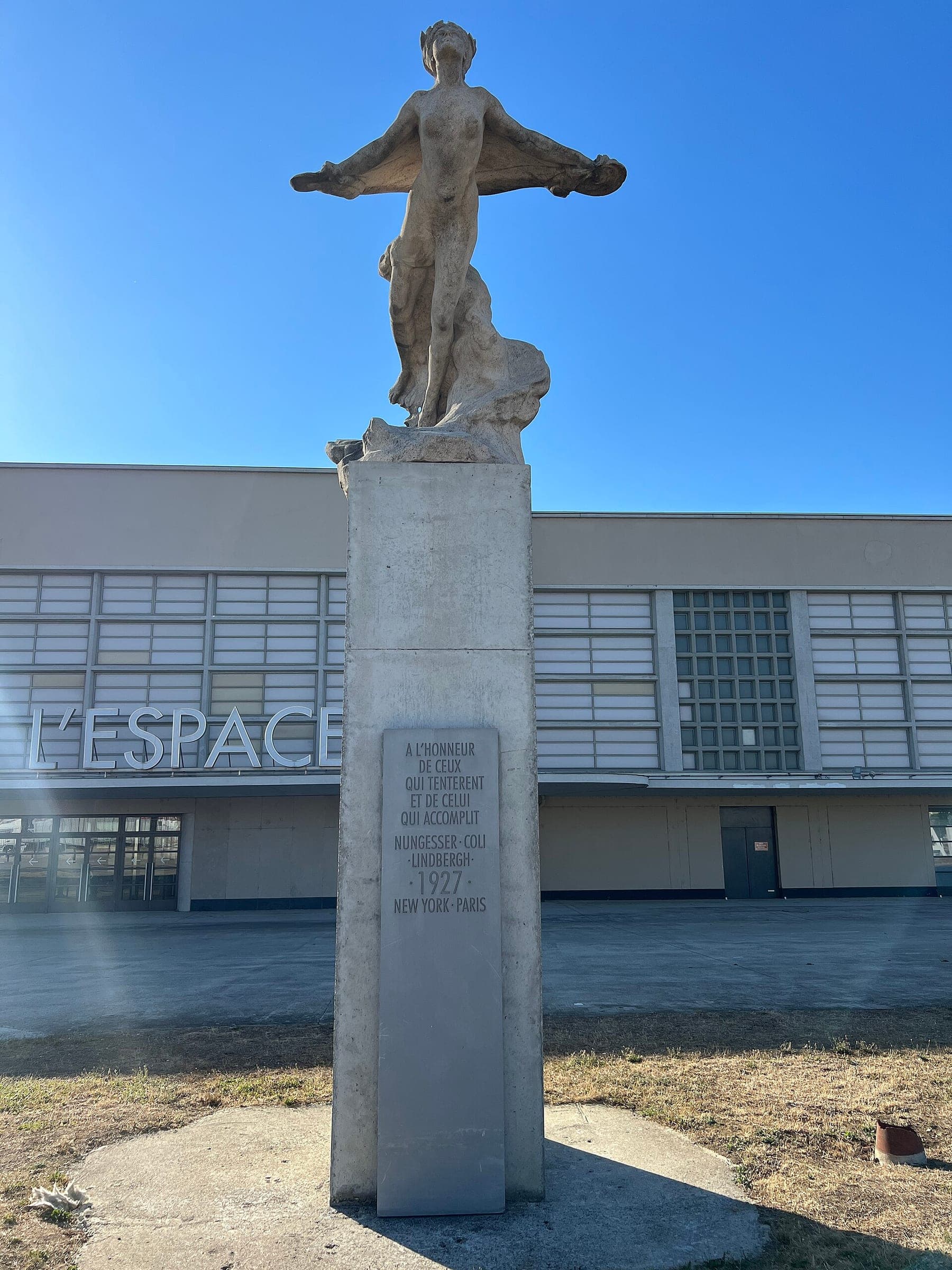
The monument to Nungesser, Coli and Lindbergh: a figure with outstretched arms on a tall stone plinth in front of the museum (2022)
And the Air Show has had its tragedies. On 3 June 1973, the Soviet Tupolev Tu-144 supersonic airliner broke up during its display and crashed into the village of Goussainville, killing its crew and people on the ground. A MiG-29 crashed during the 1989 show and a Sukhoi Su-30 in 1999; in both cases the pilots ejected and no one was killed.
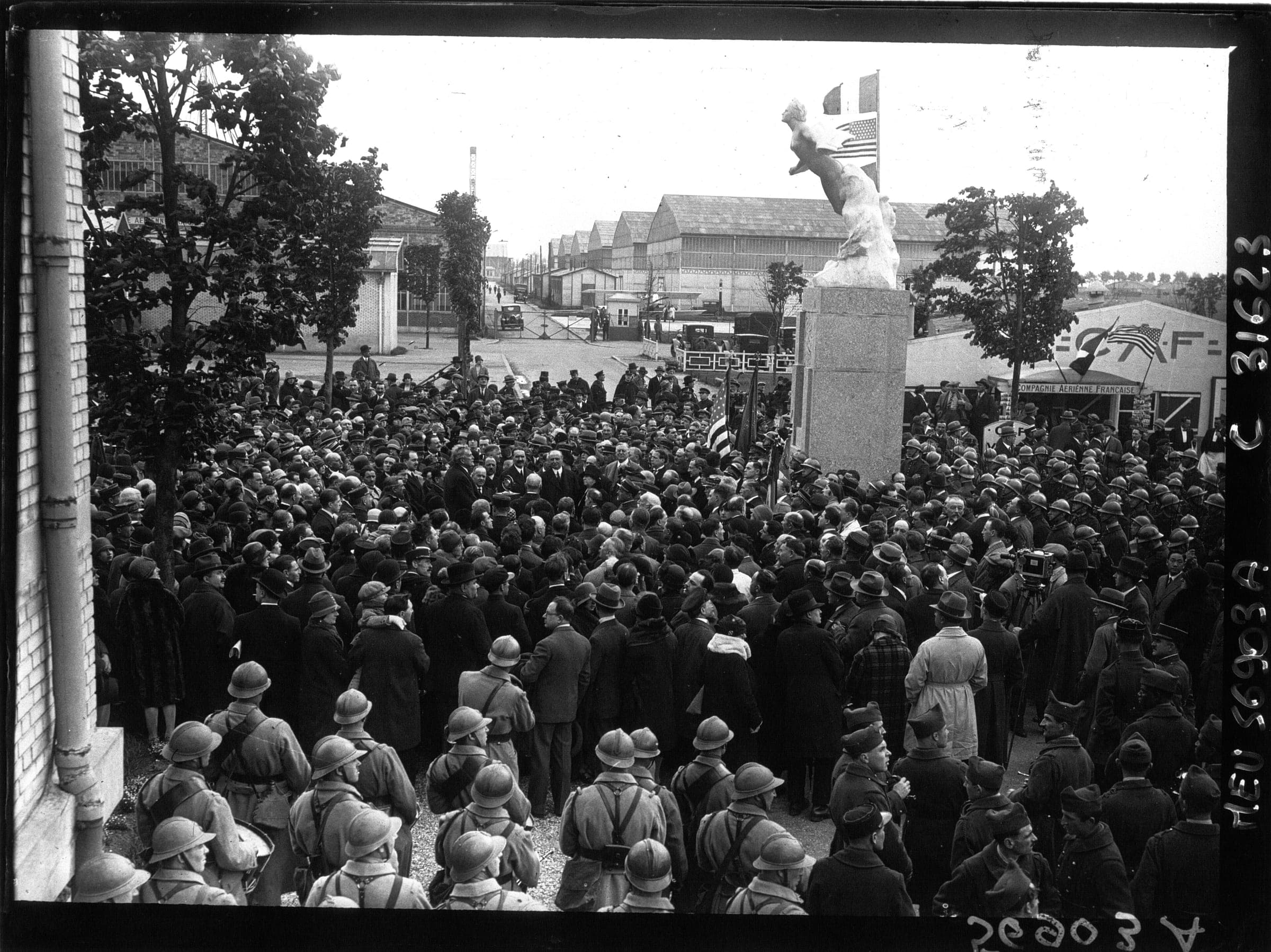
Crowds and soldiers at the unveiling of the monument to Nungesser, Coli and Lindbergh at Le Bourget, with the old hangars behind (1928)
The flights that began and ended here are remembered on the site. In 1928 a monument to Nungesser, Coli and Lindbergh was unveiled at Le Bourget before a large crowd, joining the two crossings of 1927 in one memorial. A monument to the three airmen stands in front of the museum today.
Place in world aviation
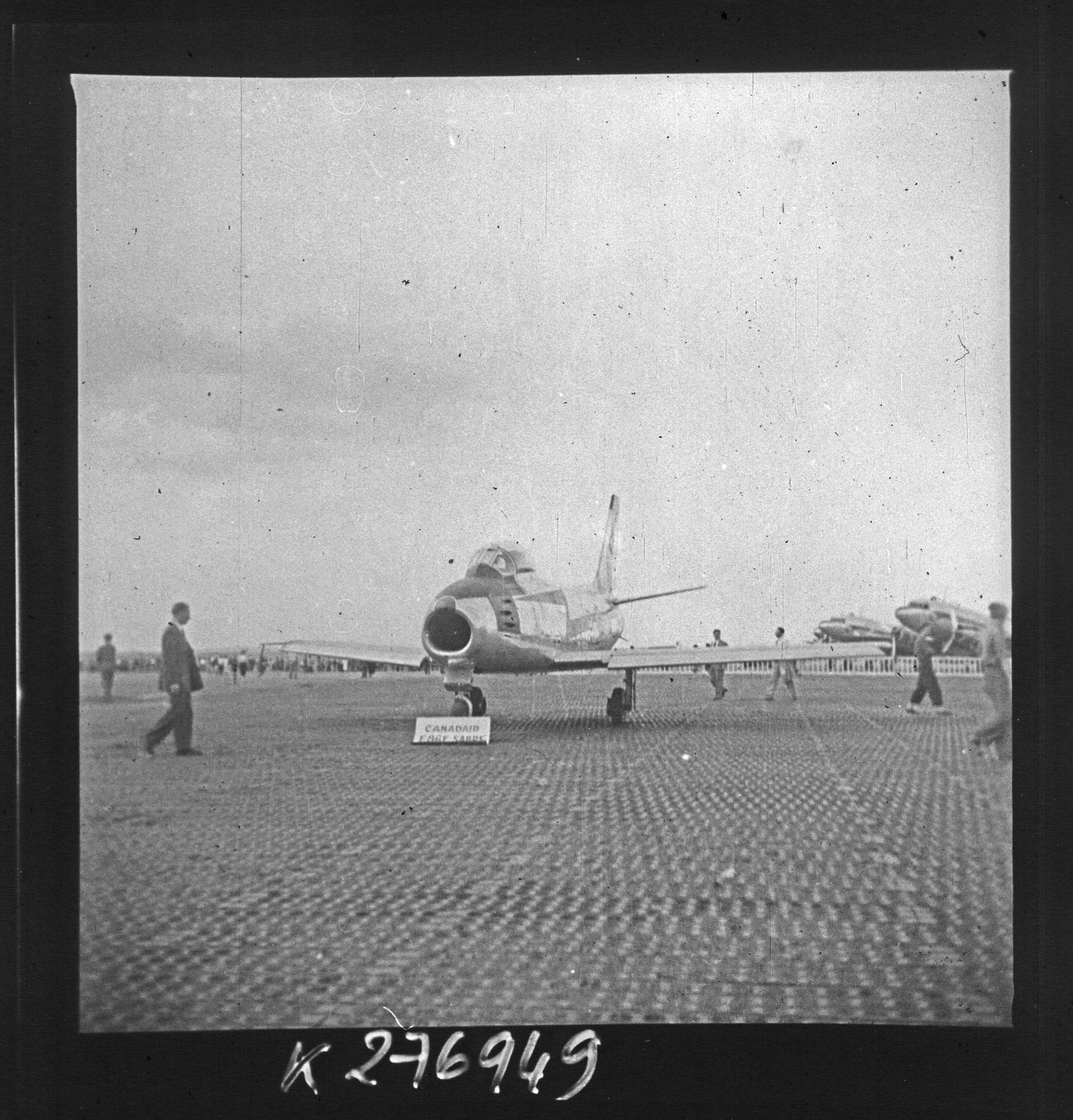
A swept-wing jet fighter displayed on the concrete at the twentieth Salon international de l'aéronautique, the first held at Le Bourget, in 1953 (1953)
Le Bourget matters to world aviation today less for the aircraft that use it than for the two institutions that share it. The first is the Paris Air Show, the Salon international de l'aéronautique et de l'espace. It is older than the airport: the first aeronautical exhibition was held in 1909 under the glass roof of the Grand Palais, when aircraft were shown like motor cars. After the Second World War the show moved out to airfields, and in 1953 it settled at Le Bourget for good. It has been held every two years, in odd-numbered years, ever since.
The show is organised by SIAE, a subsidiary of GIFAS, the French aerospace industries association, and measured by exhibitors and exhibition space it is the largest aerospace event in the world. The 2025 edition, from 16 to 22 June, brought together some 2,400 exhibitors from 48 countries and 141,000 trade visitors. The first four days are for professionals; at the weekend the public comes to watch the flying.
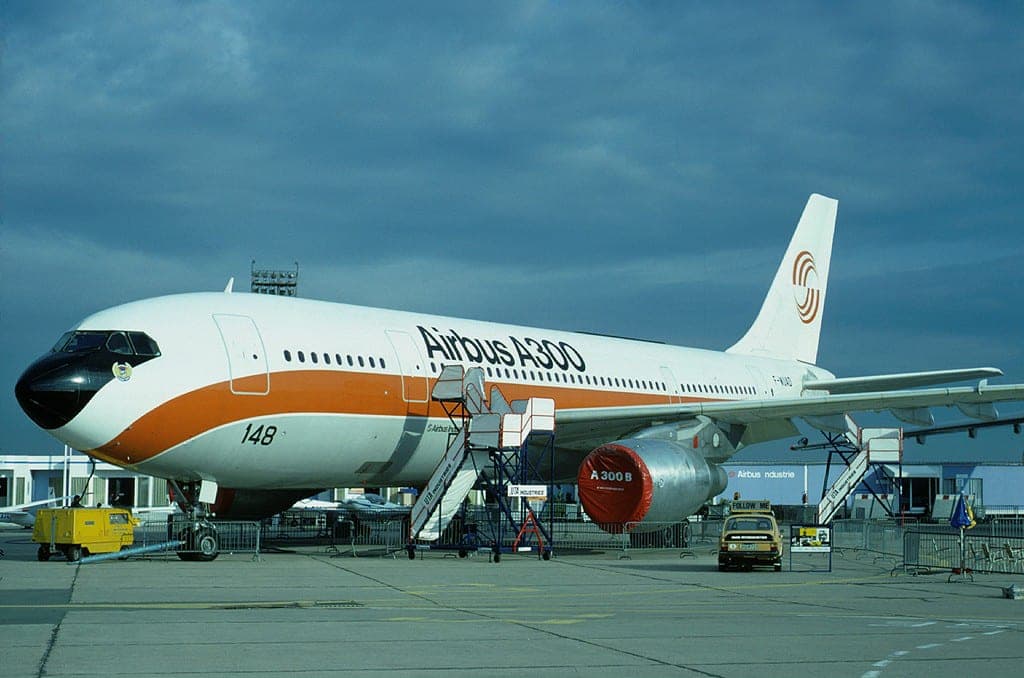
Airbus A300B2 F-WUAD in Airbus demonstration livery at Le Bourget during the 1977 show, with steps at the door and a follow-me car (1977)
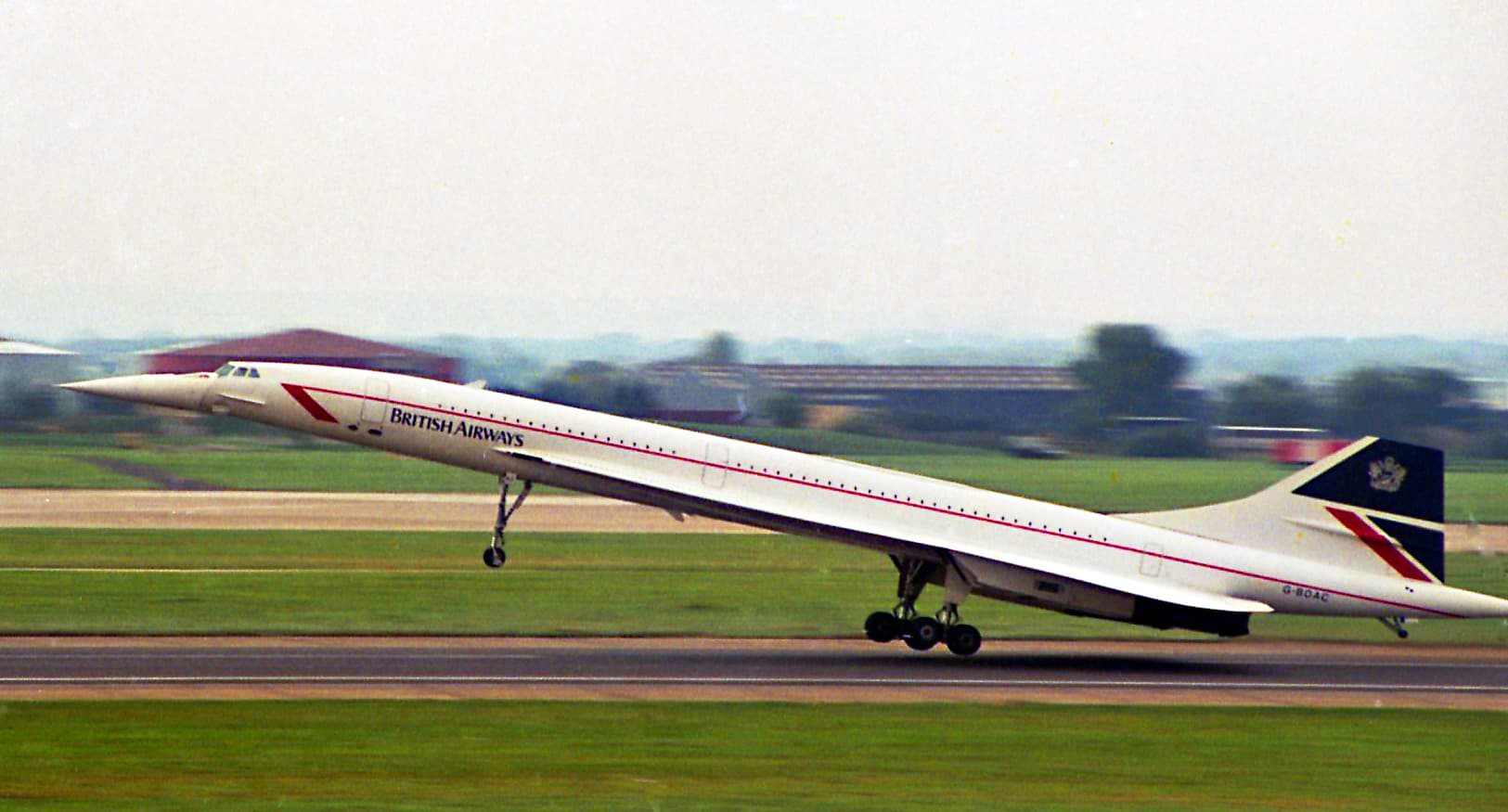
For seventy years the Salon has been where aircraft introduce themselves. Concorde made its first Paris appearance there in 1969 and its last in 2003. The Soviet Tu-144 came in 1971 and again in 1973, when it crashed. Airbus, the European consortium born in France, brought its first airliner, the A300, in its own demonstration colours in 1977. Every edition since has been a contest of order announcements between Airbus and Boeing, and between fighter makers competing for export contracts.
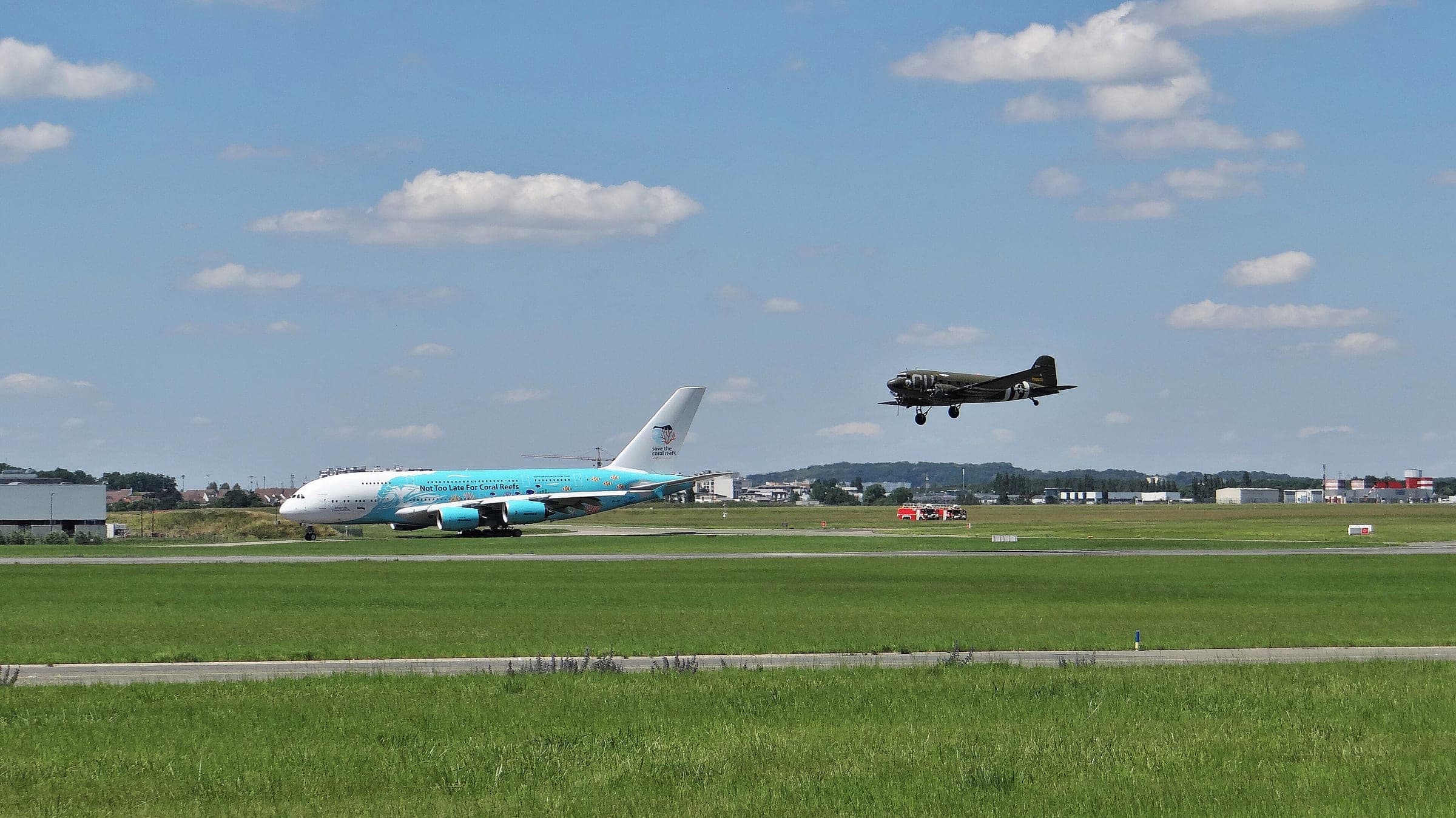
The runways built for airliners make that possible. During the show the airfield fills with aircraft of every size, from light aircraft to the A380, and veteran aircraft share the flying display with the newest types.
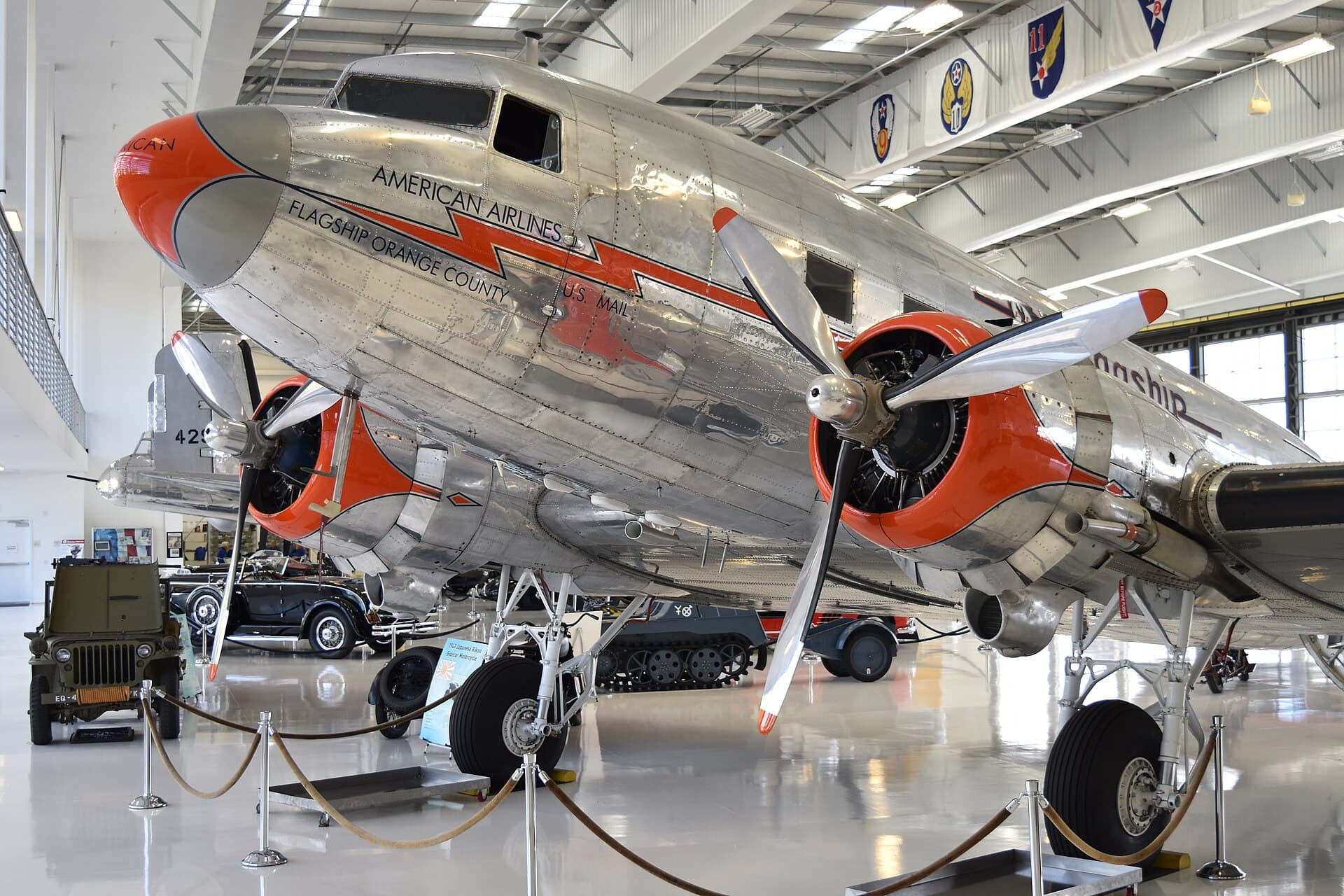
A vintage twin-engine piston airliner landing at Le Bourget during the 2019 Paris Air Show while an Airbus A380 taxis behind (2019)
The second institution is the Musée de l'Air et de l'Espace. It was founded in 1919 at Chalais-Meudon on the proposal of the engineer Albert Caquot and is one of the oldest aviation museums in the world. Its first hall at Le Bourget opened in 1975, and over the following decades the collection took over the 1937 terminal, the surrounding hangars and a large part of the apron.
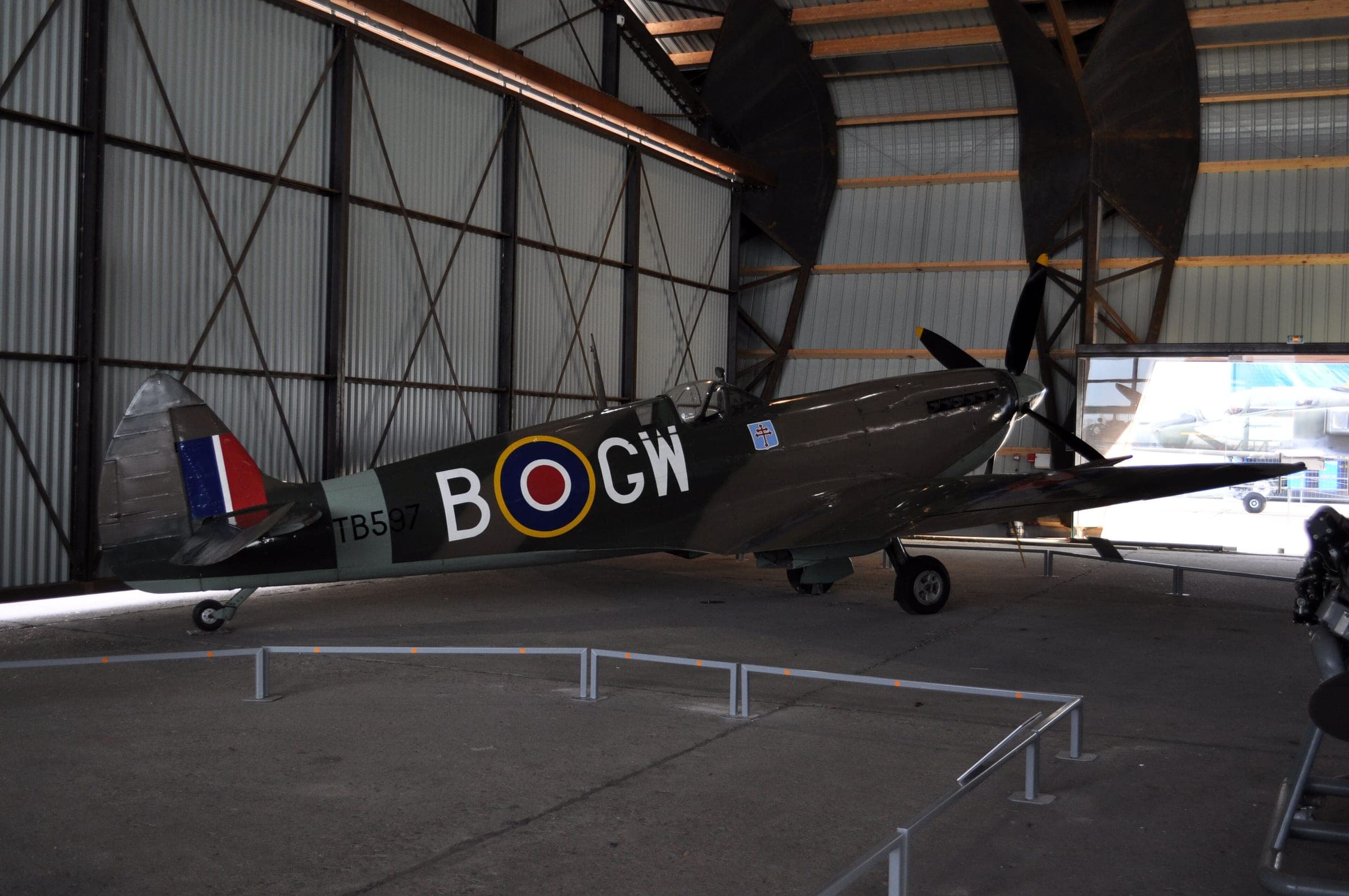
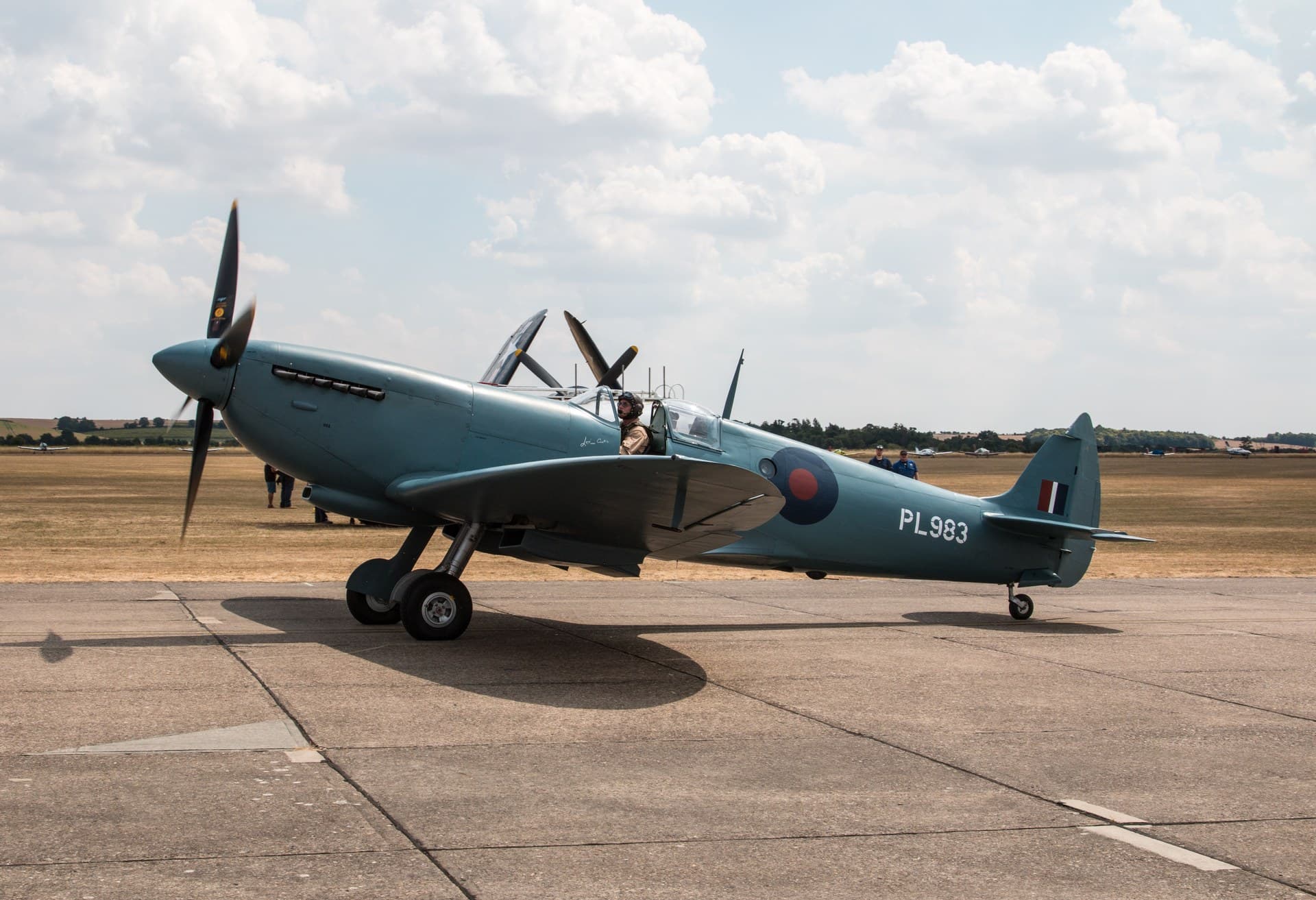
Supermarine Spitfire LF Mk XVIe in RAF markings 'GW-B' in the museum's Second World War hall (2015)
It now holds more than 19,000 items, including about 150 aircraft. The early hall covers the pioneers and the First World War, with a SPAD VII flown by Georges Guynemer. The Second World War is represented by aircraft on both sides, among them a Supermarine Spitfire and a North American P-51 Mustang. In the space hall are Ariane rockets and the Soyuz T-6 capsule in which Jean-Loup Chrétien became the first French astronaut.
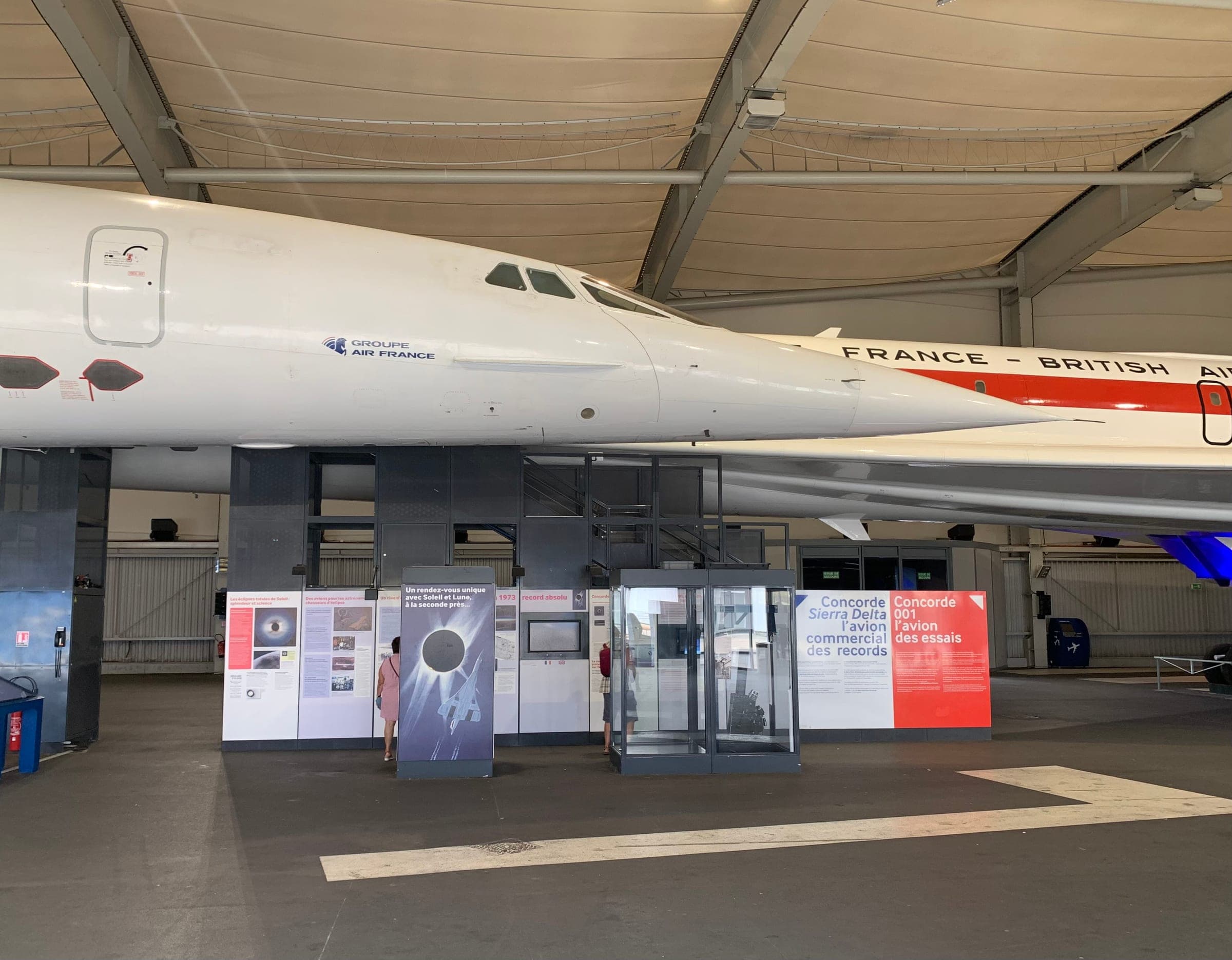
The noses of Concorde F-BTSD 'Sierra Delta' and the prototype 001 F-WTSS side by side in the museum's Concorde hall (2022)
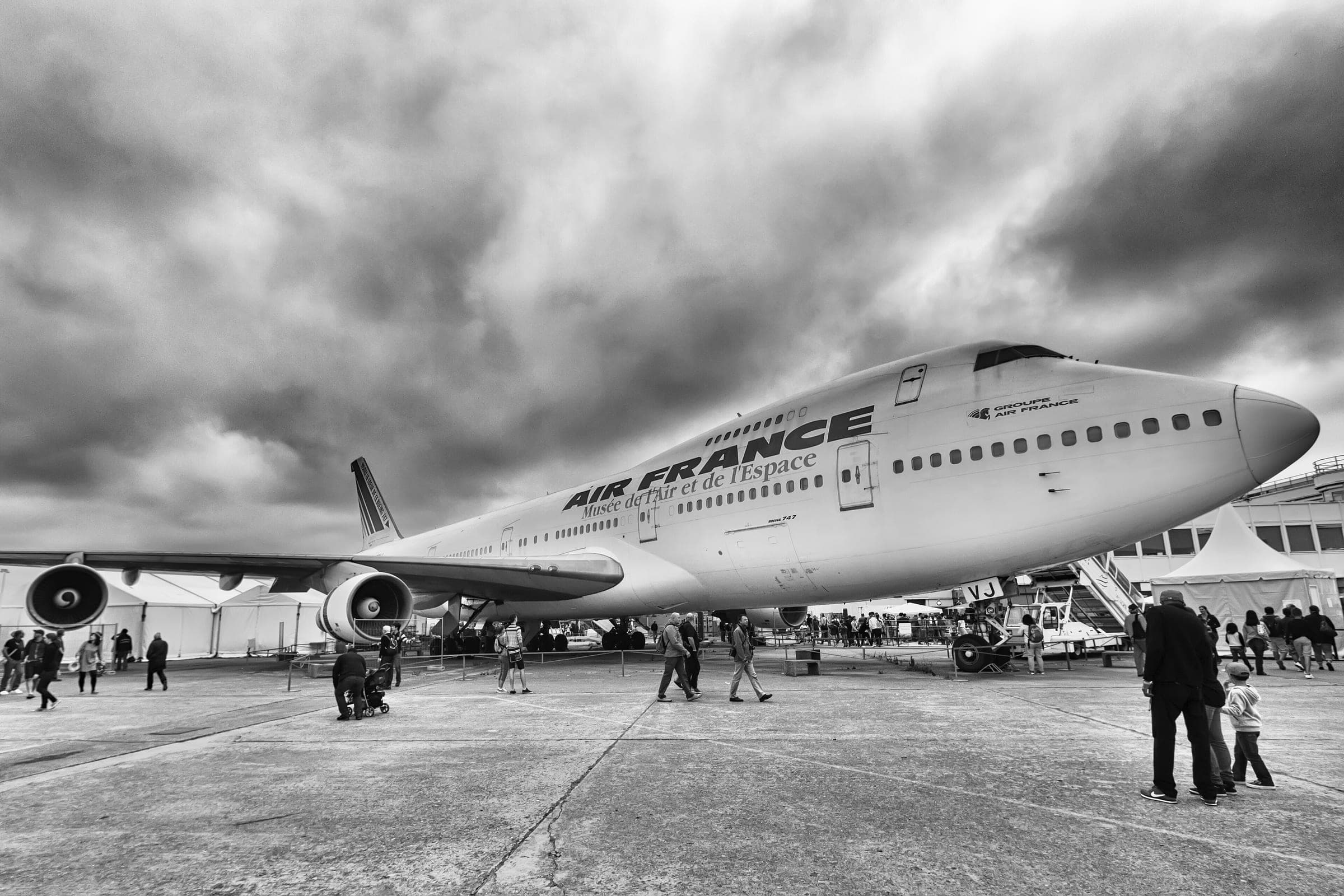
The Concorde hall holds two of them: the French prototype 001, F-WTSS, and F-BTSD 'Sierra Delta', an aircraft Air France flew in service. Outside, visitors can go aboard an Air France Boeing 747-128, the aircraft that made long-haul travel a mass market. A Douglas C-47 Dakota, the military DC-3, is also displayed, and since 14 February 2017 an Airbus A380 has joined the collection.
In 2025 the museum welcomed nearly 394,000 visitors. They walk from Nungesser and Coli's landing gear to the Point d'Interrogation of Costes and Bellonte to the Concordes, all within sight of the runways where the story played out.
The museum's Air France Boeing 747-128 on the Le Bourget apron under a heavy sky, visitors walking beneath its wing (2015)
That is Le Bourget's place in aviation. Paris's first airport made history in the 1920s and 1930s, lost its airlines to larger airports, and now keeps that history on show beside the business jets that still use its runways.
Runways
07/25
Length
9,843 ft
Surface
Paved
The main runway, and the one that takes the heavy aircraft flown in for the Paris Air Show.
03/21
Length
8,743 ft
Surface
Paved
09/27
Length
6,053 ft
Surface
Paved
Terminals
1937 terminal
Opened 1937 · Georges Labro
The Art Deco terminal that won the Air Ministry's 1935 competition and opened on 12 November 1937: a long, low stone building with tall glazed halls, a rotunda under a glass-block dome and a control tower above its curved terraces. It served airline passengers until scheduled services left for Orly and Roissy between 1977 and the early 1980s, and is now the core of the Musée de l'Air et de l'Espace.
Business aviation terminals
There is no single passenger terminal at Le Bourget today. Traffic is handled in eight business-aviation terminals run by specialist handling companies (FBOs), each with its own lounges, customs and apron, so that a passenger can go from car to aircraft in minutes.
Getting there
RER line B
Le Bourget station on the regional express line from central Paris, with a local bus onward to the airport and museum.
Tram-train T11 Express
The orbital tram-train stops at Le Bourget station, linking the airport's neighbourhood with the northern suburbs without passing through Paris.
Métro line 17 (under construction)
A station named Le Bourget Aéroport is being built on the Grand Paris Express line to Roissy, expected in 2027 to 2028.
A1 motorway
The airport lies beside the Autoroute du Nord between Paris and Roissy, the route most business passengers actually use.
Timeline
1914
A military airfield north of Paris
The fields at Le Bourget are taken over for the air defences of the Camp retranché de Paris.
1919
Opened to civil traffic
Le Bourget becomes Paris's airport, the base for the first regular services to London.
May 8, 1927
L'Oiseau Blanc takes off
Nungesser and Coli leave for New York and are never seen again.
May 21, 1927
Lindbergh lands
The Spirit of St. Louis arrives from New York after about 33 and a half hours, before a crowd of some 200,000.
September 1, 1930
Costes and Bellonte fly west
The Point d'Interrogation leaves Le Bourget for the first non-stop Paris to New York flight.
1933
Air France at Le Bourget
The newly formed national airline establishes its management on the field.
November 12, 1937
Labro's terminal opens
The Art Deco terminal from the 1935 competition is inaugurated.
June 1940
Occupation
The German occupiers take over the airfield for the Luftwaffe until the Liberation in 1944.
1952
Air France leaves for Orly
1953
The Paris Air Show settles at Le Bourget
June 16, 1961
Nureyev's defection
June 3, 1973
Tu-144 crash at the Air Show
1975
The museum's first hall opens
March 1977
International airlines leave
Scheduled international services move to Orly and Roissy; regional services follow at the start of the 1980s.
1994
The BEA moves in
2013
Hall of eight columns restored
February 14, 2017
An A380 joins the museum
June 2025
55th Paris Air Show
Some 2,400 exhibitors from 48 countries, 16 to 22 June.