Manufacturer
de Havilland
United Kingdom1920
The de Havilland Aircraft Company Limited
Company
- Country
- United Kingdom
- Headquarters
- Hatfield, Hertfordshire
Founding
- Founded
- September 1920Stag Lane Aerodrome, Edgware, north London
- How it was founded
- Formed with start-up money from George Holt Thomas, whose Airco had employed de Havilland as chief designer and had just collapsed.
- Founders
- Geoffrey de Havilland
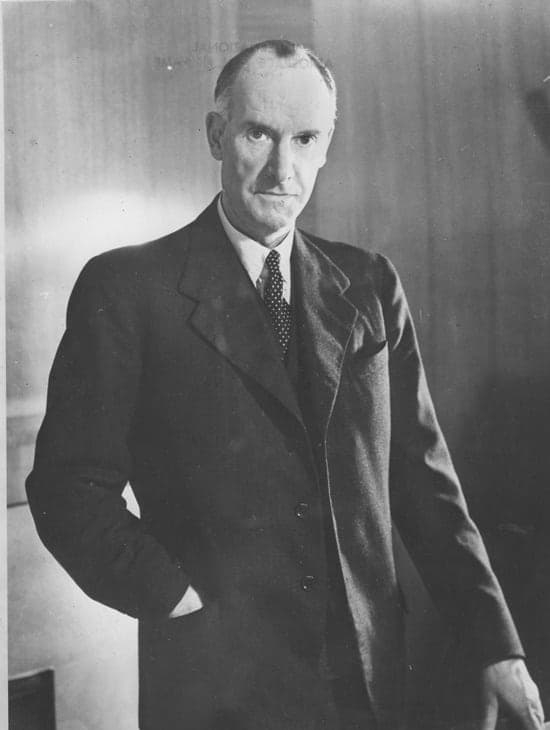
British aircraft and engine maker founded by Geoffrey de Havilland in 1920: the Moth, the Mosquito, the Vampire and the Comet, the first jet airliner.
The de Havilland Aircraft Company existed under its own name for barely forty years, from a rented corner of an aerodrome in north London in 1920 to its absorption into Hawker Siddeley in 1960. In that time it built the aeroplane on which a generation learned to fly, a wooden bomber that could outrun most of the fighters sent after it, one of Britain's first jet fighters, and the first jet airliner in the world. Few manufacturers have put as many landmarks into as short a life.
It was, unusually for a company of its size, the expression of one man's taste. Geoffrey de Havilland designed aircraft, test-flew them and ran the business that sold them, and he kept doing all three far longer than most founders do. The company's preferences were his: light structures, clean shapes, wood where others insisted on metal, and a habit of building a private venture first and persuading the customer afterwards. The Moth, the DH.88 racer, the Mosquito and the Comet were all, in different ways, arguments won against received opinion.
It was also an engine maker, a propeller maker and, later, a missile maker. The Gipsy piston engines that powered its light aircraft sold across the world, and the Goblin and Ghost jets that followed gave the company the rare ability to design an airframe and its powerplant under one roof. Overseas subsidiaries in Australia, Canada and New Zealand began as assembly shops for Moths and grew, in Canada's case, into a manufacturer that outlived its parent.
The story has a hard centre. In 1954 two Comets broke up in flight within three months, and the investigation that followed changed how every pressurised aircraft since has been designed and tested. De Havilland recovered technically but never commercially, and the independent company did not survive the reorganisation of British aviation at the end of the decade. The name did: it has been carried since 2019 by De Havilland Aircraft of Canada, which builds the Twin Otter and owns the Dash 8.
Origins
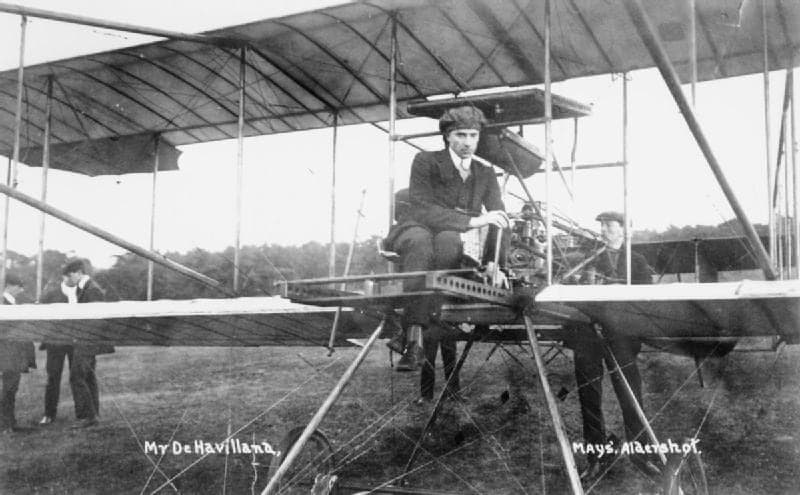
Geoffrey de Havilland was born in 1882, the son of a clergyman, and trained as an engineer. Like many young men of his generation he was drawn to motor cars and motorcycles before aeroplanes, and like very few of them he decided to build a flying machine with no one to teach him. With an advance of £1,000 from his maternal grandfather he designed and built a biplane, engine included, in a rented workshop in Fulham. In December 1909 he tried to fly it on the Highclere estate in Hampshire; after a short run the wing structure failed and the aircraft was wrecked.
He salvaged the engine and built a second, simpler biplane, which flew in September 1910. It was good enough for the War Office to buy it for £400, and with it came de Havilland himself, appointed designer and test pilot at the Army's Balloon Factory at Farnborough, soon renamed the Royal Aircraft Factory. There he worked on some of the first practical military aircraft in Britain, and learned the discipline of turning a design into something that could be built in numbers.
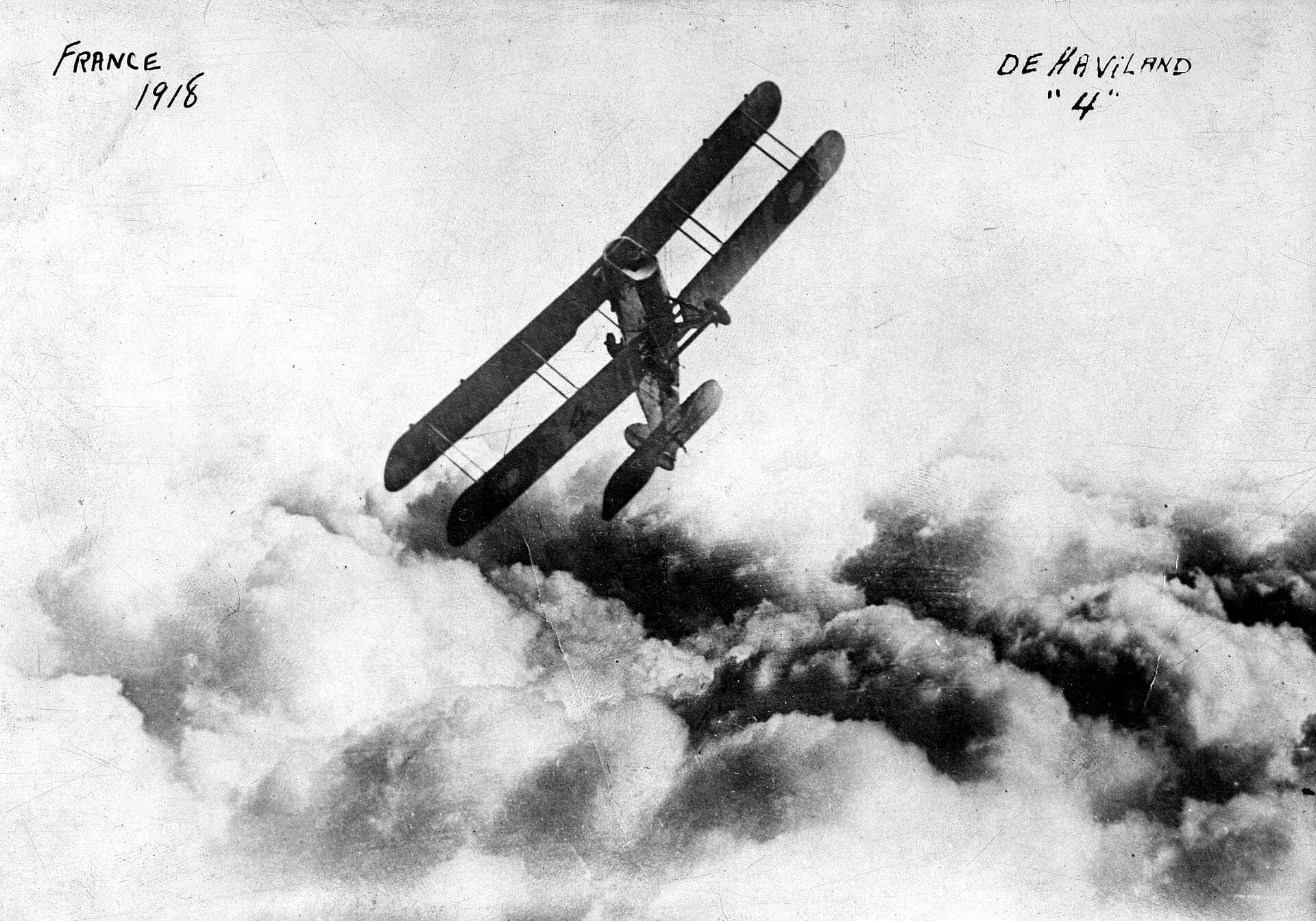
In May 1914 he moved to private industry as chief designer of the Aircraft Manufacturing Company, Airco, owned by George Holt Thomas. The war made Airco one of the largest aircraft firms in the world and made the initials DH famous. The DH.2 single-seat fighter, the DH.4 day bomber and the DH.9 that followed were built in thousands in Britain, and the DH.4 was put into mass production in the United States as well. Machines of de Havilland design are credited with some 30 per cent of all British and American aircraft of the war years.
Peace ruined Airco as quickly as war had built it. Orders collapsed, the company was sold, and in 1920 it failed. De Havilland decided to carry on alone. With a small group of colleagues from Airco and start-up money from Holt Thomas, he formed the de Havilland Aircraft Company in September 1920 and moved almost at once to Stag Lane, a modest grass aerodrome at Edgware. The first year's turnover was a little over £32,000. In 1922 the company bought the aerodrome outright for £20,000.
Expansion
The early years at Stag Lane were lean. The company built airliners in small numbers for the new cross-Channel services, took on repair work and ran a flying school, but it had no product that could sell in quantity. De Havilland's answer was to design one. He believed there was a market for an aeroplane simple and cheap enough for a private owner or a flying club, and in the DH.60 Moth, first flown on 22 February 1925, he built it: a small two-seat biplane with folding wings, so that it could be kept in a shed, and a four-cylinder engine of modest power.
The Moth arrived at the right moment. The Air Ministry was subsidising light aeroplane clubs across Britain, and the clubs wanted exactly this aircraft. It sold at home, then abroad, in versions with wooden and later metal fuselages, and it turned a word into a genus: for years afterwards any light biplane in Britain was liable to be called a moth. The company floated on the stock market in 1928 on the strength of it.
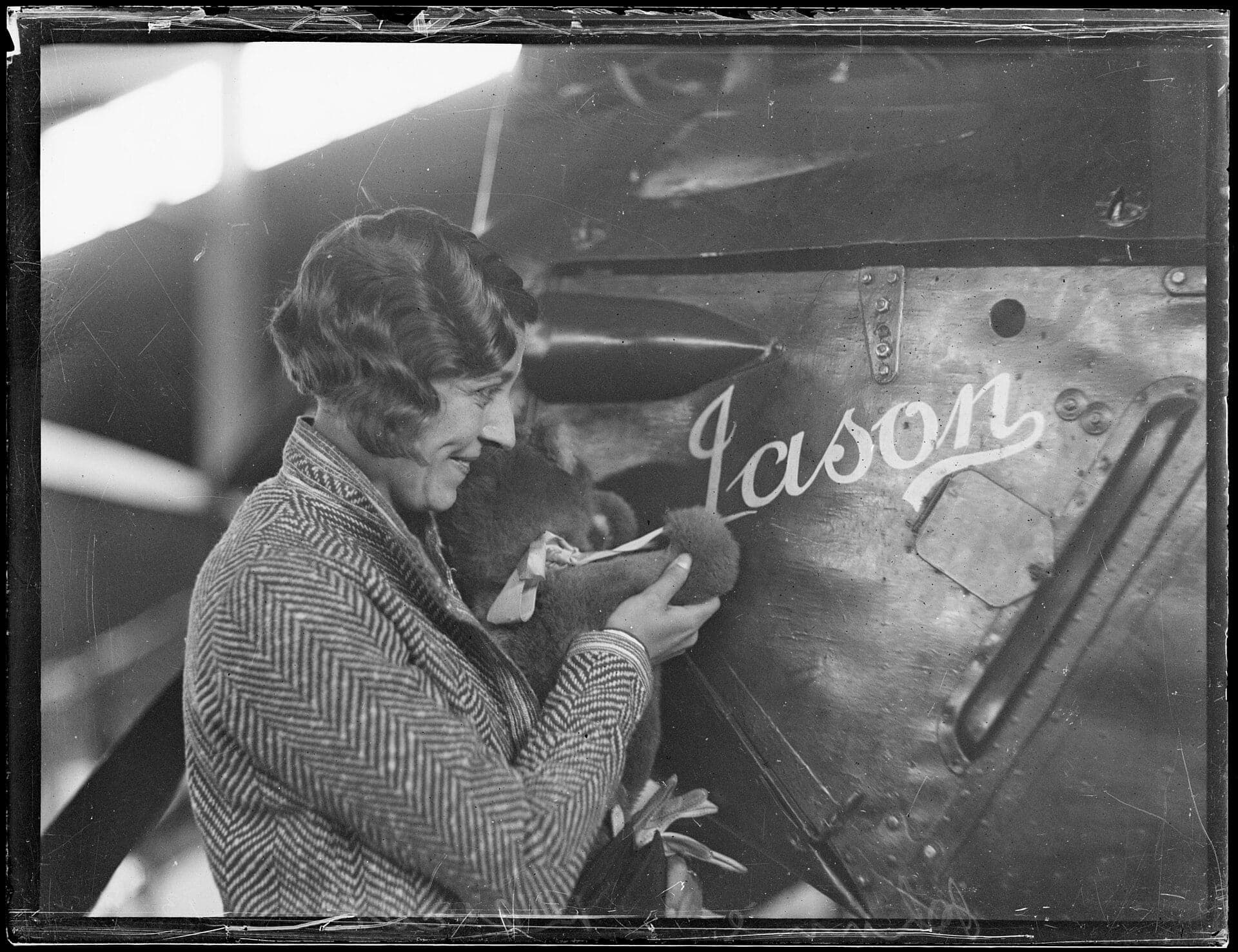
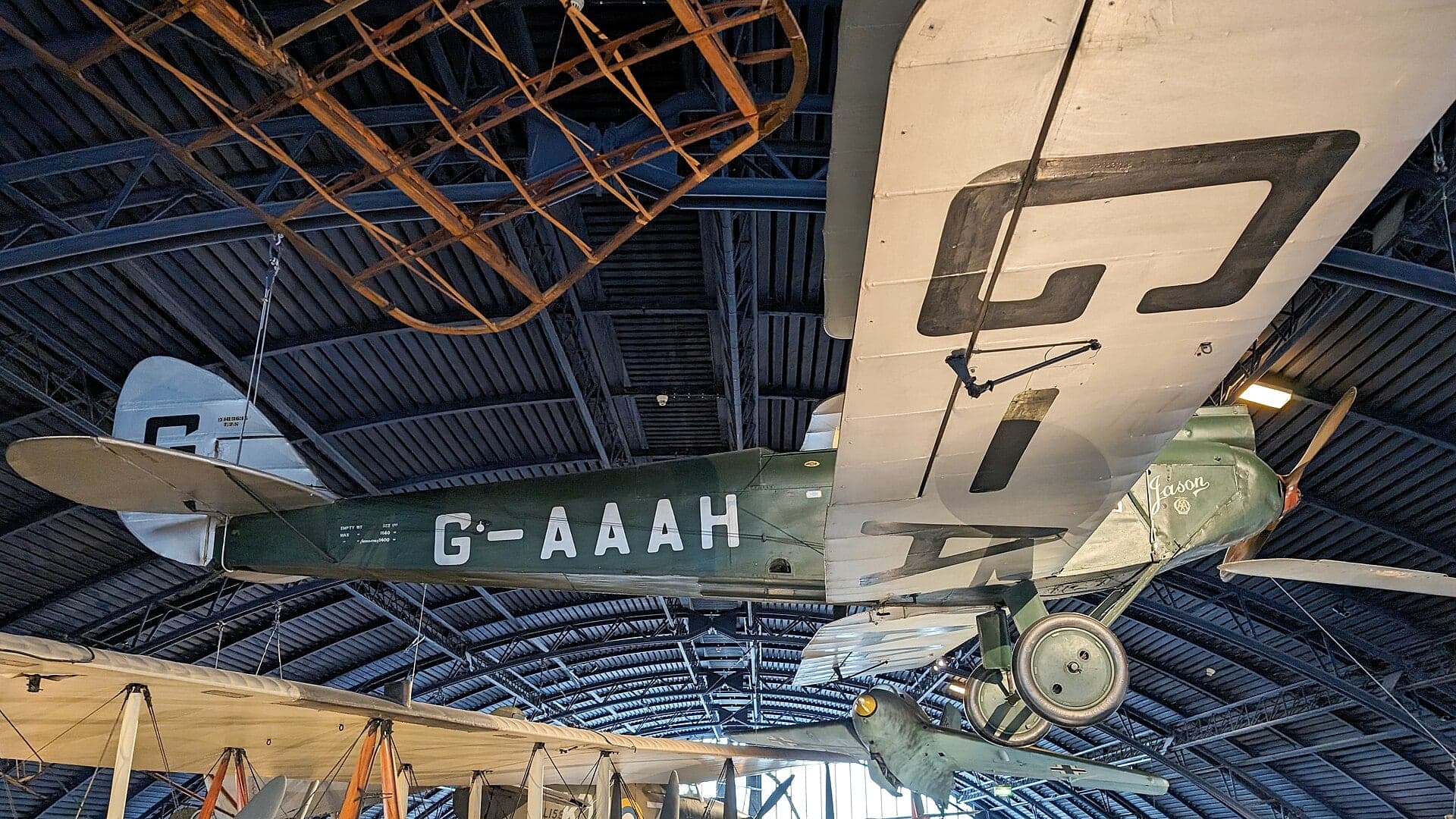
The Moth also carried the record flights that made aviation a popular sensation between the wars. The most famous was Amy Johnson's: in May 1930, with little long-distance experience, she flew a second-hand Gipsy Moth she had named Jason solo from Croydon to Darwin, the first woman to fly alone from England to Australia. The aircraft now hangs in the Science Museum in London.
Success outgrew Stag Lane. Housing was spreading around the aerodrome, and in 1930 the company established a new factory and airfield in open country beside the Great North Road at Hatfield, in Hertfordshire. The move was completed in 1934, and Stag Lane was sold for development except for a small site kept by the engine business. Hatfield would be de Havilland's home for the rest of its independent life.
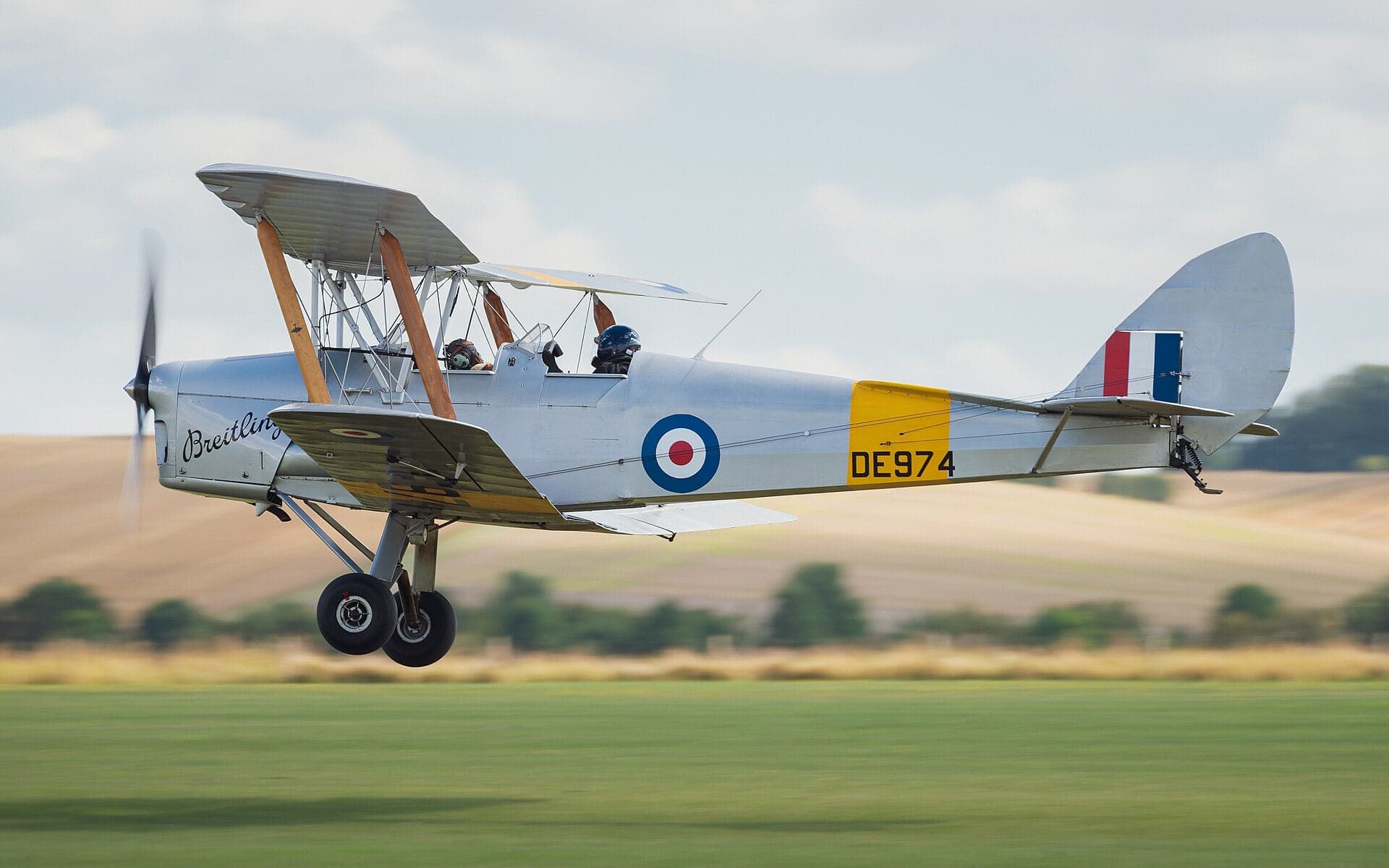
The aircraft that filled the new factory was the DH.82 Tiger Moth, first flown on 26 October 1931. It was a Moth reworked for military training, with the upper wing moved forward so that an instructor in the front seat could get out in a hurry wearing a parachute. The RAF made it its standard elementary trainer, and the Commonwealth air training schemes of the Second World War spread it across the Empire. When Hatfield was needed for other work, production moved to Morris Motors at Cowley, which built more than 4,000; total production of all Tiger Moths reached 8,868. A radio-controlled version, the Queen Bee, served as an anti-aircraft target.
Wartime production

By the late 1930s the Air Ministry wanted metal bombers bristling with gun turrets, and de Havilland proposed the opposite: a small, unarmed two-seat bomber built of wood, powered by two Rolls-Royce Merlins and relying on speed alone to survive. The idea was rejected more than once. The company went ahead with it as a private venture, and when the Ministry finally placed an order in 1940 it was for an aircraft that existed only on paper.
The design team worked away from Hatfield, in the moated manor of Salisbury Hall at London Colney, where the prototype W4050 was built in secret and taken by road to Hatfield for its first flight on 25 November 1940. It was faster than the fighters of the day. The prototype survives today in the de Havilland Aircraft Museum, on the very site where it was built.
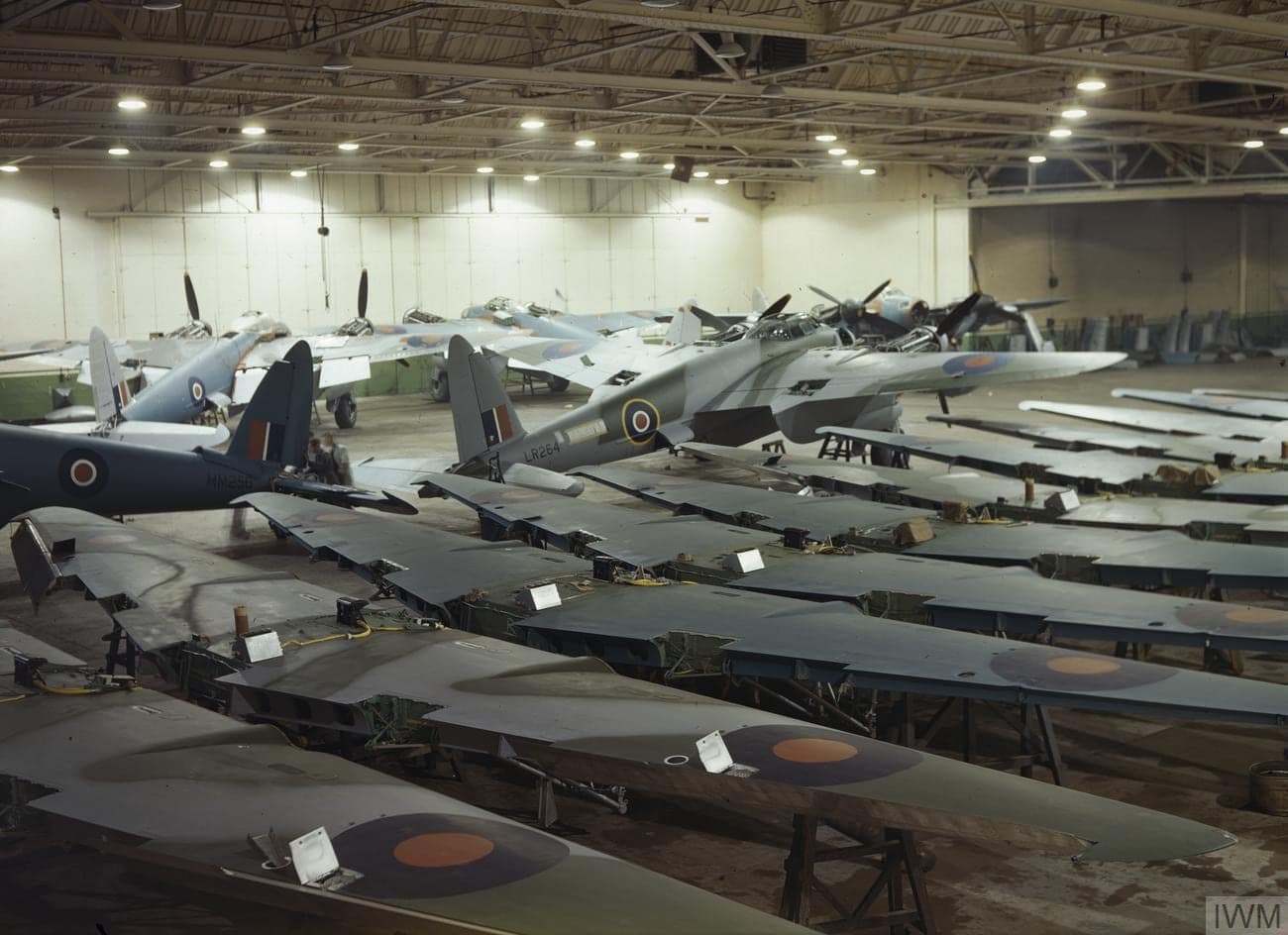
Wood was the Mosquito's real advantage. Its fuselage was a sandwich of birch ply over balsa, moulded in two halves; the skills and the materials came from furniture makers, piano factories and joiners' shops that the aluminium industry could not use. Components were made in small workshops across Britain and brought together at Hatfield and at other assembly lines, and production spread to Canada and Australia. Hatfield's capacity was so precious that Tiger Moth production was moved out to Morris Motors to make room.
The unarmed bomber became almost everything else as well: a photographic reconnaissance aircraft that ranged over the whole of occupied Europe, a night fighter, a fighter-bomber, a pathfinder for Bomber Command, an anti-shipping strike aircraft and even a fast transport for BOAC between Scotland and Sweden. By the time production ended after the war, 7,781 had been built.
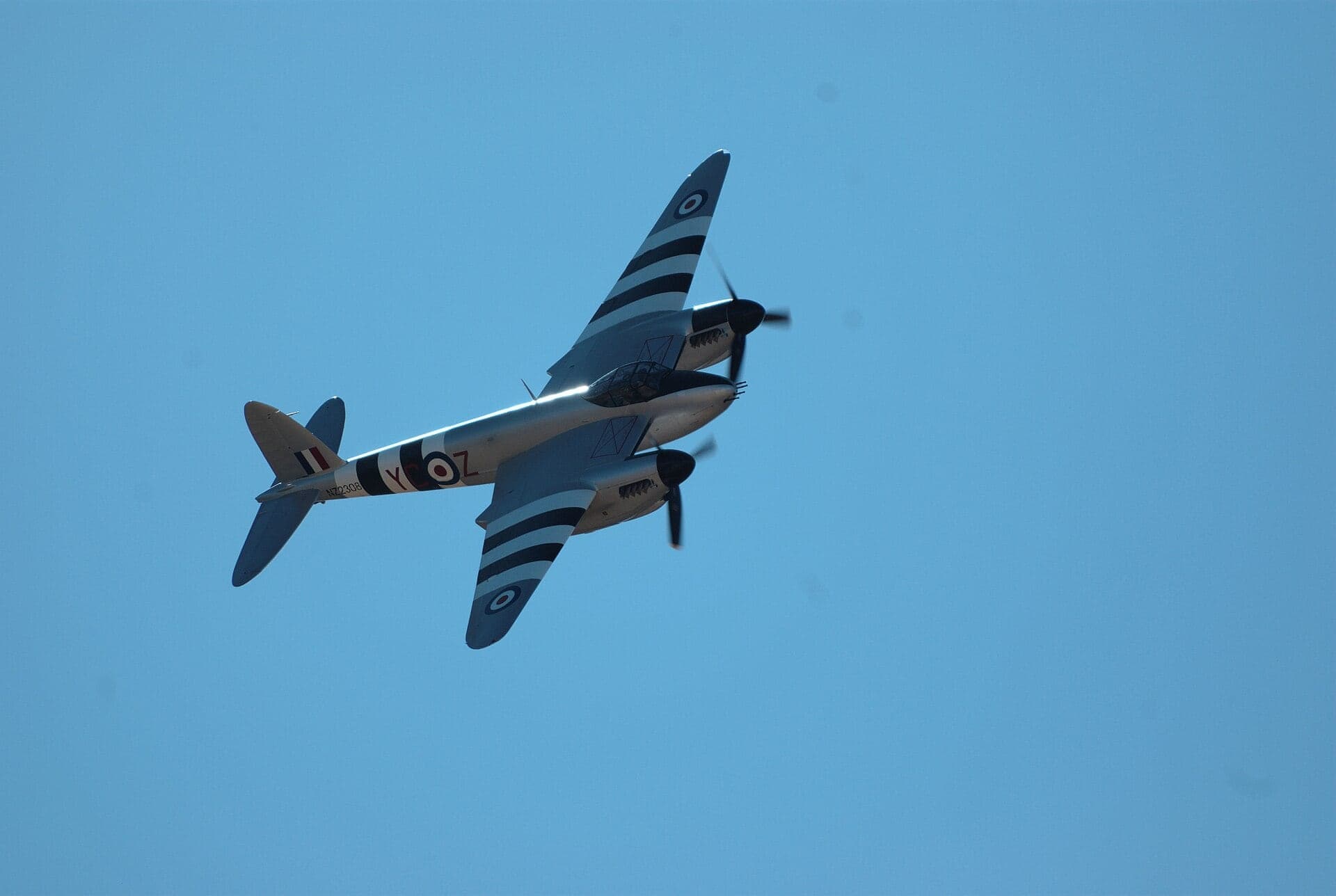
The war also enlarged the company. De Havilland took control of the Portsmouth manufacturer Airspeed in 1940, and its engine and propeller businesses became major suppliers in their own right. Above all, the Air Ministry asked it in 1941 to design a jet fighter, and Frank Halford a jet engine to power it.
The jet age
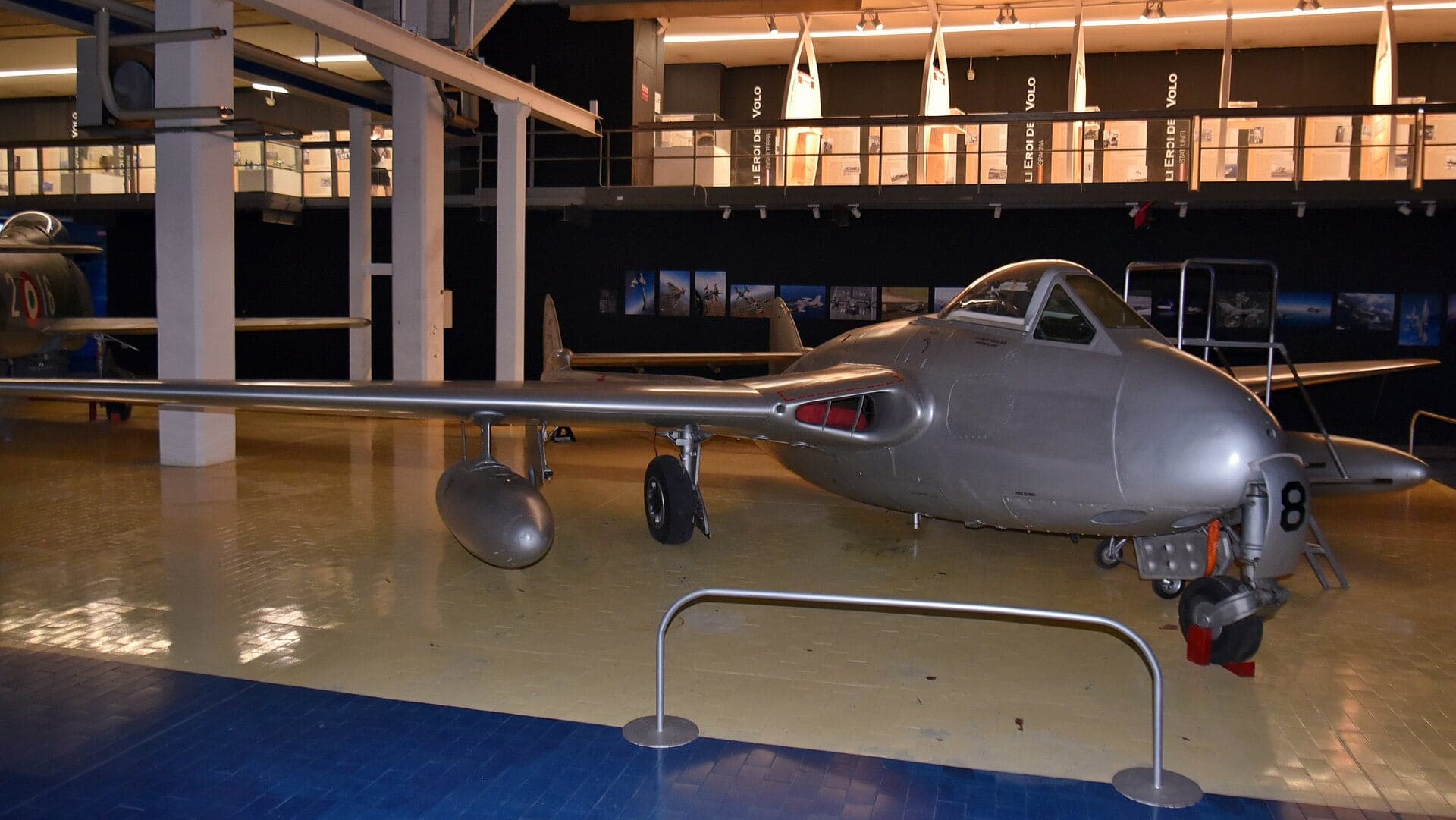
Halford's engine became the Goblin, and the fighter became the Vampire, which first flew on 20 September 1943. To keep the jet pipe short and the thrust losses small, the designers put the pilot and engine in a compact central nacelle and carried the tail on two slender booms: a layout that became the signature of de Havilland's jet fighters. The Vampire arrived too late for the war but served the RAF and some thirty other air forces afterwards, was built under licence abroad, and in December 1945 a navalised Sea Vampire made the first landing by a jet aircraft on an aircraft carrier. Its successors, the Venom and the carrier-borne Sea Vixen, kept the twin booms.
The jet age cost the founder dearly. His son Geoffrey de Havilland Jr, the company's chief test pilot, was killed on 27 September 1946 when the tailless DH.108 research aircraft broke up over the Thames Estuary; another son, John, had died in a wartime collision between two Mosquitoes. The founder, knighted in 1944, continued at the head of the company.
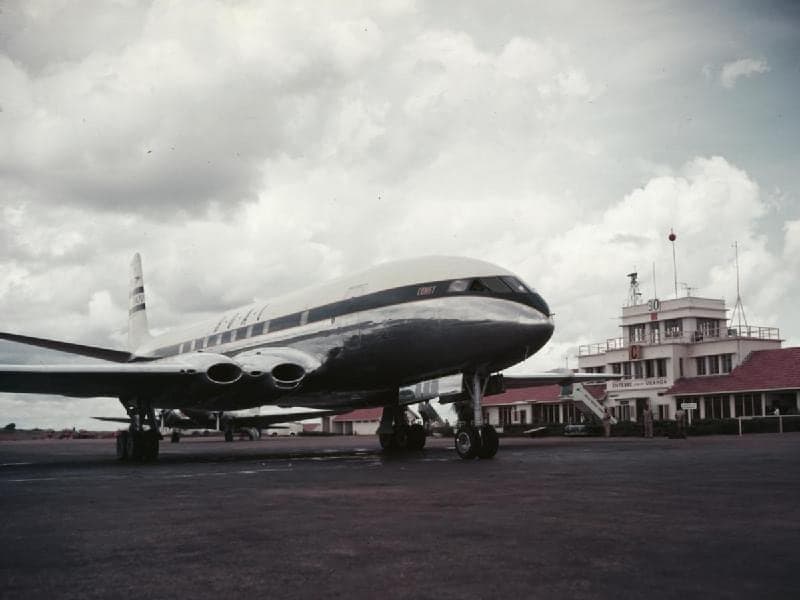
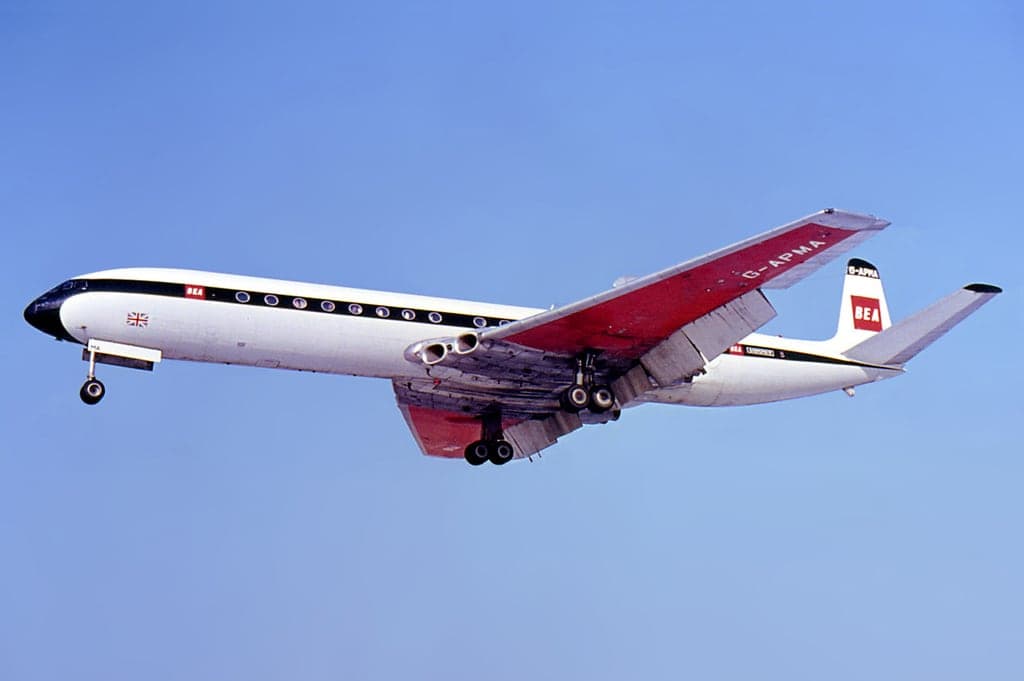
The company's great ambition was civil. The wartime Brabazon Committee had called for a jet-powered mail and passenger aircraft, and de Havilland, with the Goblin and its larger successor the Ghost in hand, took it on. The DH.106 Comet first flew at Hatfield on 27 July 1949, piloted by John Cunningham. It was a four-engined airliner with the engines buried in the wing roots, a pressurised cabin and a cruising altitude far above the weather that piston airliners had to fly through.
On 2 May 1952 BOAC's Comet G-ALYP left London for Johannesburg with fare-paying passengers, opening the world's first jet airliner service. Journey times fell by around half, and airlines in France, Canada and elsewhere placed orders. For a brief period Britain appeared to have a lead in civil aviation that American manufacturers would take years to close.
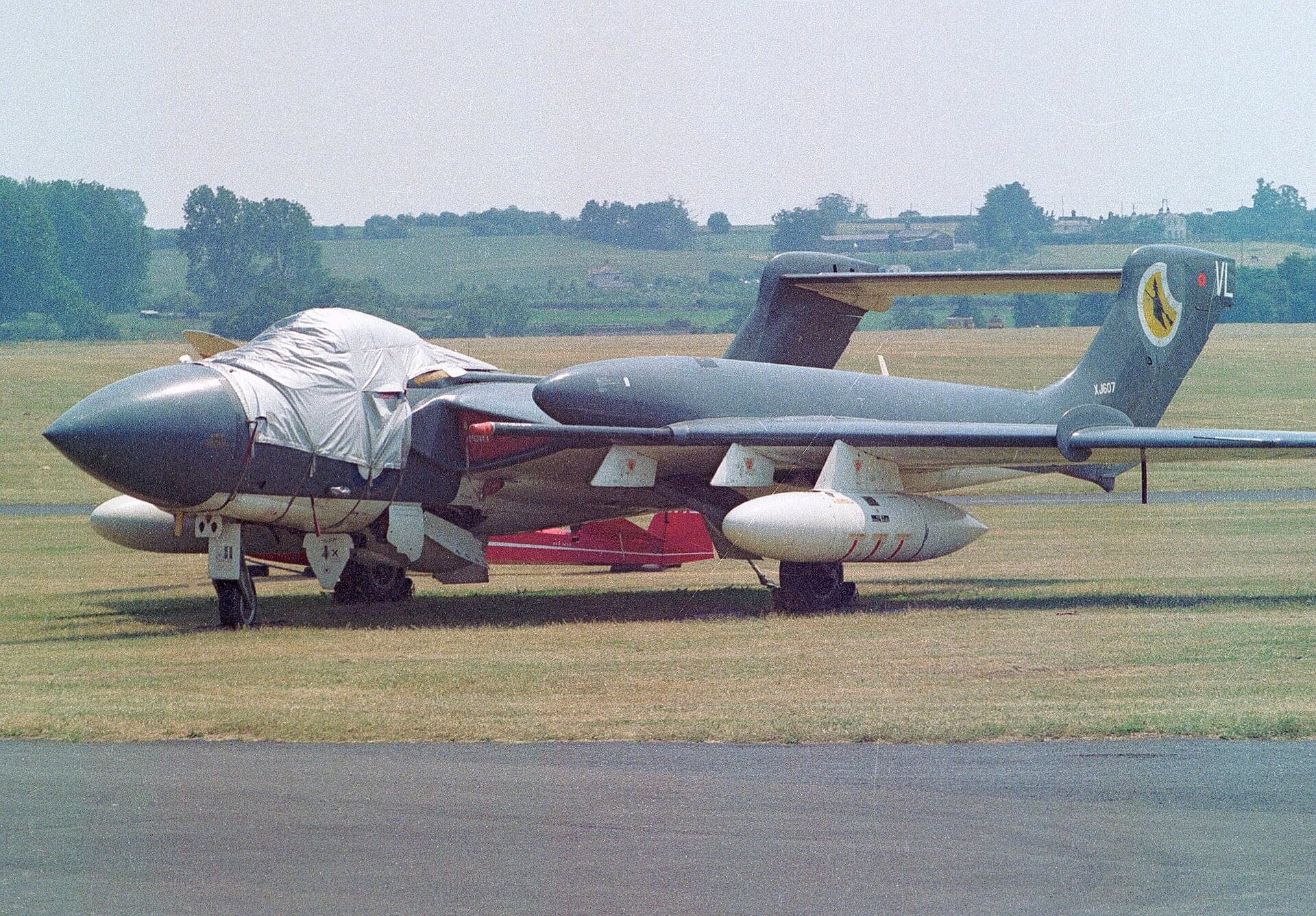
De Havilland also remained a major military supplier through the 1950s. Beyond the Sea Vixen, its propeller business developed the Firestreak air-to-air missile and later the Blue Streak ballistic missile, and its engine company supplied the Gyron and the Gnome turboshaft among others.
Products
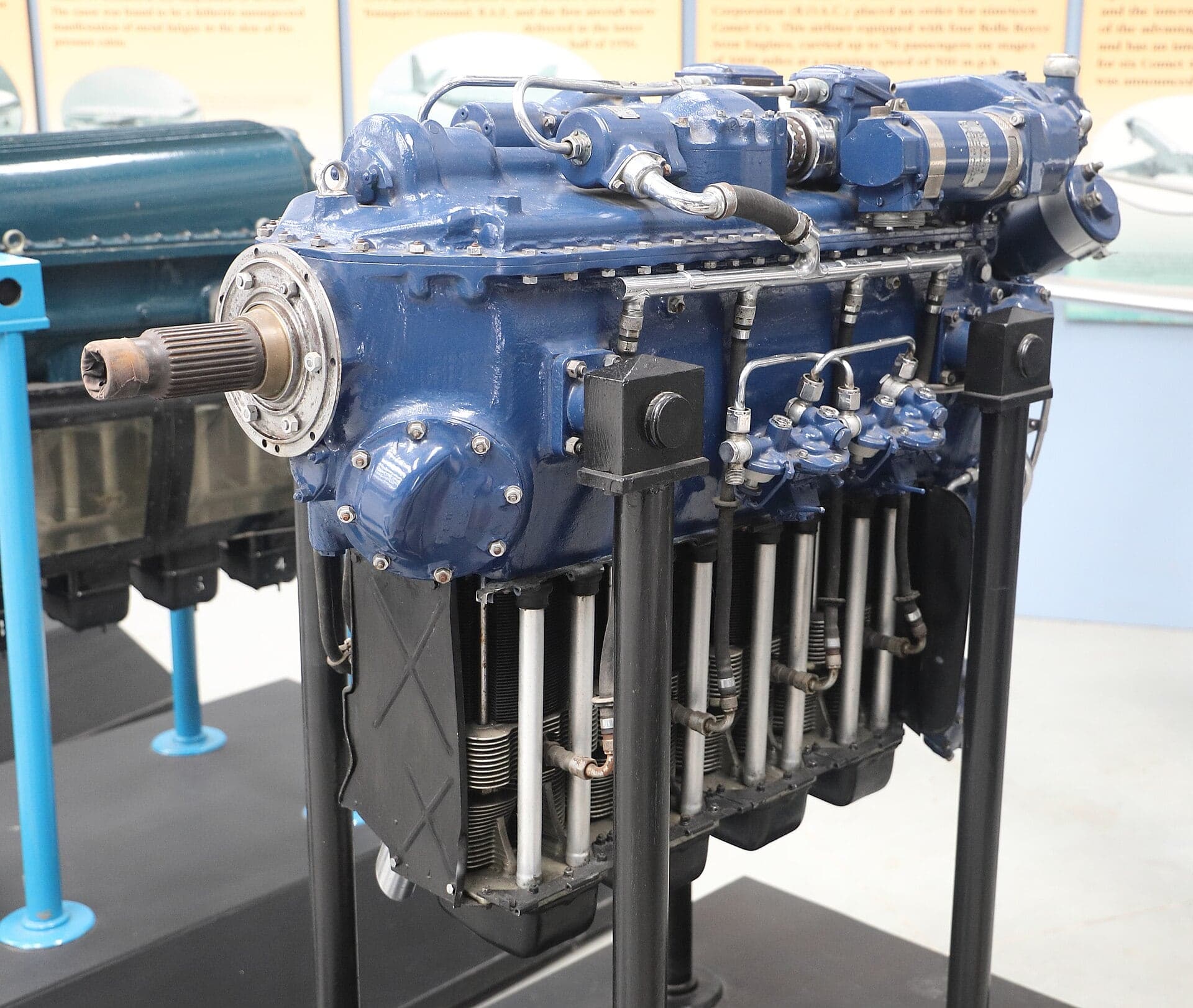
The first Moths flew on the ADC Cirrus, an engine made largely from surplus wartime parts, and supply of it was a constraint the company could not control. In 1927 de Havilland asked the engine designer Frank Halford to produce a replacement of its own. The result was the Gipsy, an air-cooled four-cylinder in-line engine, and the Moth fitted with it became the Gipsy Moth. From that point de Havilland was an engine manufacturer as well as an airframe one.
The line grew quickly. The Gipsy Major, with its cylinders inverted to give the pilot a better view over the nose, powered the Tiger Moth and a long list of other light aircraft, many of them not de Havilland's own. The six-cylinder Gipsy Six followed. Propellers were added in 1935, when a separate company began building variable-pitch designs under licence from Hamilton Standard, and in 1944 the engine side was formally established as the de Havilland Engine Company. By then it was working on jets.
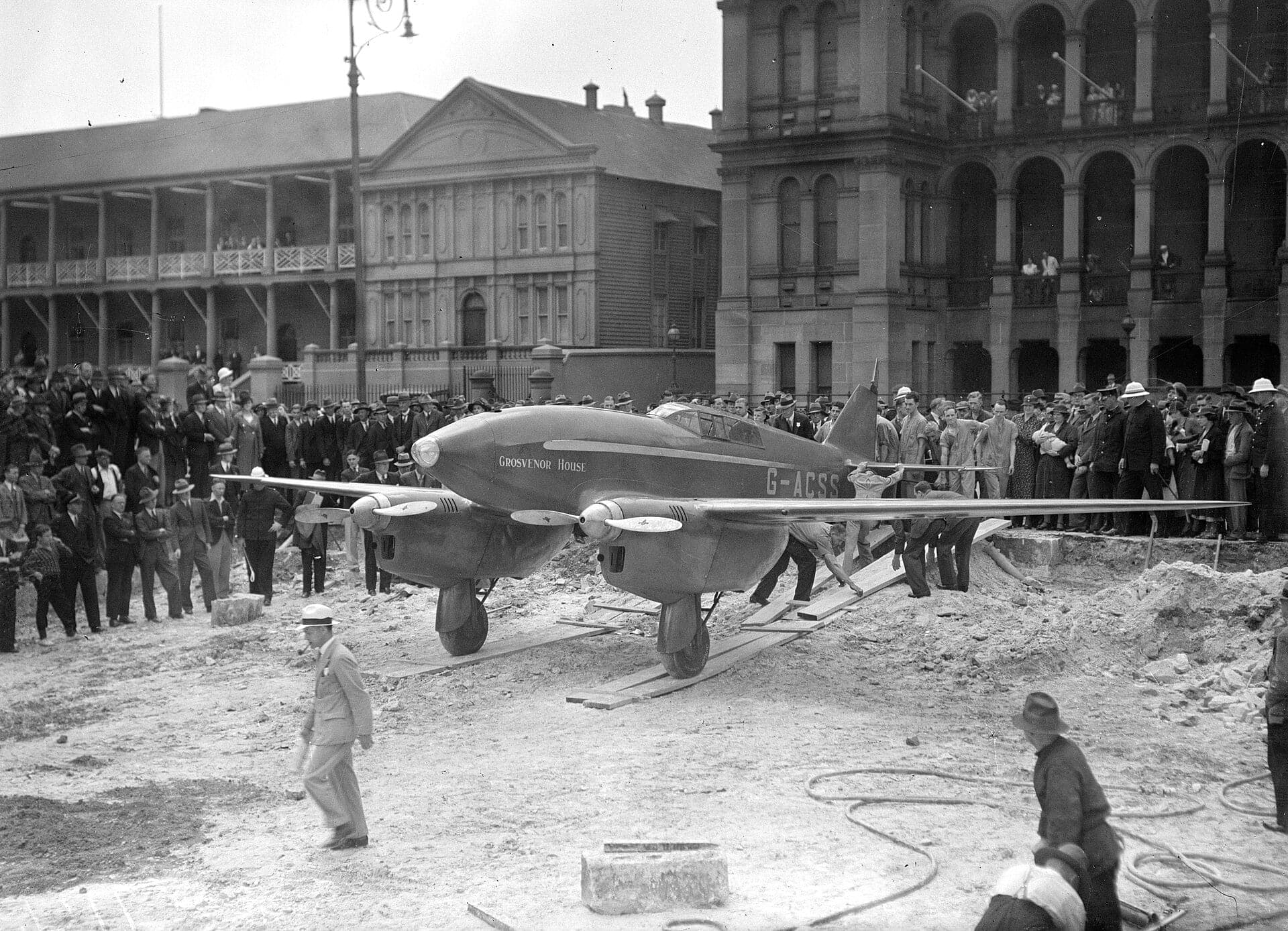
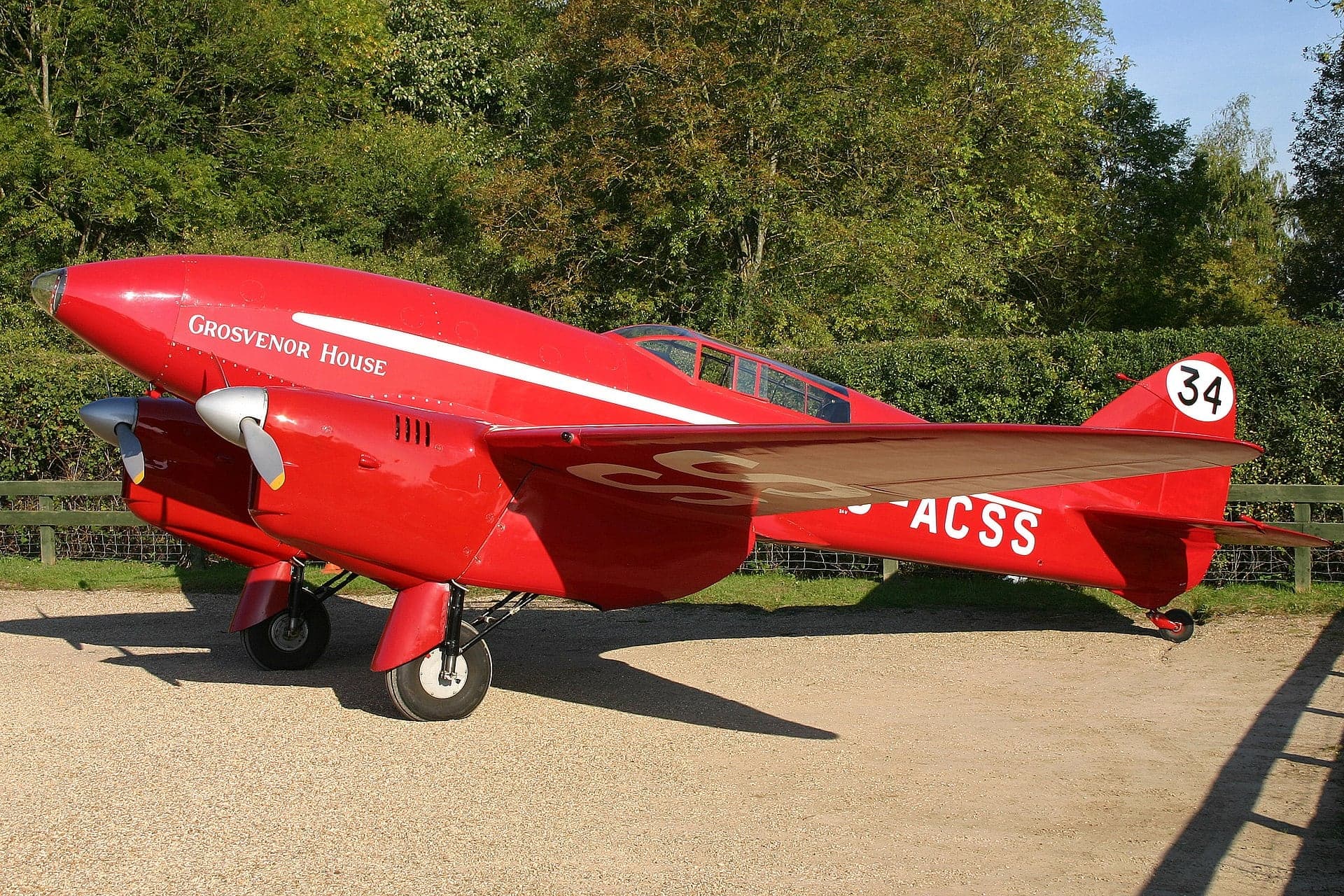
The Gipsy Six made possible the most glamorous aircraft the company ever built. In 1934 the Australian confectionery magnate Sir Macpherson Robertson put up prize money for an air race from England to Melbourne, and de Havilland offered a purpose-built racer at a fixed price to any British entrant who would order one before a deadline. Three were ordered. The DH.88 Comet was a slim twin-engined monoplane built almost entirely of wood, with a retractable undercarriage and the crew seated in tandem far back in the fuselage. Only five were ever made.
The race started from Mildenhall at dawn on 20 October 1934. The red Comet G-ACSS, named Grosvenor House and flown by Charles Scott and Tom Campbell Black, reached Melbourne in 70 hours 54 minutes and won the speed prize outright. The lesson of the race was not lost on de Havilland: a clean wooden airframe with modest engines could be very fast indeed. G-ACSS survives with the Shuttleworth Collection.
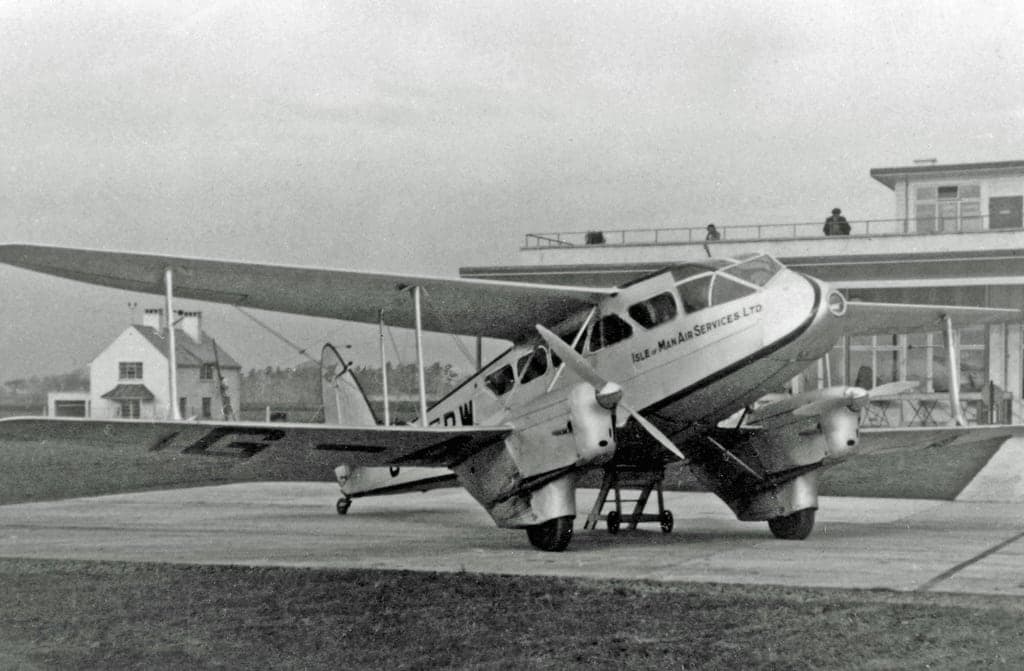
The everyday business of the 1930s was smaller airliners. The DH.84 Dragon, the four-engined DH.86 and the DH.89 Dragon Rapide were twin- and four-engined biplanes built for the short routes of Britain's new internal airlines and for operators across the Empire. The Rapide in particular was cheap, easy to fly and able to use rough fields, and it was built in hundreds and flown for decades. At the other end of the range the DH.91 Albatross of 1937 was an elegant four-engined wooden monoplane airliner, a further step on the path that led to the Mosquito.
Manufacturing
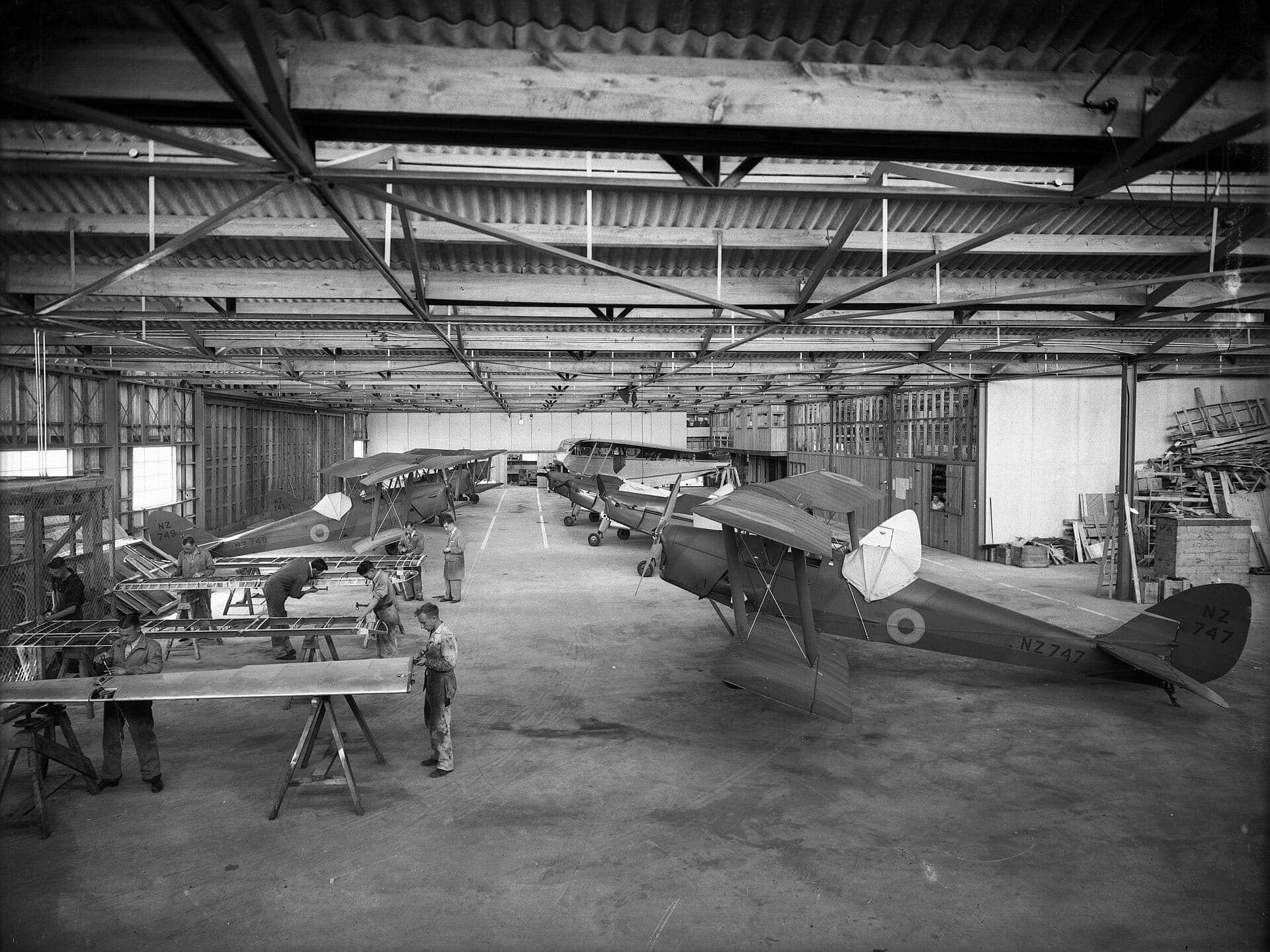
The Moth took de Havilland abroad early. Its first overseas subsidiary was set up in Melbourne in March 1927 to sell aircraft and supply parts, and de Havilland Aircraft of Canada followed in 1928, first at De Lesseps Field in Toronto and from 1929 at Downsview. A New Zealand company was formed in March 1939 at Rongotai, Wellington. In each case the original purpose was modest: to assemble British-built Moths close to their customers.
The Second World War turned the assembly shops into factories. De Havilland Australia moved to Sydney, built a new works at Bankstown and by 1945 had produced more than a thousand aircraft, mostly Tiger Moths, before going on to build 212 Mosquitoes. De Havilland Canada built Tiger Moths for the Commonwealth air training plan and then Mosquitoes at Downsview. New Zealand built Tiger Moths for its own air force.
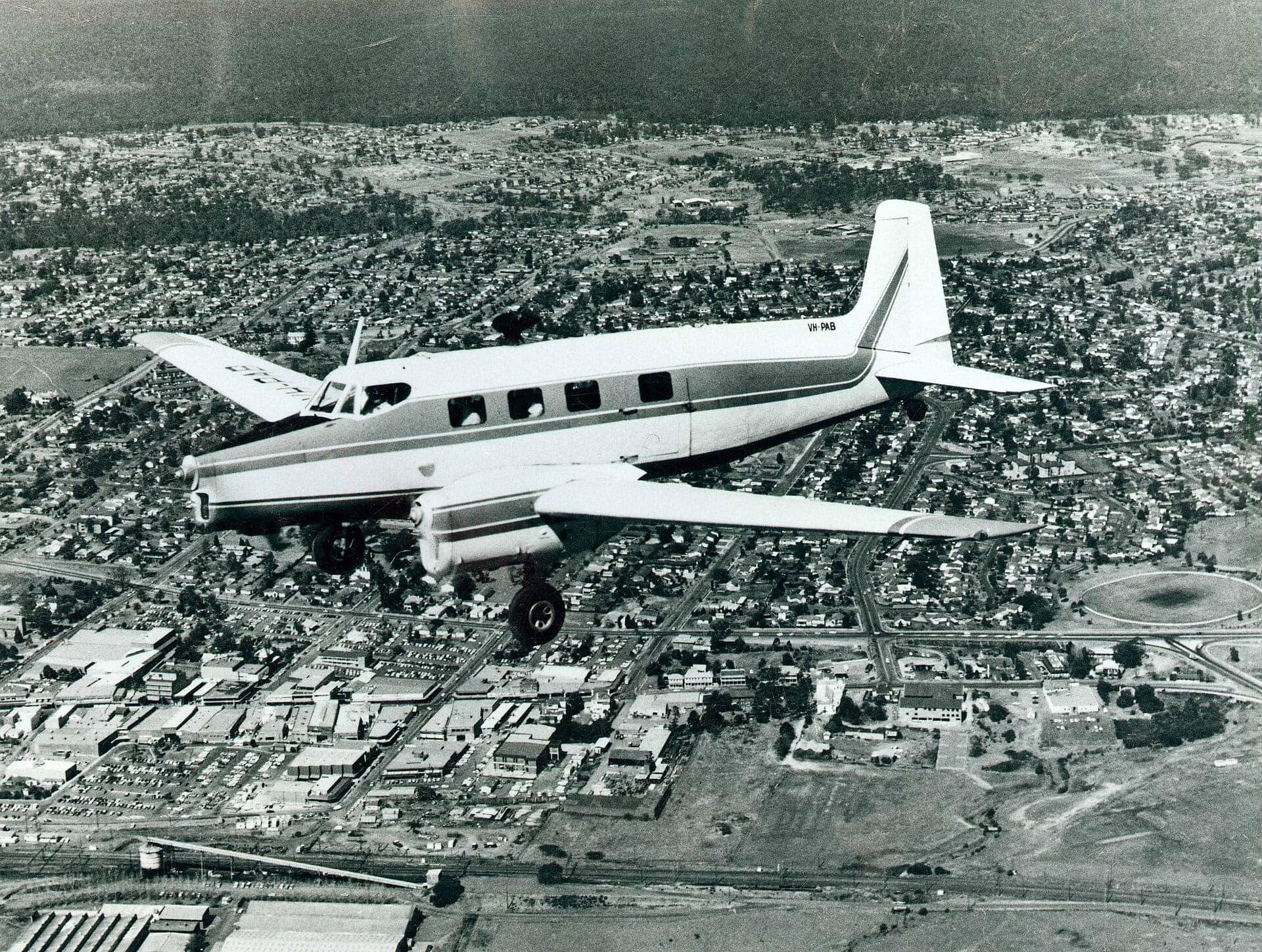
After the war the Australian company designed aircraft of its own for local conditions. The most successful was the DHA-3 Drover, a three-engined light transport of the late 1940s used by Qantas and by the Royal Flying Doctor Service; when Mosquito production ended in 1948 the Drover became the factory's main work.
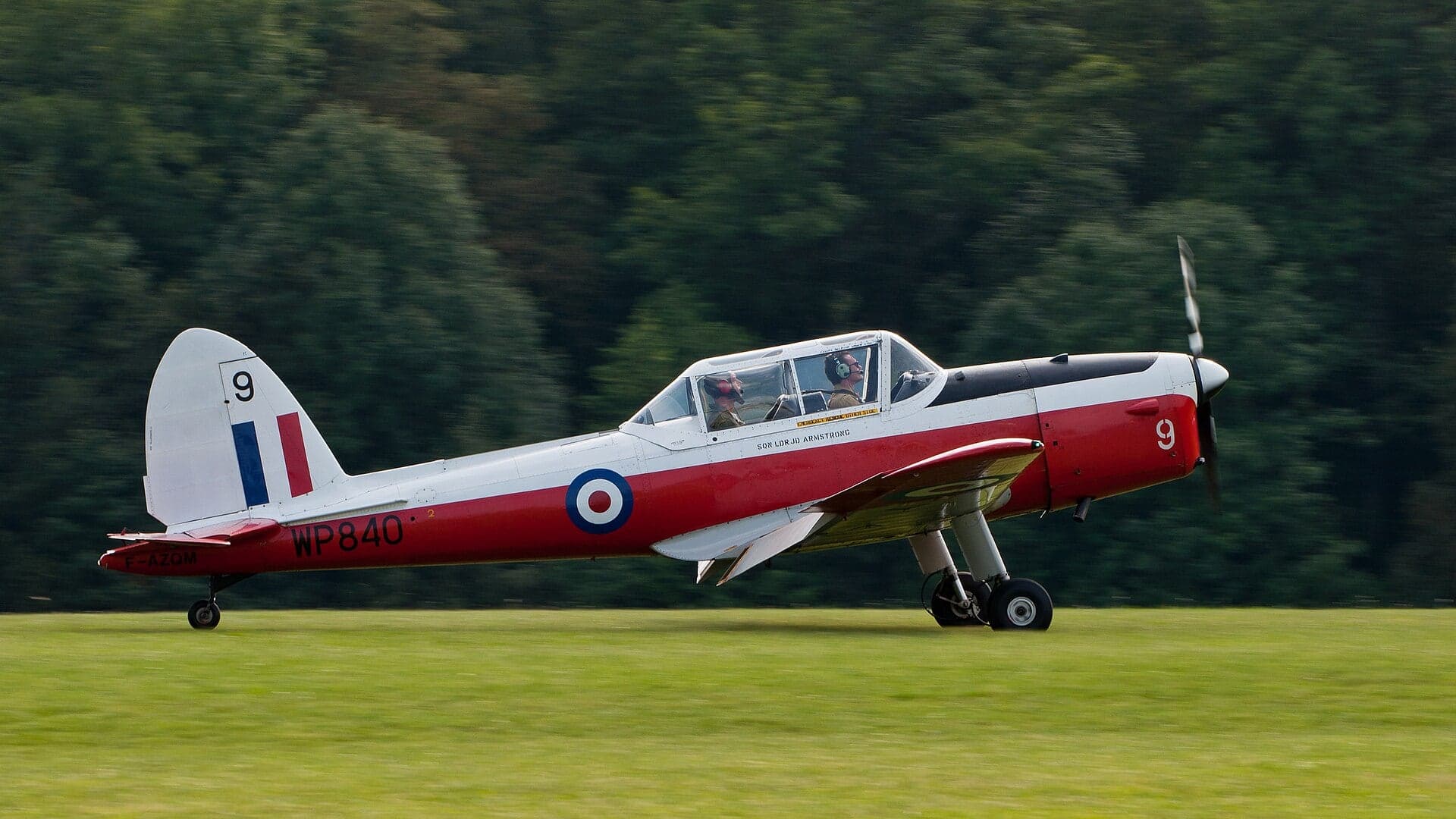
It was Canada, though, that became a manufacturer in its own right. Its first design, the DHC-1 Chipmunk, flew on 22 May 1946 and was adopted as the RAF's standard elementary trainer, replacing the Tiger Moth; it was even built under licence in Britain. The subsidiary then turned to the aircraft its own country needed: machines that could carry people and supplies into the northern bush, on wheels, skis or floats.
The DHC-2 Beaver, first flown on 16 August 1947, was the result, and 1,657 were built. The larger DHC-3 Otter followed in 1951, then the twin-engined Caribou and Buffalo transports. With these types de Havilland Canada developed a speciality, short take-off and landing aircraft for difficult places, that it would carry into the turboprop age long after the parent company had gone.
Mergers and ownership
The Comet disaster left de Havilland technically respected and financially weakened, and the British government was by the late 1950s determined to reduce the number of aircraft companies competing for its contracts. The industry consolidated into a handful of groups. In 1960 de Havilland was acquired by Hawker Siddeley, which already owned Avro, Gloster, Armstrong Whitworth and Hawker; Blackburn and Folland joined the same group. The engine company went its own way and was merged into Bristol Siddeley in 1961.
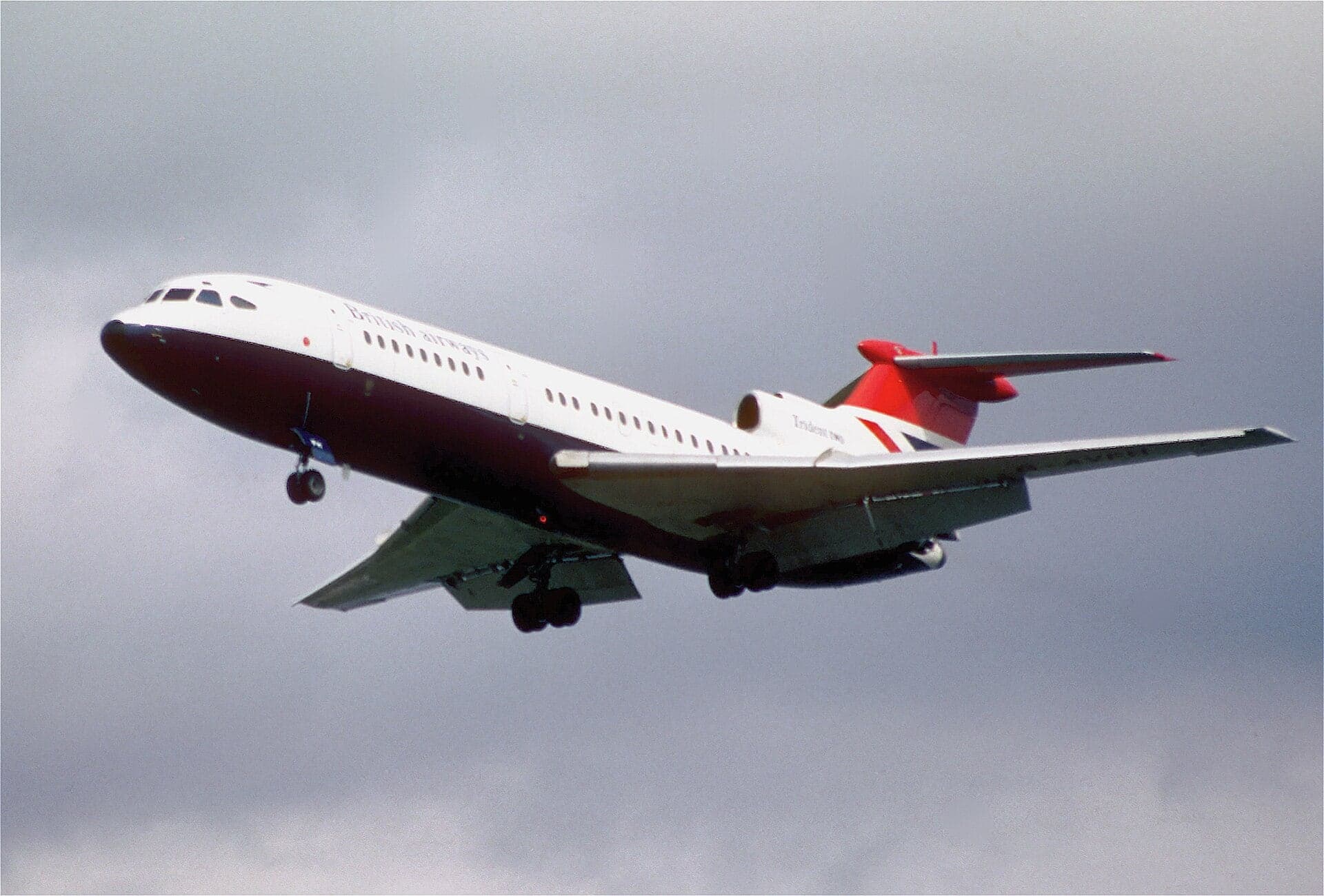
The last designs of the independent company were completed under the new owner. The DH.121 Trident, a three-engined short-haul jet built for British European Airways, first flew in 1962 and became the Hawker Siddeley Trident; its sales were hurt by BEA's request to shrink the original design. The DH.125 business jet, also first flown in 1962, did better, and its lineage stayed in production for decades under later owners.
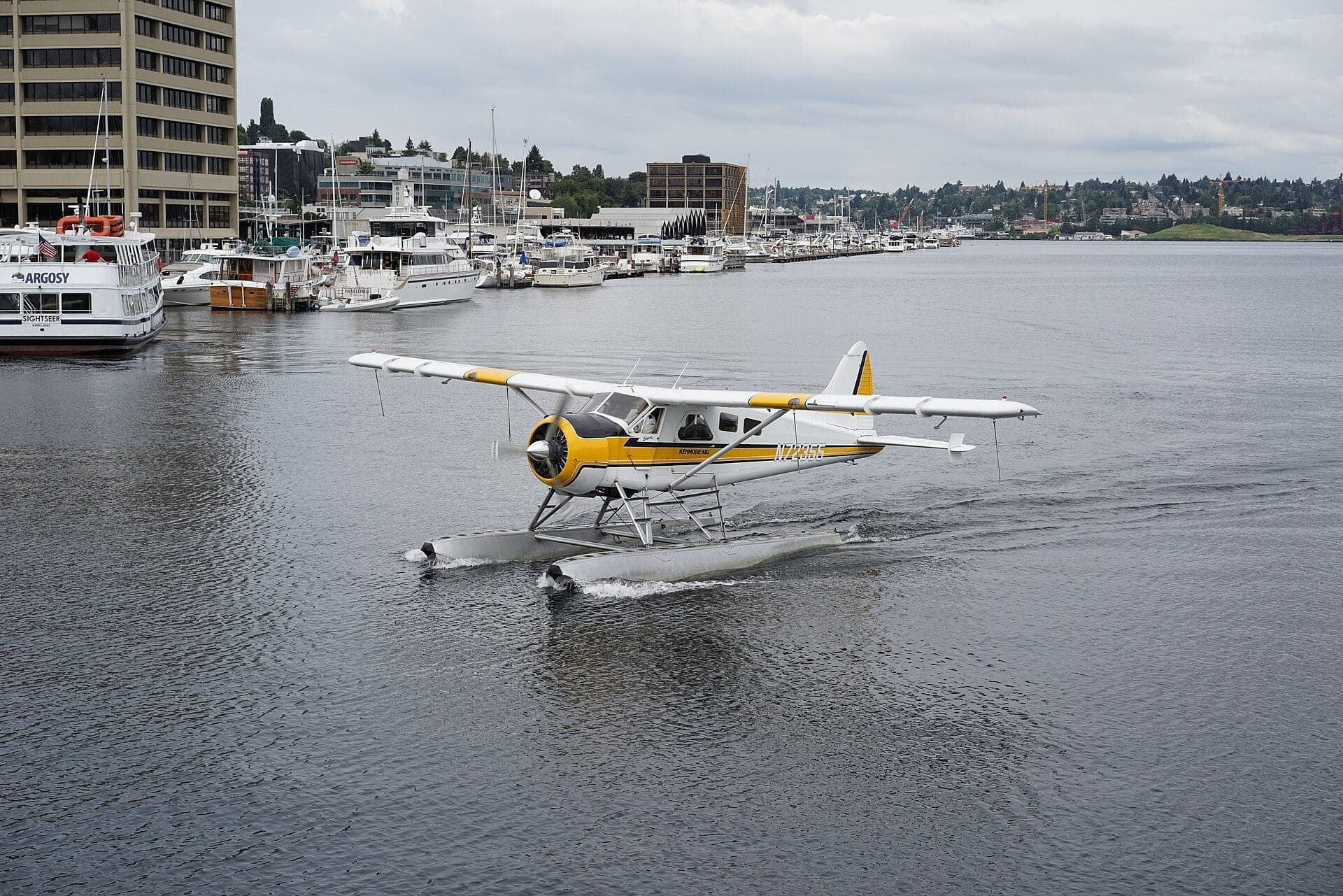
In 1963 the de Havilland name was dropped in Britain, and the company became the de Havilland Division of Hawker Siddeley Aviation. Hawker Siddeley's aircraft interests were nationalised into British Aerospace in 1977, and Hatfield, where the Moth, the Mosquito and the Comet had been built, continued under British Aerospace until it closed in 1993. Part of the site is now the University of Hertfordshire's de Havilland Campus.
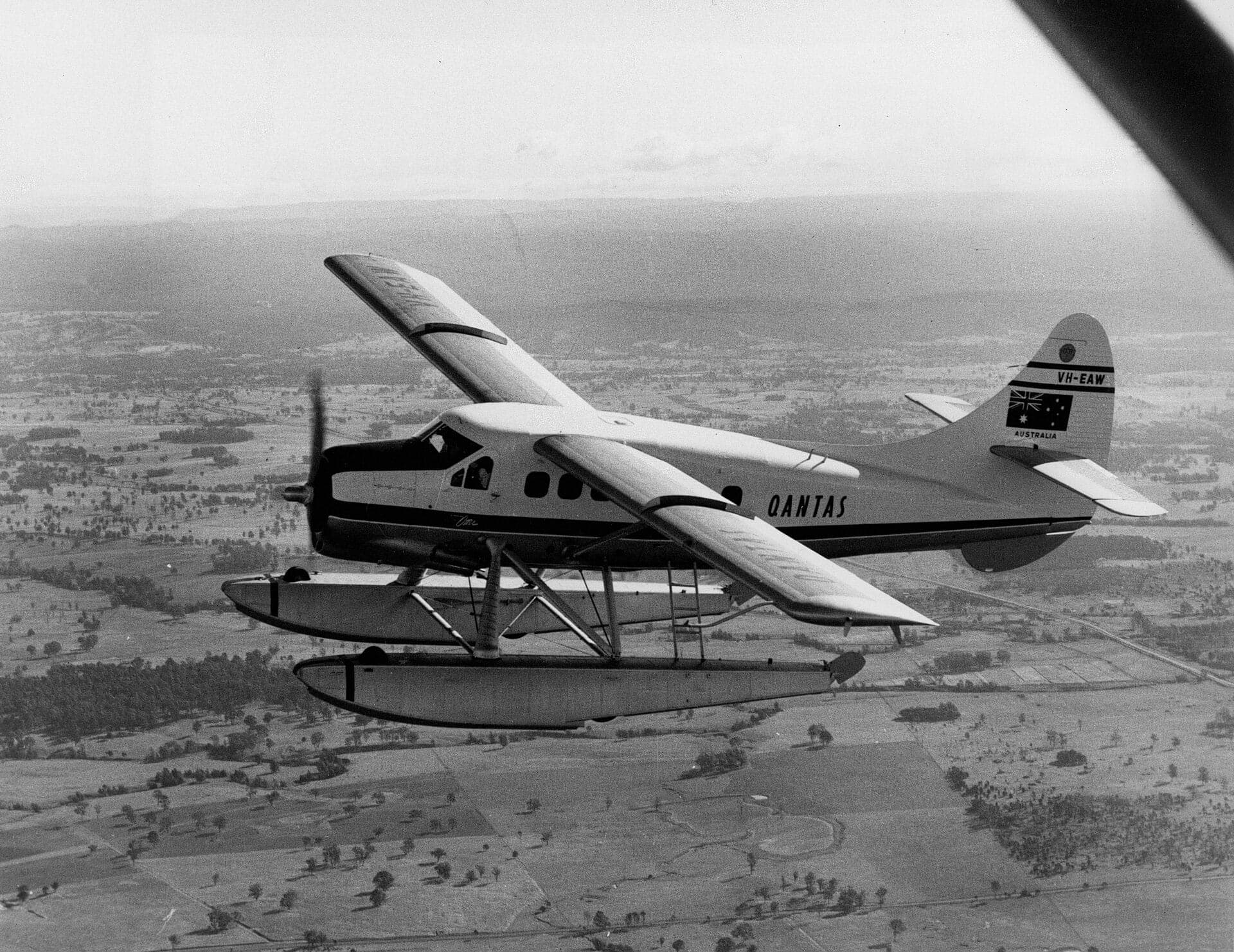
The overseas subsidiaries followed different paths. De Havilland Australia became Hawker de Havilland, and the brand had all but disappeared from Australia by the early 1990s. De Havilland Canada, which had built the Beaver and the Otter into worldwide bush-flying standards, stayed under Hawker Siddeley's ownership until 1974, when the Canadian government bought it.
Crisis
The Comet's first year brought accidents on take-off that were blamed on pilot technique and wing design, and in May 1953 a Comet broke up in a violent storm near Calcutta. Then, on 10 January 1954, G-ALYP, the aircraft that had opened jet service, disintegrated at altitude shortly after leaving Rome and fell into the sea off Elba, killing all 35 people on board. The fleet was grounded, modifications were made against suspected causes such as engine fire, and flights resumed in March. On 8 April a second Comet, G-ALYY, operating for South African Airways, broke up in the climb off Naples with the loss of 21 lives. The Comet 1's certificate of airworthiness was withdrawn.
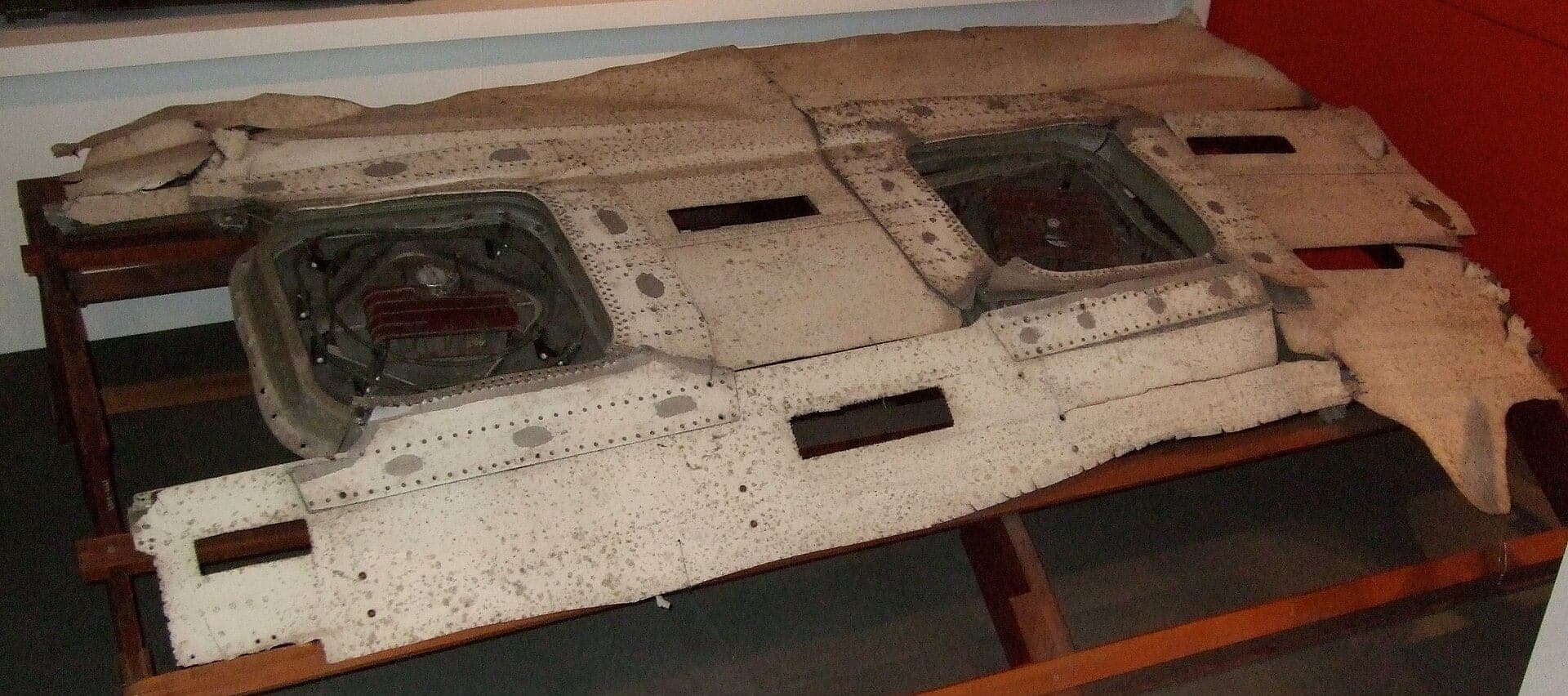
What followed was one of the founding investigations of modern air safety. The Royal Navy recovered much of G-ALYP's wreckage from the seabed, and at the Royal Aircraft Establishment at Farnborough the fuselage of another Comet, G-ALYU, was sealed in a huge water tank and repeatedly pressurised and flexed to simulate flight after flight. After the equivalent of 3,057 flights, a crack ran from the corner of a window cut-out and the cabin burst. Wreckage from G-ALYP then showed fatigue cracking that began at the corner of a cut-out for the automatic direction finder in the cabin roof.
The public inquiry under Lord Cohen concluded that the fuselage had failed through metal fatigue caused by the high stresses at the corners of openings in the pressure cabin, stresses that the design and test methods of the day had not predicted. No one had been reckless; the knowledge had simply not existed. The upper fuselage section from G-ALYP, with the fatigue cracks visible around the direction-finder windows, is preserved in the Science Museum Group collection.
The consequences reached far beyond Hatfield. Full-scale fatigue testing of pressurised structures became standard practice, openings were given rounded corners and reinforcement, and designers moved towards fail-safe structures able to carry the load even after a crack has formed. The investigation also established the practice of rebuilding an aircraft from recovered wreckage to find the origin of a failure. Every pressurised airliner since has been designed in that light.
De Havilland rebuilt the Comet with a thicker skin and rounded windows. The larger Comet 4 opened BOAC's transatlantic jet service between London and New York on 4 October 1958, but by then the Boeing 707 was only weeks from service, bigger and with longer range. The Comet was a respectable airliner and later the basis of the RAF's Nimrod maritime patrol aircraft, but just 114 were built. The years lost to the grounding had handed the jet airliner market to the United States.
Legacy
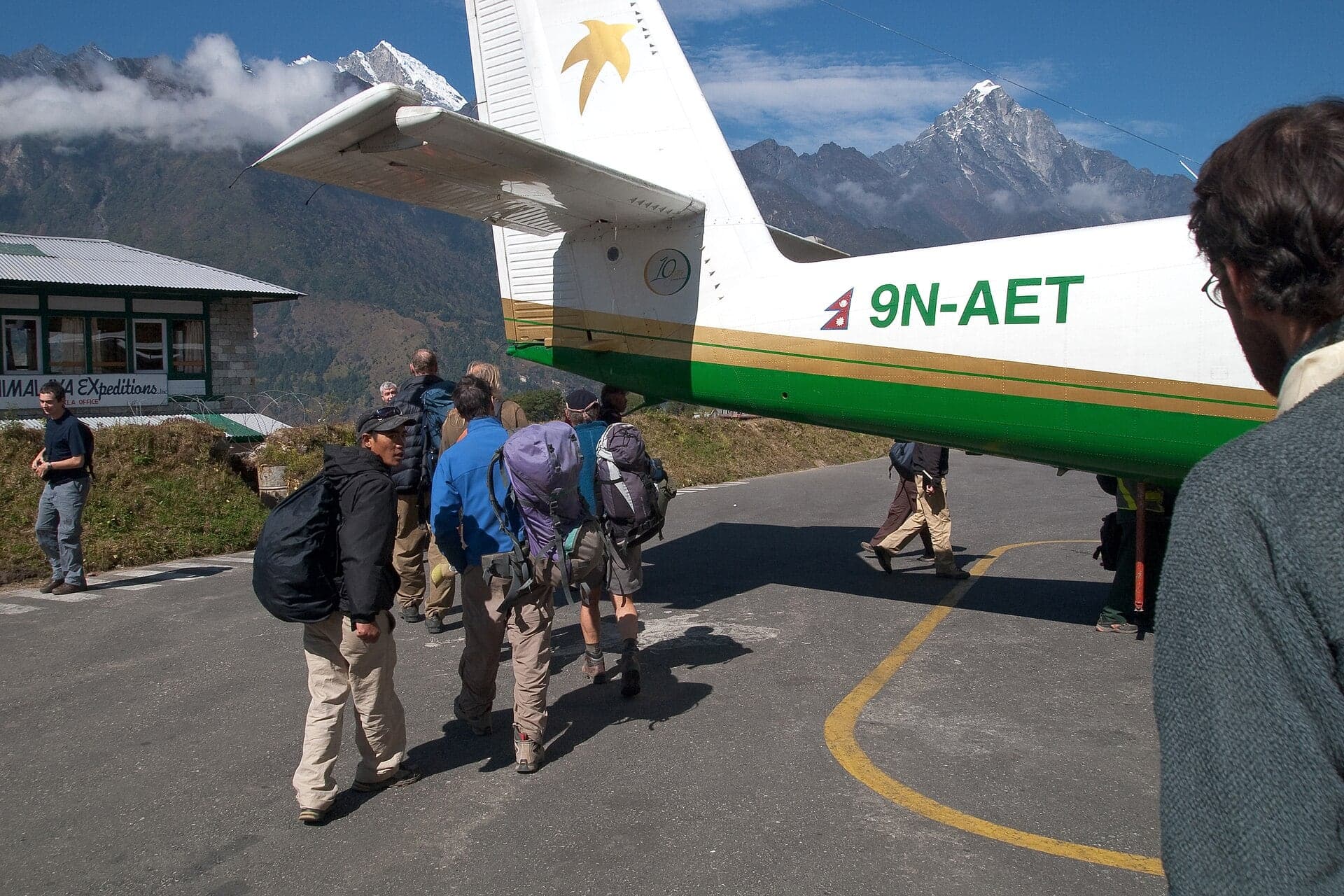
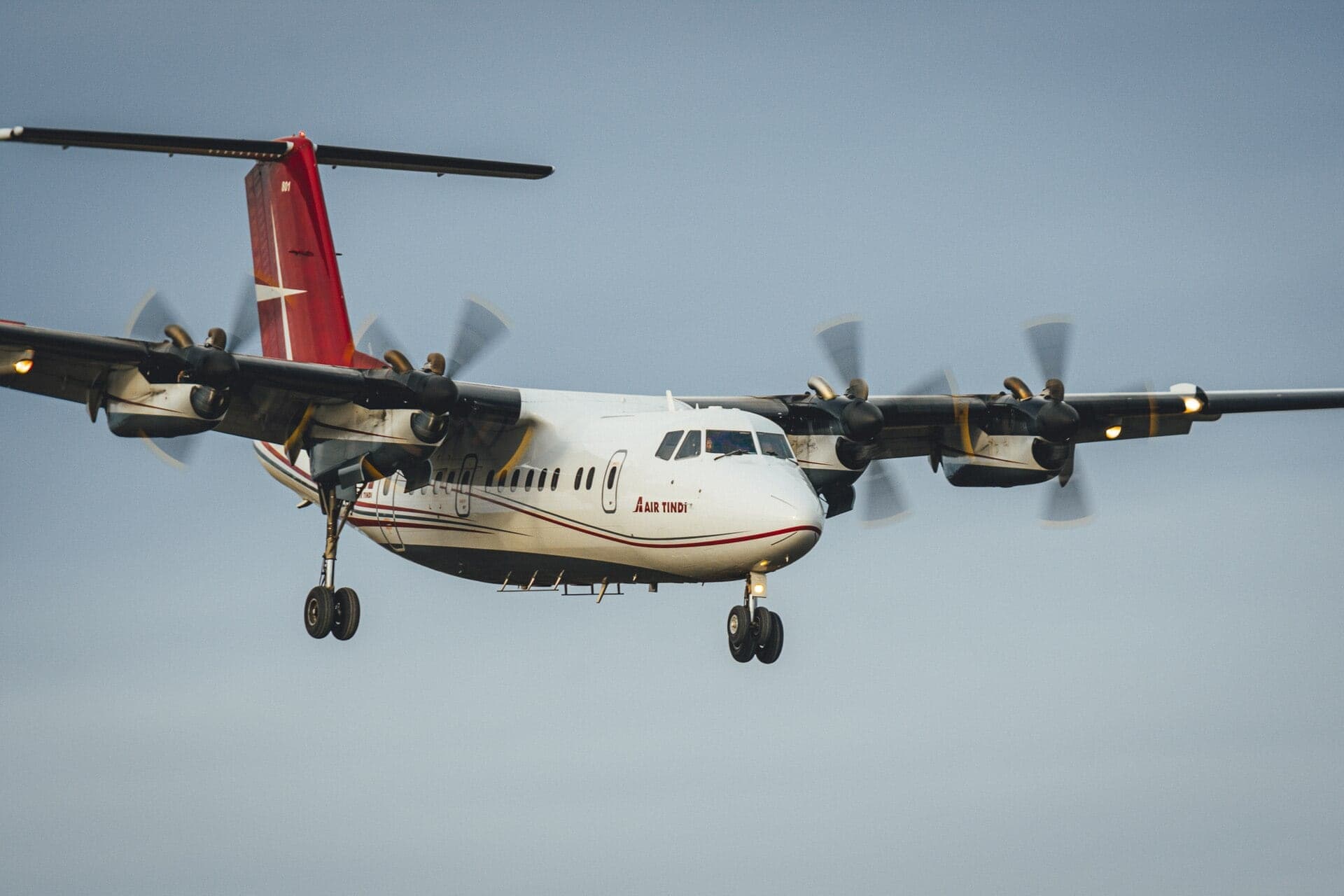
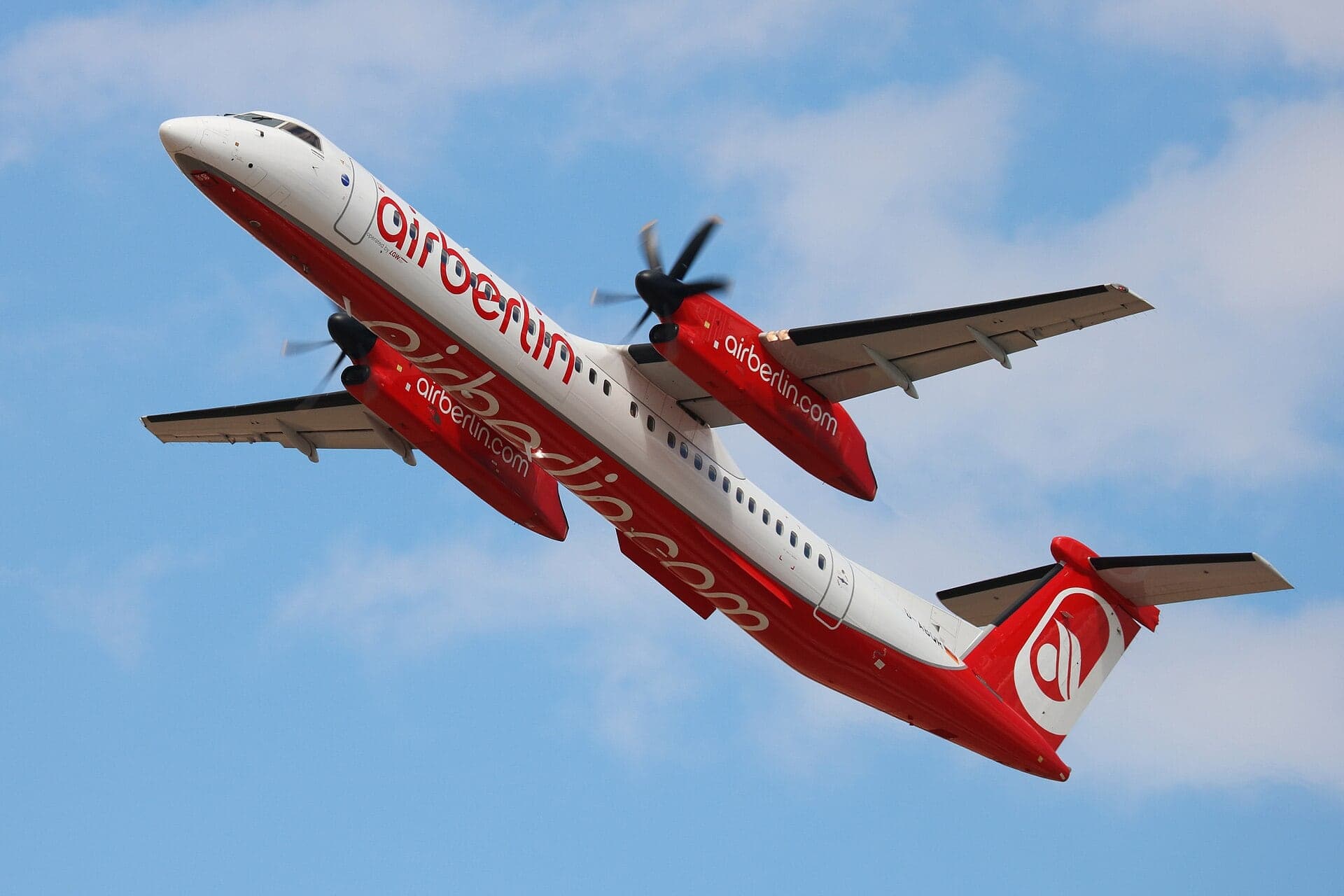
De Havilland Canada carried the name into the turboprop era. The DHC-6 Twin Otter, first flown in 1965, took the bush-plane formula to two turbine engines and became the workhorse of short, rough and high-altitude airstrips, from Arctic Canada to the Himalayas. The four-engined DHC-7 Dash 7 of 1975 applied short take-off and landing performance to a regional airliner, and the twin-engined DHC-8 Dash 8, first flown in 1983, became a standard regional aircraft around the world.
Ownership changed repeatedly. The Canadian government sold the company to Boeing in 1986; after heavy losses Boeing sold it in 1992 to Bombardier, under which the Dash 8 was developed into the larger Q400 and the de Havilland name faded from the product line. In 2006 Viking Air of Victoria, British Columbia, bought the type certificates for the out-of-production designs from the DHC-1 to the DHC-7, and put a modernised Twin Otter back into production.
In November 2018 Viking's parent, Longview Aviation Capital, agreed to buy the Dash 8 programme from Bombardier together with the rights to the de Havilland name and trademark. The deal closed on 3 June 2019, when Longview launched De Havilland Aircraft of Canada Limited, with more than 1,200 employees transferring from Bombardier. The de Havilland Canada product line was under one owner for the first time since 2006, and the company later also took on the former Canadair water bombers as the DHC-515.
In Britain the legacy is kept by museums and by the aircraft themselves. The de Havilland Aircraft Museum at Salisbury Hall preserves the Mosquito prototype where it was built; the Science Museum holds Amy Johnson's Jason and the fuselage of G-ALYP; the Shuttleworth Collection keeps Grosvenor House; and Tiger Moths still teach people to fly. Geoffrey de Havilland died in 1965. The company he founded lasted forty years under his name, and the lessons of its greatest failure are built into every airliner flying today.
Products
Programmes the company has built or is building. Entries that exist elsewhere in FLYPEDIA are linked.
Airliners
- de Havilland DH.89 Dragon RapideOut of productionFirst flight 1934
Twin-engined biplane feeder airliner of the 1930s, also used as a wartime trainer and communications aircraft.
The world's first jet airliner, in service from 1952; grounded in 1954 and rebuilt as the Comet 4.
- de Havilland DH.121 TridentOut of productionFirst flight 1962
Three-engined short-haul jet designed for BEA and completed under Hawker Siddeley.
- de Havilland Canada DHC-6 Twin OtterIn productionFirst flight 1965
Twin-turboprop short take-off utility aircraft, returned to production after 2006 by Viking Air and now built by De Havilland Canada.
- de Havilland Canada DHC-7 Dash 7Out of productionFirst flight 1975
Four-engined short take-off and landing regional airliner.
- de Havilland Canada DHC-8 Dash 8Out of productionFirst flight 1983
Twin-turboprop regional airliner, stretched into the Q400; built by Bombardier from 1992 and owned by De Havilland Canada since 2019.
Military aircraft
Elementary trainer for the RAF and the Commonwealth; more than 4,000 were built by Morris Motors in wartime.
- de Havilland DH.98 MosquitoOut of productionFirst flight 1940 · 7,781 built (1950)
Wooden twin-engined bomber, fighter and reconnaissance aircraft, built in Britain, Canada and Australia.
- de Havilland DH.100 VampireOut of productionFirst flight 1943
Twin-boom single-jet fighter; the count is British production, with more built under licence abroad.
- de Havilland DH.110 Sea VixenOut of productionFirst flight 1951
Twin-boom carrier-borne all-weather fighter for the Royal Navy.
- de Havilland Canada DHC-1 ChipmunkOut of productionFirst flight 1946
De Havilland Canada's first own design: a two-seat monoplane trainer adopted by the RAF.
General aviation
- de Havilland DH.60 MothOut of productionFirst flight 1925
The light two-seat biplane that made private and club flying affordable in Britain and abroad.
- de Havilland DH.125Out of productionFirst flight 1962
Twin-jet business aircraft whose line continued for decades under Hawker Siddeley, British Aerospace and later owners.
- de Havilland Canada DHC-2 BeaverOut of productionFirst flight 1947 · 1,657 built (1967)
Rugged single-engined bush plane on wheels, skis or floats.
- de Havilland Canada DHC-3 OtterOut of productionFirst flight 1951
Larger single-engined bush plane developed from the Beaver.
Prototypes
- de Havilland DH.88 CometOut of productionFirst flight 1934 · 5 built (1935)
Twin-engined wooden racer built for the 1934 MacRobertson race from England to Melbourne, which it won.
Divisions
- de Havilland Engine Company
Gipsy piston engines, then the Goblin and Ghost jets that powered the Vampire and the Comet. A separate company from 1944.
- de Havilland Propellers
Variable-pitch propellers under licence from Hamilton Standard, and later guided weapons.
- de Havilland Aircraft of Canada
Founded in 1928 to assemble Moths for Canada; became a designer in its own right with the Chipmunk and the Beaver.
- de Havilland Aircraft Pty Ltd
The first overseas subsidiary, set up in Melbourne in March 1927 and later producing aircraft at Bankstown, Sydney.
- de Havilland Aircraft of New Zealand
Established in March 1939 at Rongotai, Wellington.
Sites
- Stag Lane
Edgware, north LondonSince 1920
The first aerodrome and works, bought in 1922: the Moth and the early airliners. Later kept as the engine company's factory.
- Hatfield
Hatfield, Hertfordshire1930–1993
Main factory and flight test aerodrome from 1930: the Tiger Moth, the Mosquito, the Comet and the Trident. Closed by British Aerospace in 1993.
- Salisbury Hall
London Colney, Hertfordshire
Where the Mosquito was designed in secret and the prototype built; now the de Havilland Aircraft Museum.
- Downsview
Toronto, OntarioSince 1929
De Havilland Canada's works from 1929: wartime Tiger Moths and Mosquitoes, then the Beaver, Otter, Twin Otter, Dash 7 and Dash 8.
- Bankstown
Sydney, New South Wales
De Havilland Australia's factory: Tiger Moths, 212 Mosquitoes and the Drover.
- Rongotai
Wellington, New ZealandSince 1939
De Havilland New Zealand's works, building Tiger Moth trainers for the RNZAF.
Genealogy
The line of the de Havilland company. Geoffrey de Havilland had designed for Airco; when Airco collapsed he founded his own company in 1920, which set up offshoots in Australia and Canada and an engine company, and absorbed Airspeed in 1951. Hawker Siddeley bought de Havilland in 1960, dropped the name in 1963 and was merged into British Aerospace in 1977. The name survives in Canada: de Havilland Canada passed to Boeing, then Bombardier, and returned as De Havilland Aircraft of Canada in 2019.
Scroll to see the full diagram
Timeline
December 1909
Geoffrey de Havilland's first aeroplane crashes on its first attempt
Built with £1,000 from his grandfather; its engine is salvaged for Biplane No. 2, which flies in September 1910.
May 1914
De Havilland joins Airco as chief designer
September 1920
The de Havilland Aircraft Company is formed
Set up at Stag Lane, Edgware, with backing from George Holt Thomas after Airco's collapse.
February 22, 1925
First flight of the DH.60 Moth
March 1927
De Havilland Australia founded in Melbourne
1928
De Havilland Canada founded; the parent company goes public
May 1930
Amy Johnson flies solo from England to Australia in a Gipsy Moth
October 26, 1931
First flight of the DH.82 Tiger Moth
October 20, 1934
The DH.88 Comet wins the MacRobertson race
Scott and Campbell Black fly G-ACSS from Mildenhall to Melbourne in 70 hours 54 minutes.
November 25, 1940
First flight of the Mosquito prototype W4050
September 20, 1943
First flight of the Vampire
1944
The de Havilland Engine Company becomes a separate company
September 27, 1946
Geoffrey de Havilland Jr is killed testing the DH.108
The tailless research jet breaks up over the Thames Estuary.
July 27, 1949
First flight of the Comet at Hatfield
May 2, 1952
The Comet opens the first jet airliner service
BOAC's G-ALYP leaves London for Johannesburg with fare-paying passengers.
January 10, 1954
Comet G-ALYP breaks up off Elba
All 35 on board die. After a second break-up off Naples on 8 April, the Comet 1 is grounded.
October 4, 1958
The Comet 4 opens transatlantic jet service
BOAC flies London to New York in both directions on the same day.
1960
Hawker Siddeley acquires de Havilland
1963
The de Havilland name is dropped in Britain
The company becomes the de Havilland Division of Hawker Siddeley Aviation.
1993
British Aerospace closes Hatfield
June 3, 2019
De Havilland Aircraft of Canada revives the name
Longview Aviation Capital buys the Dash 8 programme and the de Havilland name and trademark from Bombardier.
- De Havilland Aircraft Co Ltd, BAE Systems Heritage
- Hatfield, Hertfordshire, BAE Systems Heritage
- Geoffrey de Havilland, BAE Systems Heritage
- De Havilland DH106 Comet 1 & 2, BAE Systems Heritage
- De Havilland DH106 Comet 3 & 4, BAE Systems Heritage
- De Havilland DH98 Mosquito, BAE Systems Heritage
- De Havilland Tiger Moth / Queen Bee, BAE Systems Heritage
- De Havilland DH100 Vampire, BAE Systems Heritage
- De Havilland Australia, BAE Systems Heritage
- De Havilland Canada DHC-2 Beaver, BAE Systems Heritage
Checked September 12, 2026