History
Concorde's First Flight
March 2, 1969
ToulouseFrance
29minutes
Time in the air
10,000ft
Altitude reached
600
Journalists watching
The first flight
- Date
- Sunday 2 March 1969
- Take-off
- 15:38, runway 33, Blagnac
- Time in the air
- 27 to 29 min
- Altitude
- 10,000 ft
- Speed
- Below 260 kt
- Configuration
- Gear down, nose drooped
- Crew
- Turcat, Guignard, Perrier, Rétif
The aircraft
- Registration
- F-WTSS
- Prototype
- Concorde 001
- Built by
- Sud Aviation, Toulouse
- Roll-out
- 11 December 1967
- Engines
- Four Olympus 593 Mk.610
- Career
- 397 flights, 812 h
- Preserved at
- Le Bourget
The programme
- Treaty signed
- 29 November 1962
- Prototypes begun
- February 1965
- British prototype
- 002, G-BSST, BAC Filton
- Its first flight
- 9 April 1969, Brian Trubshaw
- First supersonic
- 1 October 1969
- First Mach 2
- 4 November 1970
- In service
- 21 January 1976
- Built
- 20, against 350 projected

On Sunday 2 March 1969 Concorde 001, F-WTSS, took off from Toulouse-Blagnac with André Turcat in command, for a deliberately modest circuit with the undercarriage down and the nose drooped throughout. Turcat called it a trip around the runway. The British prototype followed on 9 April, 001 went supersonic on 1 October, and in 1973 the same aircraft chased a total solar eclipse across the Sahara for 74 minutes of totality.

At about half past three on the afternoon of Sunday 2 March 1969, Concorde 001 (registration F-WTSS, built by Sud Aviation at Toulouse) rolled onto runway 33 at Toulouse-Blagnac and took off. André Turcat, Sud's director of flight testing, was in the left seat, with Jacques Guignard as co-pilot and Henri Perrier and Michel Rétif behind them. Six hundred journalists had come from around the world to watch. The aeroplane climbed straight ahead at about 3,500 feet a minute to 10,000 ft, never exceeded 260 kt, and kept its undercarriage down and its nose and visor fully drooped for the entire flight. It landed twenty-seven or twenty-nine minutes later, depending on which account you read. Turcat called it a trip around the runway.
It was also the first flight of the only supersonic airliner the West ever put into service, and the culmination of seven years of work under an international treaty signed in 1962: a treaty rather than a commercial contract, with a cancellation clause so punitive that neither government could easily walk away. Britain and France had each been designing a supersonic transport independently, had discovered they had arrived at nearly the same aeroplane, and had been pushed together partly because no American company would partner either of them.

The flight was not the world's first by a supersonic airliner. A Tupolev Tu-144 had flown at Zhukovsky on 31 December 1968, two months earlier, and would go supersonic four months before Concorde did. What Concorde had, and what the Tu-144 never managed, was a working career: twenty aircraft built, twenty-seven years of scheduled service from January 1976, and a cruising speed of Mach 2 held for hours at a time. And 001 itself, the aeroplane that flew that afternoon, went on to do something no airliner has done since, it chased a total solar eclipse across the Sahara in 1973 and held the Moon's shadow for seventy-four minutes.
Background
Britain began thinking about this in October 1956, when the Supersonic Transport Aircraft Committee was formed to work out whether a practical supersonic airliner was possible. The answer depended on a wing, and the wing came from Dietrich Küchemann at the Royal Aircraft Establishment, whose work on the slender delta produced the ogee, the curved, double-swept planform that Concorde eventually wore. It was chosen over other deltas for an unglamorous reason that turns out to be the decisive one: its centre of pressure behaves predictably as the design changes and as fuel burns away, which solves the pitch-control problem that defeated the alternatives.
The second constraint was temperature. Air friction heats an airframe, and at some speed the metal begins to soften. Hiduminium R.R. 58, the aluminium alloy Concorde is largely made of, can take 127 °C, and that puts a ceiling of about Mach 2.02 on the aeroplane. Higher speeds would have meant steel or titanium, a different industry, a longer programme and a far larger bill. Choosing Mach 2 was choosing to build the aeroplane with the materials and factories that already existed: which is why Concorde flew in 1969 and the American Mach 3 project never flew at all.
By the early 1960s Britain had the Bristol 223 and France the Sud Aviation Super-Caravelle. The French design had deliberately been sized as a medium-range aircraft to avoid competing with the transatlantic American projects. When the two teams compared notes they found they had reached almost identical conclusions (the same ogee wing, the same Mach 2 ceiling, the same general layout) and were duplicating each other's very expensive work. Britain had looked for an American partner and found none interested.
So on 29 November 1962 the two governments signed a treaty. Not a contract between companies: a treaty between states, with a clause inserted at British request imposing heavy penalties for cancellation. It was meant to stop the other side walking away. In practice it bound both of them, and over the following decade, as costs rose and the commercial case weakened, that clause is a large part of why the aeroplane was finished at all.
The name has its own small history. Britain spelled it Concorde at first, then Harold Macmillan's government cut the 'e' after a perceived slight from Charles de Gaulle. At the roll-out of 001 at Toulouse on 11 December 1967, Tony Benn, the British technology minister, announced that the 'e' was restored, and said it stood for Excellence, England, Europe and Entente. An angry Scot wrote to point out that Scotland had built part of it; Benn replied that the 'e' was also for Écosse, and remarked that he might have added an 'e' for extravagance and an 'e' for escalation.
Development

Construction of two prototypes began in February 1965: 001 by Sud Aviation, later Aérospatiale, at Toulouse, and 002 by the British Aircraft Corporation at Filton near Bristol. They were not identical, and neither was identical to the aircraft that entered service seven years later: the prototypes are shorter, have a different tail, and carry the original visor design with small windows rather than the clear visor of the production aeroplanes.
001 was rolled out at Toulouse on 11 December 1967 in front of the two governments, which is where the 'e' came back. Then came fourteen months of ground work before it flew: systems, engine runs, taxi trials, and the long process of convincing two national airworthiness authorities that an aeroplane with no precedent could be allowed off the ground. The first flight had been expected earlier; weather and the ordinary attrition of testing pushed it into March.
The programme was inventing systems as it went. The droop nose, developed by Marshall's of Cambridge, exists because an aeroplane with a nose fine enough for Mach 2 has a nose the pilots cannot see past on approach: the whole forward fuselage hinges down, with a visor that retracts to give visibility. The variable intake ramps ahead of each pair of engines, controlled by digital computers, slow the incoming air from supersonic to subsonic before it reaches the compressor, and they do more than protect the engine, at cruise the intake and nozzle together produce most of the net thrust, with the engine itself contributing a minority of it. The fuel-trim system pumps fuel fore and aft between tanks to follow the centre of pressure, which moves about two metres rearward as the aircraft accelerates through the transonic range; trimming that out with control surfaces would have cost drag the aeroplane could not spare.
Concorde also carried, on the prototypes, electronic flight controls and what is generally credited as the first cockpit sidestick, technologies that would be unremarkable thirty years later and were extraordinary in 1969. Much of what Airbus would later build as standard practice was first flown on these two aeroplanes, by the same organisations, in the same buildings.
Between the prototypes and the airline aircraft came two pre-production machines, 101 and 102, and the differences between the four are a record of everything learned in the air. The prototypes' small-windowed metal visor gave way to a clear one; the tail was extended; the fuselage grew; the engine nacelles and secondary nozzles were redesigned. A Concorde on a museum stand is therefore not one aeroplane but one of four noticeably different aeroplanes, and 001 at Le Bourget is the shortest and least finished-looking of them: which is exactly what a first-of-type ought to look like.
The machine

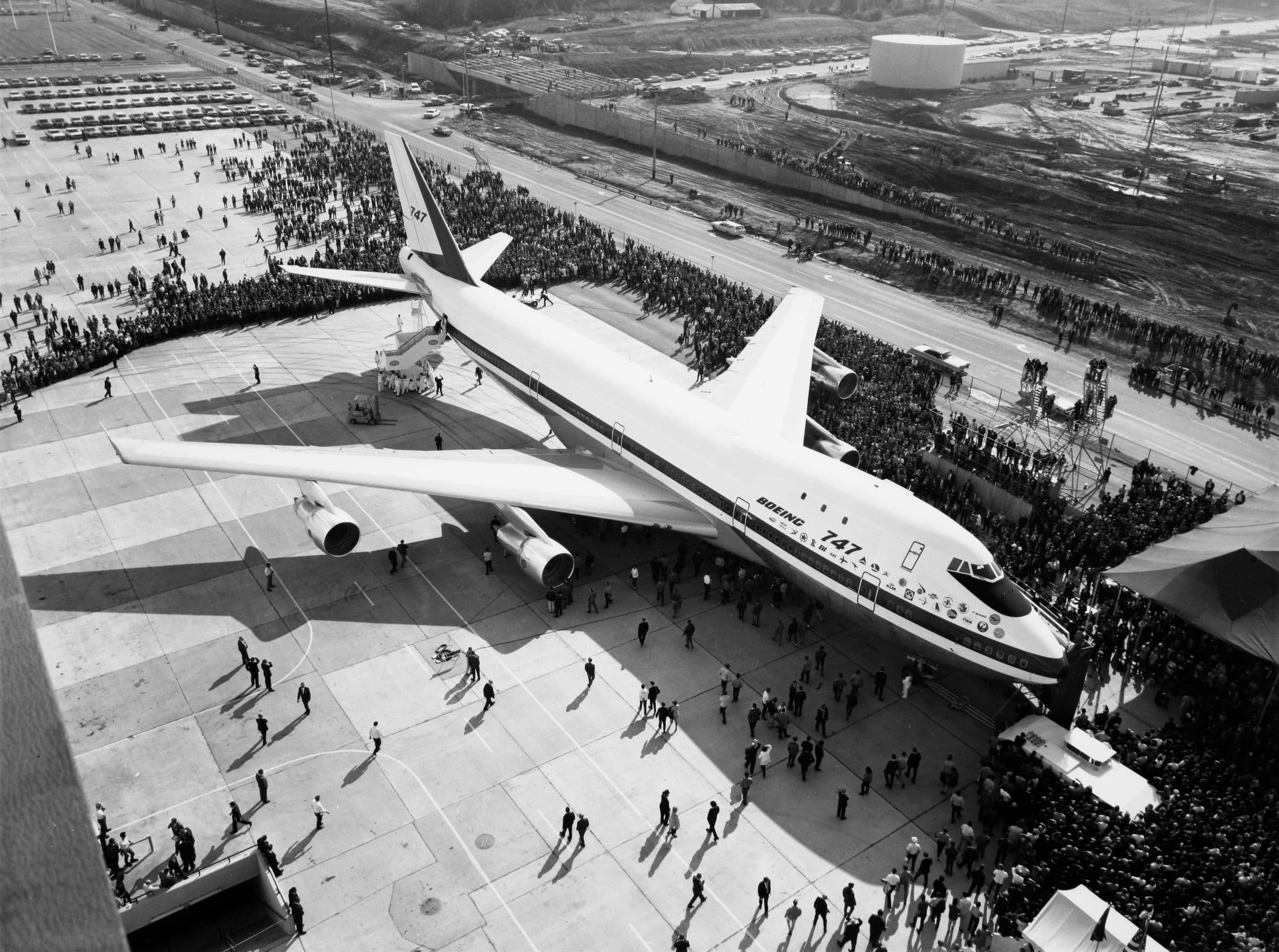
Concorde 001 was 170 ft long with a span of 78.1 ft. Empty it weighed 174,000 lb and its maximum take-off weight was 408,000 lb: a large aeroplane by the standards of 1969, though less than a third the weight of the Boeing 747 that flew ten weeks earlier and carried five times as many people.
Power came from four Rolls-Royce/SNECMA Olympus 593 turbojets, the prototype's Mk.610 rated at about 165 kN for take-off with reheat. A turbojet rather than a turbofan, because a fan is an efficiency device at subsonic speed and a liability at Mach 2; reheat, because a slender delta needs a great deal of thrust to get off the ground and through the transonic drag rise, and is then remarkably efficient above it. The Olympus was descended from the engine of the Avro Vulcan bomber, which is a reasonable summary of where the aerodynamic and propulsion knowledge for this aeroplane came from.
The airframe is a Küchemann ogee delta with no horizontal tail, controlled by six elevons along the trailing edge, and it has no high-lift devices at all: no flaps, no slats. A slender delta generates lift at low speed by making a pair of powerful vortices over its upper surface, which is why Concorde rotates to such a high angle on take-off and approach, and why it needs the droop nose. The consequence is an aeroplane with two almost separate personalities, a docile, high-drag, nose-high machine below 250 knots, and an extremely efficient cruiser at Mach 2 in the stratosphere.
And the cruise is the point. Concorde cruised at about Mach 2.02, held for hours, at altitudes around 59,000 ft where the air is thin enough for the drag to be tolerable and the sky above is visibly dark. The aircraft grows several inches longer in cruise from thermal expansion. The fastest speed ever recorded by a Concorde in testing was Mach 2.23, on 26 March 1974. Everything else in the design (the wing, the alloy, the intakes, the fuel trim, the drooping nose) follows from the decision to hold that speed with 1960s materials.
Inside, Concorde was small. The cabin seated about a hundred passengers in a single class, two either side of one aisle, in a tube 8.63 ft across, narrower than a Boeing 737. The windows were the size of a paperback because at 59,000 ft the pressure difference across them is severe, and a bulkhead machmeter told the cabin when it passed Mach 2 because from inside there was otherwise nothing to feel. It was not a luxurious aeroplane in the way a 747's upper deck was luxurious; the luxury was entirely in the clock. Sitting in a cramped seat for three and a half hours instead of a wide one for seven was the whole proposition, and for the people who bought it that was enough.
The sonic boom is worth stating precisely, because it decided the aircraft's fate. A body moving faster than sound does not make a bang at the moment it accelerates; it drags a continuous pair of shock waves behind it for as long as it is supersonic, and those waves sweep across the ground in a corridor tens of kilometres wide along the whole track of the flight. There is no way to fly a supersonic airliner over inhabited land without subjecting a strip of it to a double bang every time. That is a fact of physics and not of engineering, and it is why Concorde's timetable was made of ocean.
Preparation
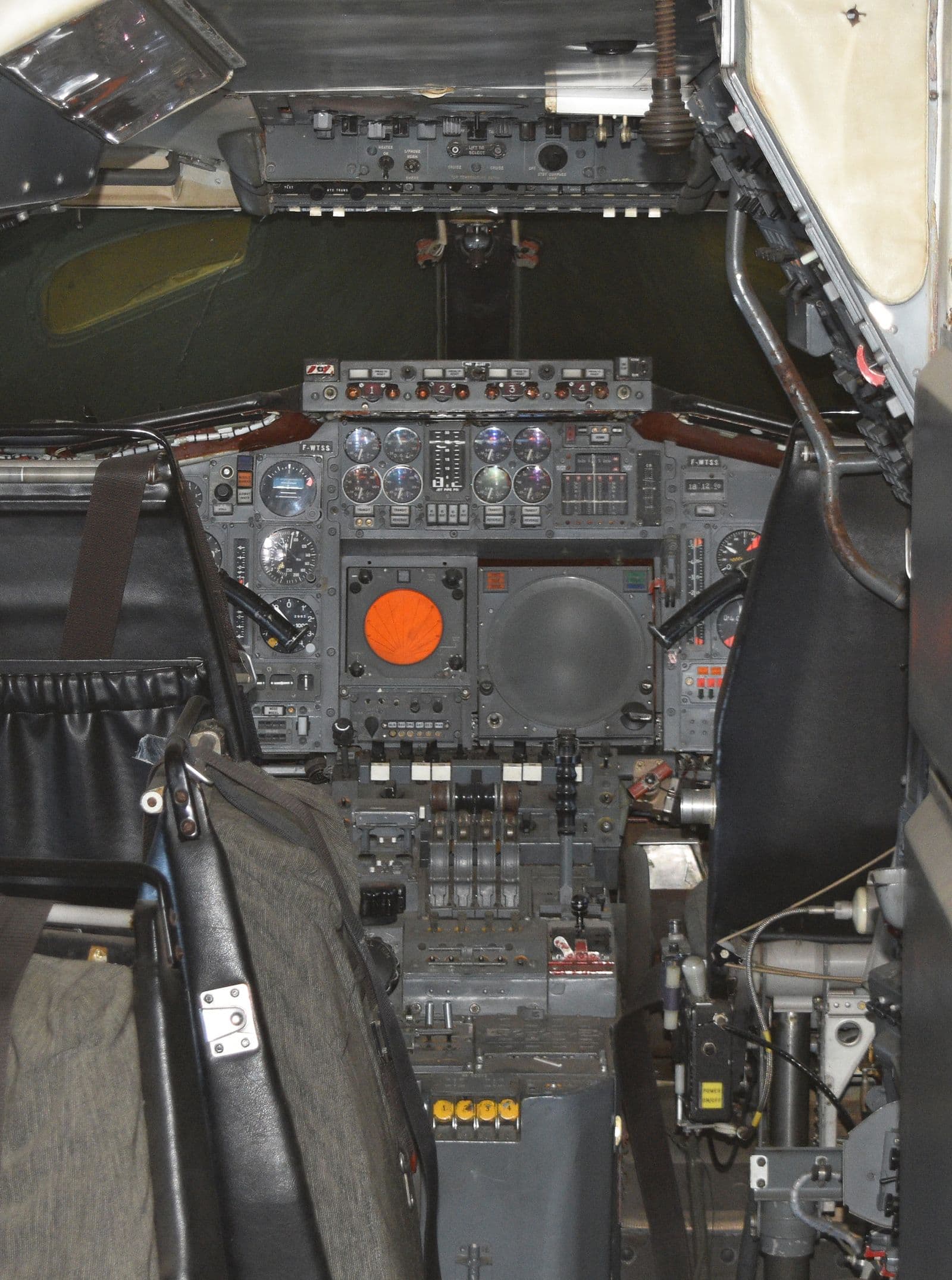
By the beginning of 1969 both prototypes were substantially finished and neither had flown. 001 had been out of its hangar for fourteen months, running engines and taxiing at Blagnac, and the date of its first flight had slipped repeatedly. Some of that was the ordinary attrition of a first-of-type: systems that had never existed before had to be made to work together, and two national airworthiness authorities had to be satisfied. Some of it was weather. Toulouse in February is not reliable, and a first flight needs a clear day.
The crew Sud Aviation put together for it were not young men learning the aeroplane; they were the people who had helped specify it. André Turcat, the company's director of flight testing, had flown the ramjet-powered Nord 1500 Griffon to Mach 2.19 and held a world speed record over a 100-kilometre course set in February 1959 at an average of 887 kt. Jacques Guignard flew as co-pilot. Henri Perrier, who would later run Concorde's flight-test operation and become a central figure in the type's engineering for thirty years, was aboard as flight engineer; the Toulouse archive caption from that day lists him simply as a pilot. Michel Rétif was the flight mechanic.
What was planned was deliberately modest. The aircraft would take off, climb straight ahead, level at 10,000 ft, make a few gentle handling checks and land: with the undercarriage down and the nose and visor drooped from beginning to end, so that nothing that could go wrong with retraction would need to go right. Nothing supersonic, nothing near the corners of the envelope, nothing at all that the prototype had not been argued into on paper. A first flight of a genuinely novel aeroplane is not a demonstration; it is an attempt to find out whether anything is badly wrong while there is still runway in reach.
The audience was another matter. Six hundred journalists from around the world had come to Toulouse, along with the technicians, engineers and factory workers who had built the thing, and the French and British political establishments had a great deal riding on the afternoon. Whatever happened would happen in front of everybody.
One more thing was riding on the afternoon that nobody said aloud. The Tupolev Tu-144 had already flown, on 31 December 1968. Whatever happened at Toulouse would not be a first flight of a supersonic airliner; it would be the second, nine weeks late, by the Western programme that had spent seven years and an extraordinary amount of public money getting there. The engineers at Blagnac were not racing anyone that Sunday, a first flight is not a race, but the political weather in London and Paris had changed with the news from Zhukovsky, and everyone on the apron knew it.
The event

The morning of Sunday 2 March 1969 came good enough. 001 taxied to runway 33 at Toulouse-Blagnac, the four Olympus were run up to full power, Airbus's own account of the day says the noise was deafening, and the aircraft lifted off. The take-off time is given as 15:38 by Airbus and as 15:40 elsewhere; the difference is the length of a radio call.
The flight went as written. Turcat climbed straight ahead at about 3,500 feet a minute to 10,000 ft and held the aircraft below 260 kt throughout, with the gear down and the nose and visor fully drooped the whole way. Nothing required the crew to improvise. Turcat's own account of it was carefully unheroic: there were no actual issues, he said, only some minor malfunctions with instruments, which is unavoidable, and the take-off, the braking and the landing were all smooth. Reported duration is either twenty-seven or twenty-nine minutes depending on the source, and both figures appear in reputable accounts; Airbus gives twenty-nine.

Then 001 came back and landed, and Turcat had to say something to six hundred journalists. What he gave them was not triumphant. He described the sortie as a trip around the runway, un tour de piste, which was exactly what it had been, and which is the remark of a test pilot who knows that the difficult flights are all still ahead. The Toulouse municipal archive's photographs from that afternoon show the four of them coming down the steps onto the tarmac among the mechanics and a cameraman, and then Turcat at a microphone in the terminal hall with the rest of the crew beside him, in front of a stage full of officials.
It is worth being clear about what the flight did and did not prove. It did not demonstrate supersonic flight, or Mach 2, or the intake system, or the fuel-trim, or anything about whether the aeroplane could earn money. Concorde would not go supersonic for another seven months. What the twenty-nine minutes established was that the ogee delta flew, that it was controllable at low speed at a high angle of attack, that the four Olympus and their systems worked together in the air, and that the programme's central claim, that this shape could be made into an aeroplane, was not wrong. For a project bound by treaty, running late and running expensive, that was the only thing anybody needed that afternoon.
Aftermath

The British prototype followed five weeks later. On 9 April 1969 Brian Trubshaw flew 002, G-BSST, from Filton to RAF Fairford, which was to be the British flight-test base, a delivery flight and a first flight at once. On 7 and 8 June both aeroplanes were shown together in public at the Paris Air Show, seven weeks after 002's first flight and three months after 001's, which is a remarkable thing to have risked with two hand-built prototypes.
001 first exceeded the speed of sound on 1 October 1969, with Turcat again in command. Mach 2 came on 4 November 1970. By then the Tu-144 had done both, supersonic on 5 June 1969 and past Mach 2 on 26 May 1970, and the Soviet aircraft would also reach commercial service first, carrying mail and freight between Moscow and Alma-Ata from 26 December 1975. The race, such as it was, was lost on every date and won on everything that came afterwards.

The long middle of the programme was flight testing on a scale no airliner had needed: two prototypes, two pre-production aircraft, and then the production machines, working through an envelope that no certification authority had ever assessed. The French certificate of airworthiness was granted on 9 October 1975 and the British on 5 December 1975. Air France and British Airways began scheduled Concorde services on the same day, 21 January 1976.
And by then the commercial case had collapsed. Options had peaked at seventy-four aircraft from sixteen airlines: Pan Am, Qantas, TWA, Lufthansa and others had all signed up in principle. What killed them was a combination: the 1973 oil crisis, which quadrupled the cost of the fuel a supersonic airliner burns most of; bans on supersonic overflight of land, which cut the aircraft out of every route except the ocean crossings; and environmental and noise objections, particularly in the United States, where Concorde's access to New York was fought through the courts and local politics into 1977. In the end only the two national airlines took delivery, seven aircraft each, and the total production run was twenty aeroplanes against a projection of 350. The aeroplane that flew perfectly on 2 March 1969 was, commercially, already in difficulty.
What the survivors did with it, once the network had shrunk to what the boom allowed, was fly the Atlantic very fast indeed. Scheduled Concorde services crossed between London or Paris and New York in a little over three hours against seven or eight for a subsonic aircraft, westbound arriving at a local clock time earlier than the local time of departure. The fastest scheduled crossing ever recorded remains British Airways' G-BOAD from New York to London on 7 February 1996: 2 hours 52 minutes 59 seconds, wheels-up to wheels-down, 3,259 nm at an average of 1,090 kt, flown by Captain Leslie Scott with Senior First Officer Tim Orchard and Senior Engineering Officer Rick Eades. February was chosen deliberately for the upper-air temperatures and the jet stream. Twenty-seven passengers were aboard.
Controversy
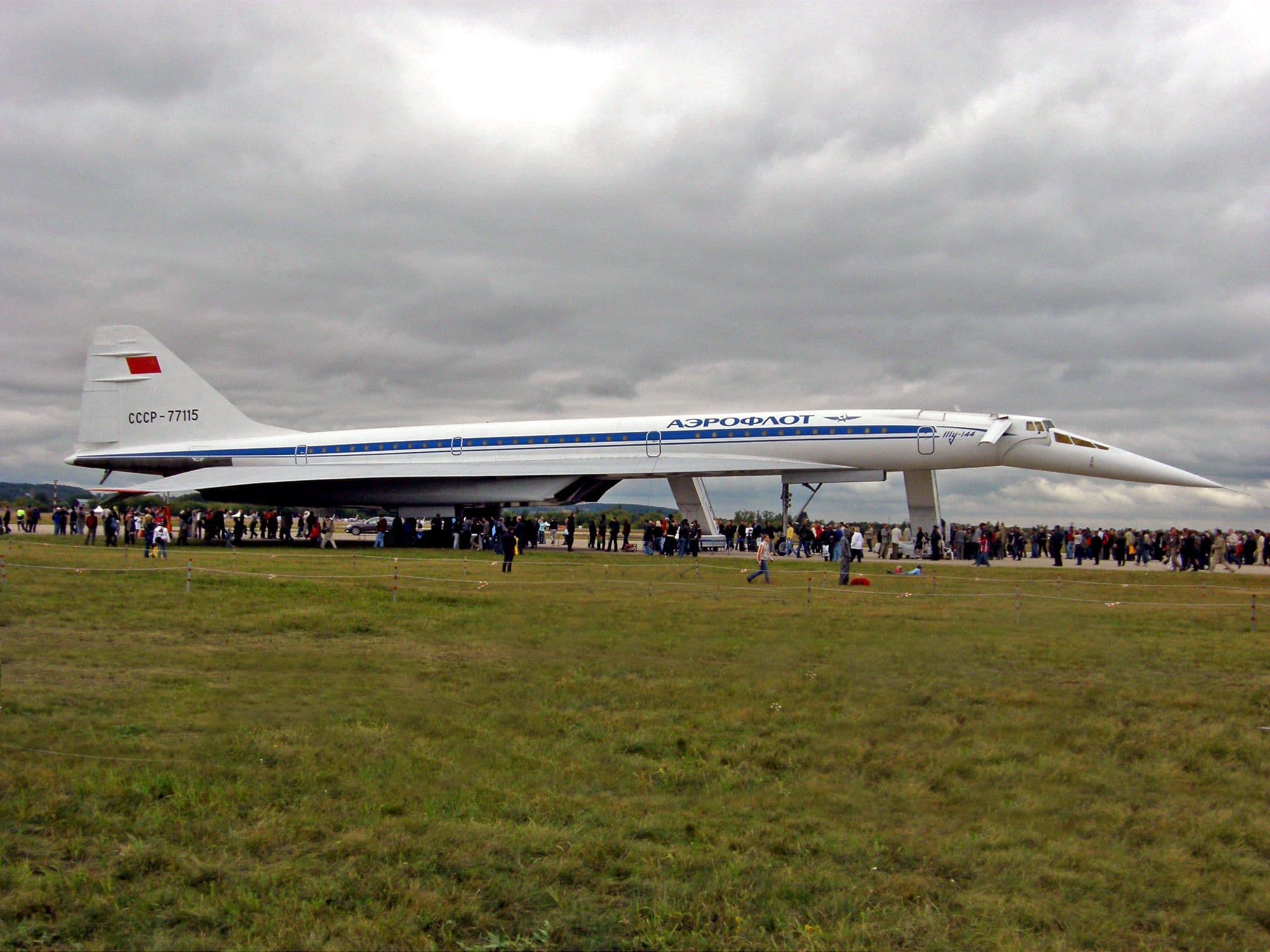
Concorde's first flight is remembered as a first, and it was not one. The Tupolev Tu-144 flew on 31 December 1968, two months earlier, went supersonic on 5 June 1969, four months before Concorde, exceeded Mach 2 on 26 May 1970, and entered commercial service, with mail and freight, on 26 December 1975, a month before Air France and British Airways. On every date that can be put in a table, the Soviet aircraft was first. What it did not have was durability: passenger services began on 1 November 1977 and ended after fifty-five scheduled flights on 1 June 1978, following a crash-landing that May, and the type carried freight until 1983. A Tu-144 had also broken up in front of the crowd at the Paris Air Show on 3 June 1973, killing six crew and eight people on the ground. Concorde flew scheduled passengers for twenty-seven years. Both statements are true and the usual retelling keeps only the second.
The second argument is about whether the aeroplane should have been built. It was launched on projections of 350 sales and delivered twenty. The treaty's cancellation penalties, inserted at British request to stop France withdrawing, ended up binding Britain to a programme that several of its own governments would have abandoned. Whether that clause saved the aeroplane or merely prevented two states from cutting a loss is a question that depends on what one thinks the aeroplane was for: as a commercial airliner it never came close to paying back its development, and as a demonstration of what a European industrial partnership could build it led more or less directly to Airbus.
There is also the matter of the boom. The objection that removed most of Concorde's market was not economic but physical: a supersonic aircraft drags a shock wave along the ground beneath it, and populated countries would not accept that. The restriction was foreseeable in 1962 and was not adequately planned for, which is the strongest criticism of the programme's commercial judgement. It confined a Mach 2 airliner to routes over water and thereby to a handful of city pairs.
Finally, two small factual disagreements, recorded because the sources do not settle them: the take-off time on 2 March 1969 is given as both 15:38 and 15:40, and the flight's duration as both twenty-seven and twenty-nine minutes.
The people

André Turcat (1921 to 2016) is the central figure. A Polytechnique graduate of 1942 who flew with the Free French air forces and then in Indochina, he was sent to the French test pilot school EPNER after handling an emergency well, and made his name on the Nord 1500 Griffon, a ramjet-powered experimental aircraft he flew to Mach 2.19, work that won him the Harmon Trophy in 1958 and, on 25 February 1959, a world speed record over a 100-kilometre closed course at 887 kt. He joined the state-owned Sud Aviation as its director of flight testing and became Concorde's chief test pilot, flying the first flight, the first supersonic flight and the 1973 eclipse flight. Afterwards he sat in the European Parliament in 1980 to 81, founded what is now the Académie de l'Air et de l'Espace in 1983, and was made a Grand Officer of the Legion of Honour in 2005.
The other three men in the cockpit on 2 March 1969 were Jacques Guignard, the co-pilot; Henri Perrier, who went on to lead Concorde's flight-test organisation and remained one of the type's defining engineers for three decades; and Michel Rétif, the flight mechanic. The Toulouse archive's caption from the day names all four coming down the aircraft steps, which is how the record of a first flight ought to read.
Brian Trubshaw flew the British prototype 002 out of Filton on 9 April 1969, and was to Britain's half of the programme what Turcat was to France's. Dietrich Küchemann, at the Royal Aircraft Establishment, gave the aeroplane the ogee slender delta that made it possible at all, and did so a decade before there was an aeroplane to put it on. Tony Benn, as British technology minister, restored the 'e' at the roll-out on 11 December 1967 and spent years defending the programme's cost in the House of Commons.
And Pierre Léna, of the Paris Observatory, had the idea over lunch that turned a supersonic airliner into the best solar observatory available in 1973, and flew aboard it with six colleagues to use it.
Recognition

In May 1972, over lunch at Toulouse airport, an astronomer from the Paris Observatory named Pierre Léna put an idea to André Turcat. There would be a total solar eclipse on 30 June 1973, its shadow crossing Africa. From the ground, the longest totality anyone could observe was 7 minutes 4 seconds. An aeroplane that could hold Mach 2 could fly along the path of the shadow, nearly keeping pace with it. How long could Concorde stay inside the umbra? The British astrophysicist John Beckman had proposed something similar before and been refused.
Approval was announced on 2 February 1973. Four portholes were cut into the roof of Concorde 001 and fitted with optical and infrared instruments and cameras. There was a test flight on 17 May and a full rehearsal on 28 June. On 30 June 1973 001 left Las Palmas in the Canaries at 10:08 GMT with Turcat commanding and Jean Dabo as co-pilot, intercepted totality over Mauritania, and ran east across the Sahara over Mali, Niger and Nigeria at Mach 2 between about 53,100 ft and 58,100 ft, landing at Fort-Lamy, today N'Djamena, in Chad.
Seven observers from France, Britain and the United States were aboard: Pierre Léna, John Beckman, Donald Hall, Donald Liebenberg, Alain Soufflot, Paul Wraight and Serge Koutchmy. They had 74 minutes of totality, more than ten times the ground maximum, with a second contact drawn out over seven minutes and a third over twelve. Five experiments ran: Léna's team on the dust of the outer F-corona, Beckman on far-infrared emission from the chromosphere, Liebenberg on oscillations in coronal brightness, Wraight on the eclipse's effect on atomic oxygen in the upper atmosphere. The altitude removed the weather entirely and cut atmospheric absorption and sky noise in the infrared to a degree no mountain observatory could match.
The honest postscript is that very little came of it scientifically. The five experiments all worked, and Léna himself later said they produced no revolutionary understanding of the corona: the flight was part of the normal progression of knowledge rather than a breakthrough, and strikingly few significant results were ever published. It remains the longest observation of a total solar eclipse ever made. Concorde 001 also flew NASA's High Speed Interferometer at high altitude on three flights in June 1973, measuring trace atmospheric pollutants; a photograph survives of the instrument bolted inside the cabin with its recording racks. The prototype finished with 397 test flights and 812 flight hours, and went to the Musée de l'Air et de l'Espace at Le Bourget, where it still is.
Legacy

Twenty Concordes were built, including the two prototypes that flew in 1969, and fourteen of them flew for a living. Air France and British Airways each operated seven, mostly across the North Atlantic, from 21 January 1976. For twenty-seven years it was possible to leave London after breakfast and be in New York before you had left, and a small number of people did it often enough that the aeroplane became a piece of cultural furniture rather than an experiment.
It ended badly and then quietly. On 25 July 2000, Air France Flight 4590 crashed shortly after taking off from Charles de Gaulle, killing all 109 people aboard and four on the ground, the only fatal accident in the type's career, and the one that broke its reputation for invulnerability. Service resumed in November 2001 after modifications, into a market that the September 11 attacks had damaged and that could no longer support the aircraft's maintenance costs. Both airlines retired their fleets in 2003. The last flight of any Concorde was on 26 November 2003, when G-BOAF circled Bristol at 2,000 ft and landed at Filton, a few hundred metres from where 002 had been built.
No successor has flown. Every commercial supersonic project since has failed to reach service, and the two constraints that shaped Concorde, the sonic boom over land and the fuel burn of sustained supersonic cruise, are the same two constraints that current attempts are still trying to get round. In 1969 supersonic airline travel looked like the obvious future and the 747 looked like an interim freighter. The opposite happened.
What the programme unambiguously did produce was a working Anglo-French aerospace partnership, with shared airframe and engine work across two countries and two languages, that had to invent the habits of collaboration as it went. Those habits, those people and in several cases those buildings became Airbus. Concorde's commercial legacy is a rounding error; its industrial legacy is the reason Europe still builds airliners.
The two prototypes are both preserved. 001, F-WTSS, is at the Musée de l'Air et de l'Espace at Le Bourget, having flown 397 times for 812 hours; 002, G-BSST, is at the Fleet Air Arm Museum at Yeovilton, where it has been on display since the 1970s.
Culturally it left more than it earned. Concorde became a shorthand for speed and for a particular kind of transatlantic glamour, appeared on stamps and in advertising and in the opening minutes of films, and was one of the very few airliners that ordinary people could identify from its silhouette alone and would stop in the street to watch. In Britain and France it also carried a quantity of national feeling that no balance sheet captures: it was, for twenty-seven years, visible proof that two middle-sized European countries could build something the United States and the Soviet Union could not make work.
From treaty to Mach 2 in service
Twenty years from a British committee to a scheduled supersonic airliner, and a first flight roughly in the middle.
October 1956
The Supersonic Transport Aircraft Committee is formed
Britain sets out to establish whether a practical supersonic airliner is possible at all.
November 29, 1962
Britain and France sign the Concorde treaty
An international treaty rather than a commercial contract, with heavy cancellation penalties added at British request.
February 1965
Construction of 001 and 002 begins
001 at Toulouse by Sud Aviation, 002 at Filton by the British Aircraft Corporation.
December 11, 1967
001 is rolled out at Toulouse
Tony Benn announces that Britain is restoring the 'e' to Concorde, for Excellence, England, Europe and Entente.
December 31, 1968
The Tupolev Tu-144 flies first
The Soviet supersonic airliner makes its maiden flight at Zhukovsky, two months ahead of Concorde.
March 2, 1969
Concorde 001 flies from Toulouse
Turcat, Guignard, Perrier and Rétif fly a deliberately modest circuit with the gear down and the nose drooped. Turcat calls it a trip around the runway.
- Altitude
- 10,000 ft
- Duration
- 27 to 29 min
April 9, 1969
002 flies from Filton to Fairford
Brian Trubshaw takes the British prototype on its first flight, which is also its delivery flight to the flight-test base.
June 7, 1969 – June 8, 1969
Both prototypes appear at the Paris Air Show
Shown together in public three months after 001's first flight and seven weeks after 002's.
October 1, 1969
001 goes supersonic
Seven months after the first flight, and four months after the Tu-144 had done it.
November 4, 1970
Concorde reaches Mach 2
The design speed, held thereafter for hours at a time in the stratosphere.
June 30, 1973
001 chases a total solar eclipse across Africa
With four portholes cut into its roof and seven astronomers aboard, 001 holds the Moon's shadow for 74 minutes: the longest observation of a total eclipse ever made.
- Totality
- 74 min
- Ground maximum
- 7 min 4 s
October 9, 1975
French certificate of airworthiness
The British certificate follows on 5 December 1975.
January 21, 1976
Air France and British Airways begin service
Scheduled supersonic passenger flights begin on the same day with both airlines, seven years after the first flight.
November 26, 2003
The last flight of any Concorde
G-BOAF circles Bristol and lands at Filton, three years after the Gonesse crash ended the type's reputation.
Who was there
- André Turcat1921 to 2016
- Pilot in command of the first flightSud Aviation's director of flight testing, who had flown the ramjet-powered Nord 1500 Griffon to Mach 2.19 and set a world speed record over 100 km in February 1959. He flew Concorde's first flight, its first supersonic flight on 1 October 1969 and the 1973 eclipse flight, later sat in the European Parliament, founded the Académie de l'Air et de l'Espace in 1983 and was made a Grand Officer of the Legion of Honour in 2005. His verdict on 2 March 1969: a trip around the runway.
- Jacques Guignard
- Co-pilot on the first flightFlew in the right-hand seat of Concorde 001 from Toulouse-Blagnac on 2 March 1969.
- Henri Perrier
- Flight engineer on the first flightWent on to lead Concorde's flight-test organisation and remained one of the type's defining engineers for three decades. The Toulouse archive's caption from the day lists him as a pilot.
- Michel Rétif
- Flight mechanic on the first flightThe fourth member of the crew on 2 March 1969.
- Brian Trubshaw
- Pilot of the British prototypeFlew Concorde 002, G-BSST, from Filton to RAF Fairford on 9 April 1969, and was to the British half of the programme what Turcat was to the French.
- Dietrich Küchemann
- Aerodynamicist of the ogee wingHis work on the slender delta at the Royal Aircraft Establishment produced the ogee planform, chosen because its centre of pressure stays predictable as the design changes and fuel burns away, the property that solved Concorde's pitch-control problem.
- Tony Benn
- British Minister of TechnologyAt the roll-out of 001 on 11 December 1967 he announced that Britain was restoring the 'e' to Concorde. Reproached by a Scot for saying the 'e' stood for England, he replied that it also stood for Écosse, and that he might have added an 'e' for extravagance and an 'e' for escalation.
- Pierre Léna
- Astronomer who proposed the eclipse flightOf the Paris Observatory. Over lunch at Toulouse airport in May 1972 he asked Turcat how long Concorde could stay inside the Moon's shadow. The answer, on 30 June 1973, was 74 minutes. He later said the five experiments all succeeded and produced no revolutionary understanding of the corona.
- John Beckman
- Astrophysicist, eclipse observerHad proposed an airborne eclipse observation before and been refused permission; flew on Concorde 001 in 1973 to observe far-infrared emission from the chromosphere.
- Jean Dabo
- Co-pilot on the eclipse flightFlew alongside Turcat from Las Palmas to Fort-Lamy on 30 June 1973.
Airports
Related entries
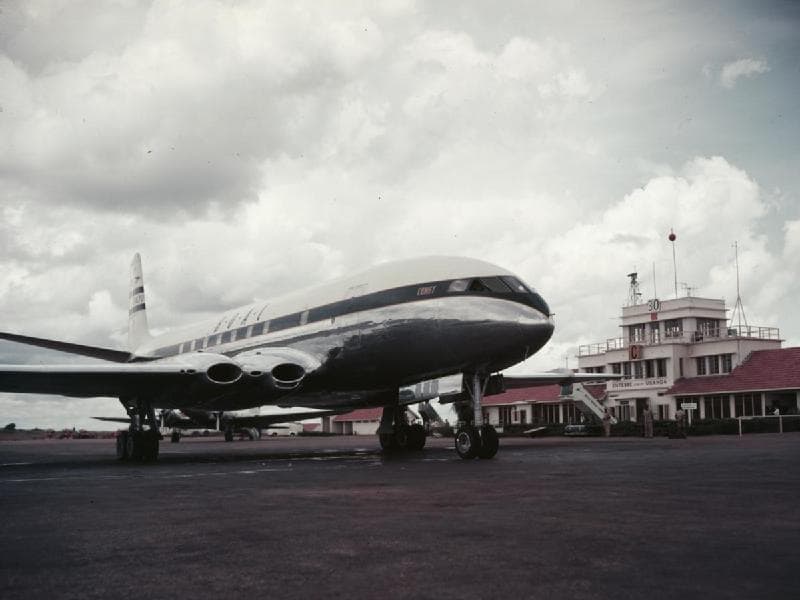
- The day Concorde flew into the history books, Airbus
- Concorde 001 first flight photographs, Toulouse-Blagnac, 2 March 1969 (fonds André Cros, 53Fi), Archives municipales de Toulouse, via Wikimedia Commons
- High Speed Interferometer flights on Concorde 001, June 1973, NASA, via Wikimedia Commons
- Eclipse Flight of Concorde 001, Nature, vol. 246 (1973)
- 2 March 1969, This Day in Aviation
- Concorde 001 — Total Solar Eclipse of 30 June 1973, Xavier Jubier
- 54 years ago today: Concorde's first ever flight, Simple Flying
- Concorde, Wikipedia
- 1973 Concorde eclipse flight, Wikipedia
- André Turcat, Wikipedia
Checked September 25, 2026